
“Sudan is currently the largest humanitarian crisis on record and the world’s largest and fastest-growing displacement crisis.” In December 2024, the International Rescue Committee (IRC), an international NGO, announced this. Due to the conflict that broke out in April 2023, 14.6 million people have been displaced, and 30.4 million people—over 64% of the population—are said to be in need of emergency assistance. While the death toll remains unclear, there are also reports that 61,202 people have died in Khartoum State alone.
However, it is hard to say that Japan’s major news organizations have devoted significant coverage to Sudan’s conflict and humanitarian crisis. For example, measuring Yomiuri Shimbun’s coverage, just three days of reporting on the wildfire that occurred in Los Angeles, USA, in January 2025 exceeded an entire year’s (2024) coverage on Sudan. The paper also ran twice as many stories in 2024 about the two members of the British royal family with cancer as it did on the situation in Sudan (※1).
In 2024, Japanese media attention was focused not on this world’s largest humanitarian crisis, but on Israel–Palestine and Russia–Ukraine. Beyond Sudan, there are many “humanitarian crises” that did not become targets of “humanitarian reporting.” This article explores disparities in coverage from that perspective. For reference, please also see GNV’s past article (March 31, 2022) titled “Questioning Japan’s Humanitarian Reporting on Armed Conflicts.”
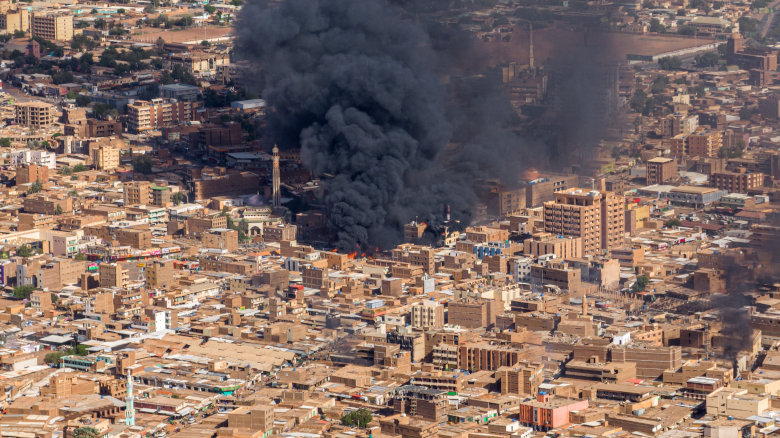
The war-scarred Omdurman market in Sudan (Photo: Abd_Almohimen_Sayed / Shutterstock.com)
目次
The “Two Big Wars”
To grasp the scale of humanitarian crises around the world, the IRC’s annual ranking of the top 10 humanitarian crises serves as one benchmark. In 2024, the order from first to tenth was: Sudan, the occupied Palestinian territory (hereafter Palestine), South Sudan, Burkina Faso, Myanmar, Mali, Somalia, Niger, Ethiopia, and the Democratic Republic of the Congo. In these countries, there are people in the millions suffering from food shortages or displacement, requiring enormous humanitarian aid. Every country on this list is affected by armed conflict.
However, in 2024, Japanese media hardly covered most of these humanitarian crises. Israel–Palestine (ranked second) and Russia–Ukraine (not ranked tenth) dominated attention on conflicts, and it is no exaggeration to say that other conflicts rarely entered the media’s field of view. For example, Mainichi Shimbun argued in an editorial (March 27, 2024) that “The world is in the midst of two big wars,” referring to Israel–Palestine and Russia–Ukraine. Judging from this phrasing, Sudan does not appear to be regarded as a “big war.”
Looking at the volume of coverage over the full year of 2024 (※2), this tendency becomes clear. As shown in the graph below, coverage of these “two wars” is exceptionally high, with a gap so large that it cannot even be compared to other conflicts. For seven of the ten humanitarian crises, the number of articles devoted to each crisis was either zero or close to zero. Coverage of Sudan amounted to roughly one article per month on average. Aside from Gaza and Ukraine, the only country with enough articles to be called substantial was Myanmar.
Various factors may underlie such a huge disparity in coverage. Among them, the weight of a country’s national interests and political concerns is likely significant. For example, regarding the Russia–Ukraine conflict, involvement by nuclear-armed major powers and other considerations mean that Japan’s level of interest is likely high from a national interest perspective. Likewise, the Israel–Palestine conflict tends to draw heightened attention in Japan as well, partly because it is of strong political concern to the United States, a factor Japan’s media are also influenced by. GNV’s analysis has demonstrated that Japan’s international reporting is influenced by the U.S. government and media attention.
Another possible factor is that the media may be making value judgments about armed conflicts by distinguishing between “wars” and “civil wars.” In other words, Gaza and Ukraine are treated as “wars” in the sense of cross-border armed conflict, while Sudan is labeled a “civil war.” However, looking at the reality of armed conflicts around the world, it cannot be said that any conflict is contained within a single country. How meaningful is this categorization in the first place? (※3)
For example, the Sudan conflict, often called a “civil war,” reportedly involves fighters from Chad and South Sudan, and the parties to the conflict have also received support such as arms supplies from the United Arab Emirates, Egypt, and Libya, according to reports. In addition, there are reports warning that if the conflict drags on, Sudan could become a “hotbed of terrorism.” Cross-border dynamics are seen in other conflicts as well. For example, Rwanda’s army has been found to be involved in the conflict in the Democratic Republic of the Congo. And in the neighboring countries of Mali, Niger, and Burkina Faso, the respective conflicts are so closely intertwined that it is difficult to separate them into individual conflicts.
People “Standing at the Edge of Hell”
Yet in media value judgments, whether the parties physically cross borders—or a country’s national interest and the political concerns of major powers—should not be all that matters. Editorials, which indicate a newspaper’s values and stance, often emphasize “human life” and “human rights.” For example, on January 1, 2024, a Mainichi Shimbun editorial argued, “Now is the time to shift our perspective from ‘state-centric’ to ‘human-centric.’ We must return to the spirit of the Universal Declaration of Human Rights, which 75 years ago proclaimed the protection of ‘the rights of all.’”
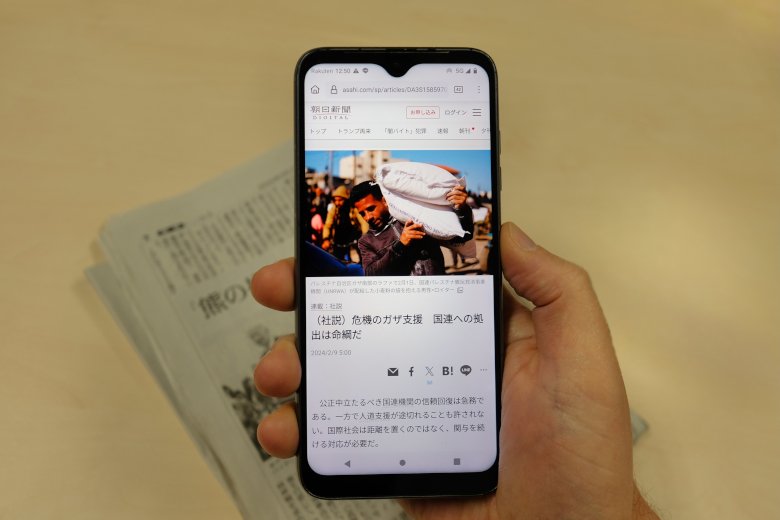
An Asahi Shimbun editorial titled “Gaza in Crisis: Contributions to the UN Are a Lifeline” (February 9, 2024) (Photo: Nick Potts)
It is not uncommon for news organizations to make emotionally charged arguments based on humanitarian spirit. You can see such phrasing even by looking at New Year’s Day editorials, which try to capture the overall state of the world. For example, Yomiuri Shimbun argued in its January 1, 2024 editorial that “It is Japan’s mission to appeal to the world the importance of peace and the preciousness of human life, and to call for truces, ceasefires, the restoration of peace, and the creation of a new order.” Mainichi Shimbun’s January 1, 2024 editorial stated, “What the international community needs is swift action to save as many lives as possible.”
In reality, however, it is hard to say that human life is valued equally in coverage. The “lives” referenced in the Mainichi editorial above are limited to those threatened by the so-called “two big wars.” The same tendency appears in Asahi Shimbun. Its New Year’s Day editorial (January 1, 2024) stated, “The year turned as people across the globe trembled at explosions and gunfire. It is not only Ukraine and Gaza. In Myanmar and Sudan, too, the fighting intensified last year and carried over unresolved into the new year,” thus briefly bringing some conflicts other than the “two big wars” into view. But the mention ended with that single sentence. The same editorial made an emotional appeal: “We hope a helping hand reaches the people of Gaza and Ukraine, who truly stand at the edge of hell.” The focus remains on victims of the “two big wars.”
Each news organization, especially regarding Gaza, has repeatedly conveyed emotionally charged messages through its editorials. For example, Yomiuri Shimbun’s editorial (November 25, 2024) emphasized the death toll and looming famine in Gaza, stating that “some 2 million residents of Gaza cannot obtain food or water and are at risk.” Asahi Shimbun’s editorial titled “Hunger Looms in Gaza: Hurry to a Ceasefire to Avert Catastrophe” (March 28, 2024) uses the word “humanitarian” six times, with phrases such as “humanitarian catastrophe” and “humanitarian tragedy.”
Newspapers’ Humanitarian Concern as Seen in Their Editorials
So how large is the disparity in news organizations’ humanitarian concern for the various humanitarian crises occurring worldwide? We surveyed one year’s worth (2024) of editorials on international reporting in Asahi Shimbun, Mainichi Shimbun, and Yomiuri Shimbun to see which countries/regions were associated with the term “humanitarian.”
There were 98 relevant editorials in total (※4). Of those, 60.5% of the editorials that discussed issues as humanitarian were about Gaza, far outnumbering any other topic in all three newspapers. The next most frequent was Ukraine (10.5%). Mentions of Lebanon, Myanmar, and Syria each accounted for around 4–5%, while mentions of other countries were almost nonexistent.
Sudan, said to be the world’s largest humanitarian crisis, accounted for only 1.3%. Breaking that down, Asahi Shimbun ran one editorial focused on the Sudan conflict (April 17, 2024), and Mainichi Shimbun had only a single phrase within its editorial timed to Japan’s end-of-war day (August 16, 2024): “Russia’s invasion of Ukraine drags on, and the humanitarian crisis in the Gaza Strip in the Palestinian territories is at its worst. In Sudan and elsewhere, civil war and hunger continue.” Yomiuri Shimbun did not mention Sudan in its editorials even once in 2024. Asahi Shimbun’s editorial on Sudan drew attention to humanitarian issues such as deaths, food shortages, and displacement, bringing the issue to the forefront. However, this was the only editorial centered on Sudan in 2024. By contrast, that same paper published 21 editorials highlighting Gaza’s humanitarian issues.
The “Forgotten” Conflict: Who Has Forgotten?
The Sudan conflict is sometimes called a “forgotten” conflict in Japan’s reporting. Such claims often do not make clear who has “forgotten” and how, nor do they necessarily turn their gaze to the news organizations themselves, which bear the role of conveying global events.
In an editorial centered on the Sudan conflict (April 17, 2024), Asahi Shimbun argued, “We must not let the civil war in Sudan become a ‘forgotten conflict.’” The same editorial also stated, “If international attention is concentrated on Ukraine and the Middle East and interest in other regions is waning, that is a grave situation.” Yet Asahi Shimbun itself is precisely in that state. Even when a relatively lengthy article on the Sudan conflict appeared, the total number of articles on Sudan in 2024 was just one-thirtieth that of Ukraine coverage and one thirty-third of Gaza coverage. Another Asahi article (June 11, 2024) also stated that “Because international attention is low, it is sometimes called a ‘forgotten conflict,’” seemingly making the forgetter the ambiguous “international community” (※5). It then added that, as a media outlet, it is “continuing to search for answers” on how to get people in Japan to pay attention.
Mainichi Shimbun likewise suggested in an article about the Sudan conflict (April 8, 2024) that the forgetter is the “international community.” Its headline, noting that the number of displaced is “five times Gaza,” showed awareness of the conflict’s scale and severity. However, the disparity in coverage at Mainichi is even greater than at Asahi: Sudan coverage amounted to one seventy-first of Ukraine coverage and one eighty-eighth of Gaza coverage.
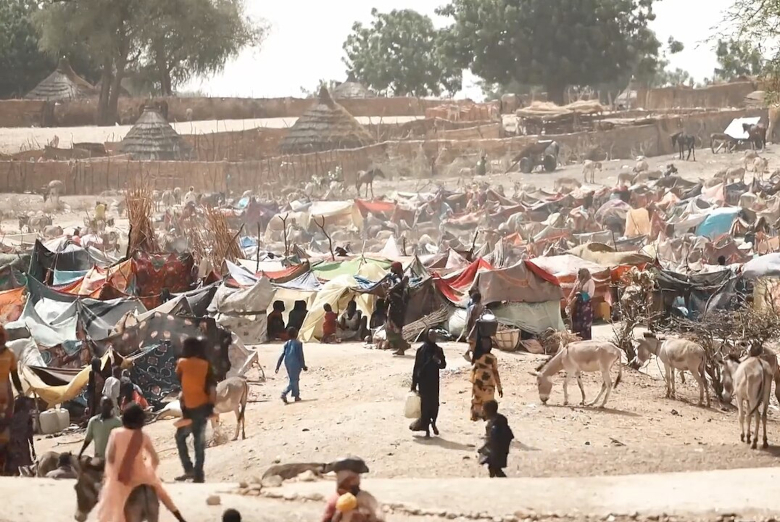
Refugees who fled the conflict in Sudan, Chad (Photo: Henry Wilkins, VOA / Wikimedia Commons [Public domain])
It is clear that the Sudan conflict is not a focus now, but when it first broke out (April 2023) there was a period when it drew some attention in Japan’s media. However, that attention was directed primarily at the Japanese nationals in the capital, Khartoum, where the conflict began, and their evacuation. Once those evacuations ended, coverage of the Sudan conflict plummeted even as the fighting intensified. In this way, Japan’s news organizations once “remembered” this conflict, only to “forget” it thereafter.
Stealth Conflicts, Stealth Humanitarian Crises
This article focused particularly on coverage of Sudan because the conflict there has produced the “largest humanitarian crisis on record.” But as noted above, many other armed conflicts are causing large-scale humanitarian crises. Among them, the conflict in South Sudan, ranked third on the IRC list, can also be called a “forgotten” conflict. While South Sudan received some attention from Japan’s media during the 2012–2017 period when Japan’s Self-Defense Forces were deployed there, coverage declined once the withdrawal was complete. The situation remained critical in 2024, but the few articles published in Japan were focused not on South Sudan’s current situation but on issues concerning the Japanese SDF personnel who had been dispatched there in the past.
However, there are conflicts that cannot even be called “forgotten.” These are conflicts that have never been covered loudly enough by Japan’s media to remain in memory. You cannot “forget” what you never remembered. The author calls conflicts that attract no attention from the outset “stealth conflicts.” Like stealth bombers that are hard to detect on radar, these conflicts remain hidden, failing to appear on the “radar” that indicates the level of media interest. In other words, although news organizations know of these conflicts’ existence and scale, they choose not to report them. One could say they are being concealed by the media.
The conflict in the Democratic Republic of the Congo is the prime example. This conflict has produced the highest death toll of any armed conflict since the Korean War. In 2024, peace talks between the Democratic Republic of the Congo and Rwanda collapsed, and record numbers of displaced people and severe food shortages continue to occur. Yet coverage has been chronically scarce. Throughout 2024, the conflict in the Democratic Republic of the Congo was not once the subject of an article in Asahi Shimbun, Mainichi Shimbun, or Yomiuri Shimbun.
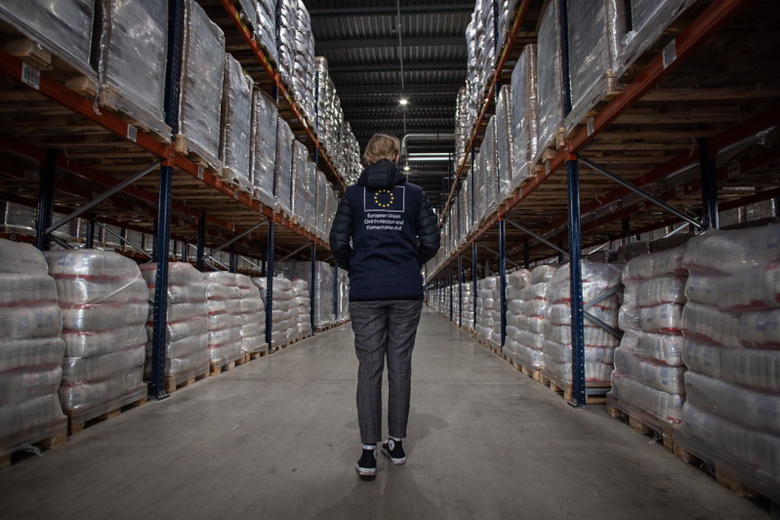
Pallets of humanitarian aid for Ukraine (Photo: EU Civil Protection and Humanitarian Aid / Flickr [CC BY-NC-ND 2.0])
Coverage Shortfalls That Help Perpetuate Humanitarian Crises
Media undercoverage affects the real world. In international reporting, news organizations tend to align with the government, but attention in the press can plausibly lead to attention by government and public opinion. There is research concluding that an increase in media coverage leads to an increase in government aid. In fact, Japan’s 2024 distribution of humanitarian assistance to other countries shows a pattern similar to coverage. For example, looking at emergency assistance provided by the Japanese government through the United Nations in 2024 by recipient country, the largest recipients were Ukraine (10.4% of the total) and Palestine (6.2%). Sudan, South Sudan, and the Democratic Republic of the Congo were not in the top ten.
A similar tendency is seen in NGO activities. For example, Peace Winds Japan, which conducts international humanitarian assistance, focuses mainly on Ukraine and Gaza, seemingly making these conflicts the two pillars of its “conflict and refugee assistance.” As of January 2025, on the website pages introducing “conflict and refugee assistance” and the countries where it has been active, we could not find any reference to Sudan (※6). Meanwhile, in response to the wildfires that broke out in Los Angeles, USA, in 2025, it raised emergency donations, immediately dispatched staff, and launched assistance activities.
If reporting in Japan on humanitarian crises in Africa were to increase, would we see changes in the actions of the Japanese government and NGOs?
Conclusion
One reason many lives that could be saved are lost every day around the world is the lack of regular reporting on conflicts. It is true that the conflict unfolding in Gaza is a vast humanitarian tragedy, and it is essential to cover it extensively. But for the same reason, it is also important to give extensive coverage to Sudan, South Sudan, the three Sahel countries, the Democratic Republic of the Congo, and others. There may be major differences among these conflicts in terms of national interests and political concerns at home. However, if humanitarian considerations are also to be incorporated into editorial decisions, a degree of balance is necessary.
Given that news organizations make emotional appeals about the importance of human life in relation to humanitarian crises in other countries, it is urgent to reconsider the tendency to limit consideration for “human life” only to people in particular places.
※1 Using the Yomiuri Shimbun database “Yomidas,” we searched the national edition with the keywords below and counted articles in which each topic was the main subject.
※2 We used the online databases of Asahi Shimbun (Asahi Shimbun Cross Search) and Mainichi Shimbun (Mai Saku). For the ten humanitarian crises announced by the IRC in 2024 and for Ukraine, we searched national-edition headlines using each country name as a keyword (for Palestine-related keywords, “パレスチナ OR ガザ OR ハマス”) and counted articles in which conflict-related content was the main subject. When multiple countries were covered, we counted the article as 1 divided by the number of countries included.
※3 GNV regards “civil war” as a misleading term and, in principle, does not use it.
※4 In Asahi Shimbun Cross Search, Mai Saku, and Yomidas, we searched headlines and full texts with the keywords “人道 AND 社説” (“humanitarian AND editorial” in Japanese). By newspaper, there were 33 relevant editorials in Asahi Shimbun, 35 in Mainichi Shimbun, and 30 in Yomiuri Shimbun. For each relevant editorial, we identified which country the term “humanitarian” referred to and counted it. When multiple countries were covered, we counted the editorial as 1 divided by the number of countries included.
※5 Regarding the term “international community,” GNV sees it as misleading because the situations and contexts in which it is used are so broad that its meaning is virtually impossible to pin down, and therefore, in principle, does not use it.
※6 However, we can confirm that in March 2024 it carried out assistance activities for Sudanese refugees from its base in South Sudan.
Writer: Virgil Hawkins
Graphics: Virgil Hawkins



#/media/File:Screengrab_of_refugee_camp_from_Number_of_Refugees_Who_Fled_Sudan_for_Chad_Double_in_Week.jpg)
人道や人命の尊さを説く各社の社説に希望を持つ一方で、実際の報道との乖離にがっかりしました。社説を書いている人たちと紛争報道をする人たち、同じ新聞社にいながらこのようなギャップが生まれる背景は何にあるのでしょうか?
「世界10大人道危機」の中でも特にアフリカ大陸の国々の紛争が報道されていないことも気になりました。各社、サブサハラアフリカにはヨハネスブルグに支社をおいていたと思います。現地まで直接取材に入ることは難しくとも、距離的に近くにいることで得られる情報等はあるかと思います。どうにかして情報を届けてほしいと思うばかりです。
or61x0
「忘れられた」紛争という言葉が印象に残りました。あたかも世間が忘れたかのように表現していますが、忘れさせたのは誰なのか、そこの責任を無視しているのが非常に残念に感じました。メディアとして果たすべき責任を一市民としても、一読者としても考える必要があると強く感じました。