
Many refugees and migrants attempting to enter Saudi Arabia from East Africa are being massacred near the border by Saudi border guards. According to the human rights organization Human Rights Watch (HRW), the number is said to be at least 665 people between March 2022 and June 2023 in total. Although many human rights violations against refugees and migrants (note 1) have been reported near Saudi Arabia’s borders, why do so many people from East Africa aim for Saudi Arabia? How do they get there? And why are they killed? This article focuses on the route commonly known as the “Eastern Route,” which crosses the sea from the northeastern part of the African continent (the Horn of Africa) to Yemen and Saudi Arabia, and looks into these issues.
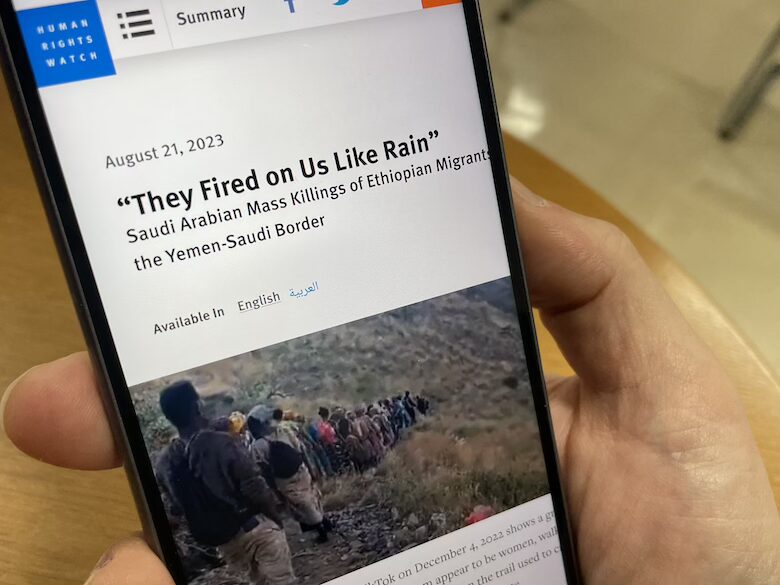
A Human Rights Watch article about the mass killings of refugees and migrants by Saudi border guards. Photo taken December 20, 2023 (Photo: Yuna Nakahigashi)
目次
What is the Eastern Route?
Between Djibouti, located in the northeastern part of the African continent, and Yemen, located on the Arabian Peninsula, lies the Bab el-Mandeb Strait, which is about 30km wide.
The two regions are geographically close, and their historical ties are deep. Their relationship goes back to before the Common Era: records state that in the 10th century BCE, Semitic peoples moved from the area where Yemen is located to the area where Ethiopia is located. Since then, ties through trade and religion between northeastern Africa and the Arabian Peninsula have continued. Today, the Bab el-Mandeb Strait also serves as a maritime trade route connecting Europe and Asia.
In addition to poverty and disasters, the armed conflicts that broke out frequently in the 1990s in countries such as Somalia and Ethiopia have, in recent years, increased the movement of refugees from northeastern Africa to Yemen. Another possible reason for the rise in refugees and migrants heading to Yemen is that Yemen, unified in 1990, was the only country on the Arabian Peninsula to have ratified the 1951 Refugee Convention. However, Yemen also experienced armed conflict in 1994 and has long struggled with severe poverty, meaning it has by no means been a stable host country for refugees.
Most Africans who become refugees remain within the continent, and neighboring countries often host them. Labor migration also mostly occurs within Africa. However, some refugees and migrants aim to leave the continent. Routes vary depending on departure point and circumstances, but broadly speaking there is a route that crosses the Sahara, goes through North Africa, and crosses the Mediterranean to Europe, and there is the route from northeastern Africa across the Red Sea or the Gulf of Aden to Yemen, commonly called the Eastern Route. As of 2019, the Eastern Route was the world’s busiest maritime migration route.
Next, we look at the Eastern Route in detail. Refugees and migrants heading to Yemen from Africa first travel to coastal areas in northeastern Africa that serve as waystations. Two main waypoints are Bossaso, a city in Puntland in northeastern Somalia, and Obock, a city in Djibouti to the east of Ethiopia. They then cross the Gulf of Aden and head for Yemen. As human rights abuses such as kidnappings have become more pronounced on the route departing from Obock, in recent years the route departing from Bossaso has been used more frequently. The vast majority of refugees and migrants who arrive in Yemen then travel through the desert aiming for Saudi Arabia.
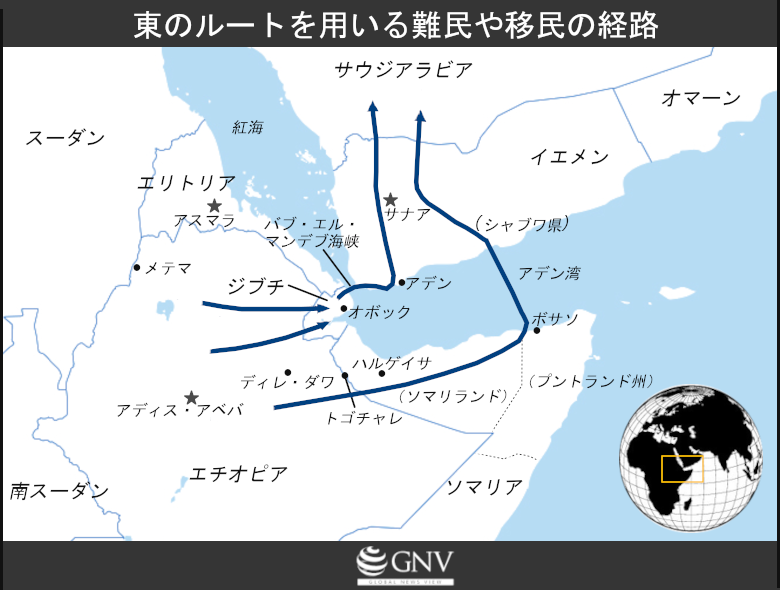
Why are there so many refugees and migrants?
Those who use the Eastern Route are mainly people from Somalia and Ethiopia. Why do so many people from these countries try to move?
Let’s look at recent trends in Somalia. In 1991 the central government collapsed, there has been no government governing the whole of Somalia, and conflict has continued. Also in 1991 Somaliland declared independence, and in 1998 Puntland in northeastern Somalia became an autonomous state. There was also external intervention: Ethiopia’s military intervention in 2006, the deployment of the African Union Mission in Somalia (AMISOM) in 2007, and Kenya’s military intervention in 2011. In 2012 a new constitution was adopted and the Federal Government of Somalia was established. This government was launched as the formal government aiming to govern Somalia. However, many domestic problems remain, including armed conflict between the government and the armed group Al-Shabaab and frequent terrorist attacks, and governance is limited.
They also suffer from natural disasters such as drought. Most recently, between 2022 and 2023, a drought said to be the worst in 40 years occurred. Due to the drought, crop failures have continued, and hunger has worsened. Although plagued by drought, in 2023 the country was also hit by a flood said to be the largest in a hundred years. These natural disasters are also one cause of conflict. In addition, due to high poverty rates and the impact of conflict, about 3.9 million children cannot go to school.
Next, recent trends in Ethiopia. In 1991 a long-standing dictatorship was overthrown, and in 1993 Eritrean independence was decided. Although large-scale armed conflict ended, domestic conditions never fully settled. The Oromo Liberation Front (OLF) and the Ogaden National Liberation Front (ONLF) resisted the Ethiopian government. In 1998 a border conflict with Eritrea broke out. Diplomatic relations between Ethiopia and Eritrea remained severed thereafter, but in 2018, triggered by Abiy Ahmed becoming prime minister, normalization of relations between the two countries was achieved. Abiy also carried out reforms of the political system and economy. However, governance problems remain, including conflict with the Tigray Region since 2020 and tensions with some in the Oromia Region.
Ethiopia also faces problems from natural disasters such as drought. The drought mentioned above in Somalia has spread widely across East Africa, and in Ethiopia in recent years drought has intensified. The drought has brought hunger to Ethiopia. Poverty has long been widespread, and employment opportunities outside of agriculture are insufficient.
Thus, many refugees and migrants are emerging from Somalia and Ethiopia, and many move to the Arabian Peninsula via the Eastern Route. However, in Yemen, a transit point on the Eastern Route, armed conflict has been ongoing since 2014, accompanied by large-scale military intervention by Saudi Arabia and the United Arab Emirates (UAE). The estimated death toll, combining direct and indirect deaths from this armed conflict, is said to reach the hundreds of thousands. In conjunction with their intervention, Saudi Arabia and the UAE have blockaded Yemen’s land, sea, and air along the borders. Despite this, the number of refugees and migrants entering Yemen has not decreased and is actually on the rise. Some people are thought to believe they can enter without being policed by taking advantage of the division of governance in Yemen among various forces due to the conflict. There are also people who head there without knowing a conflict is occurring.
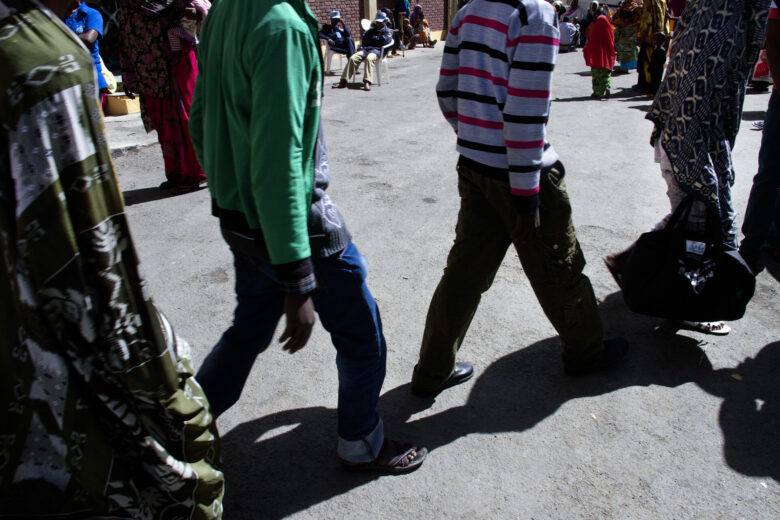
Migrants heading to buses for deportation from Saudi Arabia (Photo: UNICEF Ethiopia / Flickr [CC BY-NC-ND 2.0 DEED])
From waypoints to the sea
In addition to Obock in Djibouti and Bossaso in Somalia mentioned above as waypoints and departure points for the sea along the Eastern Route, there are various cities, such as Togochale in Djibouti. Cities such as Hargeisa in Somaliland also serve as waypoints. Here we focus on Djibouti.
According to World Bank data, in Djibouti as of 2017, 82% of the population lived below the ethical poverty line (note 2). While Djibouti cannot be described as a wealthy country, it has become a place where many people gather. Besides serving as a waypoint for refugees and migrants, Djibouti also hosts foreign military bases, with bases of the United States, China, France, Japan, and Italy located there, and Saudi Arabia also plans to establish one. Because Djibouti faces the Bab el-Mandeb Strait—a bottleneck on the sea route connecting Asia and Europe—this is thought to have strategic significance in terms of countries defending their own trade routes. The headquarters of the Intergovernmental Authority on Development (IGAD), a regional organization (note 3), is also located there.
Refugees and migrants attempting to cross the sea from Djibouti are said to number over 200,000 each year, and at least 220,000 refugees and migrants entered Djibouti in 2022. In 2023, the Djibouti government announced a crackdown and began deportations of migrants.
Refugees and migrants who depart from waypoints to the sea are frequently exposed to risks of human rights abuses. The boats refugees and migrants use to cross the sea are arranged by smugglers, but there is a risk of becoming victims of torture for ransom and human trafficking. Therefore, they need to rely on brokers with high credibility. Even if they successfully secure a boat and head out to sea, the dangers remain. Boats bound for Yemen are said to be overcrowded with many people and to lack water and food on board. There have also been reports of incidents in which migrants were thrown overboard to reduce overcrowding.
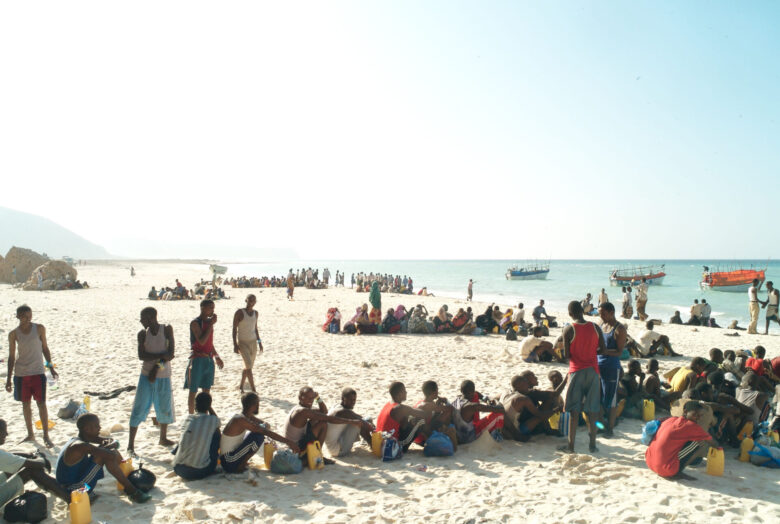
Refugees and migrants sitting on a Somali beach (Photo: Photo Unit / Flickr [CC BY-NC 2.0 DEED])
On top of that, the seas around the Eastern Route are often rough. Boat capsizing accidents along the Eastern Route at sea have been numerous. In 2023, confirmed incidents included a boat carrying migrants that was shipwrecked off Djibouti in August, leaving more than 24 missing persons, and a boat that capsized en route to Yemen in November, leaving 64 missing persons. In this way, many people have lost their lives at sea along the Eastern Route.
From Yemen to Saudi Arabia
Conflict continues in Yemen, and its impact has extended to the Eastern Route’s waters. In 2017, there was a reported incident in which a boat carrying 140 refugees and migrants at sea on the Eastern Route came under fire from a helicopter of the UAE military intervening in Yemen, killing 42 people.
Within Yemen, too, the conflict has had an impact: regulations against crimes such as human trafficking, kidnapping, and torture have weakened, and the crackdown on smugglers has not been sufficient. In fact, there are reports that refugees and migrants upon arrival in Yemen have suffered violence, extortion, torture, and forced labor at the hands of smugglers. There are also reports that both the Houthi forces, who govern most of Yemen including the capital in the north, and the forces governing the south have committed atrocities such as detention and abuse against refugees and migrants. With both sides exhibiting anti-migrant behavior, applying for asylum in Yemen has become more difficult. This is believed to be because refugees and migrants fear conscription or exploitation by enemy forces.
There are people who, even after being detained and deported, repeatedly cross the sea back to Yemen over and over to escape the situation in their home countries. Among those who use the Eastern Route, many seek to cross to the Arabian Peninsula, find work, remit money to their families, and escape their countries’ dire conditions. For this reason, many aim for Saudi Arabia despite such hardships. Some aim for other countries such as the UAE.
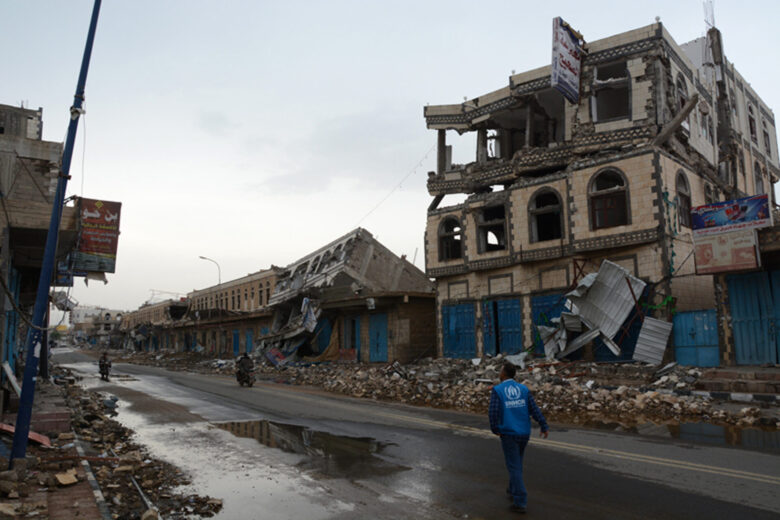
A building damaged by the war in Yemen (Photo: United Nations OCHA / Flickr [CC BY-NC-ND 2.0 DEED])
Saudi Arabia has installed a fence along its border with Yemen and deployed border guards. Refugees and migrants who manage to reach the Saudi border from Yemen are then directly targeted for their lives by Saudi border guards, as mentioned at the outset. Near the Saudi–Yemen border, there have been frequent incidents of Saudi border guards shooting refugees and migrants at close range, as well as attacking them with mortars. The number of refugees and migrants killed by Saudi border guards has been confirmed at at least 665 between March 2022 and June 2023, and may reach into the thousands. Experts mandated by the United Nations Human Rights Council (UNHRC) have referred to suspicions that the Saudi government may be systematically killing and injuring refugees and migrants, but the Saudi government strongly denies this.
Saudi Arabia and migrants
While Saudi Arabia is not a party to the Refugee Convention and has strengthened border security in attempts to stop irregular migration from Africa, it also relies on migrant labor. Economic growth through the oil industry has created many jobs in Saudi Arabia. As a result, many migrants have gathered in Saudi Arabia, and migrant workers account for more than 80% of private-sector labor. According to the International Organization for Migration (IOM), as of 2022 an estimated 750,000 Ethiopians reside in Saudi Arabia. These migrant workers include both lawful and unlawful migrants. Not a few have suffered human rights abuses such as long working hours and mistreatment.
Saudi Arabia does not grant legal status to irregular entrants, and they may be arrested, prosecuted, and deported. In 2019 the Saudi government announced that it had detained 61,125 irregular entrants. Conditions in the detention centers to which detained refugees and migrants are sent are poor. They are overcrowded, and food, water, and medical care are inadequate. Some also suffer abuse in detention. After being detained under such conditions, they are deported. Since 2017, as the Saudi government has tightened its crackdowns on refugees and migrants, human rights violations against them have worsened.
While Western governments point out human rights problems in certain other countries, they have not significantly highlighted issues such as Saudi Arabia’s human rights abuses against refugees and migrants, or the Eastern Route. For example, even though the U.S. government knew about the massacres near the Saudi–Yemen border, it has not publicly commented on or criticized them. This lack of emphasis by Western governments is thought to stem from their relationships with Saudi Arabia, particularly strategic ties in oil and arms trade. The United States and the United Kingdom have supported the Saudi-led coalition in the Yemen conflict.
In addition, the United States and Germany have been involved in training Yemeni forces and Saudi border guards and have provided weapons. Japan also depends heavily on Saudi Arabia for oil. HRW argues that the Saudi government is trying to divert attention from its human rights abuses by spending large sums to host international events in entertainment, culture, and sports.
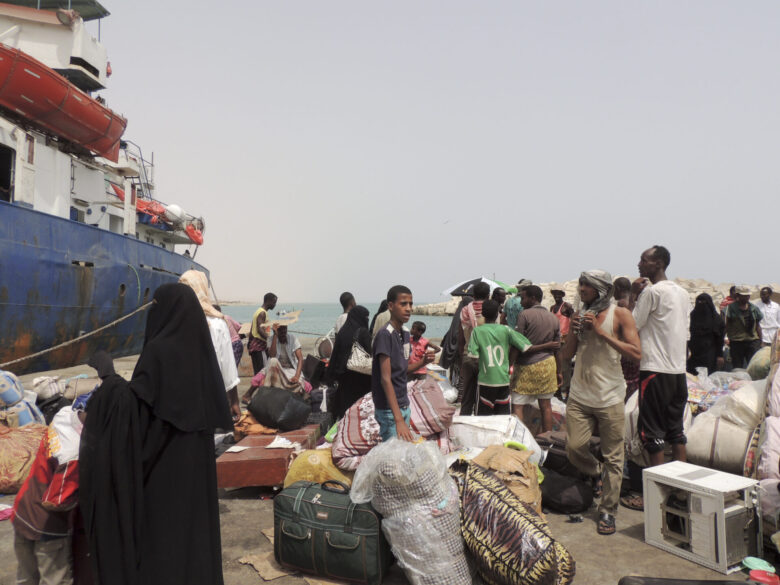
Somalis who returned home from Yemen (Photo: IOM – UN Migration / Flickr [CC BY-NC-ND 2.0 DEED])
Measures
This article has looked at the current situation of refugees and migrants from Africa who use the Eastern Route and the human rights violations they face. These issues have not necessarily been ignored.
There have been some moves by states that could be seen as steps toward improvement. In 2013, Ethiopia, reacting to human rights violations against its citizens abroad, banned travel by its citizens to the Middle East for five years. However, this ban is considered highly likely to have spurred irregular migration. In 2019, the Ethiopian and Saudi governments agreed on a recruitment system for domestic workers to improve the safety of migrant labor. And, in response to HRW’s 2023 report, Ethiopia’s Ministry of Foreign Affairs announced that it would work with Saudi Arabia to investigate human rights abuses against refugees and migrants. However, there are observations that this reflects a muted response by the Ethiopian government in consideration of its economic ties with Saudi Arabia.
There are also moves by international organizations. IOM is providing support to refugees and migrants in Yemen. IOM’s assistance is wide-ranging, including providing safe return pathways, protection and relief for survivors of human rights abuses, medical support for refugees and migrants, and the provision of supplies such as water.
While such efforts exist, they are far from sufficient to address this vast problem. Unless the root causes of refugee and migrant flows seen in this region—poverty, hunger, conflict, and the like—are eliminated, it will be impossible to stop many people from setting out for the Arabian Peninsula despite knowing the dangers. Future developments related to the Eastern Route bear close watching.
Note 1: Because it is difficult to make a complete distinction between refugees and migrants, this article uses “refugees and migrants” when referring to both collectively.
Note 2: In 2019, the World Bank defined the extreme poverty line as US$1.9 per day. However, considering human subsistence, some researchers argue that this standard is unrealistic and instead propose an “ethical poverty line.” This is the minimum threshold at which survival is ensured based on the relationship between life expectancy and income, and in 2019 it was set at US$7.4 per day. GNV adopts this ethical poverty line. However, the benchmarks available for poverty rates in the World Bank’s data were only for US$7.0 per day and US$7.5 per day, so we adopted US$7.5, which is closer to US$7.4 per day, the ethical poverty line.
Note 3: The Intergovernmental Authority on Development is a regional organization established in 1996 in East Africa to implement measures against natural disasters such as drought.
Writer: Ryoga Kuniyoshi
Graphic: MIKI Yuna









サウジアラビアが国として組織的な大虐殺をしているというのは驚きであり、恐ろしいです。
なにも殺害することはないのではないかと思いました。殺害する前に移民、難民をどうするか、国内だけでなく、国外でも議論を訴えるなどすることが必要なのでは