
Armed conflicts are constantly unfolding in dozens of places around the world. One in six people worldwide (1.2 billion) lives in areas affected by conflict, and more than one in 100 people (over 80 million) are refugees or internally displaced persons. In addition, due mainly to conflict and climate change, one in ten people (over 800 million) are currently food insecure. Armed conflicts are producing unimaginable humanitarian crises in many countries.
In Japan, interest and concern among the media, government officials, experts, and public opinion regarding these conflicts and humanitarian crises are considered to be low, and it is relatively rare for these issues to even appear in the public discourse. However, in February 2022, an event occurred that caused a sudden surge in interest across Japanese society in a particular armed conflict and its humanitarian crisis. At the time of writing, topics such as the horror and injustice of war, the importance of peace, refugee measures, and humanitarian crises and aid are flooding the media and social networks. The reason is Russia’s invasion of Ukraine, and currently, most of the attention is focused on this one conflict.
Given that there are many armed conflicts and many victims around the world, why has such “humanitarian” concern suddenly arisen only for this conflict—or, more precisely, only for the victims of this conflict? We explore this question primarily from the perspective of news coverage.
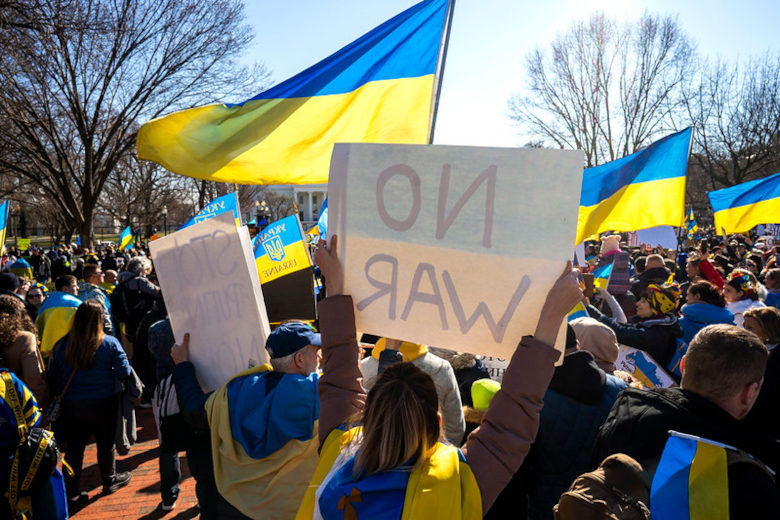
Demonstration in support of Ukraine, United States (Photo: Mike Maguire / Flickr [CC BY 2.0])
目次
Overview of humanitarian crises caused by armed conflict
First, focusing on human lives, let’s look at recent trends in conflicts and their toll. According to data from ACLED, a research organization that compiles statistics on political violence, over the five years from 2017 to 2021 nearly 800,000 lives were lost to fighting. More than half of these deaths occurred in Afghanistan (about 190,000), Yemen (about 120,000), and Syria (about 110,000). Conflicts with over 10,000 fatalities during the same period took place in Iraq, Mexico, Nigeria, Somalia, the Democratic Republic of the Congo, Brazil, Myanmar, South Sudan, and elsewhere. As for conflict-related deaths during the three months from January to March 2022 (※1), Myanmar (about 4,800) and Yemen (about 4,300) stand out as particularly high. The death toll in the current conflict in Ukraine is about half of those conflicts (about 2,300) as of March 31, 2022.
However, there are various issues lurking behind these ACLED figures. One is the discrepancy between ACLED’s data and the actual numbers. Although the data are extracted from many reports by news agencies and human rights organizations, in reality there are likely many deaths not reflected in ACLED’s records. For example, there may be significant gaps in data from Sub-Saharan Africa, which tends to be neglected by the media, and from conflict zones that are physically difficult to access. In addition, ACLED counts only deaths caused directly by fighting, and does not reflect those who lose their lives to hunger or disease resulting from armed conflict. Such indirect deaths are particularly common in low-income countries, where food insecurity tends to occur and humanitarian aid is insufficient. In conflicts in Sub-Saharan Africa, such as in the Democratic Republic of the Congo and South Sudan, indirect deaths are estimated to be nine times the number of direct deaths. In the Democratic Republic of the Congo, including indirect deaths, the toll of the conflict from 1998 to 2007 is said to have reached 5.4 million, the highest in the world in the 70 years since the Korean War in the 1950s. This conflict in the Democratic Republic of the Congo continues to this day.
The humanitarian impact of conflict cannot be measured by death tolls alone. As noted above, many people are forced from their homes by conflict, becoming refugees or internally displaced persons, and large numbers suffer from food insecurity and hunger. For example, in the Democratic Republic of the Congo, as of November 2021 the number of people driven into food insecurity by conflict reached 27 million, a quarter of the population. In Yemen, which faces a similar problem of hunger, as of March 2022 more than half the population—17.4 million people—were in need of humanitarian assistance.
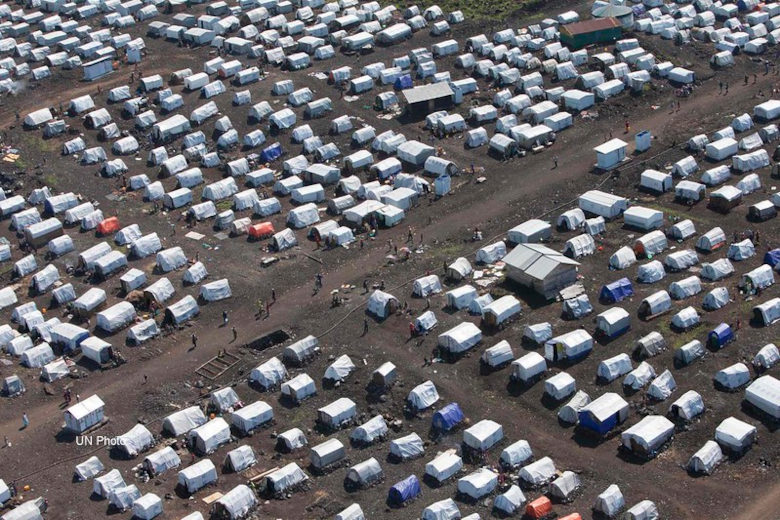
Internally displaced persons camp, Democratic Republic of the Congo (Photo: United Nations / Flickr [CC BY-NC-ND 2.0])
The “humanitarian” spotlight on particular conflicts
Even from regions far removed from armed conflicts, there is much that can be done. “Responses” can take various forms—from diplomatic measures such as mediation and sanctions to refraining from harmful actions such as exporting or importing resources that fuel conflicts—but below I focus not on diplomacy but on “humanitarian assistance” to victims.
Given the magnitude of the harm caused by armed conflict around the world, it is easy to imagine that it becomes difficult to respond adequately to everything. With countries’ budgets for humanitarian aid and similar measures limited, policymakers must set priorities and decide whom to support and by how much.
However, judging from the level of “humanitarian” support and messaging currently seen in Japan, it is clear that such actions are not being carried out based on the humanitarian needs of the recipients. In Japan, where there has previously been little action—whether in the form of humanitarian aid or advocacy—toward large-scale humanitarian crises in places like Yemen and the Democratic Republic of the Congo, attention is somehow overwhelmingly concentrated on Ukraine alone, with various actions being taken by both the government and citizens. Looking at the Japanese government’s emergency assistance (for 2022) by recipient country, as of March 2022 the amount of support to Ukraine is by far the largest. Moreover, a government that had until now closed its doors to most refugees has suddenly taken a proactive stance of accepting only Ukrainian refugees.
It is not only the central government that is responding proactively. Across Japan, local governments, companies, civic groups, media outlets, and religious organizations are launching their own Ukraine support initiatives. Furthermore, various monuments and castles and other tourist sites around the country are being lit up in the colors of the Ukrainian flag and sending out messages of support.
Public interest is also extremely strong. At the time of writing, social media is awash with hashtags carrying anti-war messages such as “#nowar” and “#stopwar.” And when you use Google Trends, a tool that shows how often people search specific words, to look up keywords like “humanitarian” and “nowar,” it shows, as in the figure below, an exceptionally high level of interest even when viewed over the past five years.
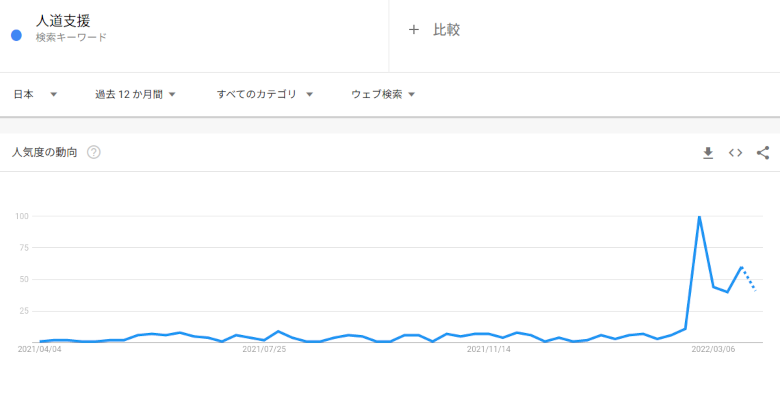
From Google Trends
Thus, while there has been little attention to victims of conflicts around the world in recent years, an unusually high level of interest is being directed toward Ukraine.
Conflict reporting and humanitarian reporting
In responding to conflicts, even if central governments have various strategic, economic, and diplomatic motives, the fact that local governments, companies, and public opinion are also moving strongly suggests the role of the media. In other words, it is conceivable that as the media give extensive coverage to the Ukraine issue and highlight the victims in ways that elicit sympathy, a perception that this issue is extremely important becomes established across society—a classic agenda-setting dynamic.
To demonstrate the significant imbalance between the reality of global humanitarian problems and the image created by actual reporting, it may not even be necessary to analyze coverage volume in great detail. At the time of writing, it is obvious that the amount of coverage of Ukraine in newspapers, on television (including news, analysis, and talk shows), and in online news far exceeds that of other conflict-related coverage in recent years. Some media outlets are cooperating with fundraising for Ukraine, and some news programs are going beyond objective reporting to actively disseminate anti-war messages. Even so, confirming and comparing the amount of coverage of other countries’ conflicts is valuable in assessing the bias of conflict reporting in Japan.
Accordingly, I compare the volume of reporting on the conflict in Ukraine with that on the Democratic Republic of the Congo and Yemen—countries that have faced severe humanitarian crises in recent years—from several angles. These three conflicts share similarities. The latest phase of the Ukraine conflict began with a sudden invasion by neighboring Russia in February 2022. Similarly, the conflict in the Democratic Republic of the Congo began in August 1998 with a sudden invasion by neighboring Rwanda and Uganda. In Yemen, although the central government was overthrown by anti-government forces in 2014, the country experienced a sudden air campaign and invasion by a coalition led by neighboring Saudi Arabia and the United Arab Emirates (UAE) a few months later in 2015.
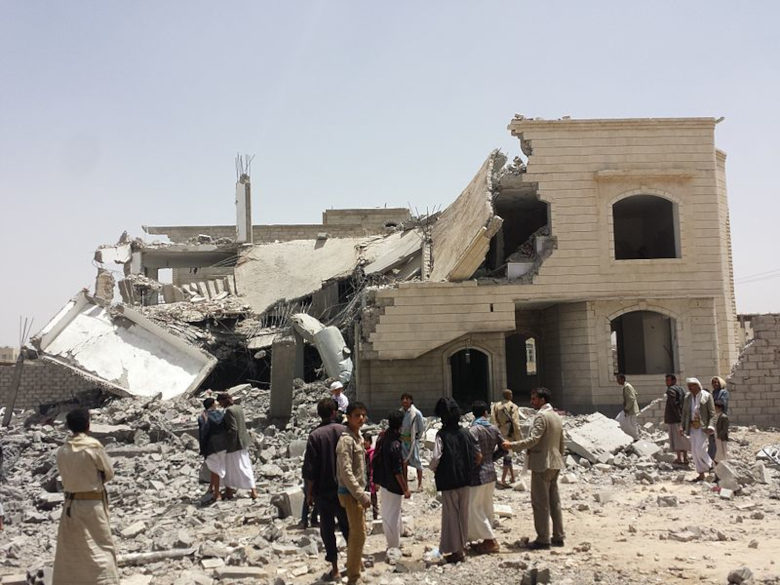
Residential area after an airstrike, Yemen (Photo: Mr. Ibrahem / Wikimedia [CC BY-SA 4.0])
This time, I analyzed coverage of the three conflicts above in the Asahi Shimbun and Yomiuri Shimbun (※2). First, I searched for the number of articles mentioning each country by name. For the Democratic Republic of the Congo and Yemen, I counted five years’ worth of articles from the start of the invasions; for Ukraine, I counted only one month’s coverage from the invasion. Although the periods differ, the disparity in volume was clear. In particular, in the Yomiuri Shimbun, the number of articles about Ukraine in one month (1,075) was 2.5 times the five-year total on the Yemen conflict (395) and four times the five-year total on the Democratic Republic of the Congo (240). Next, to measure from a humanitarian perspective, I searched for articles that included each country’s name and the keyword “humanitarian.” I cast a wide net for the Democratic Republic of the Congo and Yemen, counting 30 years of coverage, and for Ukraine I counted about three months of coverage from January 2022. Here, too, the differences were large. In three months of Asahi Shimbun coverage, there were 140 articles containing both “Ukraine” and “humanitarian,” whereas over 30 years there were 121 articles containing both “Yemen” and “humanitarian,” and 22 containing both “Democratic Republic of the Congo” and “humanitarian.”
The extent to which the Yemen conflict and the conflict in the Democratic Republic of the Congo have gone underreported is also clear from past GNV studies. For example, a study of the Yomiuri Shimbun found that coverage of Ukraine in 2014—the year Russia invaded over the Crimea issue—was more than ten times the amount of three years of coverage of the Yemen conflict at that time. Another study of the Mainichi Shimbun found that in 2018, coverage linking Saudi Arabia to the FIFA World Cup exceeded coverage of Saudi intervention in Yemen. A study of Asahi, Mainichi, and Yomiuri coverage in 2017 found that in the Yomiuri Shimbun, coverage of the Democratic Republic of the Congo was less than half that of the British royal family; in Asahi and Mainichi, there was no large difference between the two topics.
Such disparities in reporting are not limited to Ukraine. In the 1990s, conflicts in Europe such as those in Bosnia and Kosovo were reported from a humanitarian perspective more than conflicts in Africa that were far larger in scale (※4). And the disparity is not limited to conflict reporting. Although Europe accounts for only a few percent of the world’s refugees and of deaths from terrorism, as introduced in past GNV articles, reporting that links these issues to Europe makes up more than half of total coverage on refugees and on terrorism combined. Even coverage of racism is dominated by problems occurring in the United States and Europe.
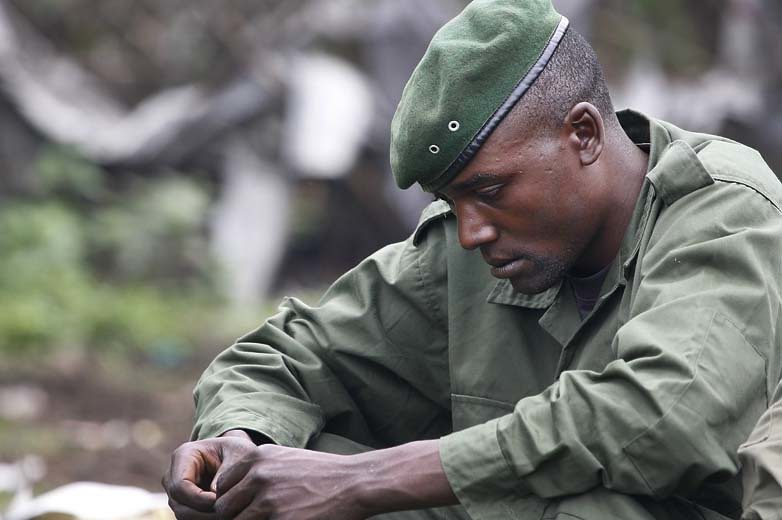
Rebel fighters, Democratic Republic of the Congo (Photo: Steve Evans / Flickr [CC BY-NC 2.0])
What determines whether something is reported?
From the data above, it is clear that the deciding factor in reporting on the “humanitarian issues” caused by armed conflicts is not the number of lives lost—a contradiction. The key seems to be not how many people die, but who dies and where. But why is that? Why are Ukrainians, among the many victims of conflicts worldwide, deemed uniquely worthy of our attention and sympathy?
First, security and politico-economic interests are likely a major factor. Russia, a party to the Ukraine conflict, is a kind of great power with nuclear weapons and has a territorial dispute with Japan. The United States, Japan’s ally and another great power, has a history of intervening in Ukraine, and in the current conflict bears significant responsibility and interest, which I believe translates into heightened interest among Japanese media as well.
Japanese media have long paid great attention to the United States and tend to align with the U.S. government. While Japan’s media are strongly critical of Russia’s unilateral invasion of Ukraine, their criticism of unilateral invasions by the United States—in the former Yugoslavia, Afghanistan, Iraq, and elsewhere—has been markedly muted. In conflict reporting and indeed in international reporting in general, one can discern a tendency for Japanese media to follow the priorities of the U.S. government and U.S. media.
If interest in the Ukraine conflict were based purely on cold calculations of national interest, there would be no need for Japanese media to emphasize human suffering in a way that elicits sympathy for victims. So why is there so much “humanitarian” reporting? One possibility is that the U.S. government and the military industry, in pursuit of national interests, are seeking to demonize their adversary Russia and amplifying its brutality through the media. Influence by government officials on the media is by no means unusual phenomenon. It is also conceivable that U.S. media coverage is strongly shaping agenda-setting in Japanese media. However, the tendency to narrate issues in simple good-versus-evil terms is not solely due to U.S. government influence. Commercial, profit-driven media, not only in Japan, may adopt such narratives to win ratings and readership from competitors.
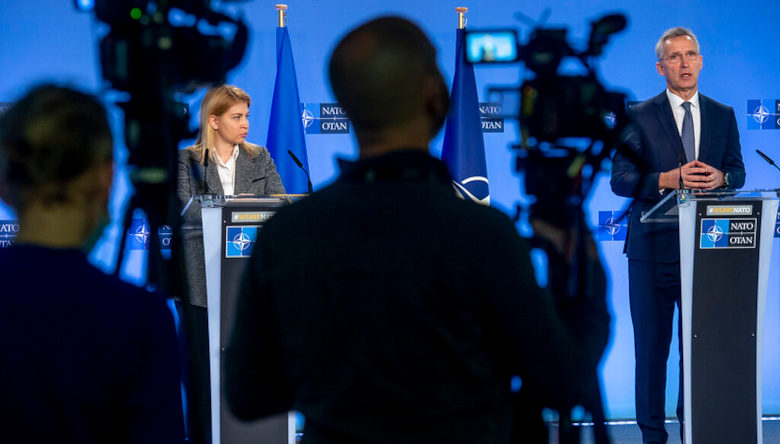
NATO press conference on the Ukraine issue (Photo: NATO / Flickr [CC BY-NC-ND 2.0])
But this alone cannot explain the high level of attention Japanese media are paying to Ukraine. Part of the criteria for deciding whether to report on something may include skin color, ethnicity, religion, or socioeconomic status. In Western coverage of Ukraine, there have been multiple recorded gaffes that emphasized the gravity of the issue because the victims “look like us.” On this point, Japan is historically and culturally quite different from those countries, and many people in Japan do not share Ukraine’s history, ethnicity, or religious values. Nevertheless, as in the West, Japanese media appear to have an implicit hierarchy based on skin color and socioeconomic status. This is evident from the fact that in general international reporting by Japanese media, coverage of low-income regions such as Sub-Saharan Africa is extremely limited. In addition, when discussing the admission of Ukrainian refugees, some commentators seem to be justifying such racial discrimination through the media (※4).
Toward true humanitarianism
In light of the above, it becomes doubtful whether Japan’s current actions toward Ukraine merit the term “humanitarian.” According to the Red Cross, “humanity” means that “human life must be respected and the suffering of individuals must be relieved, without distinction between friend and foe.” While helping those in difficulty naturally “saves” them, can the deliberate selection of certain people or groups and the provision of limited support truly be called humanitarian?
The attention and sympathy being directed at Ukraine and its people can also be seen as evidence that people’s emotions can be stirred and their hearts moved by information about those who are geographically distant, of different nationalities, ethnic identities, or languages. In other words, when information about the suffering of distant people reaches us, interest can grow. It is conceivable that with changes in the amount and manner of reporting, the stories of Yemen and the Democratic Republic of the Congo could also resonate with readers and viewers. One can only hope that genuine humanitarianism, regardless of borders or skin color, will take root in society—and the world.
※1 Due to data availability, the period covered is from January 1 to March 25, 2022.
※2 Using the Asahi Shimbun’s Kikuzo II Visual and the Yomiuri Shimbun’s Yomidas Rekishikan databases, the national morning and evening editions were searched.
※3 Over the 30 years from April 1993 to March 2022, there were 474 articles mentioning “Bosnia” and “humanitarian,” and 461 mentioning “Kosovo” and “humanitarian.”
※4 On the Nippon TV program “Shinsō News” (Deep News) on March 23, 2022, Michito Tsuruoka of Keio University commented on this situation as follows: “I think this is quite a sensitive issue. In 2015, during the Syria situation—there were in fact many Afghans as well, not just Syrians—but for Europeans, I think they were treated as people from a different culture. In contrast, this time, especially from Poland’s perspective, Ukraine is a neighboring country, and from the perspective of Europe as a whole, they are, after all, fellow Europeans. To put it bluntly, they look similar, and they are compatriots. As a result, there is a very welcoming mood—at least when it comes to accepting them, there is an extremely (abnormally?) proactive stance and a demonstration of solidarity. If we say only this, it sounds like: are Europeans practicing racial discrimination—do they accept Europeans but not people from the Middle East? But in reality, when such large numbers come in, it depends on how prepared the public is to accept them. It’s not a matter of what ought to be. Of course, as a norm, Syrians and Ukrainians should be treated equally. But when we consider political realities and the realities of the public, while the problem exists, for the time being, showing solidarity with Ukraine now is not something that should be denied.”
Writer: Virgil Hawkins




後学のために一点気になったことがあり、コメントさせて頂きます。
日本の報道における問題点はある程度分かりましたが、では欧米諸国では、すべての紛争について均等に報道されているのでしょうか。中東は?中国では?理想的な報道がされている国やマスメディアはあるのでしょうか。また、そうした報道はどの程度国民に届いていると言えるのでしょうか。
ご多用のことと存じますが、もしデータや論文等でお示し頂ける部分がございましたらでしたらご教示頂けると幸甚です。
ロシア、ウクライナのことは確かに盛んに報道されていますが、実際の所ロシア、ウクライナ内部にも報道されていない、見過ごされている人々が多々有るのではないでしょうか
↓リベラル系のメディアですらモスクワの声しか拾わず戦争に駆り出される貧しい辺境の人々を主体的な人間として捉えていないとする批判
https://twitter.com/karizo2022/status/1523156967388487681
チェチェン紛争だってそうです
最近為されたばかりのイエメン内戦の停戦などの途上国の紛争情報が軽視されているのには憂慮を覚えますが、大国の中のにも報道されない声があるので、そうした点を記事にしていただけると嬉しいです。
度々ウクライナ色の洋服でテレビに出てきたり、涙目で「人道的」な発言をする高橋杉雄氏がまさにそうですよね・・・
世界のあらゆる戦争を無視して、ウクライナ国民だけを同情の対象として扱う。
https://www.youtube.com/watch?v=xJcPA1e0Wd4
まったくおかしな話ですよね。