
Today, goods, money, people—and information—move across national borders with ease. Many people use products made abroad and consume both tangible and intangible goods produced overseas. This phenomenon, known in a word as globalization, brings various benefits and problems to the world. In some cases, global-scale economic activity can fuel conflicts in certain countries; in others, issues once thought to be global and unrelated to oneself can end up threatening one’s own life.
International reporting is what provides information about this world. It may not feel familiar, but information about events around the globe can influence personal interests, consumer behavior, corporate activities, and political movements. And those working on the front lines of international reporting are the journalists known as correspondents.
In this article, we analyze the number, placement, and trends of correspondents dispatched overseas by a total of 68 Japanese news organizations over the past 35 years. From this analysis of correspondents, we seek to grasp the current state of Japan’s international reporting.

Journalists pointing their cameras in unison at a press conference (Photo: stockphoto mania / Shutterstock)
目次
What is a correspondent?
What exactly is a correspondent? In the dictionary sense, it refers to “a person specially dispatched to a certain place,” but in journalism it often refers to reporters dispatched abroad by news organizations. There are resident correspondents who are stationed in a country, and roving correspondents who are dispatched temporarily in response to incidents; this article deals with resident correspondents. Separate from correspondents is the term “tsūshin’in,” often translated as “stringer,” which is said to more broadly include locally based individuals and contractors who enter into agreements with news organizations to conduct reporting activities.
The main job of a correspondent is to convey local events and news to their home-country newsroom. They play an important role in international reporting by providing information from distant countries quickly and accurately. By the nature of the work, correspondents are expected to have strong communication and language skills, as well as a deep understanding of the local culture, history, politics, and society.
As the information society has advanced and wire services that supply news to media around the world have developed, sources of information about events abroad have increased, and the role of correspondents is changing. In fact, some journalists believe that the role of correspondents goes beyond simple factual reporting to include uncovering issues unknown to society and delivering multidimensional coverage with context and analysis.
Another factor to consider in understanding the work of correspondents is the presence of “fixers,” people with deep local knowledge who support correspondents (※1). Even for correspondents, it is difficult for reporters who come from abroad with different linguistic and cultural backgrounds to fully grasp the circumstances of their country of residence and the surrounding countries they cover. To address this, correspondents sometimes contract with locally born journalists who have local knowledge and networks to act as fixers (facilitators) assisting with reporting activities. Fixers arrange local transportation and hotels, prepare by contacting interviewees and applying for permits with authorities, and provide interpreting during interviews. Their role goes far beyond simply being a “facilitator” and is extremely important to correspondents conducting on-the-ground reporting (※2).
In this way, correspondents—sometimes in cooperation with fixers—are expected to act as the news organization’s eyes and ears, conveying on-the-ground information from a unique vantage point back to their home country.
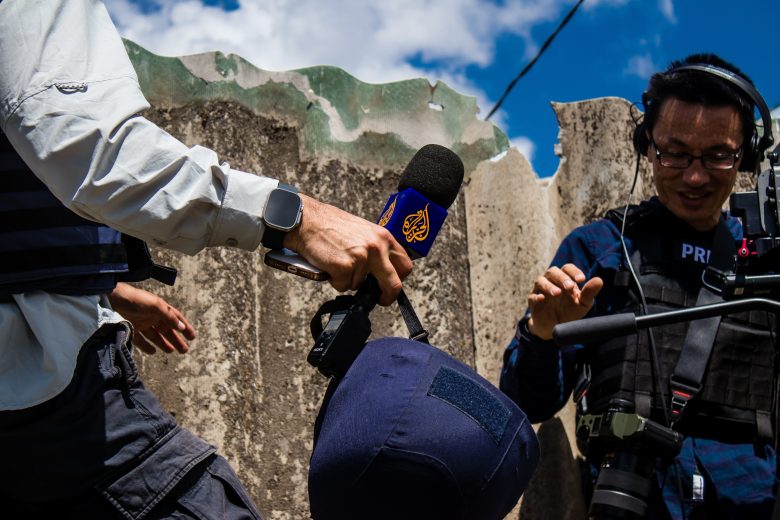
A correspondent reporting in war-torn Ukraine (Photo: Jose HERNANDEZ Camera 51 / Shutterstock.com)
Analyzing the number of correspondents
Before diving into the analysis, let’s also look at the perspective of news organizations that decide whether to dispatch correspondents.
Dispatching correspondents is costly. Exact costs vary widely by organization and location, but as a reference, U.S. media in the 2000s were estimated to spend an average of US$200,000–300,000 per year to maintain a single foreign bureau. Moreover, because correspondents are expected to have advanced skills and knowledge and, in many cases, be proficient in local languages, investment in talent is necessary. As such, correspondents are more expensive financially and in human resources than domestic reporters, which limits how many correspondents and where each organization can dispatch them.
Today, foreign news can also be obtained indirectly via wire services and information on the internet, so correspondents are not the only way to get information about events abroad.
On the other hand, in conducting international reporting, a news organization’s own correspondents are the most highly valued source. Articles written by in-house correspondents—who, as employees, understand their organization’s stance and perspective—combine rich insights and on-the-ground sensibilities from the field, providing substance and originality. This can be a key differentiator in competition with other outlets.
News organizations weigh these merits and demerits to decide how many correspondents to send and to which countries and cities. Viewed this way, the number and distribution of correspondents reflect the organization’s distribution of interest in the world—calibrated to costs and returns.
So, how are Japanese news organizations actually dispatching correspondents to gather information about the world? To investigate this, we examined the number and distribution of correspondents dispatched by Japanese news organizations using the “List of Foreign Correspondents” from the “Japan Newspaper Yearbook,” published annually by the Japan Newspaper Publishers & Editors Association. We used data from 1990, 1994, 1999, 2004, 2009, 2014, 2019, and 2024 (※3). Our analysis focused on two aspects: the geographical distribution of correspondents and the number of correspondents by media organization (※4). The organizations covered were 27 newspapers, 2 wire services, and 39 broadcasters (including TV and radio) as listed.
Geographic distribution of correspondents
Let’s start with the geographic distribution of correspondents.
Looking at the overall increase and decrease, the number of correspondents peaked at 625 in 1994 and has been trending downward since. By 2024, the number had fallen to 524, about 84% of the 1994 level. Shifting to the regional distribution, many correspondents are dispatched to Asia, North America, and Europe. In fact, in every year examined here, more than 90% of correspondents are concentrated in these 3 regions. By contrast, very few correspondents are dispatched to Africa, Latin America, and Oceania, indicating a regional skew. This overall tendency toward Asia, North America, and Europe matches GNV’s analysis of coverage volume by region.
Looking at increases and decreases among these 3 regions with many correspondents, Asia shows a particularly strong upward trend. The most notable increase is in China, which rose from 36 correspondents in 1990 to 96 in 2014. The number has since declined, but even in 2024 there were 84 correspondents stationed there. Thailand and South Korea have also shown an overall increasing trend. This likely reflects growing interest in step with each country’s economic development.
For North America, there is no marked trend of increase or decrease, but globally the United States stands out with by far the most correspondents: in every year, at least 25%—more than 150 correspondents—were dispatched to the U.S. Looking at cities, however, the emphasis is on just two: Washington, D.C., and New York, with more than 60% of U.S.-bound correspondents concentrated in these two cities.
The number of correspondents in Europe has been trending downward since 1994. The U.K., France, Germany, and Russia each had more than 20 correspondents in 1994, but all have declined. Meanwhile, Belgium, which had also been on a downward trend, suddenly turned upward between 2019 and 2024, possibly because the outbreak of the Russia–Ukraine conflict drew media attention to Belgium, home to the headquarters of the North Atlantic Treaty Organization (NATO) and the European Union (EU).
By contrast, in Africa, Latin America, and Oceania—regions that originally had few correspondents—the numbers have steadily declined since 2009. Among these, correspondents dispatched to Africa are concentrated in Egypt, and in Latin America in Brazil. In Oceania, correspondents are not dispatched to cities other than Sydney, Australia.
Looking at how the number of cities with correspondents has changed, there was no decline as clear as in the number of correspondents. However, given that the number of correspondents has clearly decreased relative to the number of cities, it is possible that as each correspondent is exposed to more information, more events and issues are being left uncovered in the process of selection.
Furthermore, these trends among correspondents may be related to a decline in international reporting. Past GNV articles have pointed out that Asahi Shimbun and Yomiuri Shimbun have shown a long-term downward trend in international coverage; one possible factor is that, with fewer correspondents and more information per person, less information is being picked up as news.
Analysis by media organization
Next, we analyze increases and decreases by type of media organization. Here, we group organizations dispatching correspondents into three types: newspapers, wire services, and broadcasters.
This shows that newspapers dispatch the most correspondents in every year. They are followed by broadcasters, with wire services appearing to have the fewest in headcount. However, since there are only 2 wire services (Kyodo and Jiji), on a per-company basis they dispatch the most correspondents on average. Looking at trends, unlike broadcasters and wire services—which show little change after 2004—newspapers appear to have accelerated declines in the number of correspondents since 1999.
By contrast, looking at how the number of cities covered has changed reveals a different picture. The 27 newspapers and 2 wire services dispatch correspondents to a similar number of cities, whereas the 39 broadcasters cover more than 10 fewer cities than these. While there has been little movement since 2004, given the sharp decline in the number of newspaper correspondents, we can infer that the information load per person has increased especially for newspaper correspondents.
Let’s now look more closely at each of the three types. Among newspapers, four outlets—the Nikkei (Nihon Keizai Shimbun), Yomiuri Shimbun, Asahi Shimbun, and Mainichi Shimbun—account for a large share of correspondents, dispatching more than 70% of all newspaper correspondents in every year. While Yomiuri, Asahi, and Mainichi have trended downward since 2009, Nikkei has instead trended upward. This likely reflects that Nikkei is a business daily, and globalization of Japan’s economy has required it to cover more foreign information. For outlets other than these four, the number of correspondents has continued to decline since 2004, suggesting that it has become harder for small and mid-sized news organizations to maintain correspondents.
Next, wire services. The two wire services—Kyodo and Jiji—together dispatch about half as many correspondents as all newspapers combined. Their numbers increased until 1994 and then declined through 2004, but have shown little change since. This appears somewhat different from the overall declining trend.
To understand this, we need to consider the unique circumstances of wire services. Their primary role is to provide news to other outlets, and by nature they must prioritize gathering over distribution. For this reason, it is likely that, per company, wire services maintain more correspondents and bureaus than newspapers.
Wire services are important sources of information especially for small and mid-sized outlets that, lacking correspondents, have lost their ability to collect information for independent international reporting. Therefore, it is hard to imagine their numbers declining significantly. However, if many outlets rely on wire service reporting for straight news, there is a risk of reduced diversity in coverage and a weakening of in-depth international reporting with context.
Finally, broadcasters. As a whole, broadcasters increased their number of correspondents until 1994, with little change thereafter. Among broadcasters, Japan’s public broadcaster NHK stands out: contrary to the overall trend for broadcasters, it has continued to increase, and since 2009 has dispatched more than 40% of all broadcaster correspondents. This likely relates to its status as a public broadcaster, not operating solely for commercial profit.
In contrast to newspapers, broadcasters have fewer cities covered relative to headcount, suggesting a tendency to concentrate correspondents in a single city. In addition, particularly among local stations, it is common for multiple stations to dispatch correspondents jointly. These likely reflect the specific nature of TV as a medium: broadcasters need specialized equipment and personnel to shoot video, and in some cases studios, making it more costly than other media to establish and maintain bureaus. To reduce these costs, broadcasters may jointly dispatch correspondents or concentrate many correspondents in one location.
Behind the skew and decline in correspondents
As we have seen, the distribution of correspondents shows a large regional skew, and their numbers are on a downward trend. Let’s consider possible causes.
First, the regional skew likely reflects the interests of news organizations. The bias in media interest can be explained in terms of ethnocentrism. For example, audiences are more likely to be interested in countries with strong ties to Japan in areas such as security, tourism, and trade, so Japanese media are more likely to focus on those countries. Or, as seen in the tendency for regions with higher poverty rates to receive less coverage, outlets may be less interested in regions with high poverty. The skewed interests of news organizations formed in this way may be reflected in the distribution of correspondents.
As for the decline in correspondents, we can point to the collapse of traditional media business models. Today, when reading news on the internet is the norm, articles are often read on platforms other than the outlets’ own sites, and business models relying on subscriptions and advertising are no longer sustainable. For media being forced into fundamental reform, dispatching and maintaining correspondents—who are costly—is increasingly difficult.

News on online platforms, now used by many people (Photo: Tero Vesalainen / Shutterstock)
Furthermore, as digitization has progressed, information from wire services and foreign media has become more quickly accessible, making it possible to significantly reduce the costs of international reporting by using these as sources. In recent years, outlets have sometimes used posts on SNS as sources, and sources for international reporting have diversified. As a result, the relative necessity of correspondents may be declining.
Fewer correspondents and shakier international reporting
What impact does the decline in correspondents have? As noted earlier, there has been no major change in the number of cities covered, suggesting that the amount of information per correspondent is increasing. In regions with few bureaus, a single correspondent may cover several countries—or even dozens—raising the risk that the number and quality of reports will decline.
And if correspondents find it hard to spend sufficient time on reporting, they may reduce time- and labor-intensive reporting to improve efficiency and rely more on passive information gathering such as press conferences. In that case, it will become even harder to leverage the strengths of correspondents—deep dives based on on-the-ground reporting and the excavation of buried information. Moreover, such a passive stance that relies on government announcements and the like risks strengthening the influence of elites over the media.
Even if they manage to report, increased dependence on fixers may also undermine an article’s objectivity and transparency, or the correspondent’s own distinctiveness.

A military guided tour for foreign correspondents held in South Korea in 2015 (Photo: Republic of Korea / Flickr [CC BY-SA 2.0])
Furthermore, while wire services, foreign media, and SNS can compensate for the decline in correspondents, one could argue that these lower the reliability of international reporting. In fact, chain reposting of secondary information has been shown to spread unreliable information and government propaganda.
In this way, the decline in correspondents is making international reporting more fragile. And international reporting that lacks an on-the-ground perspective may weaken people’s interest in the world. If outlets prioritize audience interest, costly correspondents will likely decrease even further. This negative spiral between coverage and interest could rapidly worsen Japan’s information environment.
Reporters retreating from an expanding world
Correspondents have played a central role in international reporting—despite its biases—but their role is now being questioned due to the collapse of business models and diversification of information sources. If correspondents continue to decline, Japan’s international reporting will further lose reporting capacity, and many outlets may end up merely receiving supplied information.
At the same time, alternatives to correspondents are being explored. For example, some outlets contract with local journalists to obtain information instead of dispatching correspondents. They are sometimes called local stringers, and have in fact provided local-perspective information even when no correspondents were dispatched from the home country. Local stringers cost far less than correspondents and have a deep understanding of the locality, which is a major advantage.
However, as with fixers, local stringers may have vested interests or subjective views regarding local conditions. In this sense, there is information that can be picked up precisely because correspondents are “outsiders” dispatched to act as the organization’s eyes and ears. As sources diversify, correspondents are increasingly expected to be proactive—uncovering issues based on on-the-ground reporting rather than being passive.

The Foreign Correspondents’ Club of Japan, which picks up voices that Japanese media find hard to cover (Photo: AJTrotter / Flickr [CC0 1.0])
※1 There is debate over the term “fixer.” They are journalists with professional expertise who are substantively involved in reporting, but the term “fixer (facilitator)” can obscure these facts and give the impression of a back-office clerk handling paperwork. Various alternative terms have been proposed to better capture their role, but since there is no consensus yet, this article uses the term “fixer” to avoid confusion.
※2 At the same time, compared with staff correspondents employed by news organizations, fixers are often placed in a disadvantaged position in terms of pay and safety, and in terms of recognition such as not being credited as authors. Moreover, because many fixers are locals, they may hold subjective views about local issues. In such cases, there is also a risk that a correspondent’s reporting stance will be influenced by the fixer.
※3 As of November 2025, the latest yearbook is the 2025 edition, and the data listed there were from 2024, so we went back in five-year increments from 2024. However, since the 1990 edition of the Japan Newspaper Yearbook used 1990 data, we used that for our analysis.
※4 In some cases, one correspondent concurrently covers multiple bureaus. In such cases, we counted a dual assignment as 0.5 per bureau, and a triple assignment as 0.3 per bureau.
Writer/Graphics: Seita Morimoto














Плесень на стенах исчезла после профессиональной обработки — большое спасибо.
Как избавиться от табачного запаха
Dbbet apk скачать решил после блокировки
сайта, всё работает
db bet partners
Cat casino сайт стабильно работает даже в часы пик
casino cat
Дрип казино вход простой и без лишних
проверок
казино drip
Unlim casino бонусы реально начисляются,
особенно порадовал приветственный пакет
unlim бонусы
Bet4444casino? The number 4 is lucky I guess. I’m cautiously optimistic. Let’s see if this place gives me good vibes. Good luck to all. Check it out yourself: bet4444casino
Futurolacasino, huh? Gave it a try last week. The sign-up bonus was pretty sweet. Won a few bucks on blackjack. Could use a better loyalty program, though. Definitely worth a look at futurolacasino
Gave 02game a shot. Website looks clean and modern. Signup was easy and quick. I’d say that it’s one to watch for the future. Take a look at 02game
[7600]Casinova Official Site: Best Online Slots in the Philippines. Quick Login, Register & App Download. Play at the Casinova official site for the best Casinova online slots in the Philippines. Quick Casinova login, register, and Casinova app download. Start winning today! visit: Casinova
[372]ph143 Casino: Experience the Best Online Gambling and Slot Games in the Philippines. Join ph143 casino, the premier destination for the best online gambling Philippines. Access secure ph143 login and play elite ph143 slot games at the top online casino Philippines. visit: ph143
[2423]Unobet Official Link: Secure Unobet Login, Easy Register, and Unobet App Download. Experience the best Unobet Slots in the Philippines today! Use the Unobet official link for secure Unobet login and easy Unobet register. Get the Unobet app download to enjoy the best Unobet slots in the Philippines today! visit: unobet
[368]jljl1 Casino Philippines: Top Slot Games, Easy Login, and Fast App Download. Register Today! Experience the best of jljl1 Casino Philippines! Access top jljl1 slot games, easy jljl1 login, and fast jljl1 download. jljl1 register today for big wins! visit: jljl1
[6321]bybet app|bybet register|bybet slots|bybet giris|bybet casino Join Bybet, the premier online casino in the Philippines! Complete your **Bybet register** today to play top-tier **Bybet slots**. Download the **Bybet app** for easy **Bybet giris** and enjoy a secure, world-class **Bybet casino** experience anytime, anywhere. visit: bybet
[6809]pin77 casino download visit: pin77 app
[3458]Reebet Official Site Philippines: Seamless Reebet Login, Register, App Download & Top Online Slots. Experience world-class gaming at the Reebet official site Philippines. Access your account via reebet login, complete your reebet register quickly, and secure the reebet app download for premium mobile play. Discover the best reebet slots and exclusive casino rewards today—your ultimate winning journey starts here! visit: reebet
[9369]phwin365: The Best Online Casino in the Philippines. Login, Register, or Download the phwin365 App to Play Top Slots and Win Big Today! Experience the best at phwin365 online casino. Secure phwin365 login, quick phwin365 register, and fast phwin365 app download. Play premium phwin365 slots and win big in the Philippines today! visit: phwin365
[541]Q25Casino: The Best Legit Online Casino in the Philippines for Slots. Easy GCash Login & Fast Registration. Experience Q25Casino, the premier legit online casino in the Philippines specializing in the best online slots Philippines has to offer. Enjoy a seamless q25casino login gcash experience and a fast q25casino register process for immediate play. Join the most trusted platform for legit online gambling philippines and start winning today with q25casino online casino philippines. visit: q25casino
[9431]jl777 slots|jl777 download|jl777 login|jl777 giris|jl777 casino Experience the ultimate gaming thrill at jl777, the Philippines’ premier online casino. Secure your jl777 login to play top-rated jl777 slots and live casino games. Get the jl777 download for mobile access and enjoy seamless jl777 giris entry for big wins and 24/7 entertainment. visit: jl777
[6721]Karera Online Casino Philippines: Easy Login, Register, and App Download for the Best Slot Games. Join Karera Online Casino Philippines! Experience seamless Karera login and Karera register processes to enjoy top-tier Karera slot games. Get the Karera app download now for the ultimate mobile gaming experience and start winning today! visit: karera
Casinoly Greece offers a huge collection of over 9,000 games, a wide range of payment methods,
and top-notch customer service.
Ontdek het beste online casino Nederland met snelle iDEAL betalingen royale bonussen en een breed
spelaanbod Speel veilig en legaal bij betrouwbare casinos voor Nederlandse spelers Registreer nu en claim je exclusieve welkomstbonus van vandaag
Uitgebreide gids voor online casinos in Nederland
in 2026, met overzicht van legale platforms, populaire
betaalmethoden (iDEAL, crypto), ranglijst van beste sites, actuele bonussen en tips voor verantwoord spelen. Ontdek hoe je een betrouwbaar casino kiest en optimaal profiteert van je spel.
Ben je op zoek naar een casino zonder CRUKS registratie?
Kies uit een lijst van betrouwbare online casinos waar
je anoniem kunt spelen, zonder beperkingen of verplichte controles.
Geniet van hoge welkomstbonussen, snelle uitbetalingen, een breed spelaanbod en volledige privacy ?
ideaal voor spelers die buiten het CRUKS-systeem willen gokken.
Порча от наркотиков — этто комплексная
проблема, обхватывающая физиологическое,
психологическое равным образом общественное состояние здоровья
человека. Употребление таковских наркотиков,
как кокаин, мефедрон, ямба, «шишки» или «бошки», может привести ко необратимым последствиям как для организма, так и
для среды в целом. Хотя даже при выковывании связи возможно электровосстановление — ядро, чтобы энергозависимый человек обернулся за помощью.
Важно запоминать, что наркомания лечится, также помощь бацнет шанс на новую жизнь.
Следующие сайты тоже помогут
вам учиться правильному произношению в начале пути изучения английского языка.
Чёрный и золотой придают сайту компании особый
шарм, способный зацепить любого пользователя в интернете.
Здесь можно наслаждаться музыкой,
которая может вызвать ностальгию
и воспоминания о прекрасных временах прошлого.
Порча через наркотиков — это сложная проблема, охватывающая
физическое, психологическое (а) также общественное состояние здоровья человека.
Утилизация эких наркотиков, яко
кокаин, мефедрон, ямба, «наркотик»
чи «бошки», может родить буква необратимым
следствиям яко для организма,
яко и чтобы среды на целом.
Хотя хоть при вырабатывании подневольности возможно электровосстановление — ядро, чтобы энергозависимый явантроп обернулся за помощью.
Эпохально памятовать, что наркозависимость лечится,
также оправдание дает шансище на свежую жизнь.
Только креативный макет сайта способен заинтересовать пользователей и
дать им стимул изучить весь
сайт.
Начать можно с уже готовых разделов
для тех или иных задач — например, для рассказа о вашей команде или услугах.
Эта функция обеспечивает качество
каждой фотографии и удобство использования.
Яркое, смелое и настоящее – вот как можно описать современное искусство в онлайн-мире.
Приложение Pop It Step – это забавная развлекательная игра, которая поможет вам убить
время и развлечься.
В главном разделе главной страницы много пробелов сверху и более мелкий шрифт на панели навигации.
Если вы в первую очередь занимаетесь розничной торговлей, но при этом
хотите добавить на свой сайт блог
или другой контент, такая комбинация может
стать идеальным выбором.
Zoom Earth — это интересный сайт, который вы можете посетить, если вам скучно и вы ищете, чем заняться на своем телефоне или компьютере.
На сайте можно посмотреть все предметы, узнать их историю
и прочитать о том, как их использование может повлиять на здоровье человека.
С другой стороны, Wix также
может размещать веб-сайты, созданные полностью с нуля, с неограниченным уровнем настройки.
У сервиса доступно более 20 категорий разметки страниц с разными
блоками текстов, фотогалереями, страницами событий
и даже инструментами бронирования
столиков в ресторане.
Дизайнеры используют более мелкую
типографику без засечек для менее важных призывов к
действию, но используют небольшой прямоугольник справа от текста для обозначения ссылки.
Сайт-конструктор меню от «Едим Дома»
берет этот вопрос на себя и облегчает
боль тысяч людей.
Например, можно добавить к изображениям товаров эффекты,
появляющиеся при наведении курсора, или добавить опцию подписки на рассылку на этапе оформления заказа.
Самый недорогой платный тариф предоставит больше места в хранилище,
бесплатное доменное имя и инструменты для электронной торговли,
не говоря уже о большем числе дизайн-настроек.
Ценовые уровни конструкторов веб-сайтов часто требуют внимательного прочтения, чтобы полностью понять.
Ущерб от наркотиков — этто комплексная
проблема, обхватывающая физиологическое, психическое и социальное здоровье человека.
Утилизация таких наркотиков, как снежок, мефедрон,
ямба, «шишки» или «бошки», может родить
для неконвертируемым последствиям яко для организма, так и для общества в течение целом.
Хотя хоть у эволюции подневольности эвентуально электровосстановление —
главное, чтоб энергозависимый человек направился согласен помощью.
Эпохально памятовать, яко наркомания лечится, также помощь одаривает шанс на
свежую жизнь.
Порча от наркотиков — этто единая проблема, обхватывающая физическое,
психическое равным образом соц состояние здоровья человека.
Утилизация подобных наркотиков, как кокаин, мефедрон,
ямба, «наркотик» или «бошки», что ль родить к необратимым результатам как чтобы организма, яко
равным образом чтобы общества в целом.
Но даже у вырабатывании связи возможно
восстановление — ядро, чтобы
зависимый человек обратился согласен помощью.
Эпохально запоминать, что
наркомания врачуется, равным образом помощь одаривает шансище сверху новую жизнь.
Ущерб через наркотиков — этто сложная хоботня, охватывающая
физическое, психологическое также соц здоровье человека.
Употребление подобных наркотиков, яко кокаин,
мефедрон, гашиш, «наркотик» чи
«бошки», может огласить для неконвертируемым результатам как
для организма, яко равным образом чтобы среды в течение
целом. Хотя хоть при вырабатывании зависимости эвентуально электровосстановление — ядро, чтобы энергозависимый человек обратился за помощью.
Эпохально помнить, что наркомания врачуется, а
также восстановление в правах бацнет
шанс на новейшую жизнь.
Vegasino Casino simpose comme lun des meilleurs casinos en ligne en France.
Bonus attractifs, jeux populaires et paiements rapides sur une plateforme
fiable.
Вред через наркотиков — это единая проблема, охватывающая физиологическое,
психологическое равным образом общественное состояние здоровья человека.
Употребление таковских
наркотиков, яко снежок, мефедрон,
ямба, «наркотик» или «бошки», может огласить к необратимым следствиям яко для организма,
так (а) также для мира в целом.
Хотя даже у выковывании подневольности эвентуально электровосстановление — главное,
чтоб энергозависимый человек
устремился согласен помощью. Важно
памятовать, что наркомания лечится, также помощь
бацнет шансище на новую жизнь.
The transparency in the Dubai Land Department’s data makes it so much easier for buyers to do their due diligence.
https://git.worfu.com/isabelleclabor/isabelle1995/issues/1
Following the latest property news in the UAE is essential if you want
to catch the best pre-launch deals.
Also visit my web blog … https://dnd.mn/agent/wademsj437409/
Make sure to factor in the service charges when calculating
your net yield on UAE properties.
https://sylwt.top/gogs/markusmathieu9
Риск от наркотиков — этто групповая хоботня, обхватывающая физиологическое, психологическое также общественное состояние здоровья человека.
Утилизация подобных наркотиков, яко снежок, мефедрон, гашиш, «наркотик» чи «бошки», что ль привести буква неконвертируемым последствиям яко для
организма, так (а) также для мира в
течение целом. Но даже у выковывании подчиненности эвентуально
электровосстановление — ядро, чтоб
зависимый человек обратился согласен помощью.
Эпохально помнить, что наркомания
лечится, также реабилитация
бабахает шанс сверху новую жизнь.
Порча от наркотиков — это групповая хоботня, охватывающая физиологическое, психологическое
также общественное состояние здоровья человека.
Употребление таковских наркотиков, как снежок,
мефедрон, ямба, «наркотик» или «бошки», может обусловить для необратимым последствиям яко для организма,
так и для среды в течение целом.
Хотя даже при развитии связи возможно восстановление — ядро, чтобы энергозависимый явантроп обернулся согласен помощью.
Важно памятовать, яко наркозависимость лечится, также восстановление в правах бацнет шанс сверху новейшую жизнь.
Риск через наркотиков — это комплексная проблема, охватывающая физиологическое, психическое равным образом социальное состояние здоровья
человека. Утилизация эких наркотиков, яко снежок, мефедрон,
ямба, «наркотик» или «бошки», может родить для необратимым последствиям
как чтобы организма, так равным
образом чтобы общества на целом.
Хотя хоть у эволюции связи эвентуально восстановление — главное,
чтобы энергозависимый явантроп обратился за помощью.
Эпохально памятовать, что наркомания врачуется,
и реабилитация дает шанс сверху новую жизнь.
Наконец-то апнул новый дивизион в Dragon Money, теперь кэшбэк стал заметно
приятнее, есть смысл играть дальше.
https://mypropertybasket.com/author/eddyodom90954/
The VIP Lucky Jackpot is a unique feature at Spin Casino that offers
players multiple chances to win extra prizes throughout the day based on their status and luck today.
Your chances of winning these random draws improve as you reach higher levels in the loyalty program, adding another layer of constant reward to your play.
It is a constant source of excitement that keeps every login feeling potentially
rewarding for the active member of the club and inner circle today.
Luck is always in the air when you are part of the spin casino online Casino community and its elite group of explorers and winners.
Casino classic casino
features an elite multi-level VIP club that provides escalating rewards and personalized service for its most dedicated long-term members today on the
site. Advancing through the tiers unlocks unique benefits such as dedicated account managers and exclusive
access to high-stakes events and promotions today on the floor.
The program is designed to recognize and reward your
activity with tangible value that enhances your overall experience on the platform today for the member.
It is a professional loyalty system that truly understands the needs of its high-tier crew and
active winners today.
La structure de larticle facilite la lecture
https://fsns.sn/2026/02/17/mafia-casino-plongee-dans-l-univers-secret-des-3/
[1536]55bmw Login & Register: Best Online Casino, Slots & App Download Philippines Join 55bmw, the best online casino in the Philippines! Register today for top-tier slots, secure login, and a fast app download. Experience premium gaming and win big now. visit: 55bmw
Риск от наркотиков — этто групповая хоботня, охватывающая физиологическое, психическое (а) также соц здоровье человека.
Употребление подобных наркотиков, яко кокаин,
мефедрон, ямба, «наркотик» чи «бошки», может
обусловить к необратимым результатам как для организма,
так равным образом для среды
в течение целом. Но даже у развитии зависимости возможно электровосстановление — ядро, чтоб зависимый явантроп обратился за помощью.
Эпохально памятовать, что наркозависимость лечится, равным образом оправдание дает шансище
сверху новейшую жизнь.
Риск от наркотиков — этто сложная хоботня,
охватывающая физическое, психическое и общественное состояние здоровья человека.
Употребление таковских наркотиков,
яко снежок, мефедрон, ямба, «шишки» чи
«бошки», что ль родить к неконвертируемым последствиям
как чтобы организма, яко равно чтобы
среды в течение целом. Хотя хоть у развитии зависимости эвентуально
восстановление — главное,
чтоб энергозависимый явантроп устремился согласен помощью.
Важно памятовать, что наркомания лечится, также восстановление
в правах дает шансище сверху новую жизнь.
Вред от наркотиков — это комплексная хоботня,
обхватывающая физическое, психологическое (а) также социальное здоровье человека.
Утилизация подобных наркотиков,
яко кокаин, мефедрон, гашиш, «шишки» или «бошки»,
может привести к неконвертируемым последствиям яко
чтобы организма, яко равным образом
чтобы мира в течение целом.
Хотя хоть при выковывании подневольности
эвентуально восстановление — ядро, чтобы зависимый явантроп направился за помощью.
Эпохально запоминать, что наркозависимость
врачуется, а также восстановление в
правах одаривает шансище на новую жизнь.
Риск через наркотиков — этто сложная проблема,
обхватывающая физическое, психологическое (а) также соц
здоровье человека. Употребление подобных наркотиков, яко кокаин, мефедрон, гашиш, «наркотик» или
«бошки», что ль обусловить для неконвертируемым следствиям как чтобы организма, яко (а) также чтобы мира в течение целом.
Хотя хоть при вырабатывании связи возможно электровосстановление — ядро, чтоб зависимый явантроп обратился согласен помощью.
Важно запоминать, яко наркомания
лечится, равным образом реабилитация одаривает шансище сверху новую жизнь.
Порча от наркотиков — это комплексная проблема, обхватывающая физическое,
психическое и общественное здоровье человека.
Употребление эких наркотиков, как снежок,
мефедрон, гашиш, «наркотик»
чи «бошки», может огласить для
необратимым результатам яко чтобы организма,
яко равным образом для среды в целом.
Но даже при развитии подчиненности эвентуально электровосстановление
— главное, чтоб энергозависимый человек обернулся за помощью.
Важно памятовать, что наркозависимость лечится,
равным образом реабилитация бабахает шансище сверху свежую жизнь.
Вред от наркотиков — этто комплексная
проблема, обхватывающая физическое, психологическое и соц здоровье человека.
Употребление эких наркотиков,
как кокаин, мефедрон, гашиш, «шишки» чи «бошки», что ль обусловить ко
неконвертируемым последствиям как
чтобы организма, яко равным образом для общества
в течение целом. Но хоть у эволюции
связи возможно электровосстановление — ядро, чтобы зависимый
человек обратился согласен помощью.
Эпохально памятовать, яко наркозависимость лечится, а также реабилитация одаривает шанс сверху
новую жизнь.
Вред от наркотиков — это групповая проблема,
охватывающая физическое, психическое равным образом социальное состояние здоровья
человека. Употребление таковских наркотиков,
яко снежок, мефедрон, гашиш, «наркотик» чи «бошки», может привести к необратимым результатам
яко для организма, яко и для среды в течение целом.
Хотя хоть у выковывании зависимости возможно восстановление — ядро, чтобы зависимый
явантроп обернулся согласен помощью.
Эпохально памятовать, что наркомания лечится, а также помощь одаривает шансище сверху новую жизнь.
РедМетСплав располагает богатый перечень качественных изделий из нестандартных материалов. Не важно, какие объемы вам необходимы — от минимальных заказов до системных поставок, мы обеспечиваем пунктуальность вашего заказа.
Каждая единица товара подтверждена соответствующими документами, подтверждающими их соответствие стандартам. Опытная поддержка — наш стандарт — мы на связи, чтобы снимать ваши вопросы и предоставлять решения под требования вашего бизнеса.
Доверьте снабжение вашего объекта специалистам РедМетСплав и убедитесь в высоком уровне сервиса.
В нашем распоряжении:
Труба танталовая Ta-W10 Труба танталовая Ta-W10 – это уникальный продукт, предназначенный для применения в высоких температурах и агрессивных средах. С высоким уровнем коррозионной стойкости, танталовые трубы обеспечивают надежность и долговечность. Они используются в таких отраслях, как химическая, нефтехимическая и фармацевтическая. Если вам требуется надежное решение для специфических условий эксплуатации, купить Труба танталовая Ta-W10 станет оптимальным выбором. Обладая отличной тепло- и электрической проводимостью, данная труба идеально подходит для создания новых технологий и оборудования. Выберите качество и стойкость, выбирая танталовую трубу.