
In month 2 of 2024, presidential and parliamentary elections will be held in Indonesia. In both elections, under a direct voting system, citizens will directly elect not only both the president and vice president, in addition, but also members of the national parliament, the Regional Representative Council, provincial assemblies, and regency (※1) and city council members via elections.
Indonesia has a population of approximately the 4th largest in the world at about 270 million, and with roughly 200 million eligible voters, it is also called the world’s largest direct election. In the presidential election in 2019, turnout was about 80%, and the public is said to have a high level of political interest.
Although Indonesia today appears to have a political system based on democracy, not so long ago politics was dominated by Suharto’s dictatorship. How did Indonesia become a democratic nation? And what political problems does democratic Indonesia face? This article traces Indonesia’s path to democratization and examines issues that are entrenched in current politics.
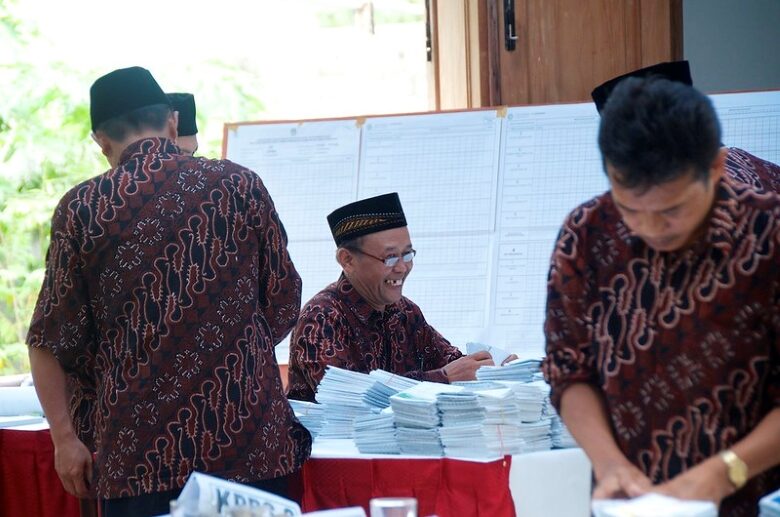
Election staff conducting vote counting (Photo: Etienne Girardet / Flickr [CC BY-SA 2.0 DEED])
目次
The road to independence and the Sukarno era
First, a summary of the history and trajectory up to Indonesia’s independence and early administrations. Indonesia is composed of more than 17,000 islands, and various dynasties ruled over what is now Indonesian territory in the past. From the 7th to the 14th centuries, the Srivijaya Kingdom flourished as a Buddhist state from the Malay Peninsula to Sumatra; in central Java in the 8th to 9th centuries, the Shailendra Dynasty prospered as a Buddhist state. The contemporaneous Old Mataram Kingdom, founded in roughly the same area, and the Majapahit Kingdom, established in the 13th century, flourished as Hindu states. The Majapahit Kingdom expanded its power over most of today’s Indonesia and nurtured Hindu culture. Around the 13th century, Islam spread via Muslim merchants, and after the 15th century various Islamic states emerged. Representative examples include the Mataram Kingdom in eastern Java and the Aceh Sultanate in northern Sumatra. 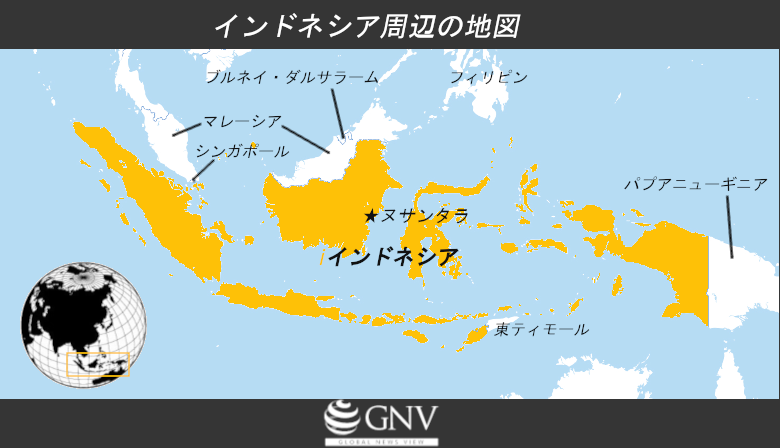
From the late 16th century, the Dutch advanced into what is now Indonesia, and from 1602 to 1798 the Dutch East India Company engaged in colonial administration. From 1799 until independence in 1949, Indonesia was a directly ruled colony of the Dutch government. During the Pacific War, Japan temporarily occupied the territory, but after Japan’s defeat, Sukarno—then chairman of the Preparatory Committee for Indonesian Independence—issued the Indonesian Declaration of Independence on 8/17, 1945. Although the Netherlands did not recognize this immediately, after the Indonesian National Revolution and related conflicts, in 1949 the Dutch transferred sovereignty to Indonesia. Even after that, the Dutch withdrew from Indonesian territory while leaving puppet entities that maintained de facto control. In 1950, these were incorporated, and excluding West Papua, Indonesia achieved independence within its present borders.
Next, a summary of politics after independence. As leader of the Indonesian National Party (PNI), Sukarno became the first president, promulgated a constitution in 1950, established a parliamentary democracy, and held the first parliamentary elections in 1955 . However, by 1957 Sukarno sought to shift to “Guided Democracy,” an authoritarian concept aiming for governance directed by a single leader rather than based on parties and parliament, and thus lacking genuinely democratic aspects. In 1959 he dissolved parliament, abolished the 1950 Constitution, and restored the 1945 Constitution, which gave stronger powers to the presidency. He then created a political system in which nationalism (PNI), Islam, and communism (the Indonesian Communist Party, PKI) were harmonized. This system was called “Nasakom.” Under Nasakom, Sukarno strengthened presidential power and dissolved parties other than the National Party and the Communist Party, turning the legislature into a rallying parliament composed only of members appointed by the president.
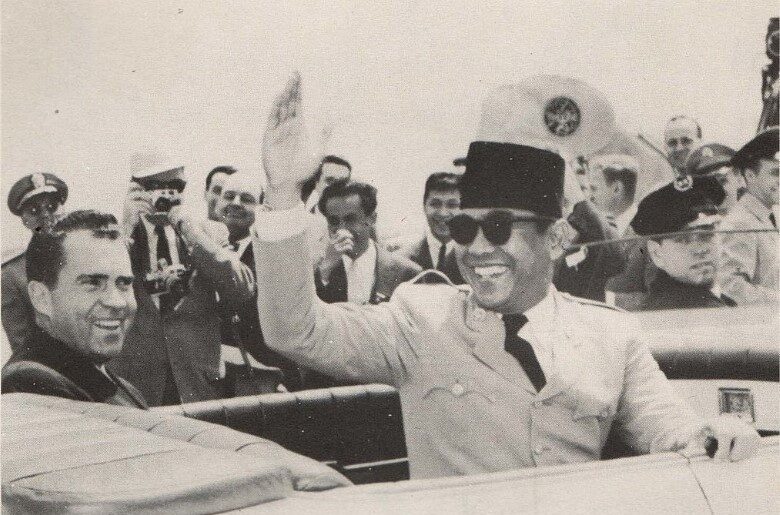
Sukarno waving from a car (Photo: United States Information Service / Wikimedia Commons [public domain])
The Suharto era
Under Sukarno, politics took precedence over the economy, leading to economic decline and severe hardship for citizens. In 1965, Sukarno fell ill and a power struggle over his succession began to unfold. On 9/30, 1965, pro-Sukarno elements in the armed forces killed six anti-Sukarno generals, occupied the presidential palace and other sites, and issued a statement claiming a military action to prevent a coup by the army’s top leadership. Major General Suharto, then commander of the Army Strategic Reserve, took command and suppressed the uprising. This became known as the 9/30 Incident.
Suharto and other senior military leaders blamed the Communist Party for the incident and launched a massacre of party members and suspected communists. Over the course of several months, an estimated 500,000 people were killed, and the Indonesian Communist Party was effectively destroyed. It has been claimed that there was support for this campaign from the United States, the United Kingdom, and Australia. Japan, too, was aware of the massacres but tacitly accepted them.
Suharto then pursued accountability for Sukarno’s cooperation with the Communist Party under Nasakom. Gradually, Suharto stripped Sukarno of power and by 1966 had become the de facto president. Sukarno remained president in name but had lost real authority. In 1967, Sukarno stepped down and Suharto became acting president; in 1968, the national parliament appointed Suharto as the second president.
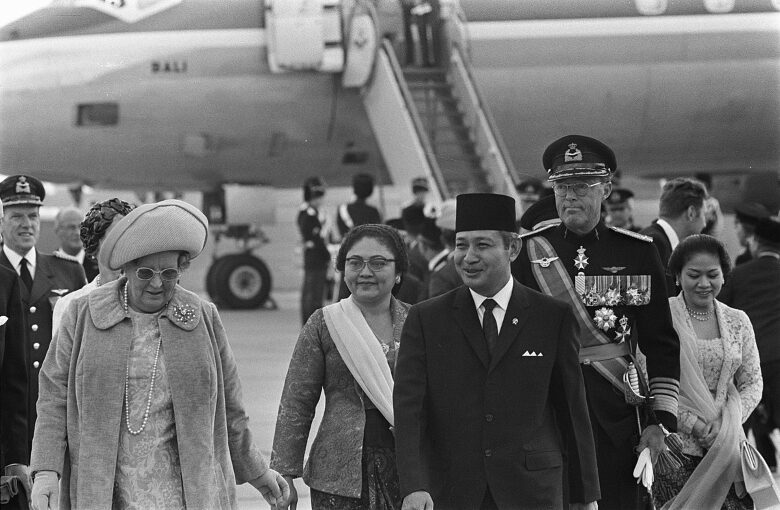
President Suharto arrives at Ypenburg in the Netherlands (Photo: Eric Koch / Anefo / Wikimedia Commons [CC0 1.0 DEED])
Suharto served as Indonesia’s president from 1967 to 1998, establishing an authoritarian system known as the “New Order” — the so-called “developmental dictatorship” (※2). He pursued development-first policies, such as developing oil resources by actively introducing foreign capital, mainly from Japan and the United States, and built a dictatorship backed by strong military support. In 1975, using the military, he invaded East Timor as Portugal withdrew from its colony and sought to annex it to Indonesia.
Under Suharto’s developmental dictatorship, Indonesia’s economy grew steadily, with an average annual GDP growth rate reaching 7% by some accounts. The poverty rate fell from 45% in 1970 to 11% in 1996, life expectancy rose from 47 in 1966 to 67 in 1997, and infant mortality fell by 60% according to reports. Yet there was a darker side to this growth: widening inequality. The growing wealth in Indonesia was distributed unfairly, with urban elites and military affiliates capturing much of it, thereby securing elite support for the regime. Suharto’s crony capitalism (※3) is another example of the inequitable distribution of wealth.
Next, why Suharto continued to win presidential selections: between 1967 and 1998 there was only one candidate in the presidential selection process — Suharto himself. Moreover, under the 1945 Constitution the People’s Consultative Assembly (MPR) was the highest state organ and the president was nominated by it, a mechanism Suharto exploited. He organized Golkar as a pro-regime vehicle and embedded it within the MPR. He also made more than half of MPR seats appointed by the president, ensuring his own selection. While freedom of party organization did not exist, two other parties did — the United Development Party (PPP) and the Indonesian Democratic Party (PDI) — but they were merely assigned roles as satellite parties (※4) and could not oppose Golkar. Under this system, five parliamentary elections were held in 1977, 1982, 1987, 1992, and 1997, all won by Golkar. Political participation by citizens thus served merely as a means to muster support for Golkar and President Suharto.
Even the Suharto regime eventually came to an end. Concentration of power in the presidency, structural corruption, widening inequality, and repression of human rights had drawn public criticism, but not enough to topple the regime. The situation changed with the Asian Financial Crisis of 1997, which caused a collapse in the rupiah’s value and rapid inflation, squeezing livelihoods. Fundamental reforms of crony capitalism and family businesses were needed, but Suharto’s failure to change course proved decisive, sparking demonstrations across the country. On 5/21, 1998, protests escalated into riots, he lost the military’s support, and he resigned as president.
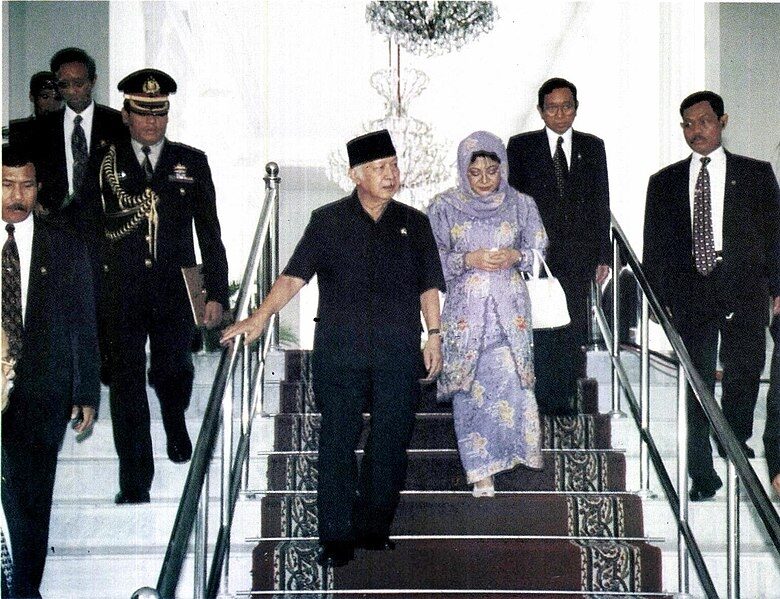
The Suharto family leaves the presidential palace after his resignation (Photo: Secretariat General of the People’s Representative Council of the Republic of Indonesia / Wikimedia Commons [public domain])
Politics after democratization
After the Suharto regime ended, B. J. Habibie, who had served as vice president under Suharto, became president, and Indonesia began a transition to democracy. Key aspects include the curbing of presidential powers, largely due to the 1999 constitutional amendments. In response to the presidential power concentration under Suharto, presidential authority was significantly reduced. The president is limited to a maximum of 2 terms (10 years), can no longer hold power indefinitely, lost legislative power and retains only the right to propose bills, lost the power to dissolve parliament entirely, and must obtain the MPR’s consent or consultation for diplomacy and appointments.
Beyond the presidency, the military’s political role — a pillar of the developmental dictatorship — was also restricted. Under Suharto, the military had dual functions (military and political), but democratization ended this dual role via the Defense Law and the TNI Law, committing the armed forces to national defense. As a result, the military withdrew from formal politics and its political influence weakened.
Freedom to organize political parties expanded after Suharto’s resignation. In the 1999 parliamentary elections, 48 parties including Golkar participated, and 21 of them won seats in the legislature. The largest share of seats was won by the Indonesian Democratic Party of Struggle (PDIP), led by Sukarno’s daughter, Megawati Sukarnoputri, followed by Golkar and the Islamic-elite-based United Development Party.
Direct elections were also introduced for the presidency and local offices. Habibie served from 1998 to 1999, Abdurrahman Wahid from 1999 to 2001, and Megawati from 2001 to 2004. Susilo Bambang Yudhoyono, president from 2004 to 2014, became the first to be elected by direct vote. Since 2014, Joko Widodo has served as president.
For parliamentary elections, shifting to open-list proportional representation (※5) is said to have strengthened citizens’ voice by better reflecting public opinion. Also, only one of Indonesia’s presidents since Suharto has been a career military officer, indicating a trend toward civilian control.
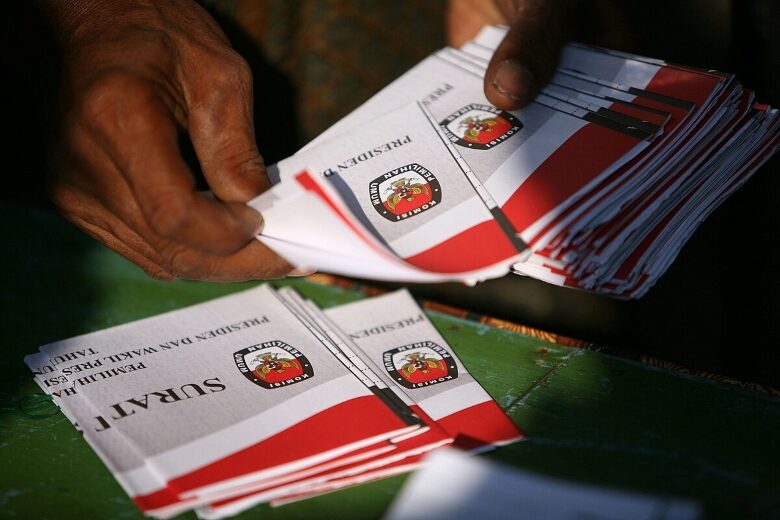
Ballot paper in the 2009 presidential election (Photo: Josh Estey/AusAID / Wikimedia Commons [CC BY 2.0 DEED])
It is worth emphasizing the enormous scale of Indonesia’s new electoral system. As noted, in 2019 about 80% of roughly 200 million eligible voters participated in the presidential election. At the same time, votes for regional legislatures were also cast. Specifically, voters cast 5 ballots at the same polling station — for president/vice president, the national parliament, the Regional Representative Council, the provincial parliament, and the regency/city council. The number of election workers handling counting and other tasks at each polling station reportedly reached about 738 ten-thousands and 5,500 people, underscoring the vast scale of elections in Indonesia.
Recent political conditions and issues
We have reviewed Indonesia’s democratization. But what is the recent state of its politics? There are concerns that Indonesia’s democracy has been declining in recent years. One reason cited is a deterioration in freedom of speech and expression.
One contributing factor is the Electronic Information and Transactions (ITE) Law, enacted under the Yudhoyono administration in 2008. While passed ostensibly to protect consumers in online transactions such as e-commerce, it has been criticized for being abused by the government to silence political criticism. In particular, provisions criminalizing “defamation” and the “dissemination of information inciting hatred” have been used excessively or arbitrarily as grounds for police reports. From January 2019 to May 2022, at least 332 people were reportedly prosecuted under suspected ITE violations.
Compared with the Suharto era, freedom of the press has greatly improved, yet those who post criticism of the president or the political system on social media may face pressure to delete posts or threats of defamation lawsuits. In addition, individuals criticized in the media over corruption have the legal right to sue journalists and publishers.
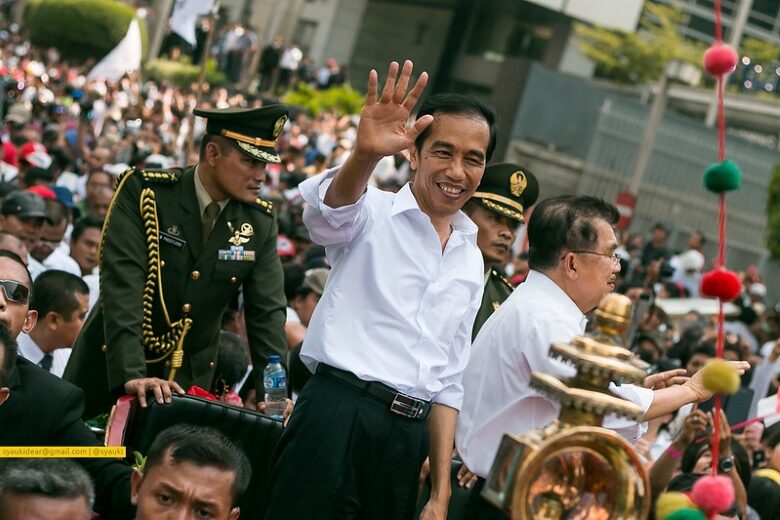
President Joko Widodo waving to the crowd (Photo: uyeah / Flickr [CC BY 2.0 DEED])
The Economist Group’s Democracy Index also declined in 2017. Indonesia fell 20 places from 48th to 68th, the largest drop among the 165 countries surveyed.
Another problem is deepening political polarization between pluralist parties promoting multi-religiosity and Islamic parties, which is ongoing. The leading pluralist party is the Indonesian Democratic Party of Struggle (PDI-P), the largest party in the governing coalition, which is the most pluralist party in Indonesia and draws broad support. On the other side are Islamic parties such as the Prosperous Justice Party (PKS), the United Development Party (PPP), and the National Mandate Party (PAN). This ideological divide has long existed latently in Indonesia and has recently been viewed as problematic.
Corruption is also seen as driving democratic backsliding. One factor is the high cost of running election campaigns, due in part to vote-buying. Some candidates or their affiliates give voters cash or daily goods in hopes of winning support for themselves or their parties. A study found that one in 3 Indonesians received such a bribe during an election. Another survey found that more than 8 out of 10 people feel corruption is widespread throughout government and business, indicating public awareness of pervasive political corruption.
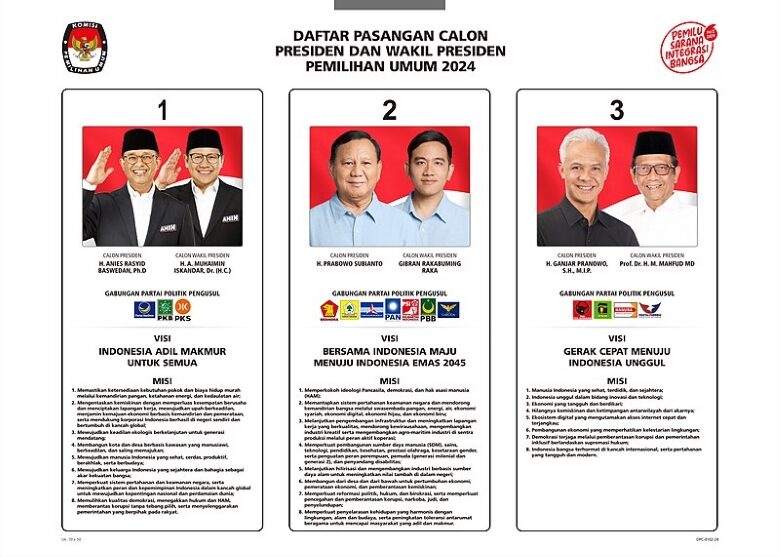
Candidates for the 2024 Indonesian presidential election (Photo: General Elections Commission of the Republic of Indonesia / Wikimedia Commons [public domain])
The 2024 presidential election and future prospects
To summarize the 2024 presidential race: This election will determine the successor to President Joko Widodo, who is completing his 2nd term, and features a three-way contest among Prabowo Subianto, Ganjar Pranowo, and Anies Baswedan. According to a poll conducted from 10/27 to 11/1, 2023, Prabowo led with about 40.6%, followed by Ganjar at 27.8% and Anies at 23.7%.
Briefly on the three candidates: Prabowo is a former lieutenant general and commander of the Army Strategic Reserve and the leader of the Gerindra Party; since 2019 he has served as defense minister. He also ran for president 2 times, in 2014 and 2019. Ganjar belongs to the ruling PDIP and served 2 terms as governor of Central Java. Anies was an academic before entering politics and became the youngest rector of an Islamic university in Indonesia; in Widodo’s 1st term he served as education minister until a cabinet reshuffle. He later served as governor of Jakarta from 2017 to 2022.
Prabowo also announced he would choose Gibran Rakabuming, Widodo’s eldest son and the mayor of Solo in Central Java, as his vice-presidential running mate. Under Indonesia’s election law, candidates for president and vice president must be at least 40 years old, so 36-year-old Gibran was originally ineligible. However, the Constitutional Court ruled that those with experience as a regional head may run even if under 40, allowing Gibran’s candidacy. The court’s chief justice at the time, Anwar Usman, is Widodo’s brother-in-law, prompting allegations that the court was used for political ends and domestic criticism of the decision.
As we have seen, although Indonesia has transitioned to democracy, numerous problems remain, and the democracy built over many years is said to be in decline. This article highlighted the deterioration of free speech and expression, political polarization, and corruption among recent issues. There are likely many other challenges as well. We will watch to see whether whoever is elected president in this election can address these problems.
Note 1: Indonesia’s administrative divisions consist of three levels: province; regency/city; and district/subdistrict/village.
Note 2: A system in which the government suppresses the public’s democratic political participation while pursuing rapid development and modernization, seen mainly in low-income countries. It prioritizes allocating economic resources to industry, resource development, and the military over policies that protect welfare and freedom, with the aim of strengthening national power.
Note 3: An economic system in which personal connections and family ties wield great influence, enabling the relatives and cronies of those in power to collude in extracting rents.
Note 4: In authoritarian states, small pro-regime parties other than the ruling party that are allowed to exist. They may represent some interests (such as those of minorities) but do not challenge the ruling party. They often exist to deflect domestic and foreign criticism of authoritarian rule.
Note 5: An electoral system in proportional representation where parties do not set a ranked list. Voters can vote for a party or for individual candidates; votes for individuals are counted as votes for their party. After seats are allocated proportionally to each party’s total, candidates with the highest personal vote totals within each party are elected.
Writer: Hayato Ishimoto
Graphics: Aoi Yagi











.jpg)

スハルトによる開発独裁が行われていたことは知っていたがその崩壊原因までは知らなかったので、いい勉強になりました。今後の選挙どうなるんでしょうね、
スハルトの虐殺に西側諸国が関与していたとは。