
It is relatively rare for women to serve as national leaders or politicians in the world. As of January 2023, women make up less than 10% of national leaders. So how are women covered when they become a country’s leader? Because it is relatively rare, is it considered more newsworthy and thus covered more? Are their appearance and gender reported on more than for male leaders? Is there a possibility they receive coverage based on stereotypes? This article analyzes how Japanese newspapers report on women leaders around the world.
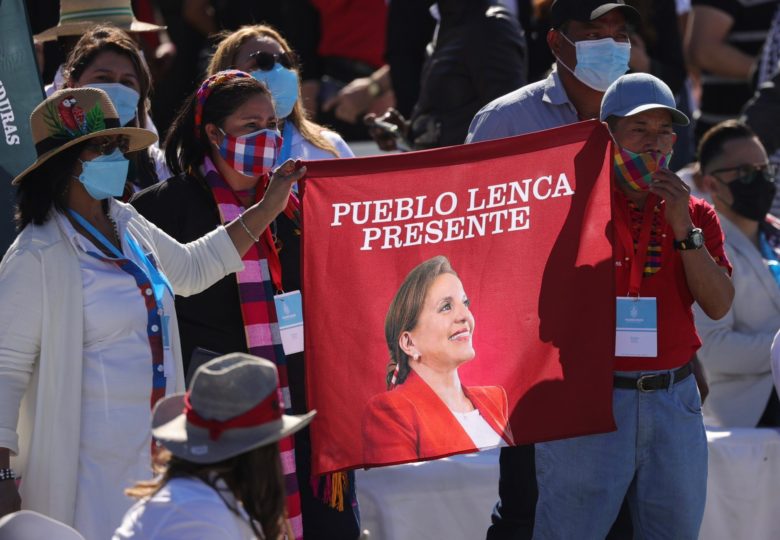
At the inauguration of Honduran President Xiomara Castro (Photo: Office of the President/Flickr [CC BY 2.0])
目次
The current state of women and politics
Before moving into the media analysis, let’s review the global status of women in politics.
The history of women leaders in the modern state begins with Sri Lanka. In 1960, Sirimavo Bandaranaike of Sri Lanka became the world’s first woman to be elected head of government through a democratic process. Six years later in 1966, Indira Gandhi was elected prime minister of India, becoming the second woman leader. This was followed by Golda Meir, who became Israel’s first woman prime minister in 1969, and Margaret Thatcher, who became the United Kingdom’s first woman prime minister in 1979.
Since the 1960s, 68 out of 193 countries have had a woman serve as prime minister or president (※1). As of January 2023, women held the position of prime minister or president in 33 countries and territories (※2). A recent example is Christine Kangaloo of Trinidad and Tobago, who was inaugurated as president on March 20, 2023.
What about politicians other than national leaders, such as cabinet members and legislators? There are 13 countries in the world where women make up more than half of the cabinet. In Albania, women account for 67% of cabinet posts, the highest in the world. Globally, women hold about 23% of cabinet seats on average. Regarding parliaments, data show that only three countries/territories have legislatures where women hold 50% or more of the seats. Rwanda has the highest proportion of women in parliament at 62%. Meanwhile, in 45 countries and territories, including Ghana, Japan, and Malaysia, women make up 15% or less of lawmakers. Globally, women account for 27% of parliamentarians. The Asian average is 21%, lower than the global average. As these figures indicate, women politicians remain in the minority in many parts of the world.
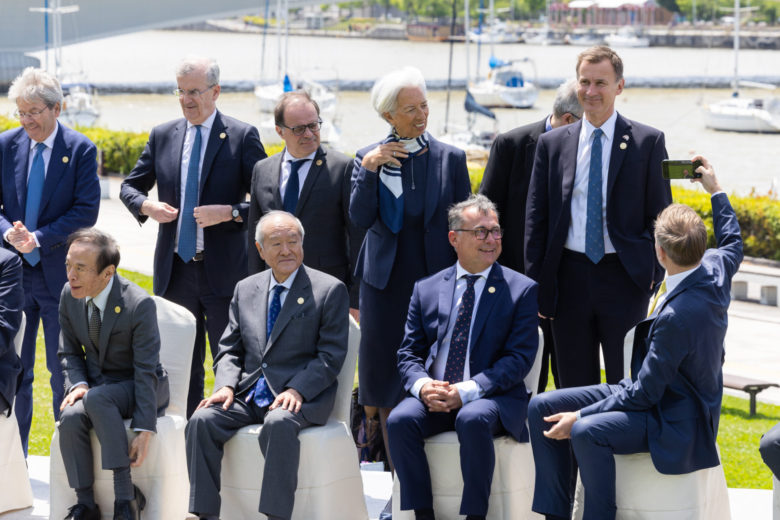
G7 finance ministers gathered (Photo: HM Treasury/Flickr [CC BY-NC-ND 2.0])
International coverage of women politicians
Given the small number of women politicians, how are they reported on? It has been pointed out that coverage of women politicians is likely to strongly reflect stereotypes related to “femininity.” For example, a study of coverage of women politicians in Canada found that compared to men, reporting on women politicians tends to focus more on their appearance—such as hairstyle and clothing—as well as their private lives, including husbands and family. Similar tendencies to focus on appearance and private life have been found in other countries such as Romania and Australia. There is also a tendency toward negative coverage of women based on stereotypes that women are more “emotional,” or biases that men are more “assertive” and thus better suited for leadership. Because a woman’s first-time accession to a politically important position is considered newsworthy in itself, there may be an increase in coverage focusing on that “first.”
All of these studies focus on women politicians within their own countries. At this stage, there are almost no research findings on how women politicians are covered in international reporting. Therefore, this time we examined how the media in one country report on women leaders in other countries. In particular, we used Japan—where women politicians are few—as a case to examine how international coverage by the media reports on women leaders. For this investigation, we focused on coverage in Yomiuri Shimbun of currently serving women leaders. As of January 2023, women were serving as national leaders in 17 countries and territories, and we focused on the period during which these leaders were selected (※3). For each leader, we counted the number of articles in the six months before and the three months after taking office. We also counted the number of articles under the same conditions for their male predecessors, and compared the number and content of articles about women leaders and male leaders. In particular, we analyzed how much and in what ways coverage of leaders reflected gender-related elements (※4)。
First, let’s look at the article counts. What stands out immediately is that, with a few exceptions, the volume of coverage about incoming women leaders in the target countries and territories is very low. Regardless of the leader’s gender, there were zero articles for seven countries: Iceland, Estonia, Tanzania, Trinidad and Tobago, Barbados, Bosnia and Herzegovina, and Lithuania. In other words, in two election cycles per country, the elections themselves were never reported. In addition, only one of the leaders (female or male) was covered in Samoa (woman leader only) and Finland (male leader only). Many countries with women leaders are hardly covered in the news to begin with. Even when there is a change of government, elections selecting a leader often do not become a subject of coverage.
This difference in volume of coverage can be said to be unrelated to gender. For Taiwan, greater volume likely reflects geographic proximity to Japan and the importance of Japan’s security considerations and relations with China. For Italy, Japanese media’s habitual focus on Western Europe and high domestic interest in tourism and food culture may be factors. As past GNV research has shown, regions outside North America and Western Europe receive very little coverage, not only in election reporting. As for Peru, although coverage mentioning the male predecessor José Castillo (28 articles) was relatively abundant, most of those articles focused on then-presidential candidate Keiko Fujimori. Given that Fujimori is the daughter of former President Alberto Fujimori, who sought asylum in Japan, her prominence likely drew attention.
Within this volume of coverage, what about differences between men and women? Among the 10 countries and territories that received any coverage, six saw greater coverage of the woman leader than of her male predecessor. In Italy, articles about the woman leader were more than double those about her male predecessor; in New Zealand there were eight articles about the woman leader versus only one for the male leader. In Moldova, there were seven articles about the woman leader and two about the man. In Denmark, articles about the woman leader were twice those about her male predecessor, and in Honduras and Samoa, the women leaders had one more article than their male predecessors.
On the other hand, Taiwan, Finland, and Peru saw more articles about the male leader. In Taiwan, there were far more articles about the male predecessor (135) than about the woman leader (86). In Peru, there were five articles about the woman leader versus 28 about the man. This shows that the appointment of a woman leader does not necessarily receive more coverage than that of her male predecessor.
“First woman”
Let’s also unpack the content. One term that stood out was “first woman.” We noticed this expression appearing frequently when a country’s first woman leader took office. Among the same 17 countries and territories examined, 10 had a first woman leader (※5). In every one of these, the term “first woman” (※6) appeared at least once in reporting. For Iceland, Samoa, Denmark, New Zealand, Bangladesh, Finland, and Honduras, there was only one article that included “first woman.” The expression appeared most often in articles about Italy; 15 of 28 articles about Prime Minister Giorgia Meloni mentioned “first woman.” Of the 86 articles about Taiwan’s President Tsai Ing-wen, 14 used the expression “first woman” (※7).
By contrast, Iceland’s current prime minister Katrin Jakobsdottir is the country’s second woman prime minister, and Finland’s current prime minister Sanna Marin is the third woman prime minister, so the novelty of being “first” may not have applied and thus not been reported. There are exceptions, however. In New Zealand, former Prime Minister Jacinda Ardern was the country’s third woman prime minister, but her high domestic approval ratings drew attention, and she received relatively more coverage than her male predecessor. This suggests that while the novelty of a “first woman leader” may be reflected to some extent in the volume of coverage, other factors also greatly influence whether women leaders are covered.
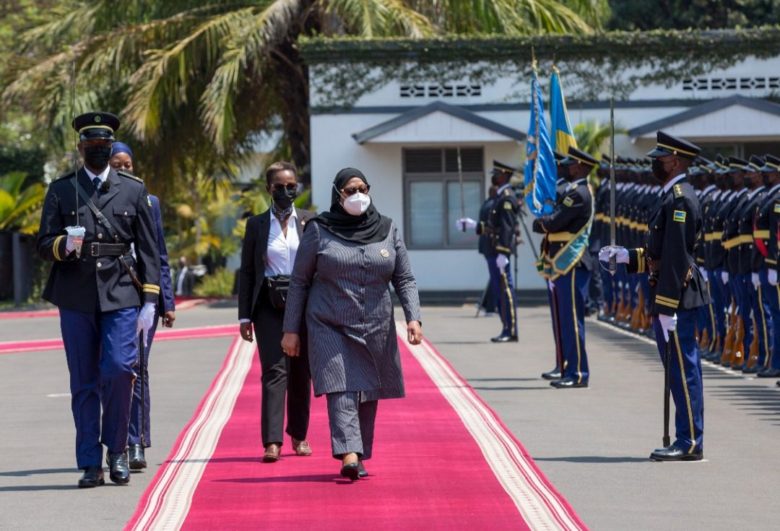
Samia Suluhu Hassan, Tanzania’s first woman president (Photo: Paul Kagame/Flickr [CC BY-NC-ND 2.0])
When gender is highlighted
A closer look at the content and phrasing also reveals coverage that draws attention to a leader’s gender. First, consider coverage of women prime ministers in Bangladesh in the 1990s. Bangladesh is a globally rare case where two women prime ministers have led the country since 1991, so instead of comparing women prime ministers to male predecessors, we analyzed coverage before and after the first inaugurations of the two women prime ministers (Khaleda Zia, the first woman prime minister, and the current prime minister, Sheikh Hasina). What stood out was the use of the honorific “joshi” (madam). Both were referred to as “Ms. Khaleda Zia” and so on, using the term “joshi.” While “joshi” is a term used for women in high positions in fields such as politics and academia, it has been considered a potentially discriminatory term for women and is rarely seen in current reporting. Looking at articles after 1994 about both prime ministers, the word “joshi” is not used, and titles like “prime minister” and “party leader” are used instead. As Asahi Shimbun explains: “Originally an ancient Chinese official title, it came to be used as an honorific for women engaged in social activities such as scholars and politicians. Because it can also be used mockingly, we now avoid it whenever possible. At Asahi Shimbun, we stopped using it for Japanese women after the 1960s, but continued to use ‘joshi’ for foreign politicians and others in many cases.” (※8)
Introductory articles such as “profiles,” often published at the time of a national leader’s election victory or inauguration, also show reporting that focuses on gender. Among the 17 countries and territories examined, nine leaders had profile-type introduction articles (※9). For example, in 1991, a profile of Khaleda Zia described “a gentle round face, colorful saris, a quiet way of speaking—Ms. Zia’s seemingly housewife-like demeanor makes it hard to imagine she spent eight years as an activist in the opposition movement,” drawing attention to her facial features, clothing, and manner of speaking. In 2022, a profile of Italy’s Giorgia Meloni stated that “she does not dress in a glamorous, feminine way, and her powerful speeches in a low voice often give people the impression she is ‘scary,’” commenting on her clothing and voice. In 2016, a profile of Taiwan’s Tsai Ing-wen noted, “She is said to ‘dislike having her being a woman singled out’ (party official), but perhaps in response to criticism during the 2012 presidential election that ‘you can’t become president wearing a skirt,’ she stuck with pants this time,” again focusing on appearance (※10).
For male leaders, there is also reporting—albeit less frequent than for women—that mentions “masculine” traits. For Taiwan’s Ma Ying-jeou, a profile described him as “a sportsman who enjoys swimming and jogging. With his tall 178-cm frame, handsome features, and fluency in English as an internationalist, he is very popular among women and young people, and is surrounded by female fans on the campaign trail,” focusing on sports and appearance considered “manly.” It also emphasizes how he is perceived by the “opposite sex” (※11).
It is hard to discern a clear pattern as to whether a “profile” article is written. Of five profile articles about women leaders, three focused on gender or appearance; among four about male leaders, one did so. This indicates that gender and appearance are emphasized more often for women than for men—though men are sometimes reported on in terms of appearance as well.
Although outside the target period, several women leaders were cited in contributed pieces as “Style Icons.” These included Katrin Jakobsdottir of Iceland, Jacinda Ardern of New Zealand, and Sanna Marin of Finland. The fact that these three national leaders were presented like actresses as “Style Icons” may reflect not only their being “women,” but also their relatively young age for national leaders and their origin from high-income Western countries (※12).
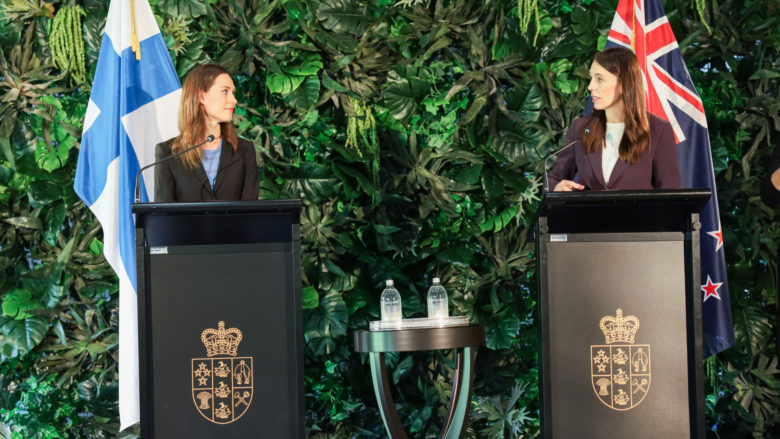
Finnish Prime Minister Sanna Marin and New Zealand Prime Minister Jacinda Ardern (Photo: FinnishGovernment/Flickr [CC BY 2.0])
Politics over gender
As noted, there are certainly articles that highlight gender, but the majority place emphasis on political elements. In more than half of the articles examined, there was no mention that the leader was a “woman,” and the focus was on the leader’s policies and political positions.
For example, Taiwan saw more articles about the male leader Ma Ying-jeou. However, this seems to stem from the political context at the time, rather than his being a man. Ma sought more cooperative relations with China, and territorial issues involving Japan, China, and Taiwan were in the spotlight, likely leading to greater coverage (※13). Coverage of Tsai Ing-wen, who later became leader, had about 33% of articles focusing on the “change of government.” About 15% mentioned “first woman.” This shows that while her being a “woman” was noted, political elements such as a change of government were considered more important.
For Italy’s Meloni, 15 out of 28 articles mentioned “first woman,” but 15 also referenced her as “far-right.” There was also frequent reporting on interim election results and approval ratings, suggesting attention to both her being a “woman” and to political elements.
In Moldova, although the woman leader Maia Sandu received more coverage than her male predecessor Igor Dodon in this study, in 2020—at the time of the election—coverage mainly focused on the region where pro-Russian residents had unilaterally declared independence, and on protests by pro-Russian citizens (※14). It is likely that events deemed newsworthy, unrelated to gender, strongly influenced the difference in coverage volume.
In Bangladesh, apart from the use of the term “joshi,” coverage was overwhelmingly about domestic politics and demonstrations. Articles about Honduras and Peru also provided detailed reporting on politics, such as opinion polls and the impeachment of presidents. Even in Samoa, where there was only one article, it did not focus solely on “first woman,” but carried the headline “Change of government in Samoa: First woman prime minister; possible review of China policy,” discussing the change of government and relations with China (※15).
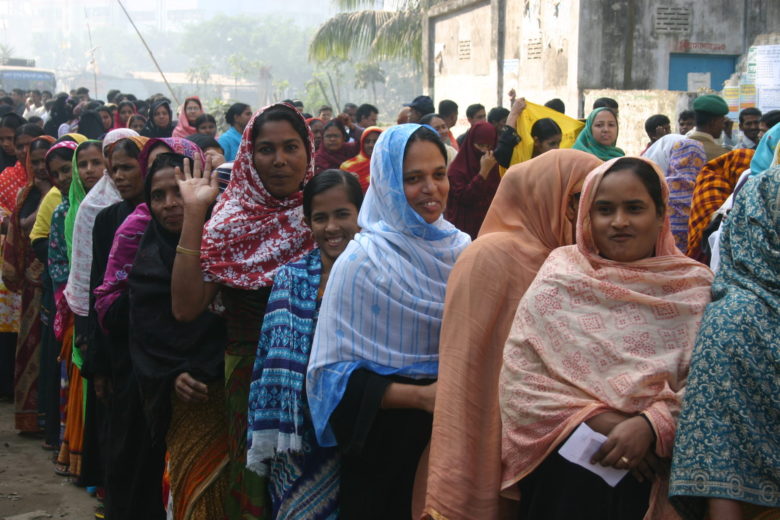
Women lining up to vote in elections in Bangladesh (Photo: Commonwealth Secretariat/Flickr [CC BY-NC 2.0])
Conclusion
The results of this study suggest that while Yomiuri Shimbun does not infrequently mention a politician’s gender, its reporting tends to place greater weight on politics than on gender. In terms of volume, phrasing, and content, although there are differences between men and women and some exceptions, there was not a strong emphasis on gender-based stereotypes. The increase in women leaders around the world may have helped “normalize” the presence of women politicians in Japanese media.
However, there are still instances where expressions that draw attention to a leader’s gender are seen. In particular, profile-type introduction articles on women leaders were found to comment on appearance, clothing, and facial features. Meanwhile, it was also found that there are relatively fewer cases where coverage of male leaders focuses on “masculinity,” indicating the presence of reporting that feels gender-asymmetric.
With more than 90% of the world’s national leaders being men, reporting that focuses on women leaders, such as “first woman,” could help spotlight women’s achievements and lead to an increase in women politicians in the future. On the other hand, focusing too much on gender may risk detracting from the core policies and politics. Going forward, we hope the media will maintain a balance between attention to women leaders and attention to their political trajectories, as the proportion of women leaders grows.
※1 Does not include regions that are not UN member states (such as Taiwan and Kosovo).
※2 The 33 countries and territories are Iceland, Italy, India, Estonia, Ethiopia, Gabon, Greece, Kosovo, Samoa, San Marino, Georgia, Singapore, Slovakia, Slovenia, Serbia, Taiwan, Tanzania, Tunisia, Denmark, Togo, Trinidad and Tobago, New Zealand, Nepal, Barbados, Hungary, Bangladesh, Finland, France, Peru, Honduras, Bosnia and Herzegovina, Moldova, and Lithuania.
※3 This study targets national leaders with major domestic political authority, and excludes heads of state with limited political powers.
※4 The 17 countries and territories whose national leaders were examined in this article are Iceland, Italy, Estonia, Samoa, Taiwan, Tanzania, Denmark, Trinidad and Tobago, New Zealand, Barbados, Bangladesh, Finland, Peru, Honduras, Bosnia and Herzegovina, Moldova, and Lithuania.
※5 For the five countries where the current national leader is not the first woman leader—Iceland, Denmark, New Zealand, and Finland—we went back to the first woman leader and analyzed coverage of that first woman (Iceland: Johanna Sigurdardottir; Denmark: Helle Thorning-Schmidt; New Zealand: Jenny Shipley; Bangladesh: Khaleda Zia; Finland: Anneli Jaatteenmaki).
※6 Includes variations such as “first woman” and “the first female.”
※7 In particular, in Samoa and Finland, which are not usually in the news spotlight, the single article appears to have been published because of the “first woman.” Going back more than 20 years, when Finland’s Centre Party led by Anneli Jaatteenmaki won the election in 2003, Yomiuri Shimbun ran the headline “Finland’s prime minister to be a woman,” reporting: “Ms. Jaatteenmaki (48), the Centre Party’s woman party leader, is expected to become prime minister. Finland had a woman president in 2000, former foreign minister Halonen (59), and there is now a strong possibility both the president and the prime minister will be women.”
Yomiuri Shimbun, “Finland’s prime minister to be a woman,” March 17, 2003.
※8 Asahi Shimbun, “Viewing the newspaper through a gender lens: Newspaper Week feature,” October 13, 2002.
※9 The nine are: Italy’s Giorgia Meloni and Mario Draghi; Taiwan’s Tsai Ing-wen and Ma Ying-jeou; New Zealand’s Chris Hipkins; Bangladesh’s Khaleda Zia and Sheikh Hasina; Peru’s Pedro Castillo; and Honduras’s Xiomara Castro.
※10 Yomiuri Shimbun, “[Profile] Khaleda Zia, who became prime minister of Bangladesh,” March 21, 1991.
Yomiuri Shimbun, “[Profile] Sheikh Hasina, who became the new prime minister of Bangladesh,” June 24, 1996.
Yomiuri Shimbun, “[Profile] Long-cherished wish achieved on second try—Tsai wins Taiwan presidency; Lee Teng-hui’s ‘protégé,’” January 17, 2016.
Yomiuri Shimbun, “[Profile] Xiomara Castro, who became president of Honduras,” January 29, 2022.
Yomiuri Shimbun, “[Profile] Giorgia Meloni, who became Italy’s first woman prime minister,” October 23, 2022.
※11 Yomiuri Shimbun, “[Profile] Ma Ying-jeou, who won Taiwan’s presidential election,” March 23, 2008.
Yomiuri Shimbun, “[Profile] Mario Draghi, who became Italy’s prime minister,” February 14, 2021.
Yomiuri Shimbun, “[Profile] Peru’s new president, Pedro Castillo,” July 21, 2021.
Yomiuri Shimbun, “[Profile] Chris Hipkins, who became New Zealand’s prime minister,” January 23, 2023.
※12 Yomiuri Shimbun, “[Style Icon] Jacinda Ardern,” Kaori Nakano (contributed), May 10, 2019.
Yomiuri Shimbun, “[Style Icon] Sanna Marin,” Kaori Nakano (contributed), April 30, 2021.
Yomiuri Shimbun, “[Style Icon] Katrin Jakobsdottir,” Kaori Nakano (contributed), May 28, 2021.
※13 Yomiuri Shimbun, “Ma elected Taiwan president; Japan–Taiwan relations expected to remain as is; government hopes for easing of tensions across the strait,” March 23, 2008.
Yomiuri Shimbun, “Taiwan’s President Ma praises actions of patrol boats that entered Senkaku; calls on Japan for talks,” June 18, 2008.
※14 Yomiuri Shimbun, “Moldova aims for withdrawal of Russian troops from the ‘Pridnestrovian Moldavian Republic,’” December 2, 2020.
Yomiuri Shimbun, “Protests against ‘pro-Russian’ forces in Moldova; demands include dissolution of parliament,” December 7, 2020.
※15 Yomiuri Shimbun, “Change of government in Samoa: First woman prime minister; possible review of China policy,” July 28, 2021.
Writer: Namie Wilson
Graphics: Virgil Hawkins




表題を一目見た時は、「ジェンダー」に注目した表現が多く存在しているのではないかと勝手な認識を持ったが、
記事を読むと国や地域に少しの違いはあれど、女性であることの珍しいさや特別感など全面的に出した報道ではなく、政策等の政治的要素にきちんとフォーカスされ報道が行われているようで、私が感じる理想に近い報道のあり方だと感じた。日本の報道の偏りも今回の記事でさらに浮き彫りになったのではないかとも思う。男女の性差がないよう、そして女性のリーダーが増えることを期待したい。
内閣や議会等の女性の割合がまだまだ低いということに驚きました。報道の仕方も女性という点に主点をおいているかのように見えるかもしれないが、初という新鮮なところなど、バックにある政治的なこともしっかりとカバーしているところもあると感じたかもしれない。
まだパーフェクトではないが、女性首脳の報道が今後もジェンダーより政治について報道されることを期待する。
特に昨今ではジェンダー表現に関する意識も高まり、メディアも平等に報道するように心がけているのかもしれない。性別に関係なく政治政策に重点を置いて報道するのは当然のことであり、その中で男らしさ女らしさをを含む表現を用いることは今では時代錯誤であると言える。が、現状はまだまだそういうメディアも多い。なので、こういう記事がメディアの報道表現を変え、また国民のジェンダーへの意識を変えることに繋がることに期待し、また、より多くの女性政治家、女性首脳が生まれることを期待する。世界人口の半分は女性なのだから。
女性の政治家について、注目しすぎても偏見の源になり、無関心すぎてもジェンダーギャップの改善につながらないという、報道の難しさがわかりました。
そしてやはり、そもそも外国の政治に関するニュースが少ないことが問題であり、今回の分析にしても数が少ないように思います。
いつの日か女性が首脳になることがニュースにならないくらいありふれた出来事になることを願っています。
もっと「女性」というだけで注目しているものかと思っていたので、概ね政治に注目しているのは想定外でした。
そもそも性別などについて報道する必要がないくらい、男女比率が平等になることを願っています。
女性がリーダーになる際、その性別に着目されて本人の政治的思考がないがしろにされてしまうとしたら、とても悲しけれど、創造していたより政治政策に重点を置いた報道がなされていることに安心した。
女性ということがどんな種類の報道でもあからさまに強調されすぎている気がします。それが良い悪いはわかりませんが、