
In February 2020, the Turkish government announced that several Turkish soldiers had lost their lives in fighting against Libyan opposition forces. These opposition forces receive military support from abroad and have become a threat to the capital, Tripoli.
Since the collapse of Muammar Gaddafi’s long-standing dictatorship in 2011, Libya has been in turmoil. Who is prolonging the chaos? What are the motives of each actor? Looking at the conflict, we will unravel Libya’s complex history and current situation.
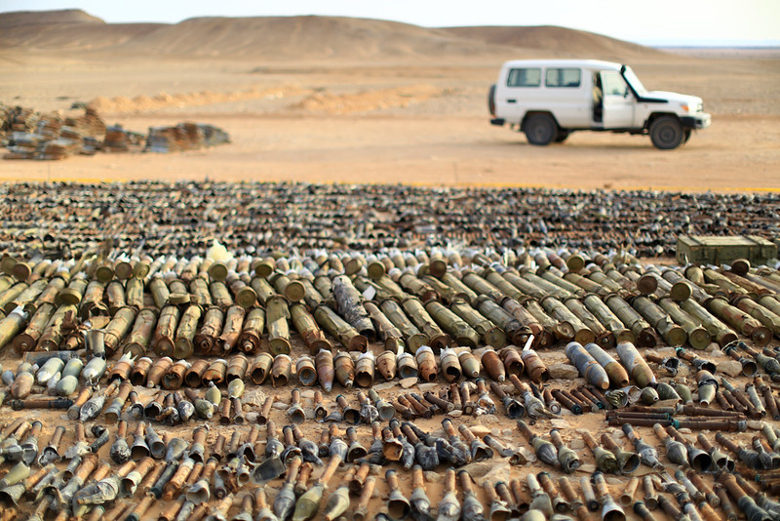
Unexploded ordnance and piles of bomb debris (Photo: United Nations Development Programme / Flickr [CC BY-NC-ND 2.0])
目次
Historical background
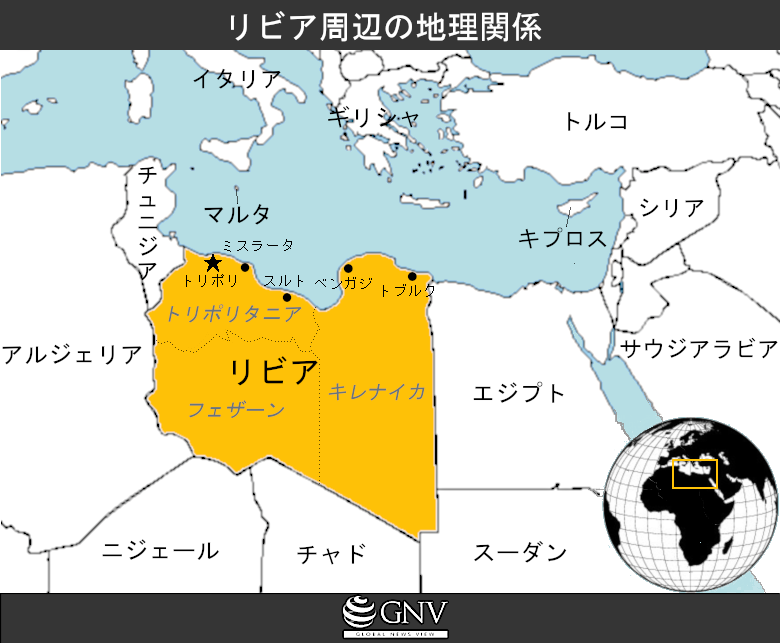
Libya is located in North Africa, and its population of just over 6.37 million consists of diverse ethnic groups, including Arabs, Berbers, and Tebu. In addition, 12% of the population are migrant workers from neighboring countries and beyond. The population is concentrated in major cities along the more than 2,000 km Mediterranean coast—Tripoli (the capital), Misrata, Benghazi, and others. With extensive port areas providing easy access to the sea, Libya has historically served as a hub of trade between Africa and Europe. Moreover, the Sirte region contains Africa’s largest oil reserves and the continent’s fourth-largest natural gas reserves, leaving it richly endowed with natural resources.
In the 16th century, under the Ottoman Empire, Libya was institutionally defined as a single state consisting of three regions (Tripolitania, Cyrenaica, and Fezzan). In the 19th century, as European powers expanded into Africa, Libya’s economy—previously sustained by caravan trade and pastoralism—changed dramatically. The center of African trade shifted from Libya to the Gulf of Guinea under European control, and the push to build railways reduced the number of caravans. Colonial expansion also began to affect pastoralism. These conditions worsened further in the 20th century. When Italy colonized Libya in the first half of the 20th century, agriculture and other economic activities run by Libyans suffered a blow, and poverty worsened dramatically.
After independence in 1951, the United Kingdom of Libya was established as a constitutional monarchy, and Idriss ascended the throne. However, lacking both industries to attract foreign capital and the basis for a self-sustaining domestic economy, Libya came to rely economically and militarily on the United States and the United Kingdom, which had supported its independence. Although large oil fields were discovered in the mid-1950s and substantial foreign capital began flowing into Libya, these funds enriched a corrupt government and foreign oil companies and were not returned to most citizens. The boom in the oil industry not only triggered a mass movement of people from local industries to the cities, but also increased immigration of highly educated technicians from the Arab world. As migration increased, a sense of identity as an “Arab nation” began to take root among citizens. The 1967 Six-Day War (*1) created social rifts between a government that took a pro-European stance and nationalism based on pan-Arabism, sowing the seeds of instability. These fissures culminated in the 1969 military coup led by Colonel Gaddafi, supported by the widespread aspirations to “restore national independence from European influence.”
Gaddafi’s rule initially focused on restoring Libya’s political independence. However, in the process of seizing oil fields from foreign companies, the United States and the United Kingdom—whose own companies were reaping vast profits from Libyan oil—grew increasingly displeased. Orders to remove foreign military installations further deepened the rift between Libya and the United States and United Kingdom. After the economic crisis of the 1970s, the introduction of Arab-socialist economic policies marked a shift in Gaddafi’s rule toward authoritarianism.
In the 1980s, confrontations between Libya and its neighbors, as well as with Western countries, intensified. After the 1988 bombing of a civilian airliner over Lockerbie, Scotland (Pan Am Flight 103), Western nations strongly condemned Libya and tightened economic sanctions, further isolating the country. Combined with sanctions, the global plunge in oil prices in the 2000s squeezed Libya’s economy and led Libya to normalize relations with Western countries. Economic liberalization rapidly increased foreign investment, and cooperation developed between Libya and Western countries in areas such as migration management and counterterrorism intelligence.
The “Arab Spring” and armed conflict
In 2011, the “Arab Spring” spread across North Africa and the Middle East, bringing waves of protest and social unrest. Libya was no exception, and the anti-Gaddafi movement took off in February. The Gaddafi regime initially cracked down harshly, but the situation evolved into armed conflict. The following month, NATO intervened militarily despite the opposition of the African Union (AU), and the Gaddafi regime collapsed. Gaddafi, who had fled, was killed on October 21, 2011. Bringing down the regime so quickly before any leadership or governing structure was in place created significant turmoil and laid the groundwork for the instability and armed conflict that persist to this day.
Amid the fighting, the National Transitional Council (NTC) was launched as an “interim government.” With support from international organizations, it led the anti-Gaddafi movement, forming the basis for later demands for democratization. However, given Libya’s highly complex background and the eventual withdrawal of international support, the NTC was pushed into instability. Many armed factions formed under the autonomy of different ethnic groups, clans, and communities, mobilizing to overthrow Gaddafi. Efforts to integrate these forces after the regime’s fall failed. The unstable situation, with multiple rival armed groups proliferating, was exacerbated by incidents such as the mass looting of military weapons from desert depots.
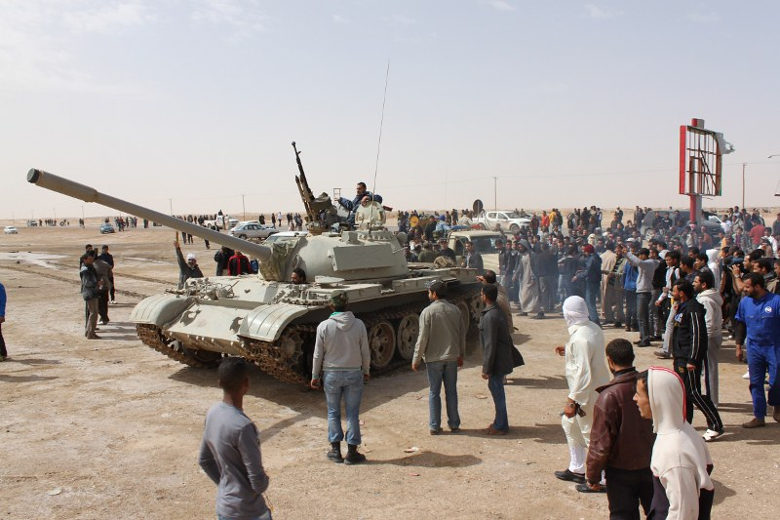
Citizens gather around a rebel tank, Ajdabiya, March 2011 (Photo: Al Jazeera English / Flickr [CC BY-SA 2.0])
The Tripolitania region, which includes the capital, saw the fiercest clashes between anti- and pro-Gaddafi forces and was the center of the Arab Spring in Libya. After Gaddafi was killed, the fragmented factions within the anti- and pro-Gaddafi camps began clashing based on regional and clan interests. Meanwhile, Cyrenaica in eastern Libya, which had historically been hostile to the Gaddafi regime, maintained relatively stable autonomy after the regime’s collapse. In Fezzan in the southwest, uprisings based on ethnically organized groups began much later. For many Islamist groups that had been repressed under Gaddafi, his death was also a turning point.
In this context, the NTC held elections in July 2012. The purpose was to form the General National Congress (GNC), tasked with drafting a constitution and laying the foundations of a parliamentary system. However, the GNC did not dissolve after its term expired and began preparing for elections to the House of Representatives (HOR) in July 2014. The vote took place with very low turnout, and liberal, secular forces won. Dissatisfied with the outcome, Islamist forces launched attacks in coordination with a coalition known as “Libya Dawn.” In August 2014, the secular parliament was driven from the capital Tripoli to Tobruk in eastern Libya, and Islamist forces took control of Tripoli.
The second phase of the conflict and the rise of Haftar
The parliament forced into Tobruk established a Tobruk-based government, while in Tripoli a government pursuing a conservative Islamist agenda was formed, polarizing the situation. The Tobruk government aligned with Khalifa Haftar, who leads the Libyan National Army (LNA), and launched a military offensive against the Tripoli authorities. Haftar was a colonel who defected from the Libyan army and went into exile in the United States in 1987. He played a central role amid the turmoil after the Tobruk authorities were expelled from the capital.
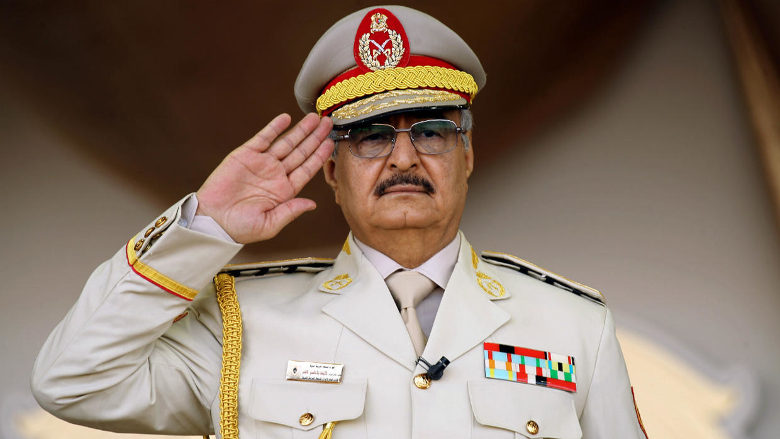
Khalifa Haftar (Photo: France24 / Wikimedia [CC BY-SA 4.0])
Meanwhile, Islamist groups such as IS and Ansar al-Sharia seized areas in Sirte and Benghazi, further fueling chaos. In response to the territorial gains of IS and Ansar al-Sharia, Haftar vowed to annihilate all Islamist forces, including “Libya Dawn,” which supported the Tripoli government.
In 2015, through UN mediation, the Tripoli and Tobruk authorities moved toward compromise, and on December 17 the establishment of the Government of National Accord (GNA) was agreed. Under this agreement, Fayez al-Sarraj would serve as prime minister of the GNA, which secured UN recognition. Domestically, however, consensus was lacking. The Tripoli side split into pro- and anti-GNA camps centered on the “Libya Dawn” coalition, and in August 2016 the Tobruk parliament voted against endorsing the GNA. Multiple rounds of talks between the Tobruk authorities and the GNA were held from 2017 to 2019, but no agreement was reached.
During this period on the ground, Haftar’s LNA continued advancing westward, retaking territories held by IS and areas under the Tripoli government. In January 2019, Haftar announced a military campaign to expand control into western Libya. Why was expanding influence westward so important? The background included Haftar’s motives to expand operational funding and military budgets by taking control of resource-rich western oil fields. In April 2019, timed with the UN Secretary-General’s visit to Tripoli, Haftar launched an operation to retake Tripoli. Although the operation failed, Tripoli has remained under siege ever since.
The world and Libya
Libya’s domestic situation is complex, but this conflict is by no means a mere “civil war.” Internationally, too, there is a clear split between those supporting Haftar and those supporting the GNA. One key to this international divide is political Islam, particularly the Muslim Brotherhood. Centered in North Africa and the Middle East, the Brotherhood advances an ideological movement to build states governed by Sharia law. Having been heavily repressed under Gaddafi, the Brotherhood supports the Tripoli government established after the regime’s collapse (*2).
The political leaders of the United Arab Emirates (UAE), Egypt, and Saudi Arabia view political Islam as a threat to their authoritarian rule, and these countries have supported the Tobruk authorities and Haftar. The UAE and Egypt have carried out airstrikes against the GNA and supplied weapons to Haftar; the UAE is also under suspicion of training Sudanese mercenaries. Russia is another actor supporting Haftar. To consolidate its position, it has provided economic and military support to the Tobruk authorities—economically by issuing Libya’s dinar, and militarily via private military companies and through airlines.
By contrast, Turkey—whose current government promotes Islamist-oriented politics—supports the Sarraj administration, i.e., the GNA. Turkey has not only sold large quantities of military equipment to the GNA, but also began deploying troops in January 2020 to strengthen Tripoli’s defenses. Behind Turkey’s bold intervention lies a desire to cultivate friendly relations with the GNA over maritime boundaries with Libya and secure access to natural gas reserves in those waters. After the ruling party lost municipal elections in Istanbul and Ankara, the administration also appeared motivated to project power abroad politically. Maintaining close ties with the Muslim Brotherhood, the GNA also receives economic and military support from Qatar, which supports Brotherhood activities globally.
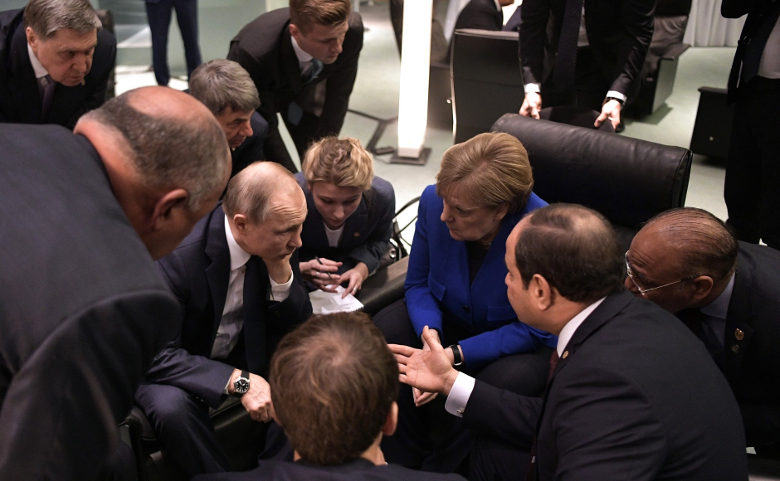
Leaders discussing the Libya issue, Berlin, 2020 (Photo: President of Russia [CC BY 4.0])
What about Europe and the United States? France has taken a posture that appears to support Haftar, while officially backing the UN-recognized GNA. The United States also officially supports the GNA, yet President Donald Trump at times made remarks suggesting support for Haftar, leaving Washington’s stance ambiguous.
International actors around Libya have produced not only “inflows” such as military interventions, but also “outflows” of people and goods. With the collapse of the state, proper management of ports faltered, turning Libya into a hub for migration, human trafficking, and smuggling. As the failed state left territory unmanaged, multiple militia groups took control; this expanded opportunities for migrants to cross borders but also led to violence and human rights abuses. Smugglers and key figures within the GNA have kept migrants aiming for Europe via Libya trapped inside the country, exploiting them as cheap labor.
As for the movement of goods, illegal drugs from Latin America are entering Europe via Libya. The country has also become a hub for illicit arms and contraband tobacco. These illegal trades fund armed conflicts in North and West Africa and serve as supply routes that prolong them. Oil smuggling is also a serious problem.
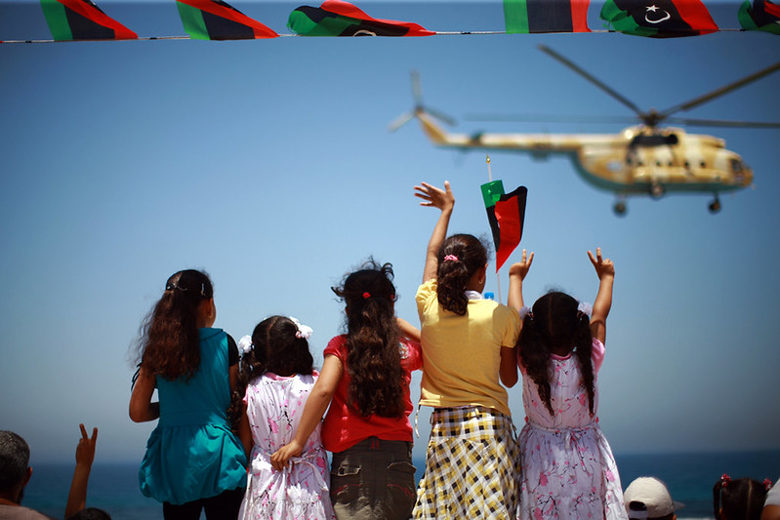
A military parade celebrating the first anniversary of the fall of the Gaddafi regime (Photo: United Nations [CC BY-NC-ND 2.0])
In January 2020, Prime Minister Sarraj and Haftar, along with stakeholders from the Middle East and the West and representatives from the UN and the African Union, gathered in Berlin, Germany. The following month in Geneva, the GNA and the Tobruk authorities agreed to a ceasefire. This ceasefire should have been a small step toward reconciliation in Libya’s long-running conflict. However, the effort was soon undone by renewed clashes. The GNA’s forces have been further strengthened with Turkish support, while the Haftar camp has also consolidated its military power in violation of the UN Security Council’s arms embargo. The key to ending the Libyan conflict may be for the GNA, the Tobruk authorities, and their backers to recognize that it is not force that will bring peace to Libya.
*1 A war fought by Israel against Egypt, Jordan, and Syria.
*2 The Muslim Brotherhood’s activities were linked to other Arab Spring movements as well. For example, in Egypt, for a short period before democratic elections were held, the Muslim Brotherhood actually held power.
Writer: Vipin Kumar
Translation: Azusa Iwane
Graphics: Yow Shuning, Saki Takeuchi



複雑なリビア情勢についてどうして今の状況が生まれてしまってるのかわかりました!
スライドさせることでその変化の過程を可視化した「リビアの勢力地図」のグラフィックが大変わかりやすく、感動しました!
見やすいグラフィックは、理解度はもちろん理解しようとする気持ちも高まります。ありがたいです。