
The execution of genocide (Note 1) by Israel in Gaza has been made possible by many external actors. For example, in the two years since the major escalation of fighting in October 2023, the United States has provided at least $21.7 billion in military aid to Israel. The United States has also extended diplomatic protection to Israel in venues such as the UN Security Council.
But it is not only governments that are involved. Numerous companies supply Israel with the materials and services needed to sustain its assault on Gaza and profit from those transactions. These are not limited to traditional arms makers that benefit from U.S. military aid to Israel, such as Lockheed Martin, Boeing, and RTX (formerly Raytheon). Global tech giants including Microsoft, Amazon, Google, OpenAI, Oracle, and Palantir have also become key players supporting Israel’s actions.
There are also Japanese companies criticized for business ties linked to Israel’s military actions. Yet while Israel’s actions in Gaza have drawn some criticism, Japan’s media have devoted little coverage to the companies whose relationships make those actions possible. This article examines the issue, focusing especially on domestic and foreign firms with close ties to Japan.

A building being bombed, Gaza (2023) (Photo: WAFA (Q2915969) / Wikimedia Commons [CC BY-SA 3.0])
目次
Big Tech and the Israeli military
Big Tech firms have long maintained cooperative relationships with the Israeli government and military. But since the escalation in October 2023, the Israeli military has greatly deepened its reliance on these companies.
Microsoft is one example. According to an investigation by the Guardian, in the six months after October 2023, monthly use of Microsoft Azure cloud storage (Note 2) by the Israeli side rose by 60% compared to the previous four months. In addition, Israel’s Ministry of Defense purchased 19,000 hours of support and consulting services from Microsoft between October 2023 and June 2024. Microsoft has also provided the Israeli military with access to OpenAI’s large language models. Notably, in January 2024, OpenAI removed its policy banning the use of its technology for military or warfare purposes.
Amazon and Google likewise continue to provide cloud computing and AI (artificial intelligence) services to the Israeli military, most notably through a $1.2 billion contract with the Israeli government signed in 2021 known as Project Nimbus. These companies’ services are believed to play a critical role in the fighting. In February 2024, the head of Israel’s National Cyber Directorate said, “Amazing things are happening on the battlefield thanks to Nimbus’s public cloud.” Israeli government documents have also been reported to require that when state-owned major weapons manufacturers procure cloud services, they must purchase them from Amazon and Google.
Furthermore, following the 2023 escalation, Palantir and Oracle—providers of AI technology platforms and cloud services—each publicly expressed support for Israel. In October 2023, Palantir posted on X (formerly Twitter), “There are some forms of evil that must only be resisted by force. Palantir stands with Israel.” In January 2024, Oracle pledged to double its investment in Israel.

Oracle advertisement, Tokyo, Japan (Photo: camknows / Flickr [CC BY-NC-SA 2.0])
The military use of technology
The full extent of the military use of services provided by these tech giants is not completely known. However, it is well known that the Israeli military uses vast amounts of cloud storage capacity and AI across a wide range of military activities, and demand has increased substantially since the October 2023 escalation. The military massively collects and stores mobile phone and other communications data, surveillance footage, and various military and intelligence data. This data is analyzed by a variety of AI systems, including facial recognition tools, and used to create and manage databases of targets for airstrikes and to command and control military operations.
For example, in August 2025 it was reported that Israel was using Microsoft services to conduct large-scale surveillance of phone calls and messages in Gaza and the West Bank. This information was said to be used in planning airstrikes and other military operations. Following the revelation, Microsoft announced it would sever ties with Unit 8200, the Israeli military’s intelligence unit. It is believed that Amazon Web Services (AWS) subsequently took over these services.
Early in the war, Israel developed an AI computing system called “Lavender.” The system automatically identified 37,000 Palestinians as “Hamas operatives,” who were then targeted for assassination. Another system called “Where’s Daddy?” was used to track the residences of people designated as operatives in order to bomb them along with their families. Given this, it is not surprising that, according to Israel’s own internal intelligence databases, as of May 2025 some 83% of Palestinians killed by Israel in Gaza were civilians.
Coverage of Big Tech and the Israeli military
As details have come to light, the deep ties between these tech companies and the Israeli military have been reported in stages. Much of the reporting has been done by Israeli outlets +972 Magazine and Local Call, and by the Guardian and Dropsite News. As a result, relevant information was readily available even to other media that did not conduct their own investigations. So how did Japan’s media cover the issue? This section examines reporting by the four national dailies: the Asahi Shimbun, the Mainichi Shimbun, the Yomiuri Shimbun, and the Nikkei (Nihon Keizai Shimbun; hereafter, the Nikkei).

Amazon cardboard boxes (Photo: Tatsuo Yamashita / Flickr [CC BY 2.0])
A review of the coverage shows that Japan’s major newspapers have reported very little on the provision of the above companies’ services to the Israeli military. The Asahi and the Mainichi have never mentioned the relationship between the Israeli military (or government) and Amazon, Google, or Project Nimbus. The Yomiuri mentioned it only once, in April 2024, reporting that 28 Google employees were fired for protesting the provision of the company’s services to the Israeli military. That article did not mention Amazon. None of the papers reported on ties between the Israeli government and Oracle, Palantir, or OpenAI.
The relationship between the Israeli military and Microsoft was covered just once by each of the three papers, in response to Microsoft’s announcement that it would stop providing services to Unit 8200. They did not report on the revelations that Microsoft products were used in the war or on employee protests against that use.
As Japan’s leading business daily, one might expect the Nikkei to cover these companies’ activities more extensively than the other three papers. However, articles on the Nikkei’s website show no notable difference in reporting on ties between these firms and the Israeli military. The Nikkei ran a single article about services Google provides to the Israeli military, focusing on the arrest of Google employees during protests. The same piece mentioned Amazon and Project Nimbus, but there was no article specifically about the military use of Amazon products. As with the other three papers, the Nikkei first reported on the military use of Microsoft’s products only after Microsoft announced it would suspend part of its services.
Not a new discovery
When reporting Microsoft’s decision to partially halt services to the Israeli military, these papers portrayed it as if Microsoft had newly discovered that its products were being used unethically. For example, a Yomiuri article reported the issue from Microsoft’s perspective, stating: “The company says that an internal investigation found evidence corroborating part of the reporting. President Brad Smith issued a statement saying, ‘We do not provide technology to conduct mass surveillance of civilians.’”
This is plainly not the case. In fact, by August 2024 it was clear—indeed acknowledged directly by an Israeli government official—that the Israeli military had been using cloud storage and AI services from Microsoft, Amazon, and Google. It was also known that the 2023 escalation directly drove a rapid increase in use of these services. Moreover, widespread use of Microsoft and OpenAI products inside the Israeli military was exposed in January 2025 and August 2025. Japan’s media did not report on the issue despite having ample sources for more than a year.

An Israeli government official speaking about cooperation with Microsoft, Google, and Amazon (July 2024) (Screenshot: from a video by Local Call/+972 Magazine)
Each of the papers did, to varying degrees, report that the Israeli military was using AI technology for surveillance and targeting. They also mentioned the “Lavender” system used to automatically generate lists of bombing targets in Gaza. But as noted above, there was scant reporting on the large-scale provision of services to the Israeli military by major global tech firms amid an unfolding genocide.
Other corporate involvement
There are many foreign companies that play a role in supporting the Israeli military’s assault on Gaza. The global movement calling for boycott, divestment, and sanctions (BDS) against companies that enable and profit from oppression and violence against Palestinians has a long history of exposing such firms. The movement is active in Japan as well (activities).
A UN report released in June 2025, “From the Economy of Occupation to the Economy of Genocide,” names many companies that supply products supporting Israel’s military actions against Palestinians (Note 3). While many arms manufacturers are listed, companies such as Caterpillar, Hyundai, and Volvo are also called out. These firms provide bulldozers and other machinery used by Israel to demolish Palestinian homes and tents in Gaza and the West Bank—sometimes while people are still inside.
Another company highlighted is FANUC, a Japanese firm specializing in automation products including robotics. According to the report, FANUC has supplied robotic equipment to major Israeli weapons manufacturers such as Elbit Systems and Israel Aerospace Industries (IAI). FANUC has claimed it has never sold its products to Israeli companies for military purposes, adding that when sales are made through intermediaries it may not know the end customer. However, there is ample evidence that its products are used for military purposes. For example, video posted by Israel’s Ministry of Defense in 2024 shows FANUC robots producing artillery shells at an Elbit Systems factory.

FANUC robots producing artillery shells at an Elbit Systems factory (January 2024) (Screenshot: from a video by Israel’s Ministry of Defense)
Other Japanese firms are involved by purchasing weapons and other military equipment from Israeli manufacturers and supplying them to Japan’s Self-Defense Forces. For example, Itochu Aviation (a subsidiary of Itochu Corporation) and Nihon Aircraft Supply (NAS) signed a memorandum of understanding on strategic cooperation with Elbit Systems in March 2023. However, after the International Court of Justice (ICJ) ruled in January 2024 that Israel’s actions in Gaza could amount to genocide, both companies terminated their agreements with Elbit Systems. In 2025, NAS appeared to continue pursuing drone imports from Israel, and Kawasaki Heavy Industries, Kaigai Bussan, and Sumisho Aero Systems Co., Ltd. have engaged in similar activities.
Coverage of ties between Japanese companies and the Israeli military
So how did Japan’s media report on links between these companies and the Israeli military’s actions in Gaza? The Asahi, the Mainichi, and the Yomiuri did not mention the June 2025 UN report on corporate involvement in Palestine even once, despite Japanese companies being named. Interestingly, the Mainichi did note that the report’s author, the UN special rapporteur, was sanctioned by the U.S. government, but did not mention the report itself—even though the main reason for the sanctions is widely believed to have been the contents of the report released ten days earlier. The Nikkei mentioned the UN report once, noting it only after the special rapporteur had been sanctioned by the U.S. That article described it as a report that “explicitly denounced more than 45 companies in Japan, the United States, and elsewhere,” yet did not name any of the companies listed.
The UN report’s allegation that FANUC robots are used in Israeli weapons production has been covered by multiple outlets, including Al Jazeera, Wired, and the HuffPost. FANUC has also become a target of the BDS movement, and an online petition demanding that it stop selling robots to Israeli weapons manufacturers has gathered more than 35,000 signatures.
Information about FANUC’s role in this matter was readily available. However, searches of the Asahi, Mainichi, and Yomiuri databases (Note 4) and the Nikkei website show that none of these newspapers has ever mentioned FANUC’s ties to Israel’s arms industry.
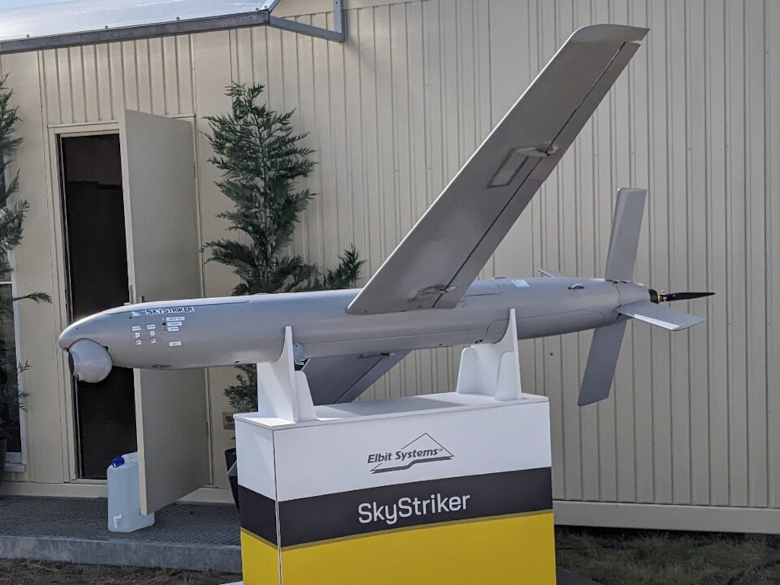
Elbit Systems’ SkyStriker attack drone (Photo: Boevaya mashina / Wikimedia Commons [CC BY-SA 3.0])
The cooperative ties between Itochu Corporation and major Israeli weapons manufacturers were mentioned by the Asahi, the Mainichi (Note 5), and the Nikkei. However, each paper first covered the issue only after Itochu announced it would terminate the cooperation agreement; none reported on the preceding protests or the petition. Nor did any of the papers mention links between Israeli weapons makers and Kaigai Bussan or Sumisho Aero Systems.
In the two years since the escalation, the Yomiuri has not mentioned ties between Japanese companies and Israeli weapons manufacturers even once.
The Asahi and the Mainichi did report on several protests against ties between Japanese firms and Israeli weapons manufacturers. For example, both papers covered protests by artists and others in March 2024 at a museum sponsored by Kawasaki Heavy Industries. The Nikkei also reported on this protest. The Mainichi further covered a February 2024 demonstration in Hiroshima targeting Nihon Aircraft Supply, though that report appeared only in the Hiroshima edition.
Who is the reporting for?
How closely a foreign issue or organization is connected to Japan often determines how much attention Japan’s media will pay to it. Nonetheless, as shown above, when it comes to ties between Japanese companies and the Israeli military, Japan’s media appear to treat it as an issue to be avoided. Moreover, while Amazon, Google, and Microsoft are not Japanese, these tech giants—whose products and services are used in Israel’s genocide in Gaza—are deeply embedded in Japanese society. Their offerings are so widely used by individuals and businesses that it is nearly impossible to avoid them.
Do these connections not make the issue worthy of coverage? Isn’t it the role of the media to shine a light on corporate complicity in human rights abuses—especially when they rise to the level of genocide? From whose vantage point are the media reporting?

It does not appear to be from the perspective of people who are targeted by Big Tech products and killed by weapons made with Japanese companies’ products. Nor does it appear to be from the perspective that Japanese consumers have a right to know that the online shopping sites, search engines, and computer software they use are provided by companies complicit in genocide. With such information, might consumers not reconsider their choices and look for alternatives (Note 6)?
What the newspapers seem to value most are corporate positions and interests. As noted, they tend to avoid reporting exposés or criticism of major companies’ problematic conduct and business relationships. Coverage tends to be reactive to companies’ own decisions and statements, with little attention to actions already brought to light.
This phenomenon is not limited to corporate cooperation with the Israeli military. GNV has previously identified similar patterns in coverage of corporate scandals and allegations abroad. In many cases, articles appear only after companies have taken action on the problem. This pattern aligns with GNV’s other findings on international reporting, indicating that Japan’s media tend to hew closer to centers of power and wealth than to their “watchdog” role.
Profits first?
As long as a company’s primary aim is profit and unbounded growth, it is hard to expect it to voluntarily prioritize human rights over overseas profits. And Israel is a highly attractive market, making it clear why companies find it difficult to resist. For years, observers have noted that Palestine has been used as a “laboratory” for the Israeli military to develop military technologies and sell them worldwide. The same is said to hold true for foreign tech companies cooperating with Israel.
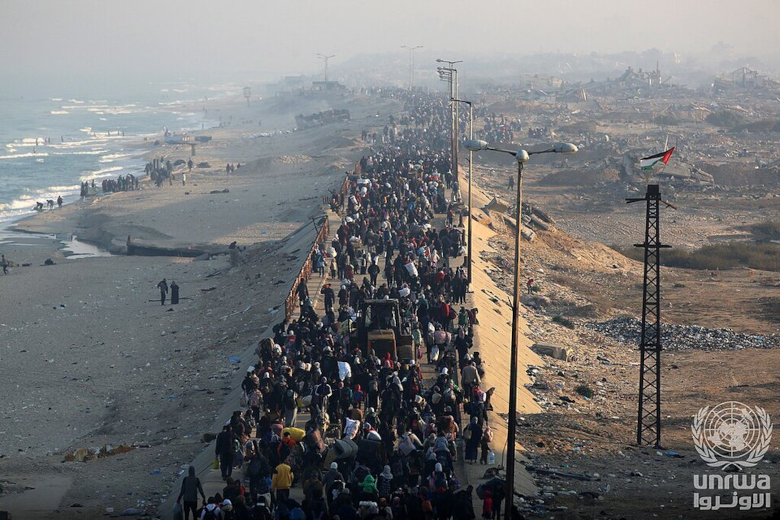
Displaced Palestinians, Gaza (2025) (Photo: Ashraf Amra, UNRWA / Wikimedia Commons [CC BY-SA 3.0 IGO])
It is fair to say that Big Tech anticipated criticism that cooperation with the Israeli government would enable human rights abuses. For instance, the contract signed with Amazon and Google in 2021 (Project Nimbus) guarantees continued service even in the event of a boycott campaign. It also includes clauses prohibiting Amazon and Google from refusing to provide services to specific government agencies—meaning they cannot stop providing services to the Israeli military or intelligence services.
At the same time, pressure from the media and the public can damage the reputations of companies that act unethically and thereby affect their profits. Under such pressure, companies may at times conclude that halting particular business activities that harm human rights is in their own interest.
Isn’t now the time for the media to fulfill their proper watchdog role?
Note 1 In August 2025, the International Association of Genocide Scholars adopted a resolution stating that Israel’s policies and actions in Gaza meet the legal definition of genocide under Article 2 of the UN Convention on the Prevention and Punishment of the Crime of Genocide. In September 2025, an independent UN international commission of inquiry concluded, after nearly two years of investigation, that Israel committed genocide against Palestinians in Gaza.
Note 2 Cloud storage: a service that allows data to be stored and managed on external servers via the internet.
Note 3 The report by UN Special Rapporteur Francesca Albanese on the situation of human rights in the Palestinian territories occupied since 1967.
Note 4 Based on searches using Asahi Shimbun’s online database “Asahi Shimbun CrossSearch,” Mainichi Shimbun’s online database “Mai-saku,” and Yomiuri Shimbun’s online database “Yomidas.”
Note 5 “Itochu Corp.: Subsidiary ends imports of equipment from Israel,” Mainichi Shimbun, February 6, 2024.
Note 6 For example, a smartphone app has appeared to help consumers find alternatives to products from unethical companies.
Writer: Virgil Hawkins





















.jpg)


Thank you for your sharing. I am worried that I lack creative ideas. It is your article that makes me full of hope. Thank you. But, I have a question, can you help me?
[289]Letswin Online Casino Philippines: Quick Letswin Login & Register. Play Top Letswin Slots & Secure your Letswin App Download for the Ultimate Gaming Experience. Experience Letswin Online Casino Philippines! Quick Letswin login & register to play top Letswin slots. Secure your Letswin app download for the best gaming now. visit: letswin
[3777]jljl333: Best Online Casino in Philippines. Quick Login, Easy Register, and App Download for Premium Slots. Join jljl333, the best online casino in the Philippines. Quick jljl333 login & register to play premium jljl333 slots. Download the jljl333 app now for the ultimate casino experience! visit: jljl333
[3850]w500casino Official Site: Fast Login, Easy Register & App Download for the Best Online Slots in the Philippines. Join the w500casino official site for the top online slots in the Philippines! Experience fast w500casino login, easy w500casino register, and a quick w500casino download to start winning today. visit: w500casino
[5817]Kinggamebio: Top Philippines Slot Online & Casino Games. Experience easy Kinggamebio login, register today, and enjoy our official app download for the best gaming experience. Experience the premier Philippines slot online and casino games at Kinggamebio. Enjoy easy Kinggamebio login, fast register, and our official app download for the ultimate gaming experience. Join today! visit: kinggamebio
[7409]mwcbet register|mwcbet login|mwcbet casino|mwcbet giris|mwcbet app Join MWCBet, the Philippines’ premier online casino platform. Complete your MWCBet register and login (giris) today to access a wide range of premium MWCBet casino games, including slots and live dealers. Download the MWCBet app for a seamless mobile gaming experience and start winning with the most trusted casino in PH! visit: mwcbet
[1427]TP777: The #1 Legit GCash Casino & Best Online Slots in the Philippines TP777 is the #1 legit GCash casino in the Philippines, offering the best online slots and a premier gaming experience. As one of the top-rated online gambling sites in the Philippines, we provide secure transactions and massive jackpots. Use the TP777 official login today to join the most trusted online casino Philippines platform and start winning big! visit: tp777
[4926]7sjl Casino & Slot Philippines: Top Online Gaming with Easy 7sjl Login, Register, and App Download. Experience the best of 7sjl Casino & Slot Philippines. Enjoy a fast 7sjl login, easy 7sjl register, and seamless 7sjl app download. Play top 7sjl slot and casino games to win big today! visit: 7sjl
[2901]SuperPH25 Online Casino: The Best SuperPH25 Slot Games in the PH. Quick SuperPH25 Login, Register, & App Download for Big Wins! Join SuperPH25 Online Casino for the best SuperPH25 slot games in the PH! Quick superph25 login & register. Get the superph25 app download now and start winning big! visit: superph25
[2550]Jili123 Online Casino Philippines: Official Login, Register, & Slot Games. Download the App Today! Join Jili123 Online Casino Philippines for the best jili123 slot games. Secure jili123 login, quick jili123 register, and easy jili123 app download. Play and win big today! visit: jili123
[4819]Juan365: The Best Philippines Online Casino & Slot Games. Official Juan365 Login, Register, and App Download. Join Juan365, the best Philippines online casino! Quick juan365 register & login to play top juan365 slot games. Get the official juan365 download for the ultimate juan365 casino experience. visit: juan365
I don’t think the title of your article matches the content lol. Just kidding, mainly because I had some doubts after reading the article. https://accounts.binance.com/register-person?ref=IHJUI7TF
feqrwm