
On 2022/2/24, Russia began its invasion of Ukraine, and since then the Ukraine–Russia war has dominated most conflict-related reporting in Japan. What, then, have the series of news reports so far actually covered about the Ukraine–Russia war? The bulk of reporting appears to be about the state of the fighting, cities destroyed by the war, the adversarial structure between Ukraine and Russia, and the military and humanitarian support provided by Western countries. However, many countries and experts have acted as mediators or called for a ceasefire and peace. Some countries have proceeded to hold talks with the belligerents, while others have published proposals for peace; the level of activity toward peace varies.
As “victory” on the battlefield—that is, a military solution—is considered unrealistic from either Ukraine’s or Russia’s standpoint, there are growing voices arguing that negotiations are inevitable for a resolution. To cover the current state of the Ukraine–Russia war comprehensively and objectively, it is necessary to report not only on the fighting and military aid but also on moves and calls toward peace. How much are Japanese media reporting on such efforts toward ceasefire or peace? Below, we consider the current situation and future prospects through an analysis of coverage volume in Japan’s major newspapers.
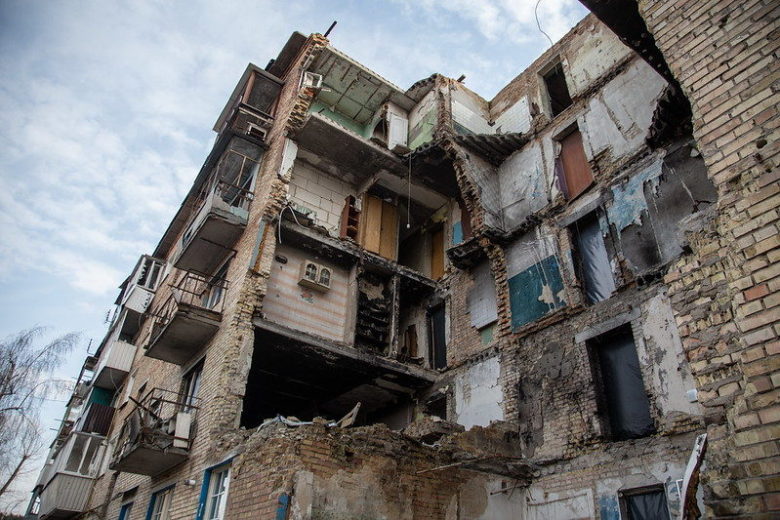
Homes in Ukraine destroyed by the war (EU Civil Protection and Humanitarian Aid / Flickr [CC BY-NC-ND 2.0])
目次
Peace talks in the early phase
On 2022/2/28, four days after Russia’s invasion of Ukraine, representatives of the Ukrainian and Russian authorities met near the Ukraine–Belarus border for ceasefire talks. At that time, Ukraine demanded an immediate ceasefire and the withdrawal of Russian troops, while Russia concealed its objective in entering the talks. Although no concrete outcome was achieved at this meeting, the two sides agreed to hold another round of ceasefire talks. On 3/3, a second round of talks was held in Brest, western Belarus. While both sides agreed to establish humanitarian corridors to protect civilians, Ukraine refused Russia’s demand for demilitarization, and no progress was made toward a ceasefire. A third round of talks was also held on 3/7, meaning a total of 3 rounds were held in Belarus, but none reached a full agreement on a ceasefire.
After the talks in Belarus, Israel attempted to mediate. Israel is one of the countries with close ties to both Russia and Ukraine, and it moved to engage in peace talks shortly after the war began. On 2022/3/3, Israel’s then–Prime Minister Naftali Bennett (at the time) (※1) held a phone call with Russia’s President Vladimir Putin. Two days later, he visited Moscow and became the first national leader since the invasion to hold a face-to-face meeting with Putin. Israel engaged not only with Russia but also with Ukraine. On 2022/March 6, March 8, and March 12, Bennett held consecutive phone calls with Ukraine’s President Volodymyr Zelenskyy, reportedly exchanging views on ceasefire efforts. The two tracks of dialogue both centered on major points of contention: Ukraine’s North Atlantic Treaty Organization (NATO) membership and territorial issues. Following Israel’s meetings, Zelenskyy acknowledged that Ukraine’s chances of joining NATO were low, and Putin ceased making statements questioning Ukraine’s rights as an independent state. There were modest signs of effect from Israel’s mediation.
Nearly a year later, on 2023/2/5, a roughly 5-hour-long interview with former Prime Minister Bennett was posted on YouTube. The interview included the startling claim that, about one month after the war began, ceasefire talks were obstructed by NATO and Western countries. According to Bennett, both Ukraine and Russia had the willingness to agree to a ceasefire. In other words, Israel’s ceasefire mediation appears to have stalled due to differences with the West in its stance toward Russia.
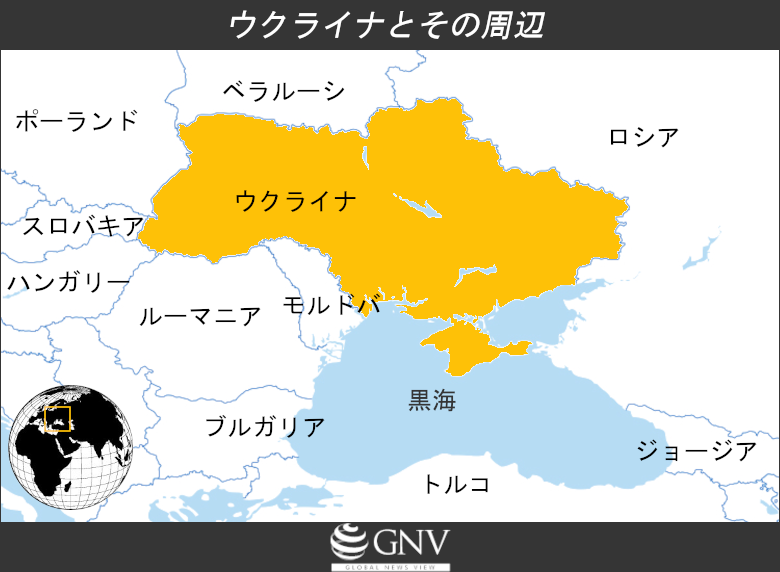
After Israel’s mediation, Turkey moved to launch peace talks. Turkey is a regional power close to both Ukraine and Russia and an important country for trade in the Black Sea region, and thus has deep historical ties to both sides. On 3/10, Turkey hosted a meeting in the southwestern city of Antalya between Ukrainian and Russian delegations. About three weeks later, on 3/29, the venue for talks that had been held in Belarus shifted to Istanbul in western Turkey, and Turkey became a full-fledged venue for mediation.
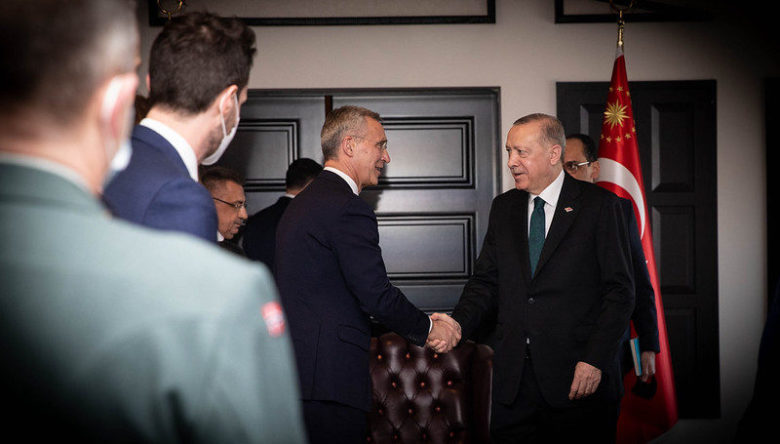
President Recep Tayyip Erdoğan of Turkey shakes hands with NATO’s secretary general (NATO North Atlantic Treaty Organization / Flickr [CC BY-NC-ND 2.0])
However, Turkey’s mediation did not lead to a ceasefire. One reason cited is intervention by Western countries. On 2022/4/9, the United Kingdom’s then–Prime Minister Boris Johnson (※2) made a surprise visit to Kyiv, Ukraine’s capital. During the visit, Johnson touted financial and military assistance to Ukraine and reportedly argued for the necessity of defeating Russia, calling for talks in Turkey to be suspended. Ukraine’s media outlet Ukrainska Pravda issued a harsh assessment of Johnson’s visit, saying it “led to the breakdown of negotiations between Russia and Ukraine.” On 4/25, following the UK’s lead, U.S. Defense Secretary Lloyd Austin also visited Kyiv and stated that America’s goal in this war was to weaken Russia. It appears there was a mismatch between the West’s hardline stance toward Russia and Turkey’s efforts to act as mediator.
China’s peace plan
China, which emphasizes its friendly relations with Russia, also launched peace efforts toward a ceasefire. On 2023/2/24, exactly one year after the invasion of Ukraine, the Chinese government published a 12-point proposal (※3) regarding the Ukraine–Russia war. In this plan, China declares itself a neutral country. However, Ukraine’s backers, led by the United States, argued that the plan favored Russia and criticized it. A month later, on 3/21, President Xi Jinping visited Moscow and held a meeting with President Putin. The meeting was intended to upgrade China–Russia ties to a “new era” of cooperation—namely, a stronger strategic partnership—and is hard to characterize as a peace initiative. Even so, during the meeting President Putin assessed that China’s 12-point plan could be used as a basis for a peace agreement, hinting at Russia’s willingness to consider a ceasefire.
China also created an opportunity for dialogue with Ukraine. On 4/26, President Xi held his first phone call with President Zelenskyy. While Zelenskyy expressed caution toward China’s plan, he indicated he would welcome the initiative. In the call, Xi told Zelenskyy that China had consistently taken a stance toward peace in the Ukraine–Russia war and that dialogue and negotiations are the only solution.
In mid-5, China dispatched top envoys, including Special Representative for Eurasian Affairs Li Hui, on a tour of Europe to explore a political resolution to the Ukraine–Russia war. The Chinese delegation visited Ukraine on 5/17 for talks. However, during the meeting, Ukrainian Foreign Minister Dmytro Kuleba conveyed to China that Ukraine would accept no proposals related to a ceasefire with Russia that involved any loss of territory or freezing of the conflict, indicating a negative view of China as a mediator.
Other attempts
Among attempts other than those by Israel, Turkey, and China, Mexico stands out. On 2022/9/12, Mexico’s President Andrés Manuel López Obrador announced he would submit a ceasefire plan on the Ukraine–Russia war to the United Nations, and he formally proposed it at the UN General Assembly on 9/22. Ukrainian authorities opposed the plan on the grounds that it benefited Russia, but on 2023/4/20, President Zelenskyy asked Mexico to help promote Ukraine’s peace plan in Latin America. To date, Mexico has been one of the countries supporting Ukraine, and Zelenskyy appears to hope Mexico will lead support for Ukraine in Latin America. Colombia also cooperated in drafting this plan.
Brazil’s President Luiz Inácio Lula da Silva has also shown movement toward peace. On 2023/1/30, President Lula proposed creating a group of nations (“G20 for Peace”) aimed at resolving the Ukraine–Russia war, envisioning the participation of Indonesia, India, China, and other Latin American countries as members. He then visited Spain over two days on 4/25–26, proposing the creation of a “G20 for Peace” to Spain as well.
Pope Francis of Vatican City has also appeared eager to serve as a mediator. In 2022/5, the Pope announced plans to meet Patriarch Kirill 1 (※4), the Patriarch of Moscow, in Jerusalem in 6, but the plan fell through. However, on 2023/4/30, he revealed that the Vatican was secretly involved in a peace mission aimed at ending the war between Ukraine and Russia. On 5/13, he held a meeting with President Zelenskyy at the Vatican, emphasizing the humanitarian dimension and conveying his readiness to act as mediator.
In addition to countries that have made concrete moves or proposals—such as Mexico, Colombia, Brazil, and Vatican City—some countries have declared their support for peace talks. Senegal’s President Macky Sall, then chair of the African Union (AU), strongly endorsed ending the war through negotiations and visited Sochi, Russia, in 6 for talks with President Putin. In addition, India’s Prime Minister Narendra Modi held a phone call with President Zelenskyy in 2022/12, expressing support for any peace negotiations.
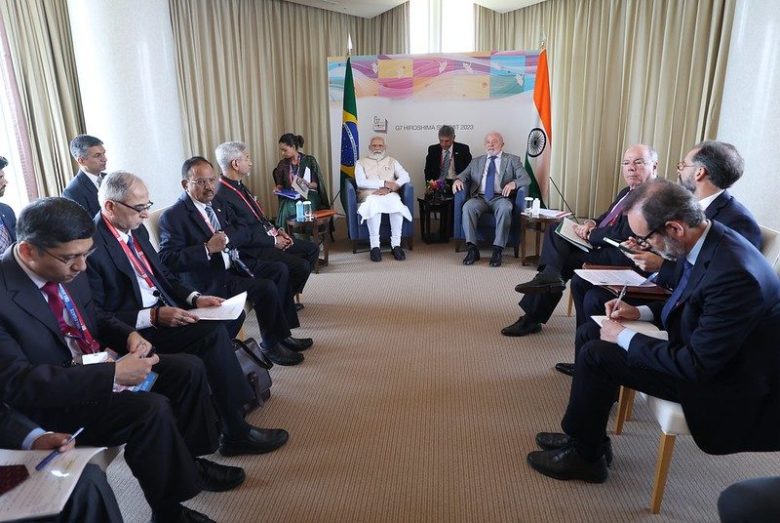
Prime Minister Modi of India and President Lula of Brazil meet at the G7 Summit held in Hiroshima, Japan (MEAphotogallery / Flickr [CC BY-NC-ND 2.0])
The United States takes a hardline stance toward Russia, but even within the U.S. there are calls for peace. Mark A. Milley, who still serves as America’s top military officer, argued for the need for a diplomatic solution—contrary to President Joe Biden and Secretary of State Antony Blinken—at an event in New York on 2022/11/9. Henry Kissinger, a former representative of U.S. diplomacy who played a role in launching numerous wars and who continues to exert indirect influence on current U.S. foreign policy, has supported resolving the Ukraine crisis through negotiations rather than a military hard line (※5).
As we have seen, numerous efforts have been made toward peace, and voices supporting those efforts can be heard around the world.
Analysis of the volume of peace-related coverage in Japanese newspapers
So how much have the moves toward peace described above actually been reported? This time, we limited our investigation to three major Japanese newspapers (Asahi Shimbun, Mainichi Shimbun, and Yomiuri Shimbun) (※6).
First, let’s look at the overall volume of reporting. Among all articles written about the Ukraine–Russia war so far, how many covered peace-related developments, regardless of the outcomes of negotiations? The study period is the one year and three months from 2022/2/24 to 2023/5/24. Note that 2022/2/24 is the date Russia began its invasion of Ukraine, which we consider the start of the war for this article.
For this study, we extracted Ukraine–Russia war–related articles from each of the three papers and counted those whose headlines included at least one of the four keywords “peace,” “peace,” “ceasefire,” or “mediation.” The results are shown in the pie chart below.

Loading…
Overall, each of the three papers—Asahi, Mainichi, and Yomiuri—published roughly 1,900 to 2,900 Ukraine–Russia war–related articles, of which only 130 to 150 were peace-related. The small proportion is evident from the chart above.
Are mediation efforts being reported?
As noted above, various countries—including Israel, Turkey, and China—have attempted mediation or actively called for a ceasefire or peace. How much have Japan’s three major newspapers captured these facts? From among reports on the Ukraine–Russia war, we counted articles where mediation efforts or calls for peace were the main theme. The results are shown in the bar chart below.
Loading…
First, consider the total volume of reporting on this war. As noted, there were roughly 2,000–3,000 articles over the one year and three months that covered the Ukraine–Russia war; compared to those figures, reporting on mediation and calls for peace is overall limited. Looking at the breakdown, the number of articles on each country’s mediation or calls for peace was notably higher for China and Turkey across all three papers—Asahi, Mainichi, and Yomiuri. In numerical terms, India and Israel followed, while coverage of Vatican City, Brazil, and Mexico varied; still, as main themes, they were hardly reported at all. The African Union and Colombia were not the focus of any articles in any of the papers. Overall, Yomiuri Shimbun carried the most peace-related coverage. Israel had fewer peace-related reports than Turkey or China, likely because the period during which it engaged in talks and mediation was shorter than for Turkey or China. Although Turkey and Israel’s mediation efforts were reported, we did not find reporting that the talks were obstructed by Western intervention.
Moreover, it is not necessarily the case that countries that took concrete actions—such as actually mediating or making proposals—received more coverage than those that merely issued calls for peace. India, which has mostly limited itself to expressing a peace-oriented stance, received more coverage than Israel, Mexico, or Brazil. The fact that Japan and India have relatively close ties in trade and security compared to Israel, Mexico, or Brazil may lie behind this difference.
Are newspapers calling for peace?
Finally, let’s look at the editorials from each newspaper. Editorials are core articles that present the views or stance of the media outlet itself, rather than those of individual journalists or commentators. We picked up all editorials published in the one year and three months since the war began that used the Ukraine–Russia war as a main theme. We then analyzed how many of those reported on peace-related developments.
Loading…
There were very many editorials on the Ukraine–Russia war (94–168), showing the high level of attention these outlets devoted to it. However, the small share that focused on peace (8.7–16.5%) stands out. Looking at the content, there were more pieces responding with opinions to actual meetings or events than editorials emphasizing the importance of negotiations, diplomacy, or peace itself. By country, China and Turkey were individually addressed in editorials. For China, there were 3 pieces in Asahi Shimbun, 5 in Mainichi Shimbun, and 5 in Yomiuri Shimbun. Examples include “China’s diplomacy: Show responsibility for peace through action” (Asahi Shimbun, March 18, 2023); “China’s stance toward Russia: Credibility won’t come from ‘watching and waiting’” (Mainichi Shimbun, March 6, 2022); and “China’s support for Russia: How long will you condone aggression?” (Yomiuri Shimbun, March 9, 2022), which, by debating the stance China should take, often advanced arguments for peace. Regarding Turkey, there was only one in Yomiuri Shimbun: “Turkey’s diplomacy: How to bring about a halt to Russia’s aggression” (Yomiuri Shimbun, August 9, 2022), which introduced Turkey’s early mediation and touched on prospects for Turkish diplomacy. We did not find editorials focused on other countries.
Are Japan’s media “hawkish”?
We have focused on moves toward peace in the Ukraine–Russia war and analyzed their trajectory and the volume of coverage in three major Japanese newspapers. This analysis shows that, relative to other reporting, peace-related coverage is limited. GNV has previously shown that in Japan’s reporting on conflicts, the traditional “war journalism” that centers on the state of fighting and the logic of victory greatly outweighs “peace journalism,” which covers peaceful movements and possibilities within conflicts. That tendency was also evident in Ukraine–Russia relations before Russia’s invasion of Ukraine.
This tendency toward “war journalism” is not unique to Japan; it is seen in reporting around the world. However, behind Japan’s reporting pattern may be the influence of the U.S. government and U.S. media, which can be said to still favor continuation of the war. Japanese media may also be strongly influenced by not only U.S. media outlets but also think tanks that support war and the weapons manufacturers behind them.
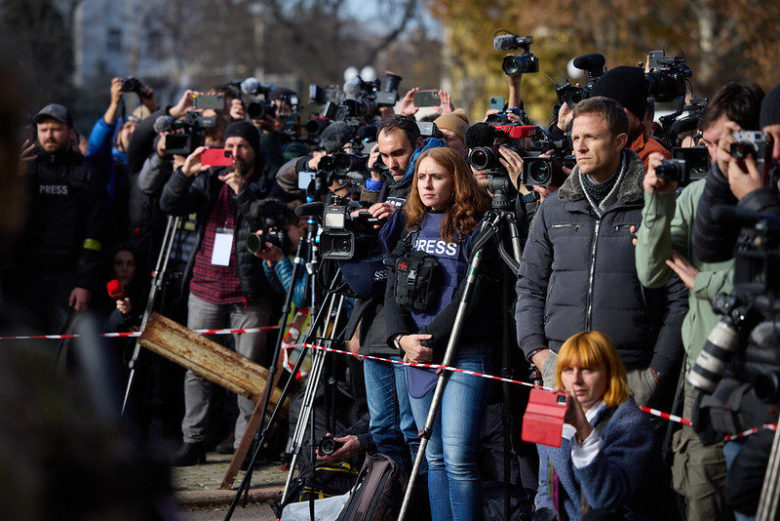
Journalists gather for a flag-raising ceremony held in Kherson Oblast, southern Ukraine (President Of Ukraine / Flickr [CC0 1.0])
Media organizations deliver information about the world to us, and that information can shape public opinion. Therefore, if there is bias in the information they deliver, it can be expected to create bias in public opinion as well. In this analysis, we examined the volume of peace-related reporting by each newspaper and pointed out its scarcity, but this is not intended as criticism to urge newspapers to increase peace-related reporting. That is because promoting peace-related reporting could in turn create a bias toward peace-related stories, which would undermine the objectivity of the media. Even so, to avoid losing that objectivity, it is the minimum a news organization should do to comprehensively cover every development in this war—including moves toward peace. If that is achieved, we, as the public, may at least be able to envision “peace” as an option. Hoping the Ukraine–Russia war moves toward resolution through negotiation, we will continue to watch media outlets’ attitudes toward peace reporting.
※1 Prime Minister Bennett’s term of office: 2021/6/13–2022/6/30.
※2 Prime Minister Johnson’s term of office: 2019/7/24–2022/9/6.
※3 China’s 12 points were as follows: 1) Respect the sovereignty of all countries. 2) Abandon Cold War mentality. 3) Cease hostilities and engage in direct talks promptly. 4) Resume peace talks. 5) Resolve the humanitarian crisis. 6) Protect civilians and prisoners of war. 7) Maintain the safety of nuclear power plants. 8) Oppose the use of nuclear weapons. 9) Facilitate grain exports. 10) Refrain from unilateral sanctions. 11) Maintain the stability of industrial and supply chains. 12) Promote post-conflict reconstruction.
※4 The Patriarch of Moscow is the head of the Russian Orthodox Church. Patriarch Kirill 1, who strongly supports President Putin and has close ties with him, stirred controversy in 2022/9 by expressing support for Russia’s invasion of Ukraine.
※5 In addition, Kissinger argues that if a negotiated resolution cannot be achieved, it will ultimately be necessary to defer to the principle of national self-determination.
※6 The survey used the databases of the three newspapers (Asahi Shimbun: “Asahi Shimbun Cross Search”; Mainichi Shimbun: “Maisaku”; Yomiuri Shimbun: “Yomidas Rekishikan”). For search methods, no categories were specified; both the morning and evening editions of the Tokyo head-office paper and the Tokyo regional editions were targeted. For Asahi Shimbun Cross Search, the target was limited to “Asahi Shimbun” only (excluding the three other publications Asahi Shimbun Digital, AERA, and Weekly Asahi).
Writer: Ikumu Nakamura
Graphics: Virgil Hawkins, Yudai Sekiguchi


ウクライナ・ロシアに対する報道はよく目にするが、こんなに和平や停戦に向けて行動を取ろうとしている国がいることを知らなかった。ウクライナ側に立つのではなく、メディアには「平和」側に立って欲しいとより強く思った。
日本の和平の動きはなかったのですか?
企業として読者の目を引き、利益を上げるというメディアの別の目的も関係しているのではないでしょうか。戦争に関するショッキングな映像・報道の方が読者の目を引き、結果的に戦争への注目度を高められる、という点も日本のメディアが好戦的になる理由だと考えられると思います。
強盗に一方的に奪われて、とりあえずこの辺にしようっていうのを和平っていうならそりゃ飲めないでしょうね。まともな人間なら。