
The rapid widening of global inequality during the COVID-19 pandemic is staggering. World Bank data show that in 2020 alone, as many as 97 million people fell into extreme poverty. Across the global population, it is the first increase in the number of people in extreme poverty since 1998, and the World Bank calls it “an unprecedented increase in history.”
In the same year, the wealth that flowed into the hands of the world’s billionaires (※1) surged, reaching an astonishing about US$4 trillion, according to the World Inequality Lab. This increase in billionaire wealth was also record-breaking, the largest in the 25 years of available records. Even if these two phenomena are not entirely directly connected, there is no doubt that the gap between the global poor and the rich is widening, an extraordinary development for the world economy.
Yet in major media such as the Asahi Shimbun, Mainichi Shimbun, Yomiuri Shimbun, and the Nikkei (hereafter, Nikkei), you will not find such astonishing figures. Moreover, it is hard to say that readers can grasp and understand the problem of global inequality and its background through the information these outlets provide. Why is an issue of such magnitude not being reported? This article explores the question.
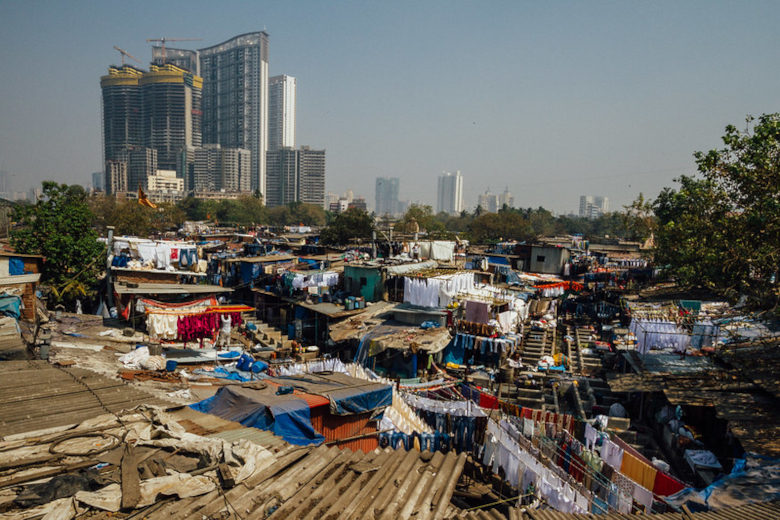
Wealth and poverty. Mumbai, India (Adam Cohn / Flickr [CC BY-NC-ND 2.0])
目次
The current state of inequality
Such a large number of people newly falling into extreme poverty is a global tragedy. However, the figure of 97 million represents only a portion of those who fell into “poverty.” The World Bank defines “extreme poverty” as living on US$1.90 or less per day, and as GNV has covered, surpassing the US$1.90 line does not necessarily mean one has escaped “extreme” poverty. To better capture the reality of poverty, the World Bank also uses additional poverty lines of US$3.20 and US$5.50; under these definitions, the number of people who fell into “poverty” increases by a further 200 million at each line (※2).
The surge in billionaire wealth also requires some explanation. The roughly US$4 trillion that the world’s billionaires amassed in the midst of the pandemic is close to the total public health spending of all countries combined. Many will wonder how many lives could have been saved if even a portion of the wealth billionaire amassed in a single year had been allocated to countries’ COVID-19 countermeasures. Part of this wealth increase is directly tied to COVID-19 responses. Although most funding for vaccine development came from taxpayers in various countries, profits from the vaccines remained solely in the hands of pharmaceutical companies. As a result, nine new billionaires were created in connection with vaccine development. Including the broader pharmaceuticals sector, the number rises to 40.
However, the rapid increase in billionaire wealth cannot be explained by pandemic measures alone. Of course, during lockdowns and other periods of reduced mobility, businesses related to e-commerce and online communications reaped major profits. As the case of U.S.-based e-commerce company Amazon illustrates, in many instances those enormous profits were mainly distributed to executives and shareholders, with very little trickling down to low-wage frontline workers who faced the risk of infection. As seen in past economic crises, policy responses also often favored corporations and the wealthy. Consequently, in countries such as the United States and Japan, government bailouts for large corporations outweighed those for small and medium-sized enterprises and for the public.
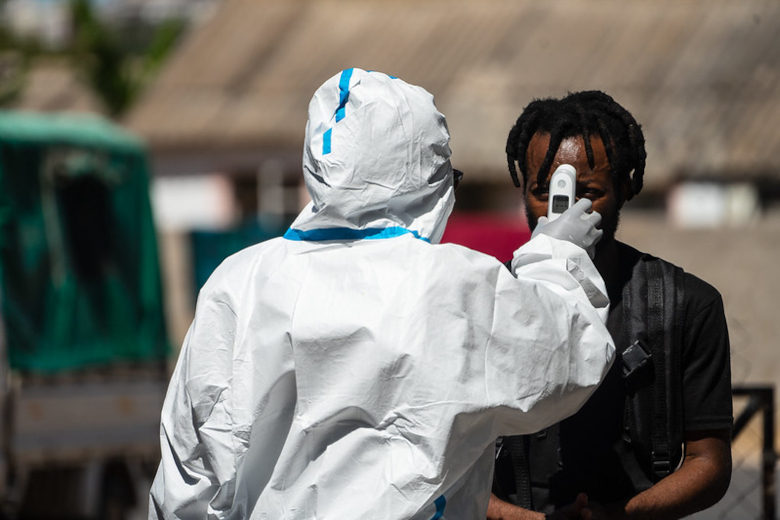
Temperature checks in front of a hospital. Harare, Zimbabwe (International Labour Organization / Flickr [CC BY-NC-ND 2.0])
Yet it can also be said that global inequality had been widening for many years prior to the pandemic. In terms of average GDP, over recent decades per capita GDP in low-income countries had been gradually increasing. However, per capita GDP in high-income countries has grown at a much faster pace. Moreover, even before the pandemic, the world was not on track to achieve the Sustainable Development Goals (SDGs) Goal 1 target of “ending extreme poverty.” Behind this lies an economic system that favors corporations and the wealthy. Related issues include unfair trade, tax avoidance and evasion through tax havens, and massive government subsidies to corporations.
Was global inequality reported?
So how has this reality of global inequality been reported in Japanese media? We examined (※3) the two years since the outbreak of COVID-19 (2020–2021) in the Asahi Shimbun, Mainichi Shimbun, Yomiuri Shimbun, and the business daily Nikkei. The focus was on reporting about the increase in the number of people in extreme poverty, the growth in wealth held by billionaires (or the wealthy, ultra-high-net-worth individuals), and reporting that connected these two issues.
The study revealed that, in every newspaper and from every angle, the rapid rise in global inequality was not treated as important. It is true that the number of articles mentioning “inequality” increased. For example, compared with the two years before the pandemic (2018–2019), in the two years after it began (2020–2021) the number of articles containing that term rose by about 1.5 to 2 times in each paper (※4). However, most of these focused on inequality within Japan, mentioned it only in passing, or referred to it vaguely. In the two years since global inequality began its rapid rise, there were almost no in-depth articles on the state of global inequality, and none of the papers ran editorials on the topic. Reporting on the most extreme manifestations of inequality—the surge in the number of people in extreme poverty and the explosion of billionaire wealth—was also extremely sparse.
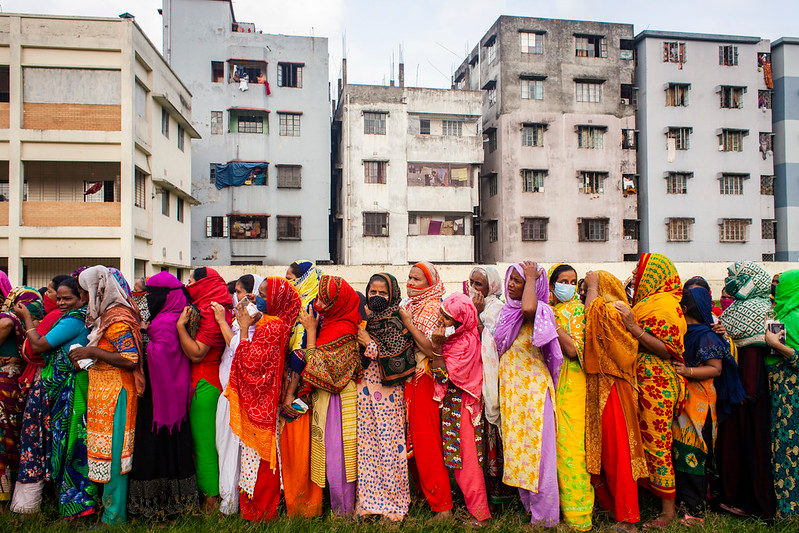
People waiting for aid. Dhaka, Bangladesh (UN Women Asia and the Pacific / Flickr [CC BY-NC-ND 2.0])
First, how was the increase in the number of people in extreme poverty reported? Across the four papers, there were almost no articles centered on this issue, though a few appeared in the early stages of the pandemic. The Asahi Shimbun ran one substantial article in May 2020 and a translated column from the New York Times in October of the same year. In October 2020, the Mainichi Shimbun ran only one brief article from Kyodo News in response to a World Bank announcement that month (※5). The Yomiuri Shimbun, in a short article in May 2020, discussed the issue of extreme poverty in the context of global economic contraction, but had no articles focused on extreme poverty itself. Lastly, the Nikkei ran a short article in April 2020 on rising extreme child poverty, and—like the Yomiuri—had one article that touched on the issue as part of the global economic contraction. In other words, across all four papers, there were just six articles on this issue in that one year (※6).
In 2021, however, none of the papers carried articles like these. Articles in 2020 sometimes included projections of how many people worldwide would fall into extreme poverty, but even those disappeared in 2021. Despite the World Bank revising its projections in January 2021 and releasing in June the actual statistics of how many people had fallen into that state, the Asahi, Mainichi, and Yomiuri never reported these figures. The Nikkei carried one translated article that mentioned rough numbers.
Even when searching across all articles in each paper—not limited to the context of inequality—the phrase “extreme poverty” appeared infrequently. The Nikkei mentioned “extreme poverty” the most, but even there it appeared only 26 times over two years, and half of those (13) were translated articles from the Financial Times. Mentions were even fewer in the Yomiuri (12), Asahi (11), and Mainichi (3). Nor did the term appear more often than before the surge in poverty. We also examined the number of articles mentioning “extreme poverty” in the two years from 2018 to 2019, and found no major difference before and after the pandemic (※7).
What about reporting on the growth in wealth held by billionaires? During the 2020–2021 period examined, references to “billionaires,” “the wealthy,” and “ultra-high-net-worth individuals” far outnumbered references to “extreme poverty.” For example, in the Mainichi Shimbun, one of those terms appeared in 102 articles—more than 30 times as many. Many of these included only a passing reference to describe a specific person. Among more substantive mentions, many appeared in connection with the 2020 U.S. presidential election. For instance, it drew attention that both the Democratic and Republican fields included billionaire candidates. There were also several articles on movements in rich lists at home and abroad, profiles of billionaires, and stories about billionaires taking space trips one after another.
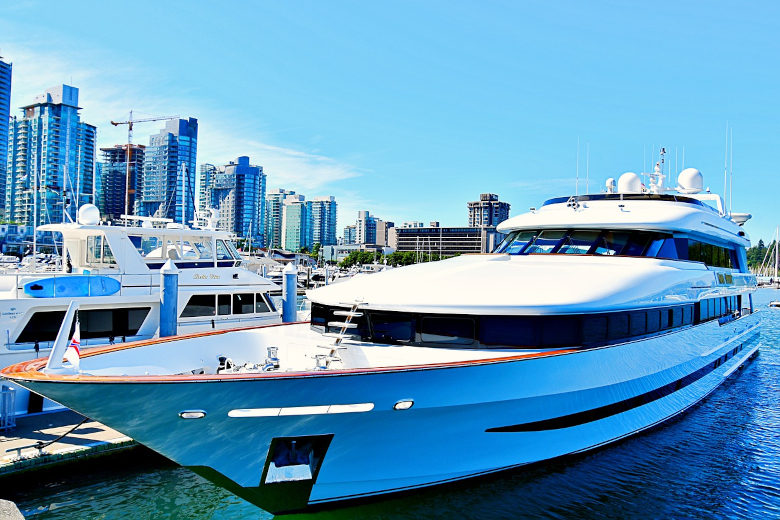
Superyacht (Max Pixel [CC 0 Public Domain])
Few articles, however, critically connected the rise in the number of people in poverty with the increase in wealth held by the rich. Most of those were about the United States (※8), with almost none taking a global perspective. For example, in the Asahi Shimbun, there were 12 articles over the two years examined that linked the respective increases in poverty and wealth during the pandemic, but nine of those were mostly about inequality within the United States. Only one article in the Asahi touched on the global problem, a commentary that briefly contrasted the growth in billionaire wealth with the shortage of COVID-19 vaccines.
Among the four papers in our sample, only the Nikkei mentioned the report released by the World Inequality Lab that presented the striking statistics on billionaire wealth accumulated during the pandemic. About three weeks after the report’s release, the Nikkei ran one article based on its contents. Although the article did not specify how much billionaire wealth had increased, it listed other statistics from the report, such as “in 2021, the top 1% of the world’s ultra-wealthy held 37.8% of global personal wealth, while the bottom 50% held just 2%.” While the article offered little interpretation of those statistics, it did center on the issue.
They can’t claim they didn’t know
As we have seen, Japan’s major news organizations did little to cover the rapid rise in global inequality and rarely mentioned the striking statistics published by the World Bank and the World Inequality Lab that demonstrate this reality.
However, it is not as if news organizations were unaware of these statistics. As noted above, in 2020 each of the four papers—albeit sparsely—ran articles citing World Bank projections of how many people were likely to fall into extreme poverty. In other words, they were aware of the World Bank’s statistics. In fact, the World Bank first released this projection in April 2020, then revised it in June and October. As noted above, in June 2021 the World Bank released the definitive figure of 97 million for the number of people who had fallen into extreme poverty. Not one of the papers reported this crucial statistic. Even if they had not directly followed the World Bank’s releases, it is unlikely they were entirely unaware, as the figures were reported by other international outlets, such as CNN and the World Economic Forum.
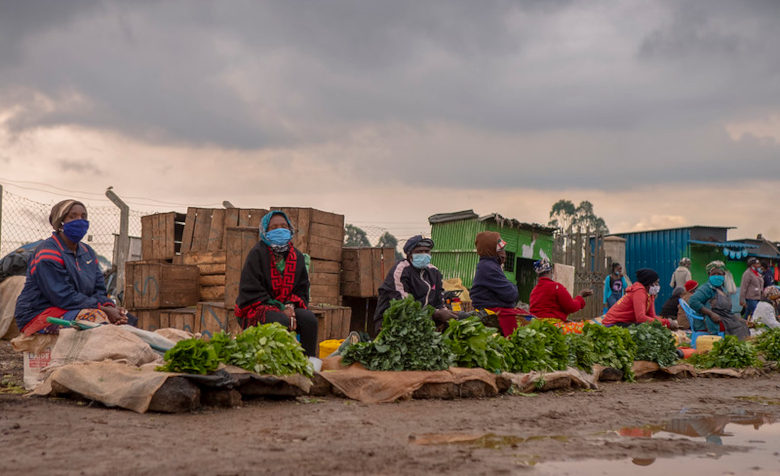
People selling vegetables by the roadside. Kenya (World Bank / Flickr [CC BY-NC-ND 2.0])
The same can be said about the concentration of wealth among billionaires. The fact that nine new billionaires emerged through the development of COVID-19 vaccines was covered by Reuters and Newsweek. The emergence of 40 new billionaires in the broader pharmaceuticals-related sector was prominently reported by Forbes, and was also noted in its Japanese edition.
Regarding the report by the World Inequality Lab that presented detailed statistics on global inequality during the pandemic, only the Nikkei among the outlets surveyed covered it. However, since the Asahi Shimbun used data from that report in an article about inequality in China, it is fair to say that at least the Asahi was aware of the institution and its report. The Mainichi and Yomiuri have never mentioned the World Inequality Lab, but given that this new report on inequality was widely covered by outlets such as the Wall Street Journal and the Guardian, it is hard to believe they did not have access to this information.
Furthermore, the UN Secretary-General has repeatedly sounded the alarm in strong terms about the rapid growth of poverty and inequality. For example, in October 2021 he said that the worsening poverty situation amid the pandemic was “a moral indictment of our times,” and that “global solidarity is missing in action.” In January 2022, he told the UN General Assembly that “the global financial system is morally bankrupt—favoring the rich and punishing the poor” (statement). He also proposed a wealth tax on those who profited during the pandemic.
In this way, from international organizations like the World Bank and the UN Secretariat to research institutions and major foreign media, a great deal of information—including concrete statistics—has been released about the rapid widening of inequality. Japan’s news organizations had ample opportunity to learn about this issue and recognize its gravity.
Delivering newspapers. Kobe, Japan (halfrain / Flickr [CC BY-SA 2.0])
Why isn’t it being reported?
So why have Japanese media, despite knowing about this issue, not treated it as important? Is global inequality intrinsically of low news value as an event or phenomenon? It would be hard to argue that this phenomenon lacks newsworthiness. Not only is it an extraordinary issue enveloping the entire world, it also involves huge-scale developments and the release of shocking statistics—clearly newsworthy in terms of magnitude and novelty.
It is not that access was physically or legally blocked, nor were there cost constraints. The World Bank (Washington, DC) and the World Inequality Lab (Paris) are located in cities where each paper already has correspondents. While on-the-ground reporting where extreme poverty surged or interviews with billionaires would of course be desirable, it should have been possible to produce articles based solely on the reports released by these institutions. Perhaps the siloed beat structure within newsrooms played a role—that is, correspondents in Paris focus primarily on France, those in Washington, DC on U.S. affairs, and reporting on developments in the host country is prioritized. Still, it is hard to believe this alone explains the lack of reporting on the astonishing expansion of global inequality and extreme poverty.
Is it that readers and media professionals themselves lack interest in this issue? It is true that few subscribers to Japanese newspapers are in extreme poverty, and in the newsroom some may question how much empathy readers can have for people in poverty far away, and thus the value of reporting on it. And because many reporters and editors in major media occupy positions commonly considered “elite,” they may be unable to report on extreme poverty from the standpoint of those directly affected. Yet, given the media’s coverage of rich lists and billionaires’ space travel, there is certainly interest in the ultra-wealthy. Humans also possess a sense of justice. The very fact of wealth being transferred from the poor to the rich can, on justice grounds, provoke concern and attract reader interest. Even from the perspective of “readers aren’t interested in global inequality,” that is not an adequate explanation for the failure to report on its rapid widening.
Perhaps the relationship with those in power is more persuasive. Numerous studies of the relationship between the press and politics find that, even in countries where press freedom is supposed to be guaranteed, those in power wield great influence over what and how the media cover issues. The tendency for Japanese media to show interest when the U.S. President or the Japanese Prime Minister expresses concern about a situation can be seen in various contexts. As our investigation also found, Japanese media’s focus on inequality within the United States was triggered by U.S. politicians’ attention to the issue. When reporting prioritizes power-holders as sources who can drive political and economic outcomes, issues prioritized by the powerful end up being covered preferentially over the problems actually occurring in the world and society. It is hard to see what incentive political spheres in “winners” of the global economy, such as the U.S. and Japan, would have to highlight global inequality. By contrast, while the UN Secretary-General is in a position that should attract attention, he has a role of speaking for the disadvantaged—the global “losers,” so to speak. Yet perhaps because he holds little real power or economic clout, the inequality issues he highlights receive little attention.
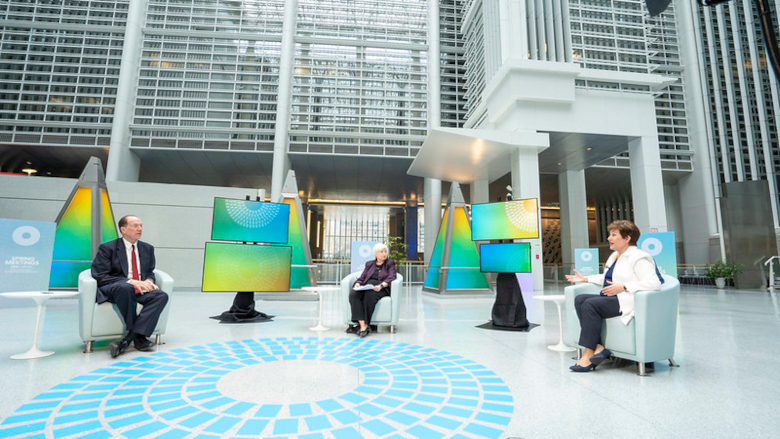
Representatives of the World Bank, IMF, and the U.S. government discussing economic recovery from the pandemic (World Bank / Flickr [CC BY-NC-ND 2.0])
Relationships between media organizations and their owners and sponsors—or with businesses and the wealthy in general—also influence what gets covered. Large newspaper companies are, after all, major corporations—profit-making entities that operate to earn revenue. Subscription fees from readers cover part of their income, but advertisers are also a major source, and they need deep-pocketed corporate sponsors. Generally speaking, companies aim to boost profits by keeping labor and tax costs down—attitudes that can harm workers and ordinary citizens. In that sense, when influential companies whose interests may conflict with those of the poor are weighed against the poor, the more a newspaper speaks for the poor, the more likely it is to alienate potential corporate sponsors. On the global stage, there is also a tendency for nationalism to spur support for companies from one’s own country.
Within this context, at the level of individual journalists, there is a tendency—whether to get hired by major newspapers, to advance within the organization, or due to corporate cultures and values shaped by such interests—to adopt behaviors aligned with them. Moreover, a survey of U.S. news organizations found that one in three reporters and editors admitted to self-censorship for their company’s benefit or to secure their job or promotion.
Through bodies that connect politics, business, and the media—such as Keidanren, advertising agencies like Dentsu, PR consulting firms, and think tanks—an information environment and “common sense” favorable to corporations and the wealthy is constructed. For example, as a major domestic think tank that analyzes international affairs and is frequently cited by the media, the Japan Institute of International Affairs (JIIA) appears, judging from the topics and research activities listed on its website, not to be truly treating global inequality and poverty as “international issues.”
Amid such pervasive “common sense” across society, newsroom decisions not to prioritize the extraordinary widening of global inequality may well be made unconsciously. As a result, there is no need for owners or sponsors to suppress reporting, nor for government officials to exert pressure. Within news organizations, there may be neither those who point out the paucity of inequality reporting nor those who question it.
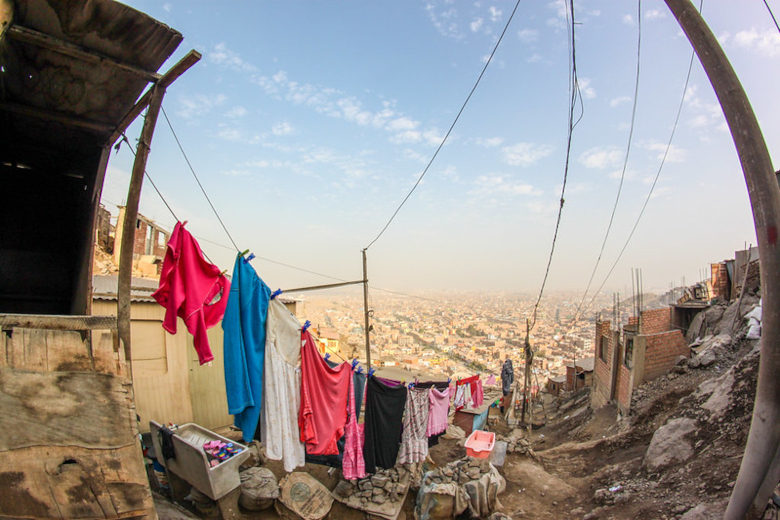
On the hill. Lima, Peru (Geraint Rowland / Flickr [CC BY-NC 2.0])
Toward media that can question “common sense”?
The media’s tendency to downplay global poverty and inequality did not begin with the pandemic; it has persisted for many years. GNV has pointed out the paucity of reporting on low-income countries in many articles over the years. However, the contrast between the scale of the widening inequality seen during the pandemic and the scant coverage of it is far too great.
Given the current state of affairs, it is hard to say that the media are fulfilling either their “mirror” role of conveying reality as it is, or their watchdog role of holding power to account. Far from questioning the organizations and individuals in whom power and wealth are concentrated, they are leaning on and aligning with them.
As extreme poverty spreads, what role can the media play if they cannot treat as important a crisis that threatens so many lives? Media power is indispensable to breaking this vicious cycle. We can only hope that, article by article, the situation will begin to change.
※1 Persons holding assets of US$1 billion or more.
※2 While GNV uses the ethical poverty line (US$7.40 per day) rather than the World Bank’s extreme poverty line (US$1.90 per day), due to insufficient data for the former, we use the World Bank’s extreme poverty line here. For details, see GNV’s article “How should we interpret the state of global poverty?”
※3 The media and databases used in this article are the Asahi Shimbun (Kikuzo II Visual), the Mainichi Shimbun (Mainichi Shimbun Maisaku), the Yomiuri Shimbun (Yomidas Rekishikan) databases, and Nikkei Online. The investigation centered on the search phrases “extreme poverty” and “billionaires OR wealthy OR ultra-high-net-worth individuals.” Period: January 1, 2020 to December 31, 2021.
※4 Using the keywords “inequality,” “economy,” and “world” in each paper. The number of articles in the two-year periods 2018–2019 and 2020–2021 (two years before and after the onset of the pandemic) were: Asahi Shimbun 315/510, Mainichi Shimbun 204/291, Yomiuri Shimbun 222/294, Nikkei 640/1,296.
※5 “World Bank: ‘Extreme poor’ to exceed 700 million in 2020—World Bank estimate,” published October 8, 2020. (Print edition only; not published on the Mainichi’s website.)
※6 In addition, there was another article in the Asahi Shimbun (October 18, 2020) that used the term “poverty line” instead of “extreme poverty” and cited the World Bank’s extreme poverty measure.
※7 Using the same conditions as ※3, searching for “extreme poverty” from January 1, 2018 to December 31, 2019 yielded 11 articles in the Asahi Shimbun, 4 in the Mainichi Shimbun, 7 in the Yomiuri Shimbun, and 14 in the Nikkei.
※8 Among these, many articles focused not on the impacts of COVID-19 but on critiques by U.S. politicians of the domestic tax system as part of the U.S. presidential election campaign.
Writer: Virgil Hawkins



「客観的」な報道の実現がいかに困難かを知ることができる記事でした。当事者意識が持ちにくい事柄に対して関心を寄せない読者や、様々な団体によって現在の偏った報道が成立しているという背景を詳しく学びました。
記事興味深く拝読しました。よく「読者のニーズに合わないから」と国際報道を敬遠する風潮が大手メディアに見られますがら興味を喚起するのもまたメディアの役目ではないでしょうか。潜在的なニーズを掘り起こすのも企業としてのあり方だと思っています。そして1つのトピックを追い続けるのは大変でしょうが、1度報道したものに関しては責任を持って追いかけてほしいものです。