
On 6/28/2020, a singer named Hachalu Hundessa was killed in Ethiopia. Outraged fans of Hachalu have staged protests across the country, and clashes with police and other groups have already resulted in more than 230 confirmed deaths. Why has this become such a major upheaval? Hachalu was Ethiopian and also Oromo. Ethiopia is a federal state composed of more than 80 ethnic groups, and while the Oromo are not an absolute majority, they are the largest ethnic group in the country. The Oromo, along with other minorities, have a history of being discriminated against, and there is also friction among minority groups. Hachalu was a representative singer of the Oromo and wrote songs that decried government discrimination. The scale of these protests speaks to the severity of discrimination against Oromo people in Ethiopia.
As such, ethnic issues frequently arise around the world in relation to political problems and conflicts. But what exactly is an “ethnic group”? Let us consider this question, including its relationship to the state.
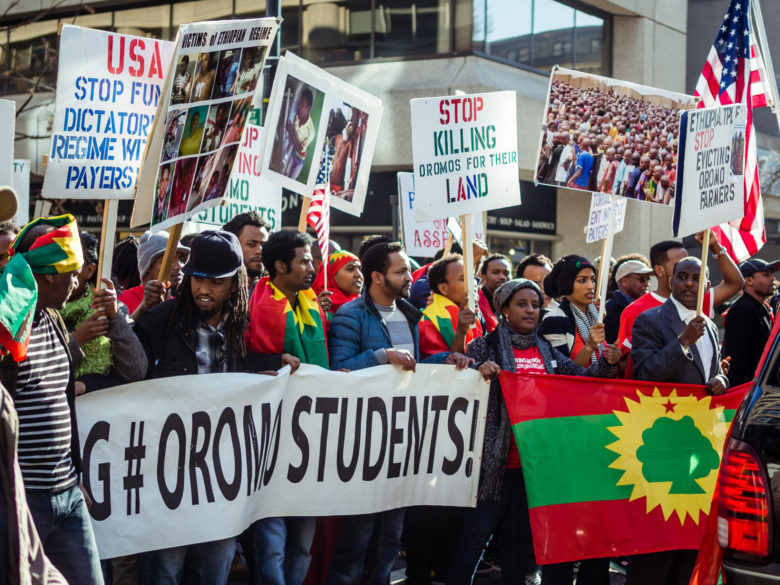
Oromo people demonstrating (2015) (Photo: ctj71081/Flickr [CC BY-NC 2.0])
目次
What is an ethnic group?
First, let’s review the definition of an ethnic group. In general, it is often defined as a group that shares a common culture. However, there is no broad consensus regarding the definition of ethnicity. Here are a few interpretations.
In one interpretation, it is defined as “a group that shares common customs, traditions, historical experiences, and in some cases geographic residence.” In this view, natal, symbolic, and cultural factors influence people’s sense of ethnicity. There are also various views about the differences between race and ethnicity. For example, according to one interpretation, race reflects how one is perceived by others and tends to be something one cannot choose for oneself. By contrast, ethnicity can be chosen and acquired by the individual, and it is even possible to belong to multiple ethnic groups. “Acquired” here means that, for example, by learning a language and customs, one can come to belong to the ethnic group one desires. That said, both “race” and “ethnicity” are constructed within societies and cannot be distinguished or defined genetically/biologically. Also, considering ethnicity through the lens of otherness, people’s sense of ethnicity is shaped not only by their own awareness but also by whether they are accepted by those within the group (in-group members) or recognized as those outside it (out-group members).
Having looked at several interpretations of what ethnicity is, might we also call groups of people who are not necessarily regarded as “ethnic groups” by that name? For example, Deaf people. There is a prevailing view that, in the sense that they share culture and language through sign language, they can be considered an ethnic group. Ethnicity is highly ambiguous and changes according to circumstances.
Boys gazing at the Taj Mahal (Photo: Adam Jones/Flickr [CC BY-SA 2.0] )
The formation of ethnicity and the state
From here, we consider the relationship between the emergence of ethnic groups and the state. First, how do ethnic groups come to be delineated? Since the time humans lived as hunter-gatherers, people have lived together in family, clan, and village units, coming to share languages and customs. This forms the basis of ethnic formation. As such groups expand, the shared culture and language change, or new culture and language are introduced through interaction with other groups. Therefore, one cannot draw clear boundaries between one ethnic group and another; rather, they change gradually like a gradient. We can observe such changes worldwide. Even if some lines can be drawn to some extent, in reality culture and language become intricately interwoven through migration, marriage, trade, and so on. Despite this, there is a force that seeks to draw clear lines. That force is the state.
Ethnic groups do not necessarily expand naturally. A leader of a group may seek great wealth and power and use force to expand their sphere of influence. As systems of rule are constructed and expansion continues, lines are drawn as points of settlement with other groups. Such actions have been repeated across the world and eventually led to the formation of states. However, people forcibly incorporated into a sphere of rule originally had different cultures and languages and a sense of belonging to other groups, so they would not easily accept new systems of rule such as taxation and conscription. Nor is it feasible to indefinitely suppress such resistance by force. Therefore, many modern states adopt assimilation policies aimed at changing people under their rule at the most fundamental level. The line “We have made Italy; now we must make Italians,” from the time of Italian unification, captures this.
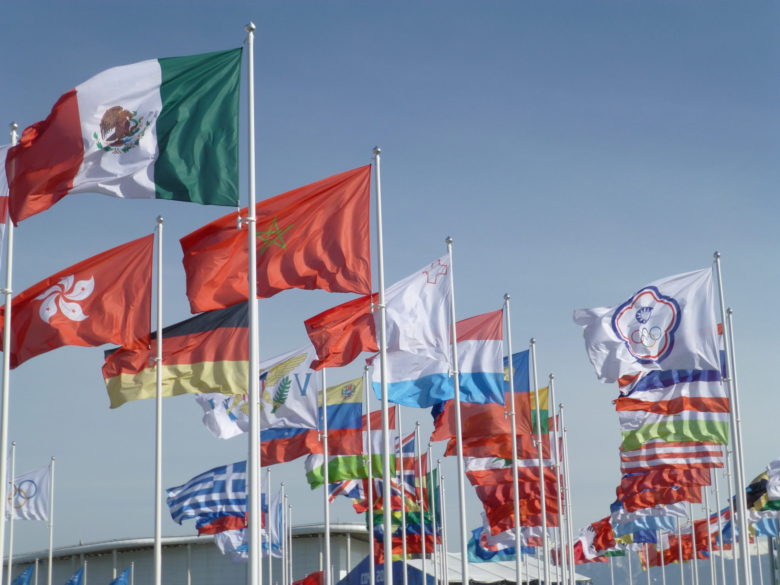
National flags of various countries flying at the Olympics (Photo: american rugbier/Flickr [CC BY-SA 2.0] )
How, then, do states pursue assimilation? When the majority ethnic group holds power, policies are adopted that dilute the language and culture of minority groups while inducing the adoption of the majority’s language and culture. Specifically, states may pursue forced assimilation and use education, media, and sports to cultivate a sense of belonging to the state that serves the interests of the rulers. Under forced assimilation, policies have been implemented whereby children from groups deemed heretical are separated from their parents and raised to imprint the national culture—many countries have in fact done this. There are also methods that impose a sense of national identity through measures such as forced name changes. When a state oversees education, it can foster shared ideas through curricula that promote patriotism across the country and try to instill a shared ethnic understanding. In language education, the use of certain languages may be prohibited, and people compelled to learn the language regarded as the most “correct” in the country—the so-called standard language. Some countries change their official language(s) for political reasons. Education has served as a means for forced assimilation and its maintenance. Meanwhile, the media can influence people under state rule to a degree by reporting content centered on one’s own country, promoting patriotism, or failing to cover minorities and their circumstances. Sports are also often used as tools to generate a sense of national unity by focusing on one’s own athletes and teams and extolling their achievements. In this way, by cultivating patriotism and strengthening a sense of belonging, identification with an ethnic group is replaced with identification with the state, and many states aim for a form in which ethnicity and state can be as closely aligned as possible. This stabilizes and fixes the state under central power.
However, there are also countries that, at the time of their founding, recognized the presence of multiple ethnic groups and adopted federalism to guarantee autonomy for each (for example, Switzerland and Ethiopia). In such countries, a single official language is not established; the languages of each ethnic group are also used as official languages. Moreover, even where a “national language” is established, many countries pursue a degree of assimilation while preserving original languages. For example, most African countries were once colonies, but after independence many of them designated the language of the former colonial power as an official or common language while also keeping multiple precolonial languages as official languages.
Furthermore, assimilation policies alone cannot explain the relationship between ethnicity and the state. Not all modern states are based on communities formed by a local majority ethnic group. Even before the modern state was consolidated, the actions of historically powerful states and companies created relationships of domination, and there were large-scale movements of people—these too have influenced the relationship between ethnicity and the state. Examples of large-scale movement include slavery and colonial policies. From the 16th to the 19th centuries, enslaved people were forcibly taken from the African continent to the Americas; they were coerced with violence but were not assimilated with European settlers or their descendants at the time. Indigenous peoples in the Americas also suffered such persecution. Under colonial policies, there was much migration from metropoles to colonies and, conversely, from colonies to metropoles. There was also migration between colonies, and these movements have had a major impact on the formation of modern states. For example, under British rule in Fiji, intercolonial migration was undertaken to address labor shortages on plantations, bringing many people from British-ruled India. As a result, the number of migrants came to exceed that of the indigenous population.
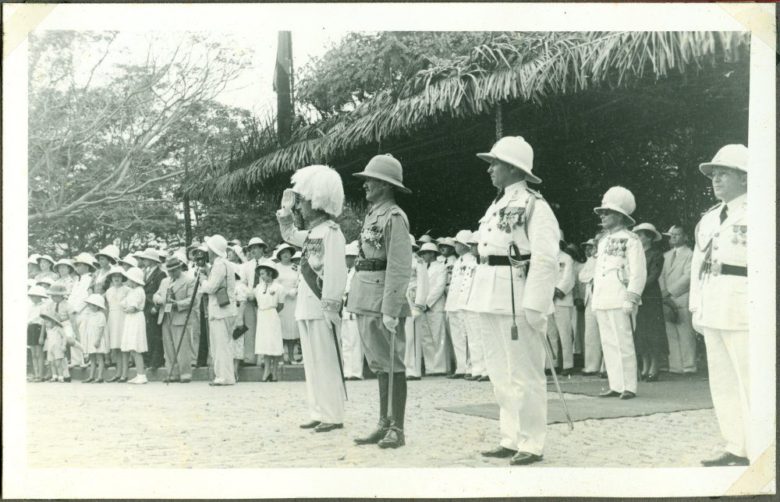
What is now the Congo under colonial rule (Photo: Liberas/Flickr [public domain])
The myth of the “homogeneous nation-state”
As we have seen, ethnicity and the state are intertwined in complex ways. Even if long-standing assimilation policies make a country appear to be a homogeneous nation-state, there is no country where ethnicity and state are fully congruent. Because the modern state has been shaped not only by evolving “interethnic” relations but also by force, war, political maneuvering, and compromise, ethnicity cannot be fully encompassed by the state. In every country—whether visible or not—multiple ethnic groups coexist. Today, too, the mismatch between ethnicity and the state and the power relations that accompany it generate friction that leads to conflict and discrimination. Here are a few brief examples where ethnicity and the state are in a complex relationship.
First, there are ethnic groups that do not form a majority within a single state and that exist across multiple countries. For example, Kurds live across Turkey, Iraq, Syria, and Iran; they are minorities in each country and face repression. The Tuareg live mainly across several countries such as Mali, Niger, and Burkina Faso, moving across them; traditionally nomadic, they sometimes cross borders. The Inuit are a people who live mainly in the ice- and snow-covered regions of Canada, the United States, and Greenland. Palestinians, as a result of the establishment of Israel and the Arab–Israeli wars, have not achieved an independent nation-state; besides the areas occupied by Israel known as the Palestinian territories, Palestinian refugees live mainly in neighboring Jordan, Syria, and elsewhere.
Next are cases of coexistence between majority and minority ethnic groups within a single state. This situation, to varying degrees, is seen in most countries, and in particular it is far from uncommon for minority ethnic groups to suffer discrimination and repression. For example, in China, Nigeria, Indonesia, Myanmar, Chile, and Argentina, minority groups have been repressed by their governments. In China’s Xinjiang Uyghur Autonomous Region, some seek separation and independence from China, but the Chinese government labels this extremism and, on the basis of ethnicity and faith (many Uyghurs are Muslim), detains people for “re-education.” In Biafra, Nigeria, citing long-term discrimination and repression, the Igbo declared Biafran independence, but the independence war ended in defeat, and protests continue today. In West Papua, Indonesia, an independence movement continues due to disparities with other parts of Indonesia and discrimination against indigenous peoples. The Rohingya in Myanmar suffer discrimination by the government, and currently more than 700,000 have fled as refugees. The Mapuche are an indigenous people of Chile and Argentina. After Spanish colonial rule and the founding of these states, they came to be ruled separately, and in both countries they have faced discriminatory treatment such as the expropriation of ancestral lands by the government. There are countless other cases around the world.
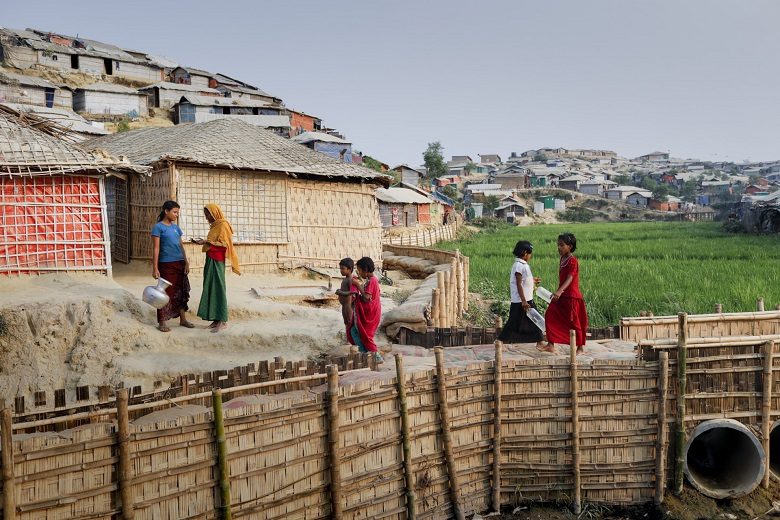
Rohingya people living in a refugee camp (Photo: EU Civil Protection and Humanitarian Aid/Flickr [CC BY-NC-ND 2.0])
Next are cases where people share a similar sense of ethnic belonging but the nation has been divided by war or political exigency, resulting in ethnic division. Examples include Germany; South and North Korea; and Somalia and Somaliland. In 1961 during the Cold War, the Berlin Wall was built due to the interests of the Eastern and Western blocs, and Germany was divided into East and West until the wall fell in 1989. On the Korean Peninsula, South and North Korea were divided by the Korean War, which broke out in the wake of World War II and the Cold War; a ceasefire persists to this day. Somalia and Somaliland were established as a single country after independence, but when the Somali government collapsed in 1991, Somaliland declared independence. Although not recognized as a state, it functions as a de facto independent country.
The last example is of countries that achieved independence after ethnic identity strengthened to the point that more people felt a stronger sense of belonging to their ethnicity than to the state. For example, the former Yugoslavia was home to many ethnic groups, but in the 1990s it broke up into several countries through conflicts (※1). In Sudan, the North and South differed in religion and ethnic background, and the central government in the North enforced assimilation policies on people in the South, provoking resistance that escalated into armed conflict. As a result, South Sudan gained independence in 2011.
What is “ethnicity”?
We have looked at ethnicity with a focus on its relationship to the state, but these are only a few examples. The mismatch between “ethnicity” and “state” around the world is evident, yet members of an “ethnic group” cannot be lumped together. Individuals within a group recognized as the same “ethnicity” do not all feel the same level of belonging. Indeed, people may not even share a common understanding of the definition or significance of the “ethnicity” to which they belong. Some people regarded by others as belonging to a given group may not feel a sense of belonging; others may feel they belong to multiple ethnicities. For some, identification with religion, occupation, gender, and so on may be stronger than identification with an ethnicity or state.
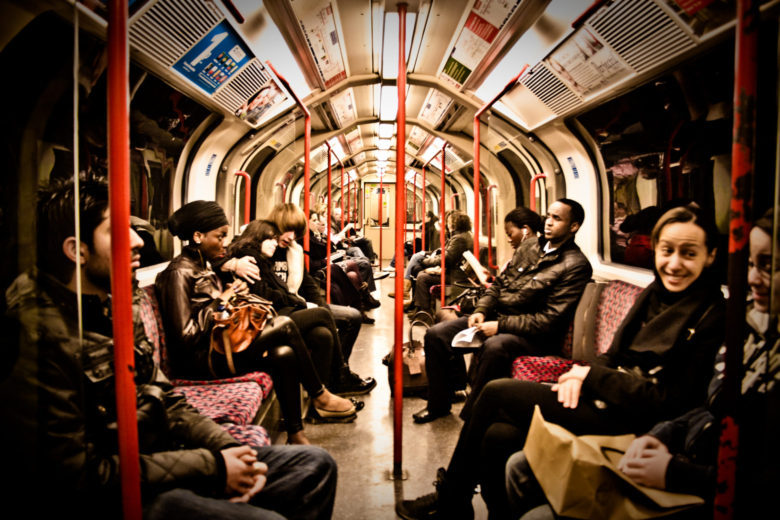
People riding the subway (Photo: Garry Knight/Flickr [CC BY 2,0] )
As the term “Imagined Communities” (※2) suggests, the larger a group becomes, the more the community’s very existence is based on people’s “imagining” rather than on actual interpersonal ties. An ethnicity is only a group of people who believe they are members of that ethnicity. Whether an individual identifies with a particular ethnicity is a matter of personal choice, and one does not have to adhere to that choice for life. It may change due to life circumstances such as marriage, migration, or changes in belief, and one may come to feel multiple identities. Labels like “ethnicity” and “nationality” are commonly used, but recognizing that these labels have limits and being mindful of the harm they can cause may be wise when using them.
As globalization advances and the movement and migration of people become frequent, we encourage you to rethink your sense of ethnicity and identity.
※1 Slovenia, Croatia, Bosnia and Herzegovina, Serbia, Montenegro, North Macedonia
※2 “Imagined Communities”: by Benedict Anderson
Writer: Minami Ono







「国家」「民族」ということばの意味について改めて考えさせられる素敵な記事でした。過去の歴史を振り返り、いまどうなっているのかという点で分かりやすく解説されていて読みやすかったです!
「同化」の手法は言語のイメージが強く、スポーツもその手法の一つとして捉えるのが、自分にとっては新しい考え方でした。
自分があまり理解できていない中で、何気なく言葉を使ってしまうことがあることに気づくことができました。
民族と国家が複雑な関係を持つ事例の分類がとても分かりやすかった。
日本を単一民族国家だと考えている人は多いだろうし難民も身近でない日本では、民族という概念やそこから派生する問題はすごく遠い世界に感じてる人が多いのだろうと思う。
日本は単一民族国家であるという認識をしている人が多い中で、政治的にではなく、沖縄や北海道の人々はどのように思っているのか、単一国家として日本の本州の文化に同化を強制されたという過去がある中で、日本本州の人々とどのような関係を築いているのかということが気になりました。
民族グループと国家が一致することがないということが、とても分かりやすく書かれていて民族に対する理解が深まりました。よく考えれば、日本も複数の民族が存在しているし、私ももう一度民族について考える必要があると思いました!
民族差別をなくすために、誰がどの民族かについて話さないという政策を取った国があると思うのですが、それは民族としてのアイデンティティを低下させてしまうのではないでしょうか。難しかったとしても、民族を認め合った上で平等を目指すという努力をすべきではないのでしょうか。
「民族」とか「単一国家」という言葉はよく耳にするけれど、様々な解釈があることは知りませんでした。この記事を読んで、もっと詳しく知りたいと思いました。