
【The following is a report based on a GNV event held in Osaka on November 27, 2025, as part of the “Thinking about the Crisis of Journalism” initiative—a loose gathering of journalists, researchers, and citizens concerned about the current state of journalism. The event took the form of a “proposal-based workshop,” in which a speaker presents solutions to concrete problems facing journalism and participants discuss them. The proposer was Virgil Hawkins of Osaka University.】
The volume of international news coverage by Japanese news organizations is relatively small. Despite globalization increasing the importance of events abroad, such coverage has in fact decreased. Moreover, geographically speaking, international reporting is heavily skewed toward a very limited number of countries. As a result, audiences only get fragmentary glimpses of a small part of the world, leaving many major events and serious issues underreported or not reported at all.
The decline in volume and the regional imbalance in international coverage are also reflected in the decrease and placement of foreign correspondents. The financial constraints news organizations have faced in recent years are expected to become even more severe, and the number of foreign correspondents each outlet can maintain will likely have to be reduced further.
In light of this situation, this report proposes that Japanese news organizations consider sharing their overseas bureaus and the international reporting materials gathered there with other outlets.

Journalists at work (Photo: wellphoto / Shutterstock.com)
目次
Challenges
GNV is conducting two long-term studies measuring the total amount of international coverage in major Japanese newspapers. The first study targets the Asahi Shimbun from 1989 to 2018, and the second targets the Yomiuri Shimbun from 2000 to 2024. Both studies show a significant decline in the number of international news articles. The drop is concentrated mainly from the mid-2000s to the mid-2010s. The decline appears to have halted since then and the volume has stabilized, but it is unclear how long this level can be maintained. Given the financial situations of the newspapers in question, it is likely that the volume of international coverage will continue to decrease.
GNV has also conducted extensive research on how Japanese news organizations cover different regions of the world. For example, in 2025 it published a 10-year study of the volume of international coverage in three newspapers: the Asahi Shimbun, the Mainichi Shimbun, and the Yomiuri Shimbun. The study found that coverage is biased toward a very limited set of countries, mainly the so-called Global North, with relatively little attention paid to countries in the Global South. For instance, these papers devoted 25% of all international coverage to a single country, the United States. By contrast, all of Latin America accounted for only 2.2%, and the entire African continent for just 2.0%.
The decline in international reporting is closely related to the decreasing number of foreign correspondents deployed by Japanese news organizations. According to an analysis of data collected by the Japan Newspaper Publishers and Editors Association (NSK), over the past 30 years (1994–2024), the total number of foreign correspondents employed by 68 newspapers, broadcasters, and news agencies fell by 16%, from 625 to 524.
The regional imbalance in coverage is also reflected in the placement of foreign correspondents. As of 2024, Japanese outlets have only four foreign correspondents across all of sub-Saharan Africa—one tenth the number assigned to the United Kingdom alone. There were five in 1994. In Latin America there are six in total, down from 12 in 1994. In the United States alone there are 158 foreign correspondents, a 13% decrease compared to 30 years ago.
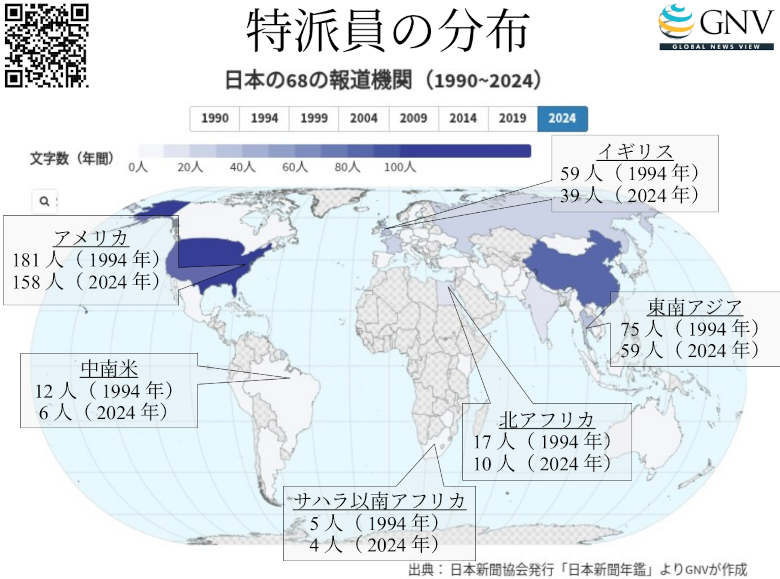
(From the workshop slides)
These worrying trends point to the fragility of the overall newsgathering infrastructure among Japanese news organizations, and reveal that in wide swaths of the world there is almost no reporting presence. Given expectations that revenues will continue to decline, this situation is likely to deteriorate further.
Proposal
The following proposal aims to address some of the issues described above.
Proposal: News organizations share resources and jointly establish overseas bureaus
This would involve news organizations that normally compete with each other sharing resources in specific regions to expand their international reporting capacity without incurring additional costs. For example, if two outlets collaborate, both can report from two regions while paying the costs for only one base. Ideally, activities would expand in regions that currently receive little coverage. In practice, one outlet would maintain an existing bureau while the other adds a new one. The outlets would divide responsibility by area and share the material they gather—reporting, interviews, video and still images—with each other.
This proposal could be trialed in regions where a newspaper stations a single foreign correspondent in one bureau to cover multiple countries or even an entire continent. For instance, both the Yomiuri Shimbun and the Asahi Shimbun currently have one correspondent in Johannesburg, South Africa, responsible for all of sub-Saharan Africa. If the two papers shared resources in this region, one correspondent could remain in Johannesburg while the other established a new bureau in, say, Kenya or Nigeria. This would greatly reduce the number of countries each correspondent has to cover and increase each outlet’s reporting access, without a major rise in costs. Latin America is also a suitable candidate for such an initiative, as the region’s correspondents are concentrated largely in Brazil.
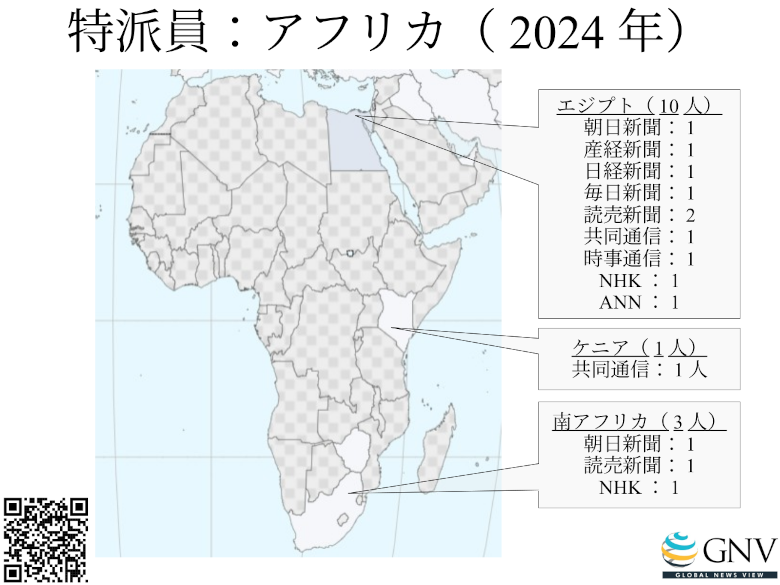
(From the workshop slides)
Such an arrangement may appear similar to the work of wire services, especially if multiple outlets participate in information sharing. However, the purpose here is not to complement or replace wire services, which gather the basic facts of events quickly and distribute them to other media. Under this proposal, newspapers and broadcasters would continue to produce detailed stories with context and analysis, and make them available to partner organizations.
A potential drawback is that the distinctiveness of each outlet may diminish, which could in turn reduce the overall diversity of coverage. In other words, what one newspaper reports about a given region would be based on the same sources as another newspaper’s reporting; the editing might differ, but the source of the content would be the same. Outlets that consider a unique perspective and a “brand” of coverage in a region essential will be cautious about such cooperation. In regions deemed strategically important, this type of collaboration may be unsuitable. However, in regions that are undercovered to begin with—such as Africa and Latin America—the loss of diversity may be an acceptable price to pay for maintaining and expanding the availability of international news.
This proposal is a relatively modest interim measure that can be implemented under financial constraints. As budgets shrink further and the number of foreign correspondents worldwide dwindles, it may become one of the few ways to maintain an original newsgathering presence in some regions.
Examples
Cooperation among news organizations is by no means a new concept. Below are a few concise examples, focusing mainly on reporting outside the outlets’ home countries.
Investigative journalism is an area where collaboration among outlets is common, primarily because investigative reporting requires far more resources than routine news coverage. In some cases, the sheer volume of data makes it difficult for a single outlet to analyze and interpret it effectively, as with the joint projects on the Panama Papers (coverage began in 2016) and the Pandora Papers (began in 2021). These investigations were conducted through the International Consortium of Investigative Journalists (ICIJ) by numerous outlets worldwide. Investigative projects may also require local knowledge or specialized skills, which encourages collaboration. For example, the Pegasus Project, which investigated the global use of the Pegasus spyware developed by the Israeli company NSO Group, involved many outlets along with NGOs and university research institutes.

Latin American journalists discussing collaboration on the Panama Papers, Colombia (Photo: Fundacion Gabo / Flickr [CC BY-SA 2.0] )
However, unlike the proposal above, many such investigative collaborations are among outlets that are not in direct competition. Even so, there are cases where competing outlets collaborate. A notable example is “The Invading Sea,” a joint project by multiple outlets in the U.S. state of Florida on climate change. In this project, outlets that usually compete on other issues share content on this specific theme. There are also several examples of competing television stations temporarily sharing reporters for specific programs.
A broader example of sharing international coverage is the Leading European Newspaper Alliance (LENA), a cooperative arrangement among eight major European newspapers. Although this is not collaboration among direct competitors, it shares some features with the present proposal in terms of exchanging international content. Each outlet maintains its own bureaus while sharing part of the content gathered there within the alliance. For example, the Spanish newspaper El País has a strong bureau network in Latin America due to historical and linguistic ties, and provides content to other members of the alliance that they would be unable to gather on their own.
Comments from the workshop
Several workshop participants offered opinions on this proposal and suggested other ways to maintain and expand international newsgathering.
It was noted that there are already precedents where competing television stations share news content during domestic disasters and emergencies. In international reporting as well, there are examples where affiliated TV networks jointly operate overseas bureaus and share the content gathered. The challenge is whether competing outlets can build a similar mechanism.
Some participants argued that Japanese outlets should consider mechanisms like the Leading European Newspaper Alliance (LENA). By collaborating with overseas outlets rather than domestic competitors, they can avoid the issue of sharing content within the same market. While there are barriers such as language and differences in domestic context, this could be seen as a feasible option.
There was also a suggestion to strengthen collaboration not only among news organizations but also with wire services, mutually sharing and utilizing gathered information, reporting, and footage. This would be a far bolder measure than the initial proposal.
Furthermore, as an alternative to maintaining overseas bureaus, it was proposed to increase reliance on local freelance reporters (stringers).
.jpg)
(At the workshop)
In closing
A recording of the presentation segment of the event is available as a podcast and video. GNV will continue to hold proposal-based workshops under the “Thinking about the Crisis of Journalism” initiative.
Author: Virgil Hawkins














Interesting points about responsible gaming & data! Platforms like jljl boss games are pushing for transparency, especially with KYC & secure onboarding – crucial for building trust & a safe environment. Good read!
[6269]J8PH Online Casino Philippines: Easy J8PH Login, Register, App Download & Best J8PH Slot Games. Experience the best at J8PH Online Casino Philippines. Enjoy quick J8PH login and J8PH register access. Get the J8PH app download for top J8PH slot games and big wins! visit: j8ph
[7419]Peryagame Online Casino Philippines: Easy Register, Login & App Download for the Best Peryagame Slots Experience. Join Peryagame Online Casino Philippines for the ultimate gaming experience! Quick Peryagame register, easy Peryagame login, and fast Peryagame app download for the best Peryagame slots. Experience the top-rated Peryagame online casino and start winning today! visit: peryagame
[7752]Gamezone Online Casino Philippines: Login, Register, and Download APK for the Best Slot Games. Experience the ultimate gaming at Gamezone Online Casino Philippines. Secure your gamezone login, register easily, and get the gamezone download apk to play the best gamezone slot games and win big today! visit: gamezone
[5021]Jadesportsbet Official Site: Secure Login, Easy Register, and App Download for the Best Slots and Sports Betting in the Philippines. Experience the best slots and sports betting at the Jadesportsbet official site. Secure your jadesportsbet login, complete a fast jadesportsbet register, and get the jadesportsbet app download for premium gaming in the Philippines. Play jadesportsbet slots and win today! visit: jadesportsbet
[428]Dito777: The Most Trusted Legit Online Casino Philippines – Your Best GCash Casino for Big Wins! Dito777 is the most trusted legit online casino Philippines. Join the best GCash casino PH for big wins. Dito777 login now for online gambling Philippines! visit: dito777
[8845]pesoBet Online Casino Philippines: The Best Online Gambling Site for Real Money Slots, Sports Betting, and Fast GCash Login. Experience pesoBet online casino Philippines, the best online gambling site for real money online slots and sports betting PH. Fast pesoBet GCash casino login! visit: pesoBet
[3217]Best Online Casino Philippines: Swerte Login, Fast Register, Top Slots, and Official Casino App Download for Big Wins. Experience the best online casino in the Philippines at Swerte! Enjoy a secure swerte login, fast swerte register process, and play the highest-paying swerte slots. Get the official swerte casino app and start your swerte download today for top-tier gaming and big wins at the country’s most trusted gambling platform. visit: swerte
[740]Phswerte Online Casino Philippines: Quick Login, Easy Register, Top Slots, and App Download for the Ultimate Gaming Experience. Experience Phswerte Online Casino Philippines! Enjoy quick phswerte login, easy phswerte register, and top phswerte slots. Get the phswerte app download for the ultimate gaming experience today. visit: phswerte
[1834]pin77 casino app login and register visit: pin77 casino
[5184]PUB777 Official Site: Best Slot Online Casino in the Philippines. Easy PUB777 Login, Register & App Download for Big Wins. Join PUB777 Official Site, the top-rated slot online casino in the Philippines. Secure PUB777 login, easy PUB777 register, and fast PUB777 app download for massive wins today! visit: pub777
Interesting take on optimizing gaming experiences! Data-driven approaches, like those JillBB uses, are clearly the future. Considering player behavior & stats – smart! Check out jillbb vip for a next-gen platform, it’s impressive how they’re using analytics.
I love tech gadgets that simplify life! Just tried FB001 and the GCash deposits were lightning fast. Check out FB001 app download for a smooth experience today!
You really make it appear so easy with your presentation but I
to find this topic to be really something that I think I’d by no means understand.
It kind of feels too complicated and extremely large for me.
I am taking a look ahead to your subsequent post, I’ll attempt to get the cling of it! http://seosecretservice.top/
Exceptional post however , I was wanting to know if you could write a litte more on this subject?
I’d be very thankful if you could elaborate a little bit further.
Thanks!
amnesteem 40 mg capsule