
In Jamaica, murders have significantly decreased in 2025. With a population of fewer than 3 million, Jamaica has recorded more than 1,000 homicides almost every year for the past 25 years. In 2025, there were 604 homicides nationwide from January 1 to November 22, and if this trend continues, the total number of homicides in 2025 is expected to be around 670. If the annual number remains below 1,000, it would be the first time in 22 years, since 2003.
However, alongside this decline in homicides, there has also been a confirmed increase in killings by police. Human rights groups and an independent commission are calling for measures such as requiring police officers to wear cameras, but the police have shown no sign of complying.
This article briefly summarizes Jamaica’s history and political situation, provides an overview of crime, and then looks in detail at these homicides.
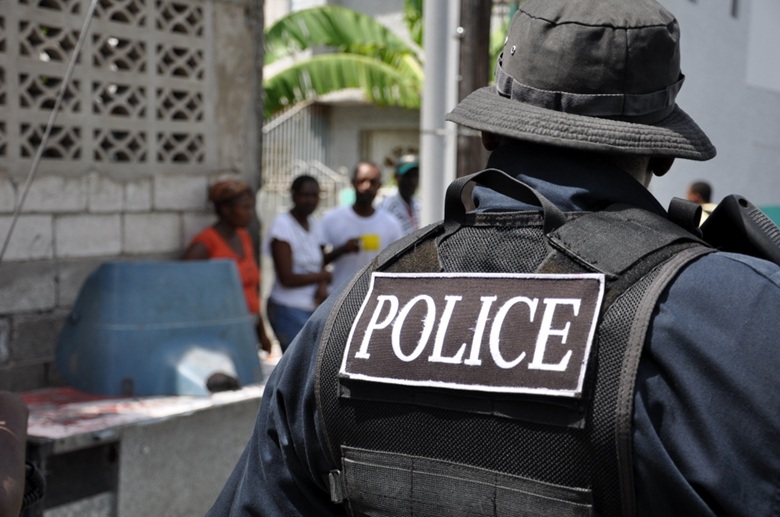
Jamaican police officers (Photo: BBC World Service / Flickr [CC BY-NC 2.0])
目次
Overview and history of Jamaica
Jamaica is an island nation in the Caribbean with a population of about 2.8 million. Over 90% of the population is of African descent, most of them descendants of enslaved people brought during the colonial era. The main industries are tourism, finance, mining, manufacturing, and agriculture, with tourism and finance accounting for particularly large shares of the economy. Beaches are one such tourist resource, but many have been geared toward visitors, creating a problem of excluding access for local residents and fishers. Although the poverty rate has been trending downward, as of 2021 about 18% of people lived on US$7.40 a day or less—an ethical poverty line (note 1).
From here, we briefly look at Jamaica’s history.
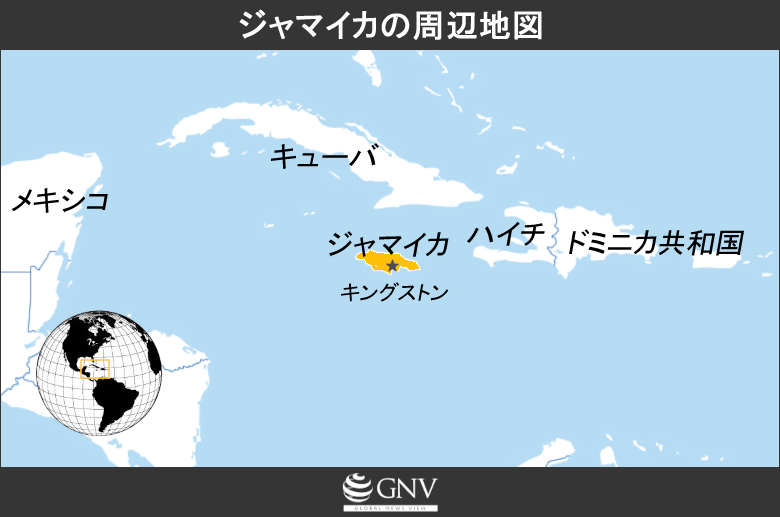
It is thought that Jamaica’s Indigenous peoples comprised two groups. One arrived around 600 CE and is known only for using red pottery. The other, who arrived around 800 CE, were the people known as the Taíno, who are known to have settled while practicing fishing and agriculture. The Taíno lived not only in Jamaica but across various Caribbean islands corresponding to today’s Cuba, Haiti, and the Dominican Republic.
Christopher Columbus landed on Jamaica in 1494, and in 1509 the Spanish began settling and colonizing the island. In the process of Spanish colonization, the Taíno were enslaved to produce supplies for nearby Spanish colonies such as Cuba, and many died from diseases brought from Europe and from overwork. As a replacement labor force, enslaved Africans began to be brought to the island. In the 17th century the colonial ruler shifted to Britain, and production of crops such as sugar, coffee, and tobacco using enslaved labor greatly expanded.
In the 17th and 18th centuries, rebellions by runaway enslaved people occurred repeatedly, and in the 19th century slavery moved toward abolition in stages. After a large-scale uprising by formerly enslaved people in 1865 was suppressed, Jamaica became a more subordinated Crown colony under direct rule by the British monarchy. In the 20th century, dissatisfaction with economic depression and movements for self-government intensified, leading to the founding of labor unions and the two major parties that continue to the present day in 2025. In 1944 a legislature based on elections was established, and in 1962 Jamaica became independent.
Politics of Jamaica
Let us also briefly review Jamaican politics after independence from the UK. One cause of Jamaica’s high crime levels is party competition, and the way politics functioned in the past continues to influence the present.
Jamaica is a constitutional monarchy with a parliamentary form of government. Since independence in 1962, it has consistently belonged to the Commonwealth, a grouping of the UK and its former colonies, with the British monarch as the nominal head of state. Regarding leaving the Commonwealth, a public opinion poll conducted in 2023 showed 49% in favor of leaving and 40% in favor of remaining. However, the Jamaican government is pushing ahead with a transition to a republic.
Since independence in 1962, Jamaican politics has been a two-party system dominated by the People’s National Party (PNP) and the Jamaica Labour Party (JLP). Each party was founded on a different labor union base; the PNP espouses social democracy, and the JLP tends to be somewhat conservative.
The PNP and JLP are both parties that predate independence and have competed fiercely over long periods. As discussed in more detail below, such rivalry has led to urban neighborhoods being divided by party, violence against supporters of the opposing party, and ultimately to organized violence by gangs connected to politics. Supporters of each party came to cluster in the same areas; to stabilize their bases, the parties used everything from brokering jobs and housing to physical violence. Gangs connected to politicians used force to ensure residents voted for their respective parties, and the parties, in return, steered various jobs to them and turned a blind eye to their crimes.
In 1980 such political violence peaked, and more than 800 people were killed. From the 1980s into the 1990s, political violence tied to the parties declined due to the economic policies implemented by both parties, but gangs shifted into drug trafficking and the violence has persisted.
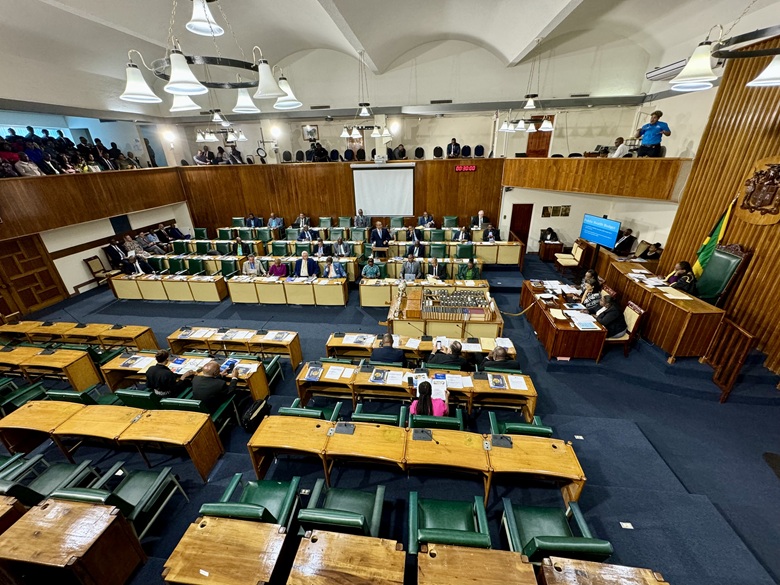
Scene from the Jamaican Parliament (Photo: Pan American Health Organization PAHO / Flickr [CC BY-NC-ND 2.0])
Although direct violence linked to politics has declined, some gangs and lawmakers still maintain ties. This has undermined public trust in politics. For example, in the Economist Intelligence Unit’s Democracy Index 2024, Jamaica scored low on government functioning, political participation, and political culture, and is categorized as a “flawed democracy.” In Transparency International’s Corruption Perceptions Index, where scores under 50 indicate serious corruption, Jamaica scored 44/100 in 2024, with the spread of bribery and impunity for corruption being pointed out.
Allegations of corruption have also been directed at Andrew Holness, who has served as prime minister since 2016. Holness, the JLP leader, won the September 3, 2025 parliamentary elections and is serving a third consecutive term as prime minister. According to a report by the Integrity Commission, Jamaica’s anti-corruption body, there were increases in Holness’s assets that could not be explained through lawful means. Holness denied the allegations, but he was forced to spend the latter part of the campaign on the defensive.
Overview of crime in Jamaica
From here, we take a closer look at crime in Jamaica. While this article focuses on homicides overall, they are intertwined with gangs, politics, and poverty.
First, let us look at the specific numbers for homicides in Jamaica.
In 2024, Jamaica recorded 1,139 total homicides, or 40.1 per 100,000 people. Since the start of the 21st century, homicides per 100,000 have hovered at roughly 40–60. Given that in 2023 the global homicide rate was about 5.2 per 100,000, the high level in Jamaica stands out. According to World Bank data available as of November 2025, Jamaica’s homicides per 100,000 rank 5th after Turks and Caicos (2022: 76), Saint Kitts and Nevis (2023: 64), Saint Vincent and the Grenadines (2023: 51), and the U.S. Virgin Islands (2012: 50).
About 60% of homicides involve criminal organizations and gangs. The underlying cause for the spread of such gang violence was the rivalry between the political parties mentioned earlier.
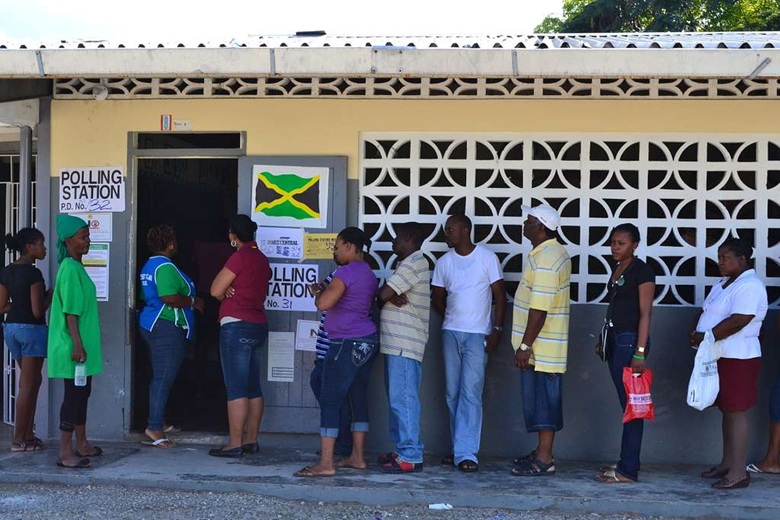
People lining up at a polling station (Photo: Defense Visual Information Distribution Service / picryl [Public Domain])
Amid the intense partisan rivalry between the PNP and JLP, supporters of each party lived collectively in specific areas, supporters of the opposing party were violently expelled, and urban areas were divided along party lines. To further cement these divided areas as strongholds, each party distributed resources such as jobs and housing to its supporters. Supporters, in turn, resorted to violence to strengthen their party over the rival party and to amplify the benefits they could obtain from their party.
Politicians also began to organize this violence and use it to make their local support unshakeable. Leaders of armed groups acted according to the wishes of politicians and worked to ensure that constituents voted for their respective parties. In exchange, gangs received job placements and impunity for criminal acts. Such organization took place from the 1960s to the 1970s, with gangs and politicians mutually conferring benefits while consolidating control over neighborhoods.
Although direct political violence declined in the 1990s, the presence of local gangs, collusion with lawmakers and police, and intolerance for differing views remained. While gang violence was tacitly accepted by colluding politicians, generational turnover proceeded within gangs, and more authoritarian leaders have been expanding their activities by financing themselves through drug and gun smuggling.
Jamaica is a transshipment point in the cocaine trade from Colombia via Mexico to the United States, and also a producer and exporter of cannabis for Europe and North America. Conversely, large numbers of guns are trafficked from the United States into Jamaica, which is one factor in increasing homicides. In fact, about 80% of murders in Jamaica involve firearms.
Gangs range from small groups confined to a single town or neighborhood to highly organized large groups with networks to organizations in other countries. It is believed that drugs imported by large gangs are distributed on the market by smaller gangs, and that firearms and ammunition are resold to local gangs. Local gangs serve as an entry point for young people into crime. Children compelled to live amid chronic poverty and violence often cannot expect to achieve social success through legitimate means, which can lead them to seek money and a sense of belonging by joining gangs.
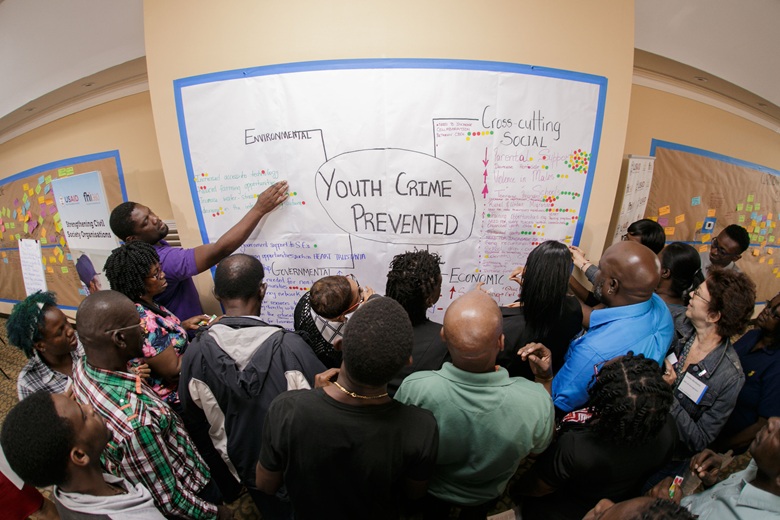
A meeting for a support program to reduce youth crime (Photo: USAID U.S. Agency for International Development / Flickr [CC BY-NC 2.0])
A dramatic drop in homicides
Despite these circumstances, the number of homicides in Jamaica has dropped dramatically in 2025. The precise reasons are unclear, but while reviewing the government’s efforts against homicides, we will examine the issues in the next section.
First, let us confirm the homicide figures for 2025.
According to crime statistics from the Jamaica Constabulary Force, there were 604 homicides nationwide between January 1 and November 22, 2025. During the same period in 2024 there were 1,041, representing a 42% year-on-year decrease. Apart from homicides, shootings (down 33% year-on-year) and rapes (down 26%) have decreased, while robberies (up 9.2%) and break-ins (up 20.2%) have increased. Not all major crimes are down, but homicides have declined markedly.
The government claims this decline in homicides is the result of its own efforts. Emphasizing the reduction during the September 2025 parliamentary elections, Prime Minister Holness cited investment in and strengthening of the security forces and tougher laws as reasons for the drop. Horace Chang, the minister responsible for national security, similarly stated that Jamaica has become safer due to police strengthening through training and intelligence operations and through legal amendments.
While the causal relationship is not clear, investments to enhance the capabilities of the security forces may have contributed to the decline. However, even with the decrease, the level remains high compared to the 1960s and 1970s, and critics argue that temporary dips in homicides followed by rises have occurred before.
Worrying human rights violations
However, such strengthened anti-crime measures carry a heightened risk of violating human rights.
States of emergency are frequently used in Jamaica as an anti-crime measure. When a state of emergency is declared, the powers of the security forces and law enforcement agencies are expanded during that period, allowing searches without warrants and detention without charge or trial. A state of emergency can be issued for up to 14 days, or for a period not exceeding three months if approved by a two-thirds majority in each house. Even though questions remain as to whether states of emergency contribute effectively to reducing crime, the Jamaican government has become quick to take measures that temporarily suspend rights such as civil liberties.
Another concern regarding the security forces is a large increase in fatal shootings by them. According to reports by the Independent Commission of Investigations (INDECOM), which investigates the police, fatal shootings rose from 189 in 2024 to 278 as of November 24, 2025. There have been multiple cases of police officers being investigated by INDECOM and charged for allegedly assaulting or killing innocent civilians.
In response, human rights groups, families of those killed by police, and INDECOM have called for officers to wear cameras to increase investigative transparency. Concerns have also been raised about the increase in police shootings as a result of operations to arrest wanted suspects.
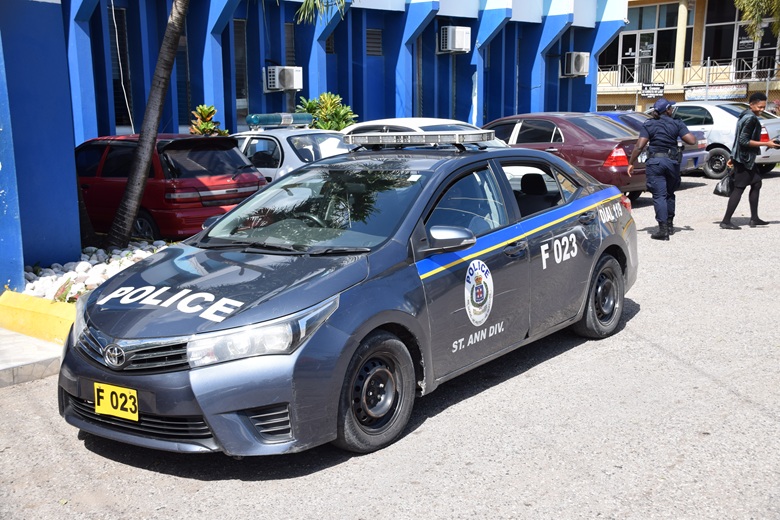
A Jamaican police vehicle (Photo: Dickelbers / Wikimedia Commons [CC BY-SA 4.0])
What it will take to build a safer society
In 2025, to reduce homicides, the Jamaican government toughened penalties for murders committed by minors. During legislative deliberations, the severity of the penalties was criticized for failing to promote the rehabilitation of juvenile offenders and increasing the likelihood of recidivism. Rather than strengthening post hoc punishments, it is considered necessary to work to improve the various underlying factors before children become involved in crime.
The decline in homicides in Jamaica itself is welcome. However, if it rests on human rights violations and restrictions on freedom, it must be improved; and beyond post hoc responses, there is also a need to address the root causes of crime, such as poverty, political collusion with gangs, and pervasive drug problems across the Americas.
※1 GNV uses an ethical poverty line (US$7.40 per day) rather than the World Bank’s extreme poverty line (US$2.15 per day). For details, see GNV’s article “How should we interpret the global poverty situation?”.
Graphics: A. Ishida






[1560]jl777 slots|jl777 download|jl777 login|jl777 giris|jl777 casino Experience the ultimate gaming thrill at jl777, the Philippines’ premier online casino. Secure your jl777 login to play top-rated jl777 slots and live casino games. Get the jl777 download for mobile access and enjoy seamless jl777 giris entry for big wins and 24/7 entertainment. visit: jl777
[514]Richjili: The Best Jili Slots Site & Legit Online Casino Philippines with GCash. Richjili is the best Jili slots site and a legit online casino in the Philippines. Experience top-rated online gambling with seamless GCash transactions. Access the Richjili official login now to enjoy premium games and big rewards at the most trusted PH gaming platform. visit: richjili
[7771]OKJILI Online Casino: Easy Login, Register & App Download for the Best Philippines Slot Games. Experience the top Philippines slot games at OKJILI Online Casino. Get easy okjili login, okjili register, and okjili app download. Play now for big rewards and premium gaming! visit: okjili
[7104]Casinova Official Site: Best Online Slots in the Philippines. Quick Login, Register & App Download. Play at the Casinova official site for the best Casinova online slots in the Philippines. Quick Casinova login, register, and Casinova app download. Start winning today! visit: Casinova
[4871]C9TAYA Online Casino Philippines: Best Slot Games, Easy Login, Register, & App Download Experience the best C9TAYA Online Casino Philippines! Enjoy top c9taya slot games, easy c9taya login, and quick c9taya register. Get the c9taya app download and win today! visit: c9taya
[4660]CMDBET Official Site Philippines: Secure CMDBET Login, Easy Register, and App Download for Premium Slot Online Gaming. **Meta Description:**
Join CMDBET Official Site Philippines for premium gaming. Access secure cmdbet login, easy cmdbet register, and the cmdbet app download for the best cmdbet slot online experience. Start winning today!
**On-Page SEO Introduction:**
Welcome to the CMDBET Official Site Philippines, your premier destination for high-stakes excitement and premium slot online gaming. Whether you are looking for a secure cmdbet login, a fast cmdbet register process, or the latest cmdbet app download to play on the go, we provide a seamless and safe environment for all Filipino players. Experience world-class cmdbet slot online titles and exclusive rewards only at the official home of CMDBET. visit: cmdbet
[7578]The Best Legit Online Casino in the Philippines for Slots and More at 668jili visit: 668jili
[1518]Hannlive: Best Slot Online, Casino Login & App Download. Register for Hannlive Philippines Today. Experience the best slot online at Hannlive Philippines. Secure Hannlive login, fast Hannlive register, and Hannlive app download. Join Hannlive casino login now! visit: hannlive
[6000]The Philippines’ Legit Online Casino for Jili Slots and GCash Payments visit: jiliokcc
[6820]Epicwin Online Casino Philippines: Easy Login, Register, and Download the Best Epicwin Slot Games for Big Wins Today. Join Epicwin Online Casino Philippines for big wins! Experience fast epicwin login & register processes. Get the epicwin download now to play premium epicwin slot games and enjoy the ultimate gaming experience today! visit: epicwin
Thanks for sharing. I read many of your blog posts, cool, your blog is very good. https://www.binance.info/zh-TC/register?ref=DCKLL1YD
4s7jzq