
In May 2024, a further 45,000 Rohingya fled their homes in Myanmar, mirroring the plight of more than one million refugees who have sought refuge from the regime. Most cross the border into Bangladesh and settle in the world’s largest refugee settlement, but in 2023 and 2024 the number of boats attempting the dangerous journey to Indonesia has increased significantly. In addition, hundreds of thousands of people are internally displaced within Myanmar. Whatever route they take, it is clear that Rohingya people are taking great risks in search of protection and the enjoyment of basic human rights. This article outlines the broad background of the Rohingya, how they became displaced, and the challenges they face.
In a refugee camp in Cox’s Bazar (Photo: UN Women Asia and Pacific / Flickr [CC BY-NC-ND 2.0])
目次
Historical background
The Rohingya are a predominantly Muslim ethnic group living in Myanmar’s Rakhine State. The region, historically known as Arakan, was renamed Rakhine by the ruling regime in the 1980s. Ancient Arakan (present-day Rakhine State) was a multicultural and multireligious society and, due to its proximity to the Indian subcontinent, was heavily influenced by South Asia.
Traces of Arab traders indicate contact in the early centuries CE, and Islam reached the region by the 8th century through Arab traders and missionaries. The presence of Muslim settlements is evidenced by archaeological remains such as mosques and Islamic artifacts, and linguistic studies show that Arabic influenced local languages. Over the centuries, the region became a cultural melting pot where Muslims came to coexist with Buddhists and Hindus.
In the 15th century, the Kingdom of Mrauk-U was founded, regarded as a golden era in Arakan’s history. The kingdom had close ties with the Bengal Sultanate, further strengthening Islamic influence. The rulers of Mrauk-U employed Muslim officials, and court culture was heavily influenced by Islamic customs. The Rohingya assert that they are the traditional descendants of these Muslim communities of Arakan and that their presence in Rakhine State dates back centuries, establishing historical roots in the region.
The British colonization of Burma in the 19th century was a turning point for the Rohingya. Burma was incorporated into British India, and labor migration brought significant demographic changes. Encouraged in part by British colonial administration, many Muslims from what is now India and Bangladesh migrated to Rakhine for agricultural work. During this period the Muslim population in the region increased, though exact figures and the extent of migration are subjects of historical debate. The colonial era also sowed the seeds of ethnic and religious conflict. British policies that favored certain ethnic groups over others in administrative status and roles generated resentment and anger. The Rohingya were seen as collaborators with the British, later contributing to ethnic friction with Rakhine Buddhists.
This period is also key to the Myanmar government’s position that Rohingya are “illegal immigrants.” The influx of Muslims from other parts of British India, particularly from Bangladesh, became the basis for the state’s claim that the Rohingya are “Bengalis,” not a recognized ethnic group in Myanmar. There is a mismatch between the Rohingya claim that their roots go back to the earliest communities of Arakan and the state’s position that they are recent (and illegal) immigrants.

The Rohingya are descendants of ancient Arakanese and other South Asians who likely moved into the region at different times. Of course, this has no bearing on the immigration status of people who moved in eras when political borders were different from today. There should be no doubt that the Rohingya have lived for generations in what is now Rakhine State.
However, the causes of the current conflict are not limited to ethnic origin. The Second World War further worsened interethnic tensions in Rakhine. During the Japanese invasion of Burma and the ensuing conflict, the Rohingya supported the British, while many Rakhine Buddhists welcomed the Japanese. This division sparked fierce clashes between the two communities, resulting in heavy casualties and displacement.
After Burma gained independence from the United Kingdom in 1948, the new government did not recognize the Rohingya as an indigenous people. The 1948 Union Citizenship Act granted citizenship to those who could prove their families had resided in Burma for two generations, but many Rohingya could not provide such proof. This set in motion their statelessness.
In 1962, when General Ne Win staged a military coup and established the first junta, the situation deteriorated further and the Rohingya became even more marginalized. Throughout the 1970s, even Rohingya who had established citizenship under the 1948 Union Citizenship Act began to have their national identity cards confiscated. As discussed below, their citizenship would continue to be severely restricted thereafter.
The history of the Rohingya comprises centuries of cultural integration and coexistence followed by decades of systematic persecution and violence. Their plight highlights serious issues, including statelessness, ethnic discrimination, and the failures of other states and international organizations to protect vulnerable people.

Main drivers of displacement
Many Rohingya have sought to escape the persecution they face in Myanmar. Over the past 50 years, it is hard to find a time when people were not fleeing abroad. However, certain events triggered mass movements. This section looks at the main displacement events from 1978 to the present.
First worth noting is the 1978 Operation Dragon King (also known as Nagamin). In this operation, security forces committed atrocities against the Rohingya and supported local Buddhists who perpetrated violence against Muslims in Rakhine State. Killings, rapes, torture, and the destruction of homes and villages in northern Rakhine led to a mass exodus of Rohingya into neighboring Bangladesh.
International outcry and pressure led to negotiations between the governments of Burma and Bangladesh. The talks produced an agreement, and later that year many Rohingya refugees were repatriated to Burma. However, the underlying issues—discrimination, statelessness, and lack of citizenship—remained unresolved, fueling future conflict and displacement. It is now widely recognized that the UN Refugee Agency (UNHCR), despite acknowledging that Rohingya in Bangladesh were in effect refugees, participated in repatriation procedures that led to further abuse of returnees and failed in its duty to protect them.
Just a few years later, with the 1982 Citizenship Law, the Rohingya were fully stripped of citizenship, as 135 ethnic groups were recognized as citizens but the Rohingya were excluded. This law rendered the Rohingya stateless and severely restricted their rights and freedoms. The new law granted “full citizenship” only to those who could prove lineage in the region prior to 1823, when British colonial rule began. Those who qualified under the 1948 Union Citizenship Act were offered an inferior form of “associate citizenship.” Many Rohingya, regardless of the reality of their roots, could not provide documentary proof. Having lost citizenship—the core of enjoying human rights—the Rohingya collectively faced large-scale violations of rights such as freedom of movement, access to education and healthcare, and especially employment opportunities, and continued to leave in search of safety abroad.

IDP camp in Rakhine State, 2012 (Photo: Foreign, Commonwealth & Development Office / Flickr [CC BY-ND 2.0])
Apart from human rights groups acknowledging abuses, there was little visible international response for most of the 1980s to the Rohingya’s plight. By 1988, however, people across Burma were organizing and demonstrating to end military rule and restore democracy. This drew international attention in support of the pro-democracy movement, and Aung San Suu Kyi, who won the Nobel Peace Prize in 1991, became prominent for her activism and imprisonment. Notably, the Rohingya were not included in the pro-democracy movement, and even Aung San Suu Kyi never voiced support for their struggle. The democracy movement faced a military crackdown, causing thousands of deaths and displacements and eventually leading to further persecution of the Rohingya. During this period a new regime took power and abandoned the colonial name “Burma,” renaming the country Myanmar.
Having successfully suppressed the democracy movement and completely ignored the results of sham elections, the junta reverted to ultranationalism at the expense of the Rohingya. The 1991 “Operation Clean and Beautiful Nation” treated the Rohingya as “foreigners,” and the military rulers sought to purge “foreigners” from Myanmar. In 1992, Myanmar created a new security force to control northern Rakhine State, where the Rohingya population is concentrated. This NaSaKa border guard was designed to heavily regulate daily life for the Rohingya by restricting marriage rights, imposing forced labor, arbitrary land confiscation, forced relocation, excessive taxes and extortion, and denying the right to travel freely. In the face of such abuses, a further 250,000 Rohingya fled Myanmar in 1991–1992.
The international response sought to resolve the situation as quickly as possible without regard for the persecuted Rohingya population. UNHCR and Bangladesh limited services provided to new arrivals from Myanmar to deter further inflows. UNHCR even applied the label of “economic migrants,” despite clear evidence that these Rohingya met the definition of refugees under the 1951 Refugee Convention. As a decade earlier, Bangladesh and Myanmar negotiated the “voluntary” return or repatriation of Rohingya without bringing about any substantive improvements in the conditions they faced in their homeland of Rakhine. It is noteworthy that in 1993 the UN Special Rapporteur on Myanmar expressed concern over how “voluntary” the returns truly were. One might argue UNHCR felt unable to withdraw from repatriation for fear of being unable to provide any further aid to those in distress, but broadly this must be seen as a failure of a protection agency to properly protect people fleeing persecution. As a symbolic remedial step, UNHCR established an office in Rakhine to monitor conditions faced by returnees.
In 1994, Myanmar began refusing birth certificates to Rohingya children, further exacerbating their marginalization. Over the next two decades, the persecution of the Rohingya continued through the systemic denial of human rights described above. In 2012, Aung San Suu Kyi and her supporters were elected to parliament, and democratic reforms finally began to appear in Myanmar. Although the military still held a majority of seats, there were improvements in human rights in many parts of the country. Unfortunately, these improvements did not extend to the Rohingya. As noted above, the Rohingya were not considered citizens of Myanmar and were not even recognized as an official ethnic group. In June and October 2012, extremist Buddhists launched attacks against Rohingya Muslims in Rakhine State, often with active assistance from police and military. These attacks left hundreds of Rohingya dead, thousands of homes burned, and 120,000 became internally displaced persons. Over the next two years, tens of thousands fled in search of refuge.

A Myanmar Border Guard Police officer looks at the scene of an arson attack in Rakhine State (Photo: Screenshot from source video / Picryl [Public domain])
In 2014, persecution of the Rohingya escalated further. Ultranationalism and hate speech increased notably with the formation of the extremist Buddhist group Ma Ba Tha. This group sought to link Rohingya in Myanmar to Islamist jihadist movements internationally. Against this backdrop of rising tensions, the first national census in 30 years banned the use of the term “Rohingya,” excluding Rohingya people from the count altogether. Following this exclusion, in 2015 their ID cards were revoked. Their national ID cards were replaced with new ones indicating they were immigrants from Bangladesh, even though this was plainly inaccurate. The government then enacted the “Race and Religion Laws,” further violating the basic human rights of Rohingya by restricting their right to practice their religion, to marry, and to private life. The National League for Democracy’s success in the November elections seemed to give many in Myanmar hope for improvement, but once again this progress did not include the Rohingya.
In 2016, after a small Rohingya group attacked police stations in Rakhine State, rising tensions erupted into violence again. They stole guns and ammunition from several locations, and in retaliation state security forces and local nationalists launched a “scorched-earth campaign.” Widespread reports emerged of killings, rapes, and the destruction of villages by the military and police against the Rohingya. This was only the beginning of the largest anti-Rohingya operation and mass flight from Myanmar.
In August 2017, a Rohingya armed group known as the Arakan Rohingya Salvation Army (ARSA) launched counterattacks against Myanmar security forces. In response, the military launched operations that the UN described as “a textbook example of ethnic cleansing.” Extensive atrocities—including mass killings, rape, and arson—were reported, and more than 700,000 Rohingya fled to Bangladesh, creating one of the world’s largest refugee crises. As they crossed the border into Bangladesh, the population of the Kutupalong refugee camp in Cox’s Bazar swelled to nearly one million.
In 2018 and 2019, the UN Human Rights Council convened the Independent International Fact-Finding Mission on Myanmar (IIFFMM) to investigate alleged abuses against Rohingya. The mission found that “genocidal acts” had been committed during the “clearance operations” targeting the Rohingya. Subsequently, in January 2020, the International Court of Justice (ICJ) ordered Myanmar to take measures to prevent further genocidal acts.
The 2021 coup once again wrested power from a democratically elected government to a military junta. The ultranationalist regime continues persecution of the Rohingya but has essentially focused on suppressing domestic opposition to military rule. This may have temporarily eased pressure on the Rohingya, but it has also reduced international attention on the crisis of Rohingya displacement. Moreover, the instability has hindered the provision of international aid to Rohingya who remain in the country.

Created based on data from Al Jazeera
The history of the Rohingya is a succession of persecution and flight. While there have been specific surges of violence and repression that triggered mass movements, periods in between have still been marked by unending abuses and a steady flow of people leaving their ancestral homeland. For generations they have been denied basic human rights owed to all people. Furthermore, their very right to exist has been contested by the state, leaving them stateless and without basic protection.
Life outside Myanmar
Much discussion of the Rohingya diaspora focuses on Bangladesh, but those fleeing Myanmar do not head only to the neighboring country. Because of geographic access, existing communities, and international agencies already operating there, Bangladesh is the most accessible destination. However, some seek alternatives: the southern route to Thailand or Malaysia, dangerous boat journeys to Indonesia, or travel from Bangladesh to other destinations in South and Southwest Asia. And of course, many are displaced within Myanmar.
Bangladesh—particularly the Cox’s Bazar area—hosts the world’s largest concentration of Rohingya refugees. Bordering Myanmar, it is the most accessible destination for many and receives domestic and international assistance, yet it faces many challenges.
First, the arrival of hundreds of thousands of refugees puts significant pressure on host communities. Access to healthcare, education, jobs, and food, for example, decreases. Bangladesh’s strained economy is pushed to both protect the interests of host communities and meet the basic needs of nearly one million refugees. The financial burden is estimated at over USD 1 billion per year, most of which is borne by Bangladesh with insufficient international support. In the early stages of the 2017 crisis, when 700,000 Rohingya crossed the border within weeks, more funding was available; however, as international humanitarian funding has declined, it has dropped to less than half of what is needed. As a result, assistance available to incoming Rohingya is limited, support for local residents has also decreased, and tensions have grown between the two groups.

A child receiving medical care in a refugee camp in Cox’s Bazar (Photo: MedGlobal Org / Flickr [CC BY-NC-ND 2.0])
Furthermore, the camps both cause and suffer from environmental degradation. For example, vast tracts of forest have been cleared to accommodate ever-expanding camps. This has caused major environmental damage in the area, such as increasing flood risks. At the same time, the camps are highly vulnerable to the adverse effects of climate change, which further exacerbates the precarious situation of Rohingya refugees, places additional pressure on local resources and host communities, and ultimately heightens tensions.
To ease the pressure on Cox’s Bazar, the Bangladeshi government relocated 30,000 Rohingya refugees in 2020. Their new camp is on the silt island of Bhasan Char, which is even more vulnerable to extreme weather and the adverse effects of climate change. Some human rights groups have described it as a prison-like island 60 km offshore, where those confined have few options for movement.
Another major concern for those crowded into refugee camps is the risk of infectious disease. Outbreaks of diphtheria, measles, and cholera remain concerns, and during the COVID-19 pandemic, while the world faced a health crisis, the risks in refugee camps were far more pronounced than in high-income countries. In camps with a population density of 40,000 per square kilometer, social distancing is impossible. Providing masks was even more unrealistic. Even access to WASH (water, sanitation and hygiene) was lacking for many; in some camps hundreds of people share a single tap for handwashing with soap and clean water. As a result, refugees living in such conditions are particularly susceptible to communicable diseases like COVID-19. While it is difficult to capture precise data on the pandemic’s impact on the camps, it demonstrated that recommended preventive measures were essentially impossible there. By April 2022, fewer than 100,000 tests had been conducted since the start of the pandemic, with about 6% positive.
Beyond Bangladesh, Rohingya refugees face other hardships. One of the most difficult routes is by boat toward Indonesia, Malaysia, or even Australia. Risks include human trafficking and the dangers of long sea journeys. Stateless people and refugees are particularly vulnerable to trafficking, and they flee with the help of smugglers (some of whom later turn out to be traffickers). Driven by desperation, they accept any help they can find and, conversely, do not seek assistance from authorities because of their irregular status and past bitter experiences with police and security forces. As a result, Rohingya refugees are trafficked for marriage, held for ransom for cash, and subjected to widespread sexual abuse on a large scale. Even if they find a smuggler to transport them, the dangers of the sea journey are great. Boats are often unseaworthy and lack supplies for passengers or even basic navigational and safety equipment. For the lucky few who escape traffickers and survive the voyage, many more obstacles await.

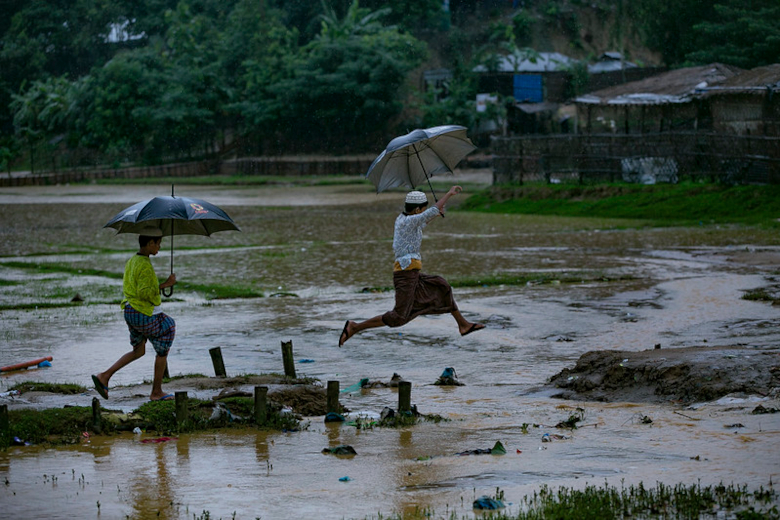
Refugees moving within a camp in Cox’s Bazar to escape flooding (Photo: UN Women Asia and Pacific / Flickr [CC BY-NC-ND 2.0])
In 2013, the Australian government implemented an unlawful policy of intercepting refugees at sea, detaining them offshore (notably on Nauru and Manus Island), and refusing their admission to Australia. This process is known as “offshoring” or “externalization,” and it is not unique to Australia. Despite its obligations under international law, Australia not only refused to accept refugees but went so far as to obstruct New Zealand’s policy of offering asylum procedures to those detained. The illegality of this is noteworthy. It left thousands of Rohingya (as well as people of other nationalities) with an ultimatum to return or remain detained, held indefinitely on remote islands. This clearly violates international law prohibiting return to places where life or liberty would be threatened (non-refoulement) and the right to seek asylum. As a result, thousands of Rohingya were detained for years, unwilling to return to persecution at home and unable to move forward to a safe haven. Over nearly a decade, the facilities on Nauru and Manus held more than 4,000 people.
For many Rohingya, escaping genocidal acts and the systemic denial of basic human rights in Myanmar may be a hopeful first step, but life in refugee camps comes with a different set of challenges that threaten their lives and freedoms. Tensions with host communities over local resources, for example, threaten their peaceful existence. The lack of humanitarian support from abroad limits access to healthcare, education, jobs, and other basic rights. Moreover, exposure to environmental hazards and disease puts their safety at risk. These threats are encapsulated by UNHCR’s headline declaring, “Flooding, fires and COVID bring fresh challenges to Rohingya refugees in Bangladesh.” For those who seek a better life beyond the camps, numerous obstacles stand in the way. Sea journeys expose refugees to trafficking, maritime dangers, and, in many cases, hostility from potential host communities.
Outlook
Recent decades have been harsh for the Rohingya. Since Myanmar’s independence, this ethnic group has had its very existence questioned, its rights denied, and its homeland largely taken away. For those who have fled and those who remain, the current situation is intolerable. How many more generations of Rohingya will be denied basic living standards and essential rights? Something must change, but how and to what extent conditions will improve remains unclear. Sultan Mohammed Zakaria of the American Institute of Bangladesh Studies (AIBS) outlines the following three possible paths for the Rohingya.

Vocational training in a refugee camp in Cox’s Bazar (Photo: UN Women / Flickr [CC BY-NC-ND 2.0])
First, Myanmar’s political landscape could change, allowing displaced Rohingya to return to Rakhine State. Of course, this must not be merely a geographic solution. Return must be to a place where people are respected, rights are protected, and participation in political life is guaranteed. Only when the Rohingya are recognized as an official ethnic group of Myanmar and granted full citizenship can they fully enjoy their inherent rights and definitively end the cycle of persecution and violence. This would require a dramatic political shift. There are no signs it will be possible in the near future, but it would be the best outcome for the Rohingya.
Second is the continuation of the status quo. Experts warn that large numbers of refugees currently displaced will remain denied education, employment, and a minimum standard of living, creating humanitarian and security problems in Myanmar, Bangladesh, and the wider region.
The third scenario, while not ideal, may be the most realistic: combining integration into host communities in Bangladesh with resettlement to third countries could offer the most likely means for the Rohingya to start new lives where they enjoy not only basic human rights but safety and security. This would only be possible through international solidarity to address the crisis. More aid is needed to support Bangladesh, which hosts the largest number of displaced people. Increased assistance would not only enable meeting the material needs of both local residents and refugees, but also help build political will within Bangladesh to enable the Rohingya to integrate and gradually enjoy more rights. Additional international support is also needed to encourage third countries to resettle Rohingya refugees. Doing so would ease the burden on Bangladesh and provide more opportunities to Rohingya seeking better lives.
The biggest obstacle to this third scenario remains political will. Over the past decade, isolationist policies have gained ground in the United States and Europe, leading to declines in resettlement. In 2014, more than 15% of refugees awaiting resettlement were actually resettled, but by 2022 it was under 8%. In addition, following Russia’s invasion, many countries have directed aid to Ukraine, and in response to the mass killing in Gaza, many have also moved to protect Palestinians, shifting political focus away from the Rohingya crisis. None of this bodes well for Rohingya refugees left in limbo. It is essential that political will in various countries shifts toward supporting a response to this protracted crisis. Otherwise, the Rohingya will continue toward the worst-case scenario: remaining both displaced and stateless.
Writer: Brian Aycock
Translation: Madoka Konishi
Graphics: Ayane Ishida








Your point of view caught my eye and was very interesting. Thanks. I have a question for you.