
There are people around the world who, as a principle, do not eat meat—namely, vegetarians and vegans. They follow diets that exclude the flesh of animals such as meat and seafood and their by-products, or all animal-derived foods, for a variety of reasons. The history of vegetarianism is in fact long; for example, it was practiced in Egypt for about 4,000 years. The reasons they choose not to consume animals are by no means uniform. In this article, I would like to introduce what “vegetarianism,” which has existed from ancient times to the present, actually is, why it is practiced, and the impact it has on society and the planet.
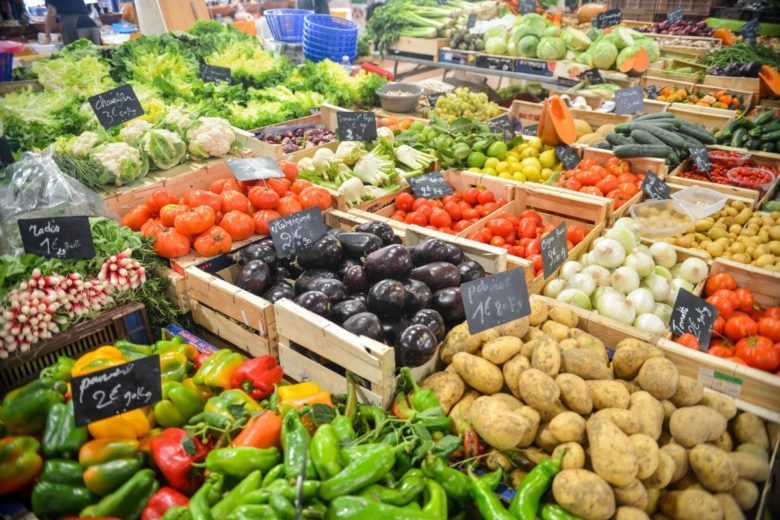
Vegetables lined up at a market (brainsick/Pxhere [CC0])
目次
What is vegetarianism? How is it different from veganism?
People who do not eat meat or seafood are called “vegetarians,” and the principle itself is called “vegetarianism.” In fact, there are several types of vegetarianism, but what they all have in common is that they do not eat meat. According to the Vegetarian Society, a typical vegetarian does not consume animal flesh, seafood such as fish and shellfish, or any by-products of animal slaughter. Therefore, vegetarians may consume eggs and dairy products. There are foods that some people choose to include or exclude, and the terminology differs accordingly (Note 1). A more stringent form of vegetarianism that excludes eggs, dairy, and all animal-derived foods, including honey, is called “veganism,” and those who practice it—as well as the diet itself—are called vegan (Note 2).
On the other hand, some people practice a relatively looser form of vegetarianism. Examples include pescatarians, who do not eat meat but do eat seafood, and flexitarians, who are basically vegetarian but allow meat in certain situations. However, since these people do consume animal flesh, they are sometimes interpreted as not fitting the definition of vegetarian. While vegetarianism allows for some choice regarding what to consume or avoid, veganism avoids anything that involves even a small degree of animal exploitation.
So why are vegetarianism and veganism practiced? Below is a summary of the reasons and background behind the choice not to consume animals.
Vegetarianism and veganism as consideration for animals
One of the reasons many people around the world do not consume animals is religion. Let us begin with India, the country with the largest number of vegetarians. India is deeply tied to Hinduism, and roughly 80% of the population is Hindu. Ahimsa (non-violence, non-killing) is a fundamental principle of Hinduism, and eating animals is taboo, so there are many vegetarians. In surveys conducted so far, the proportion of vegetarians in India has been put at about 30–40% of the population. However, some point out that this figure is influenced by social pressure that regards not eating meat as virtuous, and that the real proportion is around 20%. In any case, the fact that at least one in five people do not eat meat is the highest proportion in the world.
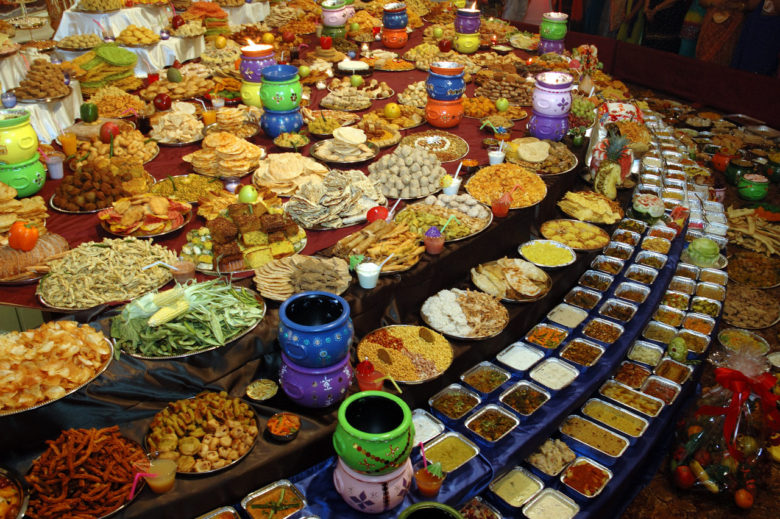
Hindu vegetarian cuisine (chiragkpatel/Flickr [CC BY-NC 2.0])
However, some argue that the association of vegetarianism with Hindu teachings has social and political underpinnings. According to this view, there was once a strategy to ensure that the Brahmin class (the highest caste) could consume meat without worrying about shortages. It is also noted that when Islam entered India in the 8th century, consumption of beef—normally avoided by Hindus—increased, threatening the supply of dairy products. The scheming of upper castes to reduce meat consumption under the pretext of religion, it is said, has come to be seen as a religious virtue today.
There are others who refrain from eating meat due to the teachings of their faith. For example, Jainism, which also has many followers in India, shares the concept of ahimsa found in Hinduism, and some adherents practice vegetarianism. Furthermore, as represented by the vegetarian cuisine “shojin ryori” eaten in countries such as China and Japan, there are Buddhist sects that hold that one should avoid killing animals. In addition, the Old Testament, the holy scripture of Judaism, lists many animals, including pigs, as unfit to eat. In Islam, which shares roots with Old Testament teachings, the consumption of animals considered impure, such as pigs and dogs, is prohibited, and even other animals are only permitted if they have been slaughtered according to approved procedures (Note 3). While there are various doctrines and restrictions, it is fair to say that people who do not eat meat for religious reasons live all over the world.
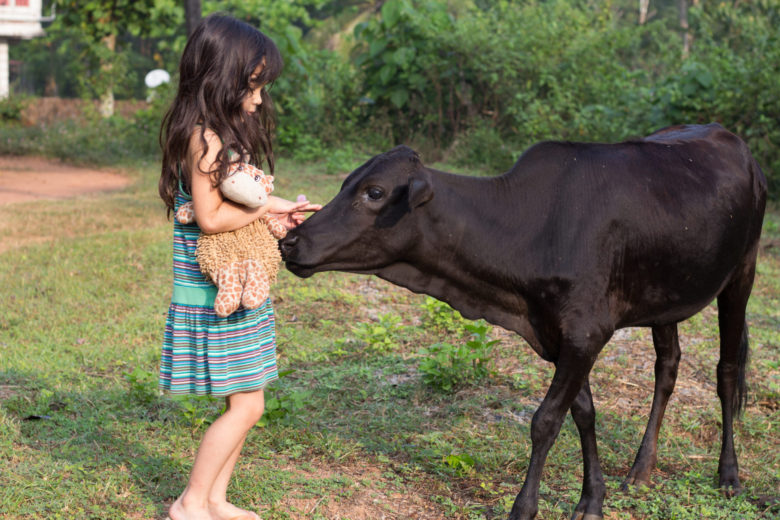
A girl playing with a cow (Avinash Bhat/Flickr [CC BY-SA 2.0])
Next is bioethics and animal welfare. It is the animal protection view that, just as we must not kill human beings, we must not kill animals or treat them cruelly. It has been demonstrated biologically that animals, like humans, feel pleasure and pain (i.e., they have consciousness and sentience). Harming such life is inconsistent with the morality that humans should not harm one another. In other words, animals should be respected, and “speciesism” is rejected.
The above treats harming animals itself as taboo, but there is a somewhat different view that it is wrong to treat animals as mere commodities or to consume them on a massive scale. In modern times, goods are mass-produced and mass-consumed, and animals have likewise been commodified as “things” and treated cruelly. The idea here is that there should not be lives that are kept alive and consumed solely for human convenience. In reality, because increasing production efficiency and maximizing profit are top priorities in livestock production, the conditions on the ground are gruesome.
For example, in egg production, male chicks are killed immediately after hatching. Hens spend their entire lives without ever seeing sunlight, confined to cages or overcrowded sheds where they can barely move, repeatedly suffering bleeding and broken bones. Dairy calves are separated from their mothers within 12 hours of birth; the cows are then unnaturally engorged to provide us with milk, artificially inseminated over and over, and slaughtered when their milk runs dry. Tragedy also occurs in live export. It was reported that more than 1,000 sheep exported from Australia to the Middle East died on a ship where it was difficult even to breathe. To reject such tragic livestock practices, some people choose to stop consuming animal products.
Thus, among those who give animal welfare as their reason for giving up meat, some hold that animals should not be eaten at all, while others oppose livestock practices and the exploitation of animals. People who practice veganism for these reasons also oppose all forms of exploitation; therefore, they avoid leather goods and products such as cosmetics developed through animal testing. The term “vegan” is used beyond food for non-animal products, and in many Western countries such products are labeled “Vegan.” The main reason for the rapid increase in the number of vegans in the UK is said to be concern for animal welfare, according to reports. In Australia and other Western regions, there are also many activities promoting plant-based eating, such as demonstrations organized by vegans calling for an end to the consumption of animals.
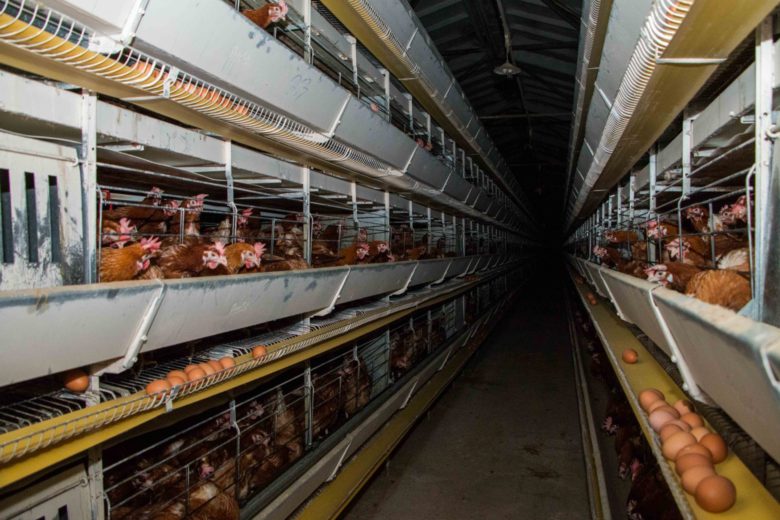
Battery cages in a cramped poultry farm (Dzīvnieku brīvība/Flickr [CC BY-NC 2.0])
Vegetarianism and veganism as consideration for the planet and oneself
Beyond consideration for animals, environmental protection is another reason for not eating meat. At first glance, meat consumption may seem unrelated to the global environment, but in reality, livestock production has a serious impact on our planet. Deforestation is one example. To produce meat, animals must be raised to maturity using large amounts of feed, and growing that feed requires vast tracts of land. According to a report by the UN Food and Agriculture Organization (FAO), 26% of the land on Earth is currently occupied by the cultivation of feed crops. In Brazil, roughly 70% of the destroyed Amazon rainforest is used as pasture, and much of the remaining land is also used to grow soybeans for cattle feed.
Livestock production also contributes to global warming. In fact, about 20% of greenhouse gases emitted come from livestock, a share that exceeds transportation, which is commonly known as a leading source of greenhouse gas emissions. Methane, one of the greenhouse gases, is generated from animal (especially cattle) excrement and has a warming effect 23 times that of carbon dioxide. Cows emit 70–120 kg of methane per head per year; for example, if 100 kg is emitted in a year, that is equivalent to 2,300 kg of carbon dioxide.
The massive consumption of water, a natural resource, is also becoming a problem. Producing meat uses enormous amounts of water; for example, while producing 1 kg of wheat requires 500–4,000 liters of water, producing 1 kg of meat requires 5,000–40,000 liters. That is ten times as much. As water shortages worsen, consuming meat can be said to indirectly exacerbate the problem. The environmental issues related to livestock are not limited to these, and new research and data are being published one after another. People who want to consume sustainably become vegetarian or vegan, or consciously avoid animal-based foods. This has become a major trend in many Western countries in recent years.
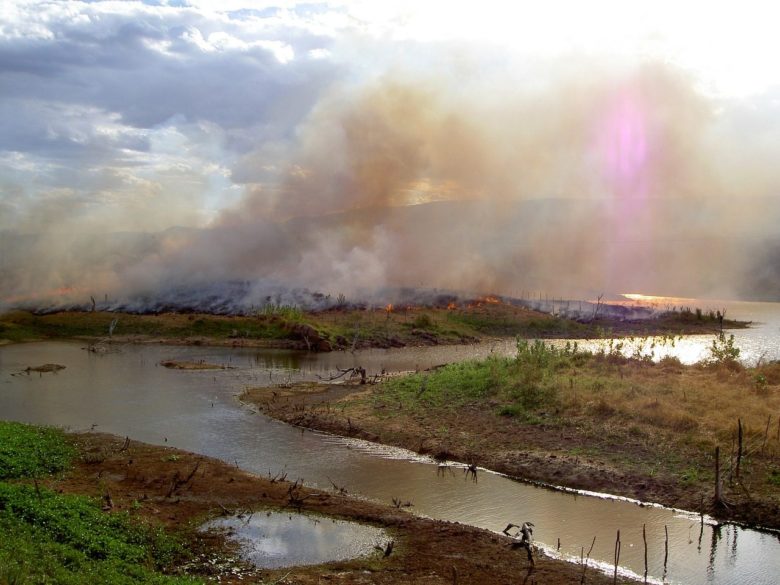
The Brazilian Amazon burning (Alzenir Ferreira de Souza/Wikimedia Commons [CC0])
Another reason for not eating animals is consideration for oneself—namely, a focus on health. There are diseases that can be prevented by refraining from animal-based foods. Switching to a plant-based diet is known to lower cholesterol and blood pressure and reduce the risk of heart disease and cancer. The excessive use of antibiotics to increase livestock production efficiency is also criticized, and some people avoid meat to avoid indirectly ingesting large amounts of antibiotics. Furthermore, there is concern that the overuse of antibiotics increases resistant bacteria that can infect not only animals but also humans.
What do we eat?
The logic of life is that, to live, we must take other lives. Sometimes the environment in which one was raised or one’s faith inevitably influences one’s diet; at other times, whether to eat something or not is a matter of individual choice. However, it is also true that meat-eating has negative aspects for animals, who, like us, are living beings, and for the planet we live on. In countries such as China, as the number of people whose standard of living has risen increases, meat consumption is also rising. Even so, it is said that if each of us simply reduces our meat intake moderately, we can cut water consumption by up to 35%, for example. Furthermore, by increasing our intake of vegetables and fruits in place of meat, lifestyle-related diseases will decline, as many as 8 million lives could be saved by 2050, greenhouse gas emissions could be reduced to two-thirds of current levels, and about 1.5 trillion US dollars in costs related to climate change and health care could be saved, according to a report.
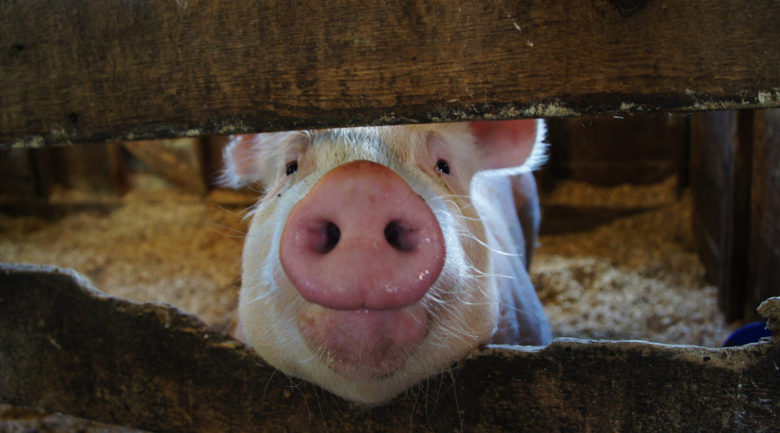
A pig peering through a fence (Steve Evans/Wikimedia Commons [CC BY 2.0])
In regions where veganism has become a trend, sales of meat and dairy products have declined, and the livestock industry has begun to feel a sense of crisis. In Europe, the livestock industry is lobbying governments to regulate the sale of non-animal products made to resemble meat as meat substitutes. While such tensions exist, this article has introduced the reasons why vegetarians and vegans choose not to eat animals. Perhaps it is time for us to rethink food, life, and the planet.
Note 1: Vegetarians who do not consume dairy but do eat eggs are called ovo vegetarians; those who do not eat eggs but do consume dairy are called lacto vegetarians; and those who consume both eggs and dairy are called lacto-ovo vegetarians.
Note 2: There are also fruitarians, adherents of a fruit-based diet that seeks not to kill even plants.
Note 3: Foods permitted in Judaism are called kosher, and in Islam, halal.
Writer: Mina Kosaka
We’re also on social media!
Follow us here ↓















畜産業界の動物の悲惨な状況を見ると、人間の自己中心さを改めて感じます。でもやっぱりベジタリアン、ヴィーガンになる勇気も強さもないです。でもでも今日はベジタリアンの日などと決めて、少しずつ取り組んでいきたいと思います。
ベジタリアニズムやヴィーガニズムの区別から、私が初めて聞くペスカタリアンやフレクシタリアンという概念まで、非常に勉強になりました。ありがとうございます。
肉の消費から議論する、食糧問題、環境問題は非常に興味があるとともに、今の若い世代が将来に備えて本気で考えなければならないテーマに対し、危機感を煽らされました。個人的な解決や結論にとどまることなく、大勢のコミュニティーの人、あるいは国単位、地球単位でこの問題に目を向けなければならないのは間違いありません。畜産業界だけでなく、経済全体と相談しながらこの議題を進めるべく、こうした記事によって世間が目を向ける流れを作る必要があると感じさせられました。
『肉と環境に関する問題はこれだけにとどまらず、さまざまな機関が次々と研究やデータを発表している。』このデータにも非常に興味をそそられ、自分でも調べてみたいと思います。リンク先の記事も非常に興味深いものでした。
私事ですが、私は現在「未来のエネルギー問題」を扱うゼミで勉めています。そこで議論するうちに行き着くのがやはり、環境問題や食糧問題でした。こちらの記事を拝読し、肉の消費とエネルギーという視点から、有効な解決へのシミュレーションが議論できるのではと考えています。こうした引き金が見つかり、大変嬉しいです。
これから、何を食べるか。日常から一歩身を引いて、考えてみたいと思います。
カースト上位層の思惑によって肉を口にしなくなったという歴史を持つ地域があることを初めて知りました。
ヴィーガンやベジタリアンと肉を食べる人の食事コストはどれくらい変わってくるんだろうか?
今後の技術の進歩で野菜を用いて今の肉と同様のものが食べられるようになればどんどんヴィーガンニズムが進んでいくと思うが現在ヴィーガンになることによって起こる不利益は肉を食べられないということ以外にあるのだろうか?
ヴィーガンに対しては、私自身あまりいい印象を抱いていない。
理由としては、フランスの複数の畜産業者に対して、ヴィーガンが攻撃したというニュースを見たからである。
もちろん一部の過激な人々のみではあると思うが、あくまで個人の選択によって食事の主義は決められるべきであって、暴力的な手段に訴えるべきではない。菜食主義の主張自体は素晴らしいのだから、そのコミュニティは、暴力には断固反対することをもっと対外的に主張していかないと、ヴィーガンコミュニティに対するイメージは下がる一方だろう。
このコメントから、なんだか、ヴィーガンがひとつの「組織」もしくは「人種」みたいに読めちゃいます。
ビーガンというのは「コミュニティ」として存在しているわけではなく、この記事にもあるように、多くの個人がさまざまな理由で、さまざまな形で肉や動物性のものをやめているわけで、組織で動いているわけではなく、何かがあったときに声明発表をするわけでもないのです。
魚介類についてはあまり記事では触れられていませんが、調べてみたところ、畜産業と同じような理由で魚介類を口にしない方もいるようですね。
どのような食生活を選択するかは各個人の自由だと思います。わたしもお肉もお魚もどちらも好きです。(野菜も好きです。)ただ、記事を読んで、どういう過程で生産されたお肉、お魚なのかは配慮したいなと思いました。ヴィーガンとかベジタリアンみたいな括りで、「良好な環境で生育された動物だけを食べる主義」っていうのに呼び名があったら、きっと賛同する人も多いと思うので、この主義を実践する人が増えて、だんだんと食料の生産過程も変わるのかなーって思いました。もう既にあるのかな?ありそうだけど
国によりますが、どういう過程で畜産が生産されたのかというラベルが肉のパックなどに貼られることもあります。
フェアトレード認証マークみたいな制度です。
アメリカだとこのような感じです:
https://awionline.org/content/consumers-guide-food-labels-and-animal-welfare
https://www.nytimes.com/2017/01/31/dining/animal-welfare-labels.html
私の周囲にもベジタリアンが少なくなく、この記事を通して、その人達の考えや思いを少しでも知ることができ勉強になった。
私個人としては、すぐに肉を食べない生活にするということは難しそうだが、日々の食事の中で色んな生物によって生かされているのだと感謝したいと思った。
ベジタリアンとヴィーガンの違いがわからなかったのですが、この記事で知ることが出来ました。ベジタリアニズムを実践する人の中でもペスカタリアンやフレクシタリアンなどの人がいるということも初めて知ることができて嬉しいです!
肉を食べないのは宗教が関係しているからだと思っていましたが、そういうことになっているだけで本当はバラモン階級の策略かもしれないというところを読んでとても衝撃を受けました。
生き物を人間の都合で消費するのは確かに良くないことだし、ヴィーガニズムを実践する人を本当に尊敬します。私もなれたら良いなとは思いますが、肉や魚や乳製品が食べられないのは想像できないし我慢もできる気がしません…
世界にはこのような人々がいるということや、動物達のむごい殺され方など、たくさん衝撃を受けたしとても勉強になりました。
今日から肉や魚を抜く、ということはできそうにないので、少しずつ自分にできることを考えて少しずつ実践していこうと思いました。あと、肉や魚や乳製品を消費するときに 、犠牲になってくれたことに感謝して食べようと思いました。
ベジタリアンとヴィーガンの違いがよくわかる記事でした。ありがとうございます。
ベジタリアンやヴィーガンについて、動物愛護のための菜食主義は個人的な問題だと思っていたが、、地球環境に菜食主義がこれだけ関与しているとは知らなかった。自分自身にも深く関わる大切な問題だと知れてよかった。今後、肉を食べない生活をするのは難しいけれど、何か小さいことからでも変えれたらいいなと思った。そのきっかけをこの記事が与えてくれました。
動物倫理の側面から畜産への疑問があり、また世界の食糧不足への配慮の必要を感じたこともあり、肉を食べることをやめました。ときどき生ハムを食べたい!というような気持ちになることもありますが、そのために苦しむ豚を思うと欲も消えてゆきます。肉を食べなければ生きていけないと思い込み、さまざまな問題から目を背けて生きていましたし、自分ひとりが肉を食べないくらいで世界は変わらないと思っていました。もちろん、世界そのものは変わらないかもしれません。世界を変えるためではなく、自分がどのように世界に在りたいかを表現しつづけるしかない。そんなふうに思いながら、気のすむまで続けてみようと思います。
起因として肉食で病気するからですよ。
昔はそういう知識があって宗教とかでも禁止されたのだと思います。無駄な殺生もそうですし、昔の人は食べて体調がどうなるかとか現代人より良くわかってますから。しかし科学的根拠というのが昔はついていかなかったので、殺生話だけ残ったのでしょう。
私は難病にかかり、食べ物やその摂取量、食べる時間などについて勉強していますが、昔は本能的に理解されていた知識が、科学的根拠が偉い時代になって、忘れ去られている事を知りました。
付け加えて、科学的根拠が追いついて事実が発表されるやいなや、商人たちがそれを防ごうと一生懸命マーケティングをしています。科学者を買収して保身するための発表を促した事件もあるほどです。
肉、一時的なパワーはガッツリ手に入っても同時に不要物も沢山体内に流れ込んでくるので、長期的に見て体に良くないですよ。
かといって肉食べて栄養取るように体が覚えてると急にヴィーガンやったところで体の舵取りがついていきません。
断続的な断食で体質リセットしながら肉を断つか、1-2年かけて少しずつ肉減らすしかないです。
肉を食べると欲深くなります。食欲、性欲、強欲、関係ないようですがとにかく欲が強くなります。食欲は強くなりすぎると自分を傷つけますし、その他の2欲は強すぎると他人を傷付けます。
菜食になると体がクリアになって、血液が浄化された感覚がよくわかります。体験した人にしか分かりませんが、肉を食べると次の日にはそのクリアさは失われるほどです。
菜食は長生きしないというデタラメがありますが、長寿の方全然おられます。肉を食べている長寿の人も、肉はごく少量です。体で処理できる量しか食べないのです。
文章も読みやすく、ソースも随時提示されていて、非常に丁寧な記事だと思いました。インドの菜食事情にはカースト上位層の権謀があったなど、知らなかった話も多く、大変勉強になりました。
両親の影響で幼い頃から魚釣りをしていて、釣った魚を食べるのが当たり前の環境で育ちました。食べるまでの工程を見ている分、命の重みは知っているつもりでした。それに、以前から人間も動物であるのだから動物を食べるのはかわいそう(=植物を食べるのはかわいそうではない)という考え方に疑問があり、その考え方にある意味人間至上主義的なものを感じていました。しかし、「肉食」に関しては動物愛護の観点や、よく耳にする宗教的な観点以外からも考慮すべきことが多いと知りました。食事一つをとっても、生きることの責任はとても大きいのだと感じさせられました。