
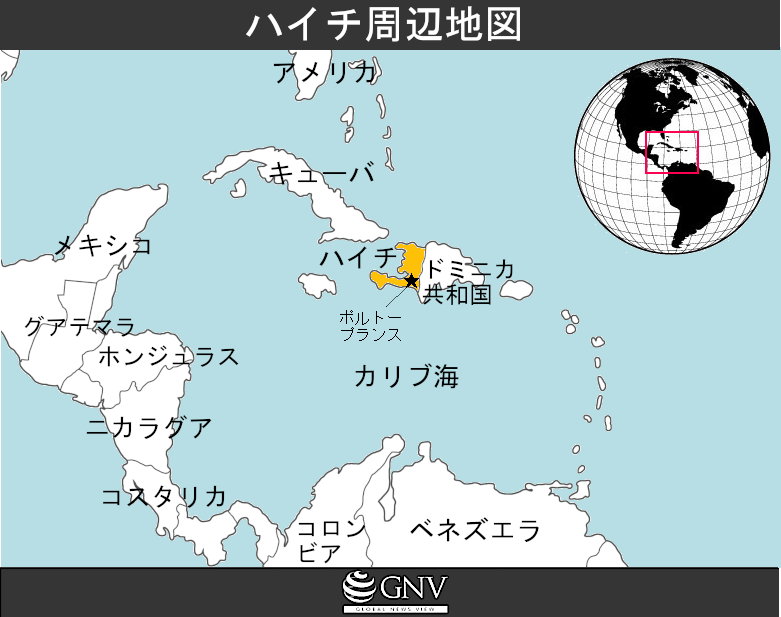
One day in February 2019, a private plane touched down at Port-au-Prince International Airport. The American mercenaries on board joined aides to Haiti’s president and proceeded toward the Bank of the Republic of Haiti. Their assignment: transfer $80 million into an account controlled by the Haitian president. If discovered, it would undoubtedly spark a major scandal… Is this a scene from a movie? No—these are all real events that took place in Haiti. What is happening now in this small Caribbean nation?
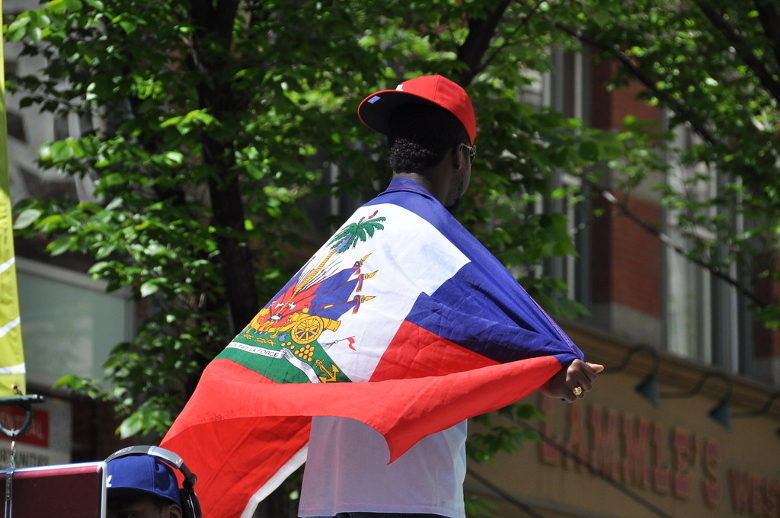
Man draped in the Haitian flag (acdallahh/ Flickr [CC BY 2.0])
Glorious independence and dictatorship
Today Haiti is often called “the poorest country in Latin America,” but during the French colonial era there was a time when it was described as “the richest and most productive” territory in the world. A major source of France’s wealth in its glory days was in fact Haiti’s sugarcane plantations, worked by 500,000–700,000 enslaved Africans. No account of Haiti is complete without its story of independence. In 1804, enslaved Black people rose up and won their rights from colonial France, creating the world’s first Black republic—Haiti. This news offered hope to the descendants of enslaved Africans throughout Latin America, while giving the slaveholding powers of Europe and the United States a pretext for various forms of obstruction and interference.
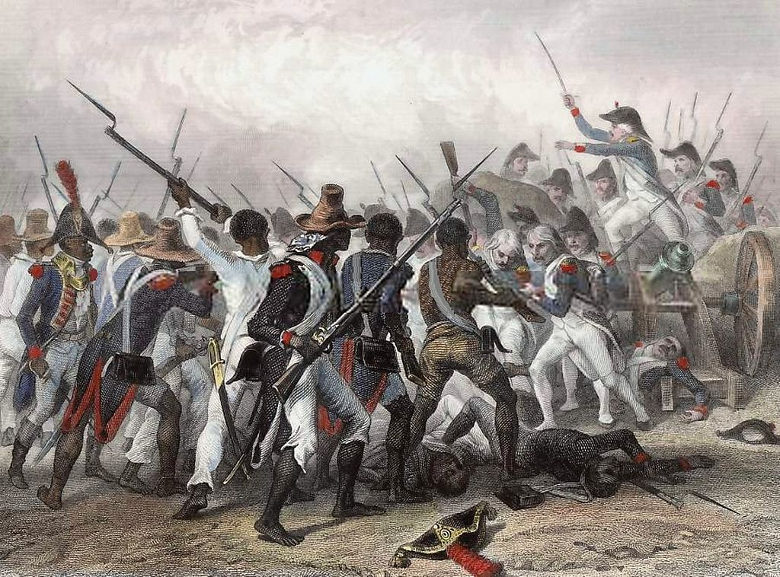
The Haitian Revolution (Illustration: Auguste Raffet /Wikimedia Commons)
The first great burden placed on Haiti was the enormous indemnity demanded as the price for recognition as an independent state. Having lost a massive source of revenue with Haiti’s independence, France demanded a whopping 150 million gold francs. Haiti fully repaid this over roughly 120 years, dedicating about 80 percent of its national budget to servicing the debt.
U.S. interference also contributed to Haiti’s suffering. Viewing the Caribbean as its backyard, the United States regarded Haiti alongside Cuba as an area of concern; in 1915, citing default, it occupied Haiti and imposed military rule. After 20 years of U.S. military administration came a period of turbulence between civilian and military governments. In 1957, François Duvalier (known as “Papa Doc”), a former physician, rose to the presidency on a wave of popular support but then became a dictator, later handing power to his son Jean‑Claude Duvalier (“Baby Doc”). Their family dictatorship lasted about 30 years until 1986. Beyond the wholesale looting of public finances, the regime’s secret police, the Tonton Macoute (official name: the Volunteer Militia for National Security), enforced harsh censorship. A human rights group estimated 60,000–100,000 civilians were killed or disappeared, and many others were imprisoned and tortured. That dark era seemed to end when nationwide protests in 1985 prompted the military to demand Duvalier’s departure, leading to his exile in France; yet protests and human rights abuses continued thereafter.
Intervention in the name of democracy
In 1987, a new democratic constitution was enacted. With a base of support among the poor, a figure who drew great expectations was former priest Jean‑Bertrand Aristide, who took office in 1991.
His time in office was turbulent. Less than a year later, he was ousted in a coup and went into exile in the United States. While Haiti fell under military rule, he worked to win international support; under a UN mission and the deployment of a multinational force, he returned to the presidency in 1994, albeit only “through his original term ending in 1995.”
Amid the ensuing political chaos, however, the United States pushed the Haitian government to adopt market and policy reforms favoring U.S. interests (Note 1). The first target was agriculture. Framed as a remedy for Haiti’s dire situation, the plan promoted imports of U.S. rice made cheaper by subsidies. As low‑priced rice flooded the Haitian market, domestic rice prices collapsed and local rice farming was devastated—damage that has lingered to this day. Former U.S. President Bill Clinton later apologized, saying there was no ill intent, but Haiti still relies on imports for most of its rice consumption; there has been no fundamental solution.
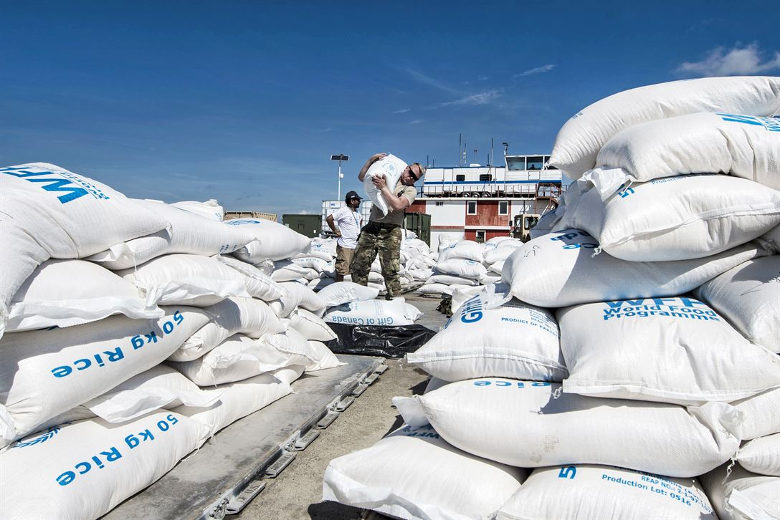
Piles of rice being brought into Haiti (Photo: Staff Sgt. Robert Waggoner /U.S. Dept of Defense)
After the term of René Garcia Préval beginning in 1996, Aristide became president again in 2000. Four years later, he found himself stuck far away in the Central African Republic, unable to return home. Why? In the background was a coup plotted by the United States and France and Canada. The Bush administration’s claim at the time was that, amid worsening security, Aristide had “voluntarily” gone into exile in the Central African Republic. This contradicts Aristide’s account that he was not told his destination until just before landing and was effectively kidnapped. Notably, a year before his abduction, Aristide had demanded that France return the indemnity payments. In addition, Aristide’s push to raise the minimum wage would have increased production costs for U.S. apparel manufacturers operating locally. These matters were likely not unrelated to the abduction.
Contrary to expectations, wage‑hike demands did not subside after Aristide’s departure. According to U.S. diplomatic cables released by WikiLeaks, the United States took a hard line: in 2009, the U.S. embassy pressured subcontracted factories in Haiti’s garment sector to keep the minimum wage at 24 cents per hour. Although the Haitian government compromised and parliament set the minimum at $3 per day, that fell far short of the $12.50/day estimated to support a family of three in Haiti.
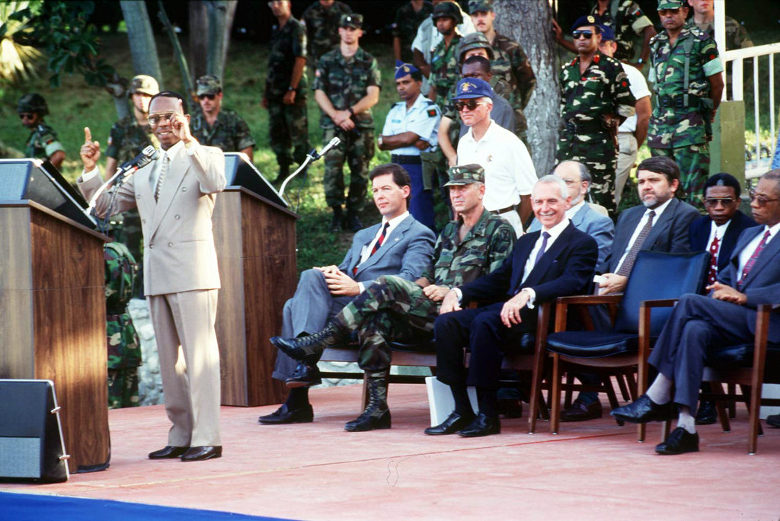
Former President Aristide speaking with a smile in the 1990s, alongside U.S. government and military officials (Photo: Expert Infantry /Flickr [CC BY 2.0])
Then on January 12, 2010, amid ongoing turmoil, a devastating magnitude‑7.0 earthquake struck. The toll was immense: 300,000 dead; about 3.7 million people affected—roughly one‑third of the population; losses totaling 780 million yen, 1.2 times the country’s 2009 GDP; and a cholera outbreak. As the country descended into a level of chaos rarely seen in the world, U.S. intervention policy once again began to take shape.
Less than 24 hours after the quake, the conservative think tank Heritage Foundation, which wields significant influence over U.S. policy, proposed to the U.S. government that it cancel public housing construction plans, set up tax‑free enterprise zones, and remove minimum wage provisions. While couched in terms of “reconstruction,” the proposal was poised to create jobs and profits primarily for U.S. contractors rather than jobs within Haiti. For some reason, the statement was quickly withdrawn.
A turbulent present
In 2011, in an election financed by contributions from the United States, France, and Canada, singer Michel Martelly was elected president with a low vote share of 16.7%. He was dogged by allegations after taking office, including embezzlement and money laundering. For example, since 2008 Venezuela had supported Haiti financially through oil supplies (the PetroCaribe fund (Note 2)), but under Martelly’s administration most of those funds went missing. His successor, current President Jovenel Moïse, also appears to have embezzled funds. Reports say about $2 billion was siphoned off over eight years.
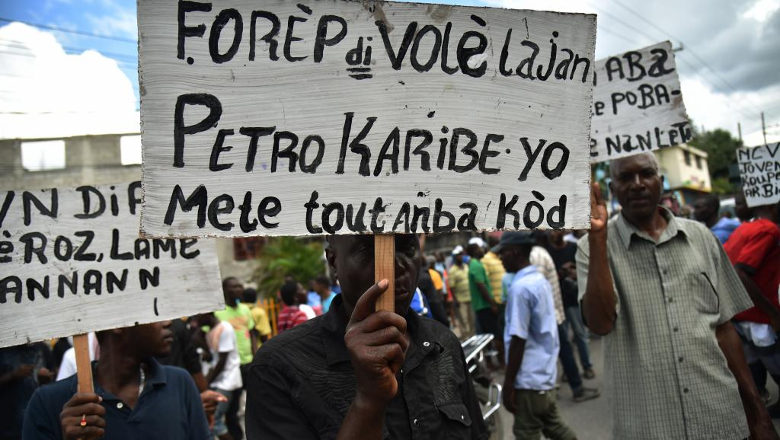
Demonstration over PetroCaribe (Photo: Medyalokal /Wikimedia Commons [CC BY-SA 4.0])
But Venezuela’s economy (Note 3) eventually reached its limits (for details, see this article), and in 2017 PetroCaribe ceased to function. The impact on Haiti was, predictably, severe: fuel shortages, electricity shortages, and extreme inflation. Seeking relief, in July that year, under guidance from the International Monetary Fund (IMF), the government considered raising fuel prices, including a 51% hike in kerosene. Protesters pushed back, and the movement grew; the prime minister who sided with the masses clashed with the president and was forced to resign. The government’s decision to join the United States in issuing a statement withdrawing recognition of its benefactor, Venezuelan President Maduro’s government, further inflamed public anger.
It was President Moïse who scrambled. Public anger did not subside, revenues dried up, and there was no money left to stabilize the situation. This brings us back to the opening. In a desperate move, the plan was to transfer $80 million in operating funds from a petroleum fund managed at the Haitian central bank—funds said to be inaccessible without the prime minister’s consent—into the president’s account. The scheme was exposed; the account was frozen, and the mercenaries were arrested. However, they quietly returned to the United States without ever being brought before a court.
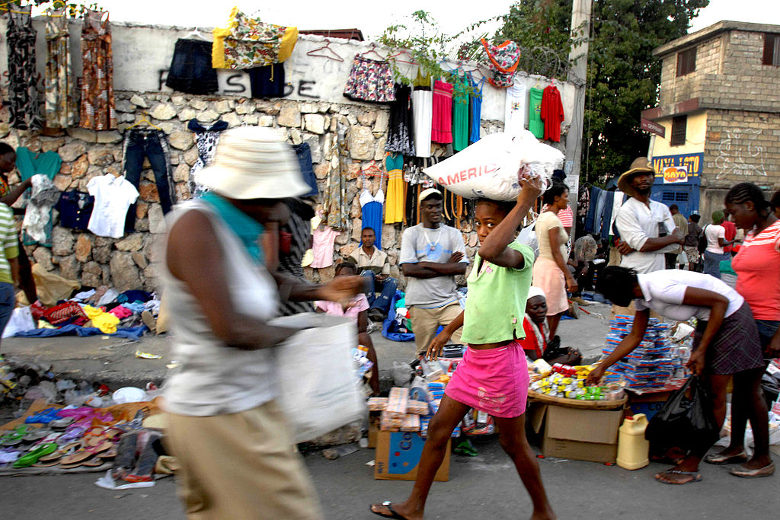
Girl carrying U.S. rice at a street market in Port‑au‑Prince (Photo: Fred W. Baker III /Wikimedia Commons)
Since achieving independence as the first republic founded by former slaves, Haiti has ironically been buffeted by foreign military, political, and economic interventions. On top of political instability, disasters have struck, and the country seems to be at an impasse on multiple fronts—starting with a lack of funds. What does the future hold for this nation?
Note 1: Refers to the “shock doctrine,” a concept advanced by journalist Naomi Klein.
Note 2: PetroCaribe is an oil alliance composed of host country Venezuela and 17 member countries. Through this alliance, Venezuela supplied oil at an affordable $100 per barrel. Haiti also participates in the PetroCaribe fund, which allows members, after receiving in‑kind oil supplies, to use part of the proceeds from domestic sales for their national budgets.
Note 3: Venezuela is currently in turmoil, with two presidents and a migration/refugee crisis. For details, see this article.
Writer: Yuka Ikeda
Graphics: Saki Takeuchi
We’re also on social media!
Follow us here ↓


大国が経済的、政治的、軍事的に水面下でこんなにも圧力をかけていることをこの記事を読むまで知らなかった。
不法資本流出のように、大国が途上国を搾取することで潤う実質的な帝国主義が今も続いていることを改めて思い知った。
歴史的な問題をはじめ、大国からの圧力、自然災害など、ハイチを苦しめる要因がこれほど多くあることを初めて知りました。
簡単に解決できる問題ではなく改善には長い時間を要しそうであり、心が痛くなりました。
何でハイチがフランスに賠償金を払わなければいけないの??
何でアメリカに最低賃金上げるの反対されないといけなの??
軍事政権民主政治大統領まで全部操られて
地震後に制度も利用されて
こんな悲しいひどいことってあるんだ、、と驚きました。
アメリカやフランスといった大国からこれほど干渉を受けている事実を初めてりました。特に、災害を利用して介入を強めたことには衝撃を受けました。さらに、国を良くする立場にある大統領までも国民が苦しんでいる現状にかまわず汚職を行っていて悲しく感じました。問題は複雑ですが、この状況を多くの人に知ってもらうことが改善の一歩につながると思いました。
民間軍事会社の人たちがハイチ中央銀行付近で逮捕された事件について、
かなり詳細で証拠(第1資料)付きの調査報道の長い記事が出ています。
https://cepr.shorthandstories.com/haiti-contractors/index.html
どう見ても極めて怪しい事件ですね・・・
植民地責任論に代表されるように、強国優位の構図は戦争が終結したとされようと、根強く残っているのだと少し意識すれば気づきます。おかしな話に違いないのに、声を上げるべき人や国が声を上げない。このままじゃ何も変わらないと感じます。
We are a gaggle of volunteers and starting a new scheme in our community.
Your site offered us with valuable information to work on. You have
done a formidable task and our entire group can be grateful to you.
What’s up, of course this article is in fact pleasant and I have learned
lot of things from it regarding blogging. thanks.
you’re really a excellent webmaster. The site loading pace is incredible.
It kind of feels that you’re doing any unique trick. Also, The contents
are masterpiece. you’ve performed a wonderful task in this matter!
Howdy very nice blog!! Man .. Excellent .. Superb .. I will bookmark your web
site and take the feeds also? I am happy to seek out so many useful info right here in the publish, we need develop extra techniques in this regard, thank
you for sharing. . . . . .