
What kind of image do we hold of North Korea as a country? Fear of abductions and missiles? Anger at human rights abuses? A socialist one-party regime on the verge of collapse? Scholars have put such images into words as “Incomprehensible” and “Insult and Fear.”
So then, where do we usually get information about North Korea, a country that is difficult to visit even as a traveler? North Korea has an official website called “Uriminzokkiri,” which can be viewed in Japanese. The state news agency, the “Korean Central News Agency,” also distributes news in English under the name “Korean News,” but few people likely check those sites on a daily basis. Since it’s not as if we can easily find snapshots of everyday life on social media, most of the information we get about North Korea seems to come from what we see and hear in Japanese TV and newspapers.
However, because it is difficult for foreign media to report freely and independently inside North Korea, outlets end up using the same information sources and are compelled to rely on photos and footage from North Korean authorities. While the uniformity of facts that make up the news is undeniable, the “cooking”—the effort to add originality through presentation—plays a big role. It is therefore highly likely that the image of North Korea we hold is greatly influenced by how it is presented by Japanese media. In this article, we analyze the TV footage itself and examine how the media portrays and frames North Korea by comparing coverage before and after major events surrounding the country.
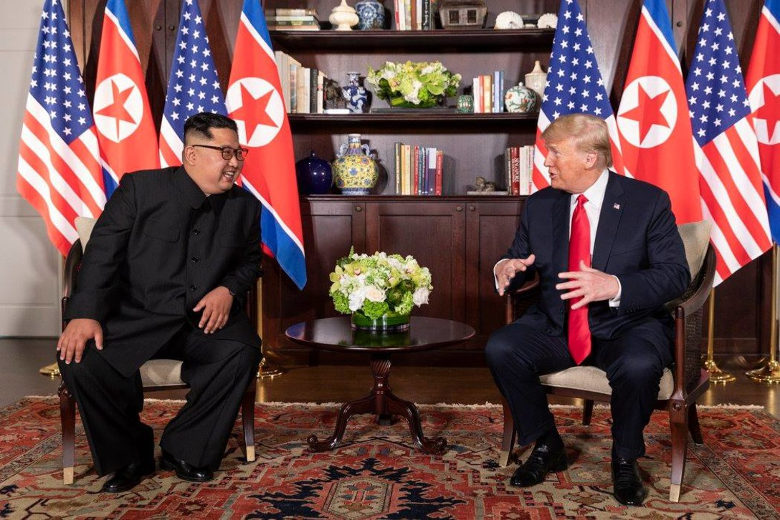
Photo: Kim Jong Un and President Trump at the U.S.–North Korea summit on June 12, 2018 (Photo: Shealah Craighead, White House Photo)
NHK coverage of the U.S.–North Korea summit
The image is from the U.S.–North Korea summit held on June 12, 2018. This event in Singapore was the first-ever meeting between the leaders of the United States and North Korea, and together with the second summit in Hanoi, is still fresh in our memory. Did the portrayal of North Korea’s third leader, Chairman Kim Jong Un, change? Here, we examine NHK’s nightly news program “News Watch 9” as a case study.
News Watch 9 is a weekday news program that airs from 9:00 to 10:00 p.m. Examining 43 editions over the month before and after the summit (May 12–July 12) (※1), we found that it carried news about North Korea on 25 days, totaling 203 minutes.
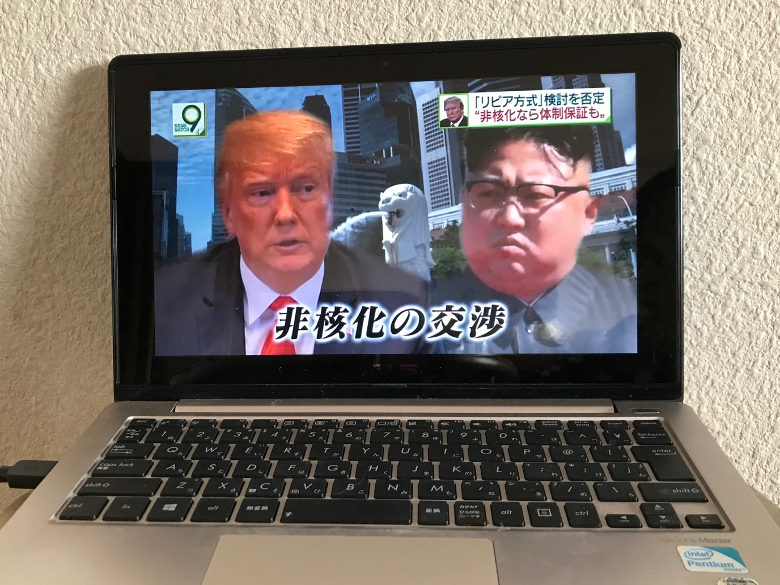
President Trump and Chairman Kim Jong Un appearing to lock eyes in a stare-down (May 18)
In the month before the summit, coverage appeared on 15 days (totaling 118 minutes), whereas in the month after it ran on 9 days (totaling 46 minutes), a significant difference. The volume increased before the summit as the daily confusion over whether it would actually take place was reported, and then decreased afterward, likely also because of the Osaka earthquake and the torrential rain disaster in western Japan. On June 12, the day of the summit, 39 minutes—two-thirds of the program—were devoted to related news.
In terms of content, there were many reports on the process of North Korean and U.S. officials coordinating the summit, as well as analysis by experts and NHK correspondents in Washington and Seoul. There were also features on films and photo books that attempt to capture the lives of North Korean citizens (May 16, June 28), but much footage from Korean Central Television was used, and many press conferences by President Trump and the families of abductees were included. On the day before and the day of the summit (June 11 and 12), anchor Yoshio Arima reported live from Singapore, showing footage of the meeting and scenes from around the city.
Chairman Kim’s actions in the spotlight
So, did the “presentation” of North Korea—and especially Chairman Kim Jong Un—change around the time of the U.S.–North Korea summit? First, the graph below compares which of Chairman Kim’s actions were selected and used as footage in the month before and after the summit, excluding the day of the summit itself (※2).

Loading…
Before the summit, there were many scenes of Chairman Kim “speaking”: footage overlaid with narration while he appears to be talking to someone unidentified, scenes of him addressing the Korean People’s Army, and meetings with South Korean President Moon Jae-in and the Russian foreign minister. By contrast, after the summit, footage of Chairman Kim shaking hands with President Trump and the two strolling around the venue hotel was used for longer stretches.
Before the summit, his facial expressions alone were often isolated without context, making it hard to tell what he was doing. As in the photo above, images were edited to show President Trump and Chairman Kim’s faces on the left and right of the screen as if facing off or glaring at each other, accompanied by narration like, “The summit is only X days away….” After the summit, however, such editing decreased, and longer shots of Chairman Kim shaking hands or walking were shown.
Also, footage frequently seen before the summit—Chairman Kim saluting the military or gazing at the troops—appeared only once after the summit, making it harder to project an image of Chairman Kim showing a stern face before the military.
The smiling supreme leader
Next, as part of analyzing Chairman Kim’s expressions, we measured how long his “smile” appeared on screen. Here, we define a smile as the corners of his mouth turning upward. The graph below shows, over time, the percentage of the seconds in which footage of Chairman Kim was used that showed him smiling.
Loading…
From this graph, we can see that the time he is shown smiling increases from before to after the summit. Even excluding the day of the summit, more than 50% of the footage of Chairman Kim in the month after showed him smiling. If one were to judge based solely on the news after the summit, rather than the initial image of an “incomprehensible dictator,” a softer impression—of someone promoting international cooperation—would surely come to the fore. With the nuclear and missile issues and human rights issues beginning with the abductions still unresolved, this trend risks giving a biased impression of Chairman Kim.
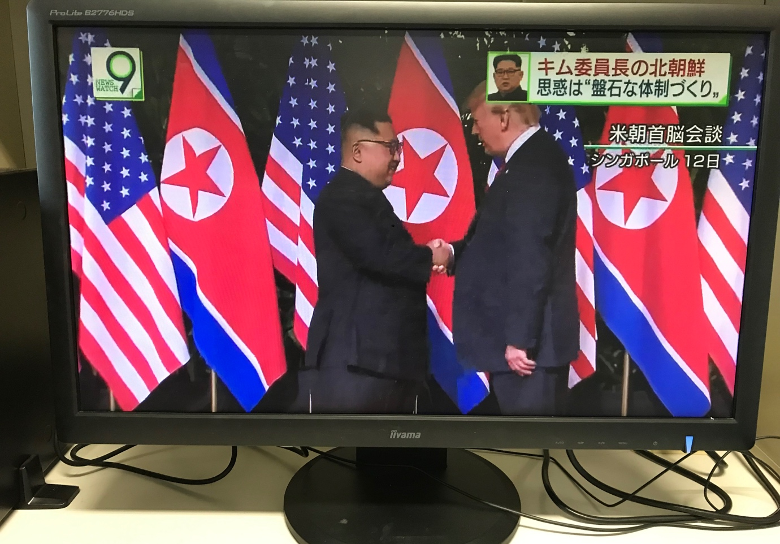
Chairman Kim Jong Un smiling as he shakes hands with President Trump (June 28)
Before the summit, the same footage—such as Chairman Kim speaking to someone in front of a white wall—was repeatedly used as a backdrop in various contexts. After the summit, however, that footage was used far less, and summit footage made up the majority. Overall, what stands out in this analysis is the limited variety of archival footage shown on screen. That is precisely why the Singapore summit footage—where media from around the world could film Chairman Kim—was valuable, and it may be one reason why smiling images of him were often used even after the summit.
Footage is also “constructed”
Even when the background footage is the same, narration and on-screen text superimposed on it can easily manipulate the impression he gives. As in the photo below, there was footage that used Chairman Kim’s gesture of adjusting his glasses as if it depicted him plotting to cancel the summit. One could call it the product of the video maker’s imagination, but it is unlikely that Chairman Kim adjusted his glasses with that intention. This reminds us how easy it is for the media to snip out part of the footage and make it “speak” as if the message came from the subject.
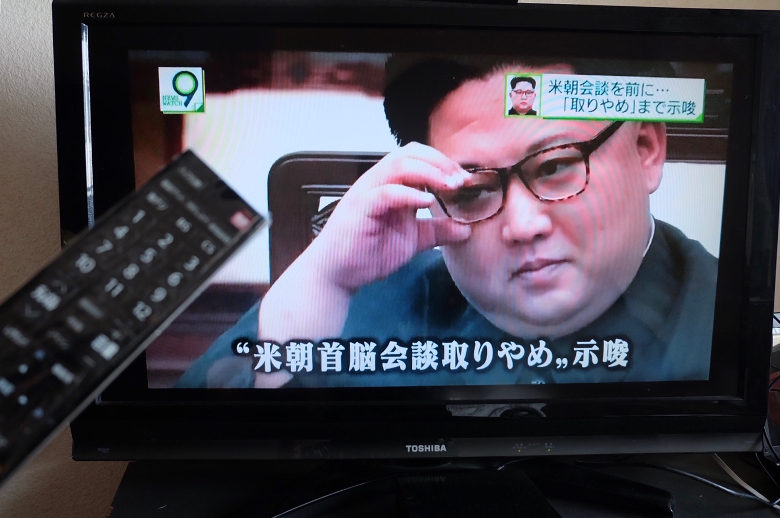
Making the gesture of adjusting his glasses look mysterious (May 16)
By changing which actions are selected and which expressions are highlighted, it is surprisingly easy to manipulate the viewer’s impression. Just as that U.S.–North Korea summit was criticized as a mere “political show,” we too may have been swayed by the way the media turned it into a “show.” Media literacy that includes a critical eye toward each and every scene is required of us.
※1 During the period there were nine Saturdays and Sundays, and there was one suspension due to a soccer broadcast (June 19). Also, on July 6 there was a two-hour broadcast devoted to heavy rain disaster coverage.
※2 Kim Jong Un’s actions were divided into 10 categories—speaking; facial expression; walking; handshake; military parade (saluting, gazing at the military); waving; clapping; hug; photo op; signing—and the number of instances was counted.
Writer: Shiori Yamashita


報道される指導者の行動を分析するという観点が面白かった。
確かに、私自身も米朝会談で金正恩の印象は良くなっていたことは否めない。
報道の切り取られる部分によって無意識に誤ったイメージを付けられる危険性を自覚した上で、批判的に物事を捉えていきたいと再認識させられた。
“疑うことが重要だ”と口で言うのは容易いけれど、いざ振り返ってみると想像以上にメディアに洗脳されている自分がいるのに気づいた。