
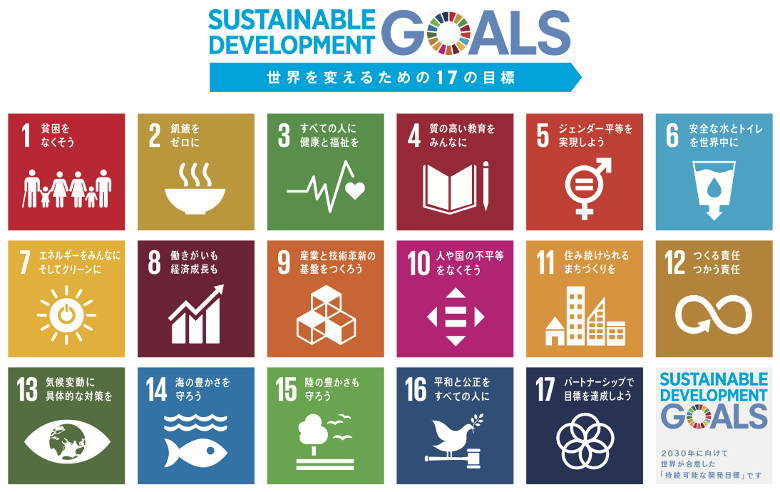
Around the world, problems such as poverty and hunger, inequality and climate change are piling up, at times threatening people’s human security and even preventing them from living with dignity. As many as 800 million people live in extreme poverty, and inequality among people and countries is widening. In order to quickly move toward solutions to these issues, in 2015 the United Nations set the Sustainable Development Goals (Sustainable Development Goals: SDGs, hereinafter “SDGs”). The 17 goals list global challenges—poverty, labor, inequality, climate change, and more—that must be addressed by 2030.
The term SDGs has likely become familiar in Japan as well. One reason SDGs has permeated Japanese society is that the term is used in many contexts, including news coverage. Recently, a variety of actors—government, businesses, NGOs—have been running campaigns, events, and projects using this framework. But how many of the narratives truly capture the essence of the problems the SDGs address? Here, we focus on news reporting and analyze how the SDGs are being covered.
United Nations Department of Public Information / Hakuhodo Creative Volunteer
Background to the formulation of the SDGs
Before analyzing media coverage, let’s look a bit more closely at the SDGs. In September 2015, at UN Headquarters in New York, the SDGs were presented as the outcome document of the “UN Sustainable Development Summit,” titled “Transforming our world: the 2030 Agenda for Sustainable Development.” The SDGs set out 17 goals and 169 targets to address the world’s many challenges. The areas covered extend far beyond eradicating poverty to include gender, education, health and healthcare, environmental issues, labor issues, and even food and peace. Each of these goals interrelates with the others in a comprehensive and inclusive manner, aiming to end poverty in all its forms and manifestations, fight inequality, and tackle climate change.
However, this is not the first time international development goals have been set. For example, in 2000 the Millennium Development Goals (MDGs) were established to address global challenges that needed to be solved by 2015. While some targets were achieved under the MDGs, there remained problems in fully meeting the goals. Solving poverty was listed as the first MDG. The target of “halving, between 1990 and 2015, the proportion of people living on less than $1 a day” was said to have been achieved by 2015. However, this was largely due to China’s rapid economic growth and developments in India. Globally, in some regions the proportion of people living in extreme poverty was not halved. On the African continent as a whole—where people in extreme poverty are concentrated—the number of people living in poverty did not halve; rather, the number increased. Other MDG targets, such as reducing under-five mortality and improving maternal health, showed improvement but did not meet the numeric targets.

Loading…
Thus, the SDGs were set out as goals to solve the world’s problems over the next 15 years. Whereas the MDGs focused mainly on issues in developing countries, the SDGs aim to solve challenges through a comprehensive view of the entire world. This is reflected in “Goal 17: Partnerships for the Goals.” Solving today’s global challenges requires diverse stakeholders to engage with global problems and for the whole world to cooperate and take action. Moreover, because there were significant delays in achieving goals in certain regions under the MDGs, the SDGs adopted as a core concept the slogan “no one will be left behind.”
How is it being reported?
Behind the formulation of the SDGs lie numerous challenges the world cannot ignore. So how have Japanese news outlets framed the problems underlying the SDGs, their remedies, and their possibilities and limits? Searching the Yomiuri Shimbun database for the past five years (2014–2018) for articles containing the term “SDGs” or “Sustainable Development Goals” returned 104 articles.
From 2014 to 2018, the number of SDGs-related articles gradually increased. When we look at the number of articles every six months, the trend is as shown in the graph below.
Loading…
First, note that from 2015, when the SDGs were adopted, through the second half of 2017, SDGs were hardly a topic in terms of volume of coverage. Even so, there was a slight increase in the first half of 2016. What lay behind this temporary uptick? Looking at reporting from January to June 2016, roughly half of the articles were related to the 42nd G7 Summit (Ise-Shima Summit). On May 20, 2016, ahead of the summit, Japanese Prime Minister Abe, who also chaired the summit, announced Japan’s contributions to the SDGs at the “SDGs Promotion Headquarters,” indicating that the G7 took SDGs into account at its first summit since their adoption. However, among the G7’s main agenda items—global economy and trade, political and diplomatic issues, climate change and energy—development appeared as a separate item, and the SDGs were only touched on within that. In other words, while the SDGs were acknowledged at the G7 Summit, they did not become a main agenda item.
The articles analyzed show a similar pattern. That is, while SDGs appear in the text, none of the pieces made SDGs a primary theme in connection with the Ise-Shima Summit—for example, by focusing on achieving the goals. This tendency to follow summits is evident in GNV pieces that examined poverty in Africa and the plastic waste problem.
Furthermore, the number of articles rose sharply in the second half of 2017 and then continued to grow over the first and second halves of 2018. One factor behind the uptick in late 2017 was comedian Pikotaro’s performance at the UN High-level Political Forum in July 2017. At the forum, Pikotaro presented a UN version of PPAP (Public Private Action for Partnership). The performance has been viewed more than 250,000 times on YouTube, and may have helped raise awareness of the term SDGs in Japan. Of the seven articles in July 2017, four mentioned Pikotaro. Perhaps reflecting that trend, 2018 saw the highest number of articles containing the term SDGs or Sustainable Development Goals: 48 pieces, or about four per month. The month with the most such articles in 2018 was November, with 13. So what did these articles report? Below, we analyze the content of SDGs-related reporting in more detail.
SDGs coverage for the sake of the Expo?
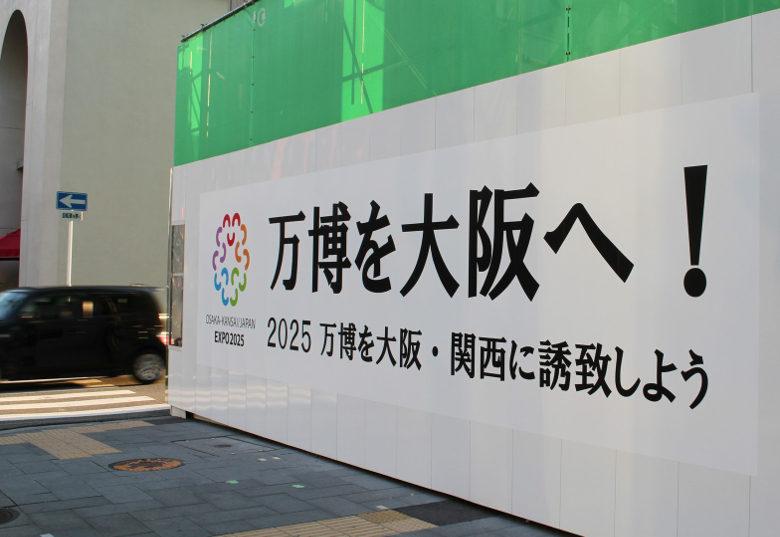
Looking into why article counts rose in November 2018, we find that about half—seven of the 13—were related to the 2025 Osaka Expo. As the purpose of the Expo, a society in which the national strategy “Society 5.0”—fusing cyber and physical space to bring richness to people’s lives—and the SDGs are achieved is presented.
The SDGs framework used in the Expo bid appears in newspapers in the same way. Yomiuri Shimbun’s coverage also notes that the Expo sets out to support the achievement of the SDGs, describing it as an Expo conscious of solving international issues (Note 2). However, when considering how proactive the Osaka Expo actually is toward achieving the SDGs, the bid proposal’s lack of specificity leaves some doubts. Is it just me who feels that the rhetoric of “contributing to the SDGs” was cleverly used for the sake of the country (to win the bid) rather than out of genuine commitment?
A billboard calling for Osaka to host the Expo (Photo: GORIMON/Flickr [CC BY-NC 2.0])
In the second half of 2018, there were 27 articles containing the term SDGs or Sustainable Development Goals, and 10 of them—about 30%—were Expo-related. Among these, there were hardly any that reported concretely on the global challenges the SDGs set out. If even reporting on the Expo scarcely addresses the issues raised by the SDGs, can we really call it an “Expo that contributes to the SDGs”? The structure of newspapers chasing the bid committee’s rhetoric of an “Expo contributing to the SDGs” mirrors the SDGs reporting around the G7 Summit.
Thus, while the terms SDGs and Sustainable Development Goals are being used in many arenas, it remains questionable whether there is a proper understanding of the problems behind the SDGs and how to achieve each goal. We therefore dug deeper into what topics are being reported in connection with the SDGs, focusing on poverty. Of the 104 articles in our sample containing SDGs or Sustainable Development, 50 included the word “poverty.” However, in most cases “poverty” was used merely as part of a general overview of the SDGs. Only six of the 104 articles discussed global poverty or poverty in developing countries alongside the term SDGs.
How, then, was poverty in the world or in developing countries discussed in relation to the SDGs? Take, for example, an article from November 8, 2016. It introduced a Japan-based NPO working on maternal and child health, touching on Zambia in southern Africa as a site of its activities. Across the five years examined, there was only one case where a developing country could barely be considered the main theme. Even among the mere six SDGs-related articles that addressed poverty in the world, there were almost none in which poor or developing countries were the primary actors. Even in the Yomiuri Shimbun, Japan’s largest newspaper by circulation, reporting that connects global poverty and the SDGs is very limited. Moreover, beyond poverty, there is little focus on regions and people that most urgently need solutions to problems such as inequality, hunger, climate change, and peace.
Toward reporting that can truly engage with the SDGs
Current Japanese coverage of the SDGs cannot be said to report in detail on the problems behind the SDGs or their solutions. Rather, it could be interpreted as using SDGs as a keyword to attract readers’ interest to domestic topics.
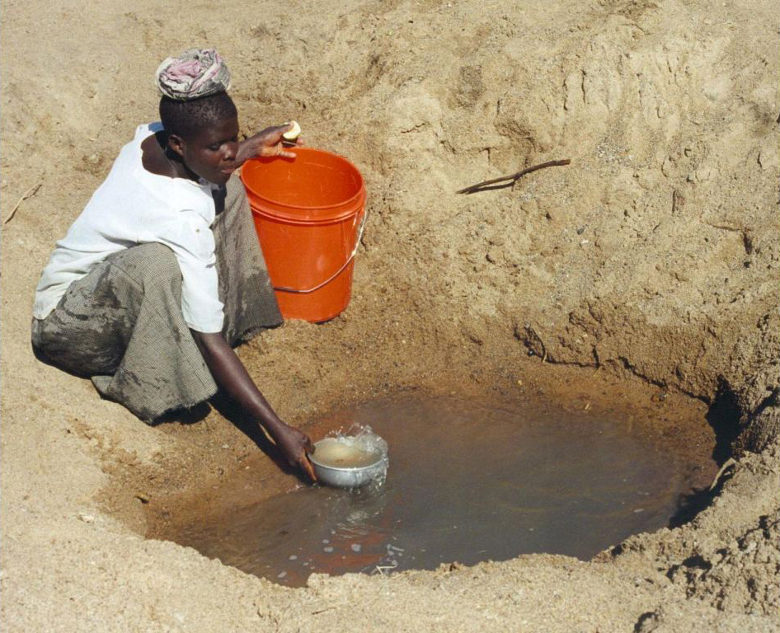
Of course, as noted repeatedly, the SDGs do not limit their scope to developing countries. That is because the core issues of the SDGs—economic growth, social inclusion, and environmental protection—exist in every society. For example, as the widespread use of the term “child poverty” indicates, there are problems of poverty and inequality within Japanese society as well. Absolute poverty and hunger, and inequalities among countries that threaten human dignity, are urgent problems around the world. Taking action as global partners toward solving these problems is also imperative. In other words, achieving the SDGs requires action that looks beyond domestic issues to the world at large.
A woman drawing water at a village water source in Tanzania (Photo: Bob Metcalf/Wikimedia (Public Domain)
To repeat the point made at the outset, around 800 million people still live in extreme poverty, and inequality among people and countries is widening. At the current pace, the proportion of people in Africa living in extreme poverty will be about 10% in 2050—20 years after the SDGs’ target year. In other words, at this rate, even by 2050, twenty years after the SDGs’ target year, extreme poverty will not be eradicated worldwide.
We cannot speak of “leaving no one behind” without focusing on the most marginalized and most vulnerable people. Otherwise, “leave no one behind” is merely a hollow concept, and we will fall far short of achieving the SDGs. As we have seen, reporting on the SDGs and the problems behind them presents a very limited view. Given this situation in the media—which is supposed to play the role of informing us about the world—how much can we deepen our understanding of the world’s many problems? As GNV has covered, globalization has advanced to the point that the world’s problems and our lives are inseparable. The many issues set out in the SDGs are problems that concern us.
Note 1: Based on World Bank data. “Poor” here is calculated using the World Bank’s absolute poverty line of $1.90 per day. For South Asia, data for 1999 and 2015 were unavailable, so 2002 and 2014 data were used instead.
Note 2: For example, Yomiuri Shimbun, November 25, 2018, “Osaka Expo: Dream Space on the Sea—Decision to host in 2025 = Feature,” and Yomiuri Shimbun, November 25, 2018, “Balancing Environment and Economic Growth; Emphasizing the Warmth of Osakans; Final PR for Expo.”
Writer: Janet Simpson












実際SDGsが目指しているものと、日本の政府、企業、報道によるSDGsの見せ方との間に、
差があまりにも激しすぎて、全然違うものを見てるかのように思ってしまいます。
日本の政府、企業、報道の見せ方では、「SDGsに貢献しています!」とアピールしながら、
SDGsをいかに自国、自社にとってのチャンスにするものなのか。このようにしか見えません。
アフリカの話をほとんどせずにSDGsを語っているところがあまりに現実離れをしてます。
少なくとも肝心なゴール1(極度の貧困の撲滅)に関しては、このままだと2030年までにその達成に近づきそうにありません。
報道はこのような指摘をしなければいけないのに、結局のところ、アフリカなしで、自国政府と企業側からしか捉えられていません。
ちょっとした募金、ちょっとした工夫、ましてや自国・自社のアピールポイントや祭り騒ぎで済むような話ではありません。
本格的に世界を見つめ直して、本格的に取り組むしかありません。
自分の利益のために、SDGsをレタリックとして使ったという構図が、近年企業が重視しているCSRの話と似ているなと思いました。
企業が利益を得る上で、貧困を助長しているものも多々ある中で、自社のイメージアップという利益を得るために、CSRをレタリックとして使っているように感じています。
なぜCSRを果たす必要があるのか、SDGsを達成する必要があるのか、しっかりととらえ直す必要があると思いました。
じ