
On this planet, an enormous variety of animals live. Humans have long coexisted with animals, sometimes viewing them as food, sometimes as pets, and at times as threats to our lives. On television, we see them through entertainment programs starring adorable pets and documentaries on wildlife. Even on TV news, coverage of zoo animals is often presented with a certain entertainment value. It is not hard to imagine that lions on the savanna and pandas and penguins at zoos are frequently featured. So then, in newspapers—which provide more serious reporting that does not rely on visuals—which animals are covered, and from what perspectives?

Roaring lion cub (Photo: Casino Lobby/Flickr [CC BY 2.0])
Overview of reporting on animals
In this study, we examined, for the Asahi, Yomiuri, and Mainichi newspapers, the total number of characters in international-section articles concerning animals over the five years from 2013 to 2017. The total came to 185,215 characters, which accounts for less than 1% of all international reporting by character count. By region, Asia was the largest at 66%, and compared with the overall trend in international coverage, the share for Asia was remarkably high. This was likely due to the great number of articles about China related to avian influenza and pandas, as well as many pieces on the ivory trade and fisheries issues between Japan and Taiwan. Looking at countries globally, China accounted for roughly 30%, which is also a large figure compared with its share in overall international reporting. Europe (10%) and Africa (10%) followed with relatively higher shares, while Oceania (5%), North America (4%), and Latin America and the Caribbean (0.7%) were very small. Distinctive here, compared to other types of coverage, is that North America’s share was quite small, whereas reporting on Africa was about three times its share in overall international news. In Europe, North America, and Africa, the animals featured were varied, but in Oceania, most articles were about whales. This stems from disputes over research whaling between Japan and Australia/New Zealand and litigation at the International Court of Justice.
Comparison by category
So, in what contexts do animals appear in articles? First, we classified how animals are featured into five categories—animals as human food; animal protection/decline; animals as threats to humans; animals as spectacles; and animals related to politics, such as pets of political leaders or those involved in diplomacy—and compared the total character counts.

Loading…
Comparison by type of animal
So, which animals were most frequently covered? Comparing the total character counts of articles whose headlines included an animal’s name, the results were as follows.
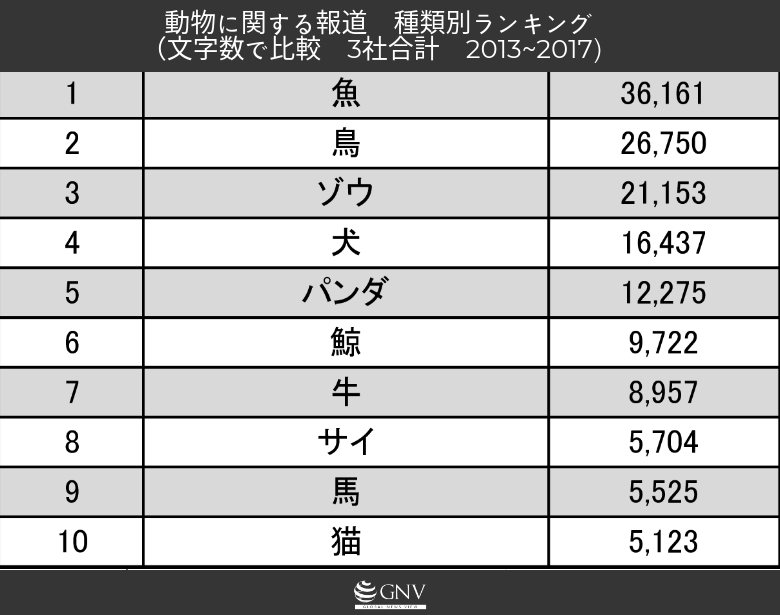
Reporting on animals: ranking by type
Looking at the animals that ranked highest, for fish/fisheries, which came in first, more than 80% of the coverage was fisheries-related in the context of food. Asia accounted for over half of the related regions, with an overwhelming number of articles about the fisheries agreement between Japan and Taiwan. Next most common was Europe, where most articles concerned Russia’s food embargo against the West.
Next, birds ranked highly. Regarding birds, more than 80% of the articles that treated animals as threats were about birds. This is because there were many articles on avian influenza. In 2013, human infections with avian influenza virus were confirmed in China, and since then increases in the numbers of infections and deaths have been widely reported. According to reports by the World Health Organization (WHO), from the outbreak in 2013 through September 13, 2017, total deaths exceeded 600. As a result, over 80% of the articles whose headlines included birds were related to China. While articles about birds reported as threats exceeded 20,000 characters, articles whose headlines referred to chicken as meat totaled only 4,300 characters.
Elephants, which ranked second, had over 90% of their coverage in the protection/decline category. The high volume of reporting on elephants was due to the ivory poaching issue becoming a focal point at the 2016 Conference of the Parties (COP17). Most pieces took the perspective of opposing ivory poaching and seeking to protect elephants. By region, Asia accounted for over half, followed by Africa at just under 40%. There were also a few articles that framed elephants as threats, covering incidents in which people were attacked or killed by elephants.
With regard to dogs, many articles were about dogs as food, accounting for one-third. This was because criticism of China’s “dog meat festival” intensified for a time, concentrated in 2014 and 2015. Many of the articles on dog meat took a critical view of treating dogs as food. Next most common were pieces classified as political, such as pets of political figures or animals used for diplomacy. Examples included the Akita dog presented by Japan to Russia’s President Putin, and news about the pet dogs of former President Park Geun-hye that were left behind at the presidential residence.
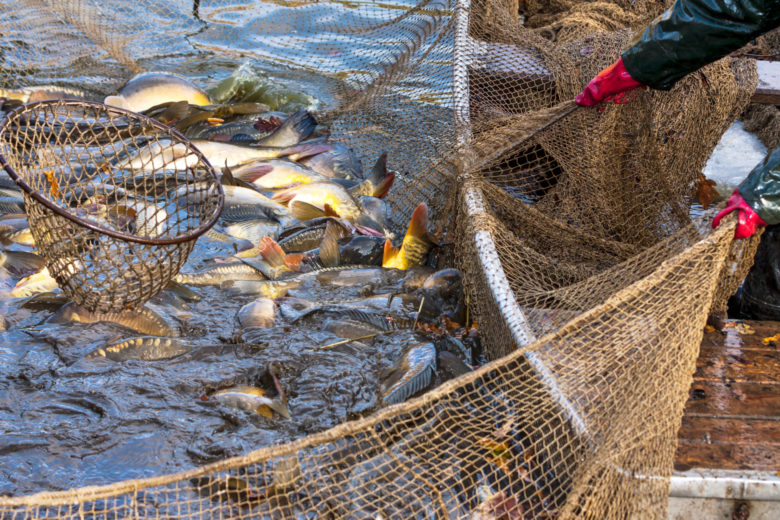
Fish hauled up (Photo: Beneda Miroslav / Shutterstock.com)
Pandas, which ranked fifth, first of all had more than 6,000 characters’ worth of political articles, accounting for over half of all panda coverage. These discussed pandas being given by China to other countries for diplomatic purposes, such as Germany, South Korea, and Indonesia. Some articles even used the term “panda diplomacy.” Next most common were articles that reported on pandas as spectacles. These covered the birth and death of pandas in China and Taiwan and their growth. While this accounted for only about 20% of the total panda coverage by character count, in terms of the number of articles it made up just over 40%, indicating that even if each report was brief, pandas were reported on frequently. Whereas coverage of other animals was concentrated in periods when there were noteworthy incidents or debates—such as avian influenza or the ivory issue—articles about pandas tended to be reported continuously, not only when major events like loans to other countries occurred, but also with updates on their growth and current status. The estimated population of giant pandas was just under 2,000 as of 2015, so they are by no means numerous. Nonetheless, the fact that they are reported so frequently suggests that Japan’s geographic and political closeness to China may also influence animal coverage. And beyond that, as the phrase “crowd-pulling panda” implies, pandas, the stars of zoos, may simply attract readers’ interest.

Two pandas (Photo: Todorob.petar.p/Wikimedia Commons [CC BY-SA 4.0])
International reporting on animals is not especially abundant. Nevertheless, within that coverage, animals are presented from diverse perspectives—protection, food, threats, and so on. Even in the world of animals, countries and regions with strong geographic and political ties tend to receive more coverage. We also see that, while Africa is usually the subject of very little reporting, attention increases when the topic is animals. And above all, as in zoos, pandas seem to catch people’s eyes in newspapers as well.
Writer: Eiko Asano
Graphics: Eiko Asano



















報道分析で動物に着目しているのが面白かったです。
アフリカは動物に関して報道されるといっても、10%に留まるというのは少ないと感じます。
パンダを代表例として、単に動物に関する問題の大きさだけでなく、他の国際報道と同様に地理的関係や政治的関係でニュースバリューが決まるという傾向が非常に興味深かったです。
パンダが5位なのは想定内ですが、見せ物としてのパンダの報道はナンセンスだし必要ないと思います。
パンダの報道はテレビの方が多い気がしますが、わざわざニュースとして報道するのはばかばかしくてあまり見てられないです。
国内の報道で見ると、もう少し動物が関連する割合が増えるかなと思いました。
日本では、名古屋の動物園にいるイケメンゴリラの「シャバーニ」が有名ですよね。
アフリカは動物なら出てくるんですね。人も取り上げてほしいです。
ランキングを見ていると、日本と関係が深いから取り上げられているような動物が多い気がしました。魚や鯨は言わずもがな、鳥については、中国と日本が近く、脅威になりうるし、何年か前に日本でも鳥インフルが問題になっていたことが大きいのかなと思いました。パンダは、日本国内の報道も多い気がするので、その傾向が国際報道にも顕われたのではないかと思いました。
漁業のニュースがあまり印象になかったので意外でした。
最近もザギトワ選手に秋田犬が贈呈されたことが頻繁に報じられていたことを思い出しました。