
In June 2015, same-sex marriage was legalized across the United States. Many will remember how Facebook and other social media turned rainbow-colored. In the 2010s, there has been a move to accept homosexuality in developed countries such as the United States and Europe, drawing increasing attention. Terms like “LGBT (lesbian (L), gay (G), bisexual (B), transgender (T); there are also various other identities such as intersex (I) and queer (Q), and LGBT is used as a collective term) (※1)” and “gender identity disorder (※2)” are becoming familiar to those of us living today.
Many people probably learned these words through newspapers and the news. Here, we want to explore when and why global developments related to sexuality began to be reported.
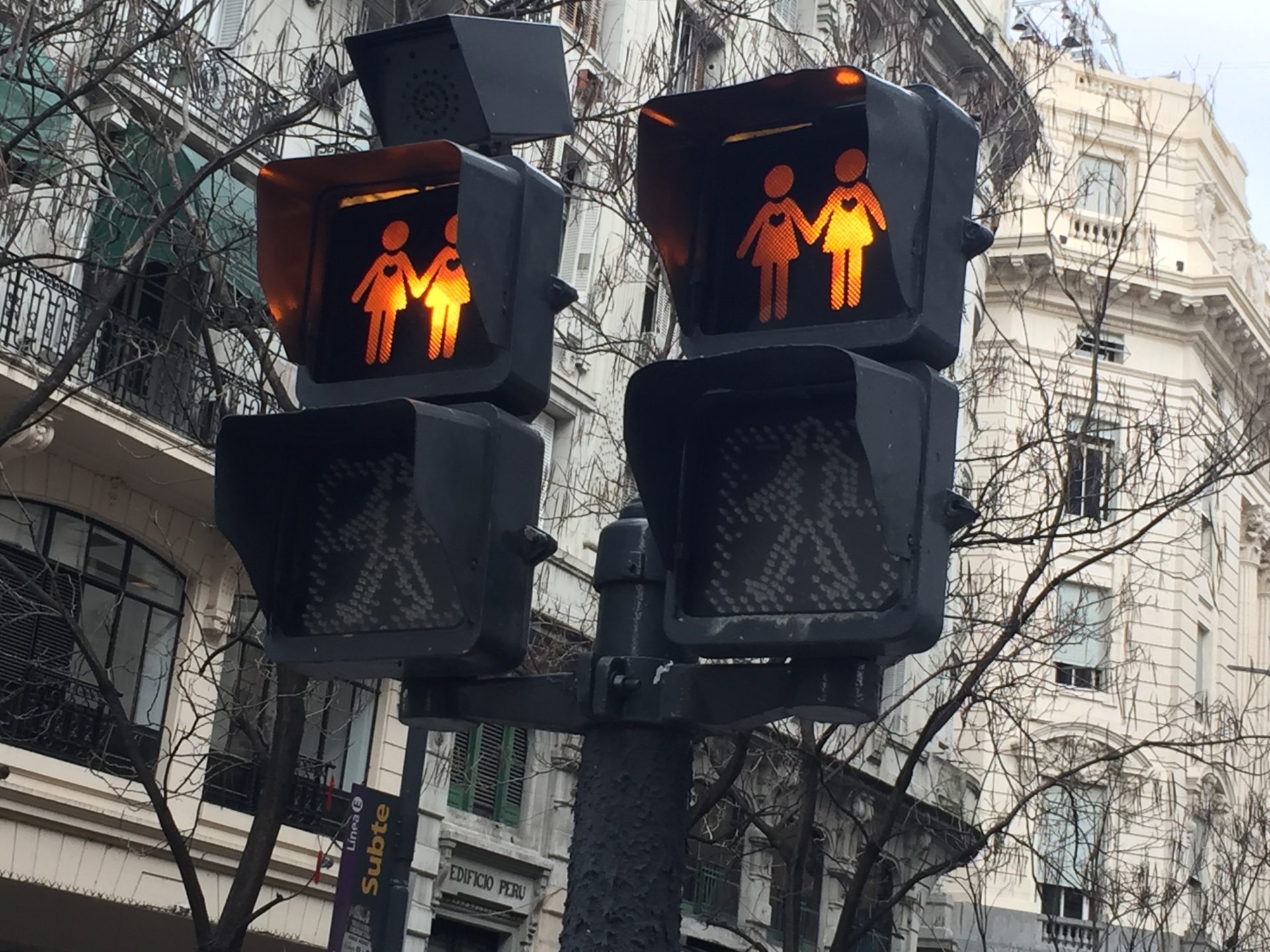
When did LGBT-related terms first appear?
First, let’s look at when words such as “homosexuality” began to appear in international reporting, using the Asahi Shimbun as a case study. The term “homosexuality” has been used in the Asahi Shimbun since around the 1930s. About 50 years later, in the 1980s, expressions like “gay” and “lesbian” came into use. Before 1990, the term “homo” sometimes appeared in reporting on homosexuality, but as it came to be regarded as a slur, it has largely disappeared. In the 2000s, words such as “gender identity disorder,” “same-sex marriage,” and “sexual minorities” began to appear, and in 2004, the abbreviation “LGBT” finally made its appearance.
When and why did news about LGBT surge?
Let’s focus on the periods when international reporting on LGBT and homosexuality surged and the reasons why. The volume of international news coverage in the Asahi Shimbun (1984–2017) is as shown in the graph below (※3).

Loading…
In the 1980s, homosexuality was covered in connection with the then-emerging HIV/AIDS epidemic. It drew attention because many infections occurred through same-sex sexual activity. In the 1990s, apart from debates over whether homosexuality would be accepted in the U.S. military, it was not widely featured. In 2004, coverage increased due to then-U.S. President Bush promoting a constitutional amendment to ban same-sex marriage and because an EU Commission president candidate made sexist remarks. The next spike came in 2008, when the series of events surrounding the arrest and downfall of Malaysia’s former deputy prime minister and then prime ministerial candidate Anwar, on grounds of homosexuality, was reported.
Then in 2013, under President Obama, the United States and other developed countries showed a growing acceptance of homosexuality and same-sex marriage. The Sochi Olympics in Russia, which imposes penalties for “promoting” homosexuality, also sparked debates about the treatment of LGBT athletes. Interest in LGBT issues remained relatively high thereafter, and in 2015, the U.S. Supreme Court ruled in favor of same-sex marriage, effectively legalizing it nationwide—an event that drew global attention. Many in Japan likely changed their Facebook profile photos to rainbow colors. In 2016, there was continued coverage related to the United States, as well as reporting on the mass shooting at a gay nightclub in the U.S.
When dividing the content of international reporting by field, “politics” was most common (20.7%). “Politics” includes articles on whether candidates in U.S. presidential elections supported homosexuality and the public’s reaction to that, as well as news of homosexual individuals being appointed to positions such as bureaucrats or party leaders. Next most common were items about “law and courts” concerning same-sex marriage and homosexuality (18.6%). In recent years, especially in developed countries, the status and rights of LGBT people have become key issues, leading to more of these stories. There were also articles that examined LGBT in relation to “religion” (7.2%), including stories about people suffering under religions that condemn homosexuality and about the Pope acknowledging homosexuality. Other categories included opinion pieces based on interviews with LGBT individuals (6.7%) and HIV/AIDS-related articles (6.2%). LGBT parades and activism were also relatively well covered (6.2%).
Broadly speaking, even if there are years when international reporting on LGBT and homosexuality surges, as the graph shows, the truth is that in most years these issues receive little attention.
Issues about LGBT that get covered—and those that don’t
So, which countries produce events that attract media attention even under these circumstances?
Loading…
Regarding LGBT, the country most covered by the Asahi Shimbun was the United States. France and the UK/Russia follow with 8.5 and 8 articles respectively, highlighting how overwhelming the U.S. total of 81.5 articles is. Malaysia, the fourth most reported country, was covered only in relation to former prime ministerial candidate Anwar; after that incident, it received no further attention. The large differences in coverage by country are obvious at a glance, and Japanese media are heavily skewed toward developed countries—especially the United States. As GNV has previously pointed out, the world we see in Japanese reporting is effectively divided into a world that gets covered and a world that does not.
Beyond the situation in Europe and the U.S., the world is vast, and there are many LGBT-related issues that go unreported. For example, as many as 72 countries criminalize homosexuality. In Japan, where positive developments around LGBT are often reported, this fact tends to be obscured. In countries such as Iran, Sudan, Saudi Arabia, and Yemen, homosexuality is considered a crime punishable by death. In Syria and Iraq, there have been cases in which non-state actors, including the Islamic State (IS), executed homosexual individuals.
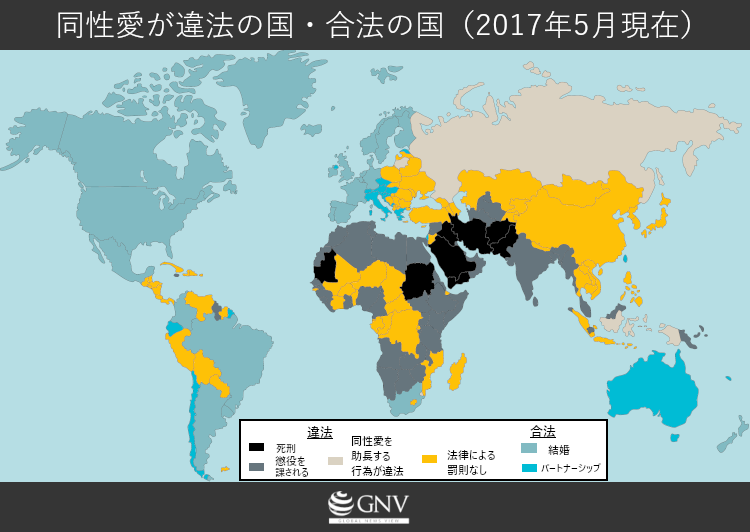
Created based on data from ILGA
Let’s look specifically at the situation regarding LGBT in several countries. Starting with Africa: Reporting on Africa accounted for only 1.2% of the total between 1984 and 2017. In 2005, South Africa became the fifth country in the world to legalize same-sex marriage. It was also the first country in the world to prohibit discrimination against LGBT people in its constitution. While some countries are advancing protections for LGBT rights, far fewer African countries recognize these rights, and in Sudan and Mauritania the death penalty applies. In Uganda, laws enacted during the colonial era that prohibit same-sex sexual acts have led to homosexual individuals being treated as criminals. In February 2014, President Museveni signed the “Anti-Homosexuality Act,” which cracked down on homosexuality and drew criticism from the West. Although it was repealed in August that year, in November a bill titled the “Prohibition of Promotion of Unnatural Sexual Practices” was introduced in parliament. This “promotion” includes providing medical services to homosexual individuals. Even under such conditions, activists continue steady efforts on the ground.
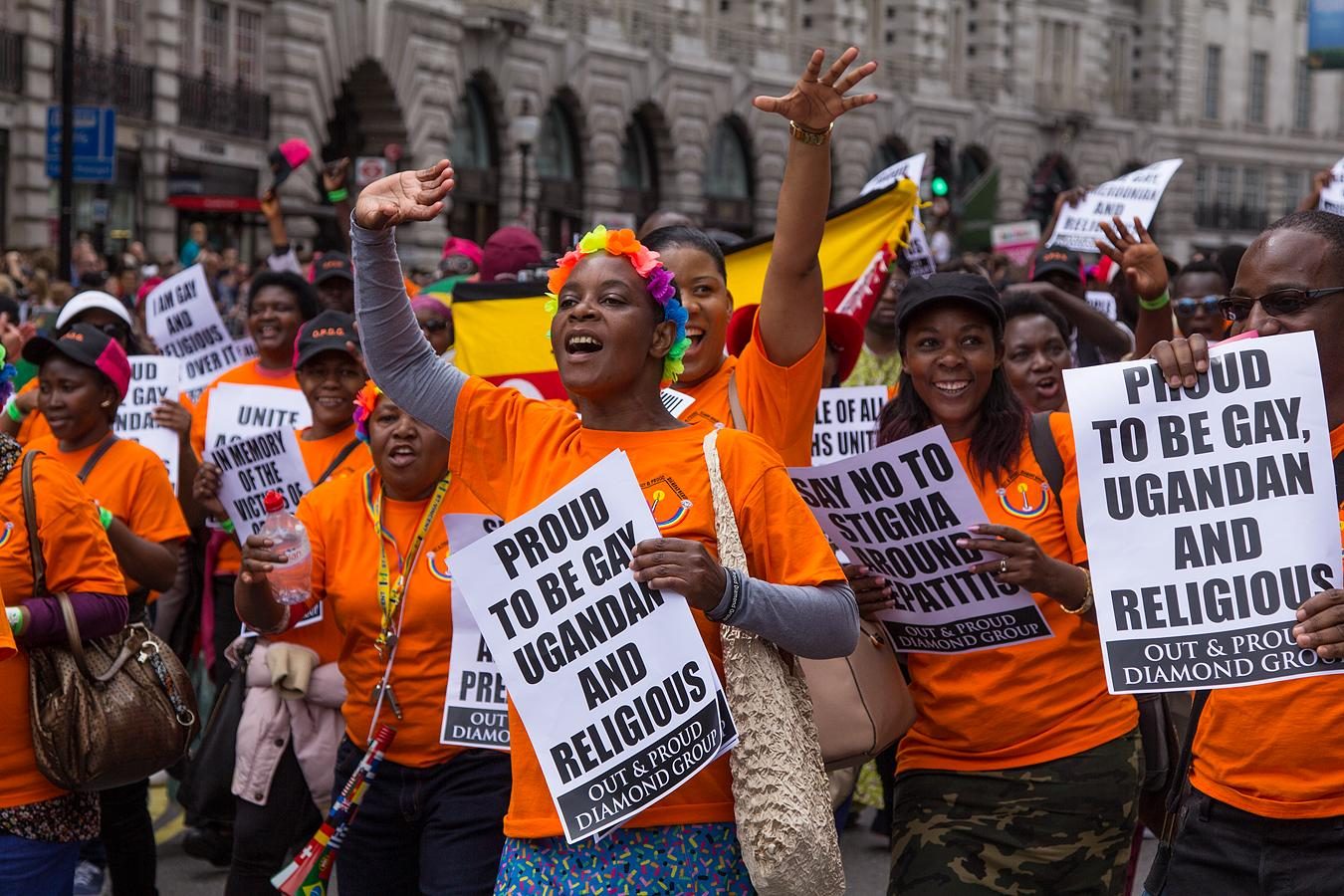
A protest march against Uganda held in London (Photo: Chris Beckett/Flickr [ CC BY-NC-ND 2.0])
In China, a major country close to Japan but less covered than Europe and the U.S., there have been positive developments since 2018. According to news reports, the major social media platform “Sina Weibo,” often called China’s Twitter, reversed its ban on content related to homosexuality, to the delight of the LGBT community. After the company operating Weibo announced it would delete content related to homosexuality, protest posts with the hashtag “#我是同性恋 (I am homosexual)” surged, and the decision was overturned. However, challenges remain in China, such as the continued difficulty of screening films with homosexuality as a theme in theaters.
In South Asian countries such as India and Nepal, there is a growing movement to legally recognize a “third gender” beyond the male-female binary. The Asahi Shimbun reported this only once, in 2008. It began in 2007 when Nepal’s Supreme Court recognized a “third gender.” On documents such as passports, in addition to “M (male)” and “F (female),” “T (transgender)” and “O (other)” can now be used. In one Indian state, a transgender mayor was elected in January 2015 and is serving in public office. On the other hand, the introduction of such systems has not necessarily led to a significant reduction in prejudice and discrimination against LGBT people, and India’s penal code stipulates imprisonment for “carnal intercourse against the order of nature.” This law dates back to the 1860s under British colonial rule, and there have been signs of its repeal thanks to the efforts of many human rights activists.
Finally, let’s touch on LGBT issues in Latin America, which are the least reported. The Asahi Shimbun touched on positive aspects of LGBT people’s lives there, but only two reports appeared between 1984 and 2017. What is the actual situation? In fact, in Latin America, many countries—such as Brazil, Mexico, and Ecuador—have adopted or amended laws in the past decade regarding LGBT rights related to marriage and the elimination of discrimination. These developments began much earlier than in the United States. However, there is a contradiction in that discrimination and prejudice in society remain deeply rooted. A report states that nearly 600 LGBT individuals in Latin America were killed due to anti-LGBT violence between January 2013 and March 2014. Killings involving violence such as stoning, torture, and rape sometimes go unpunished. The number of people fleeing such violence and becoming migrants is also increasing. Latin American countries face this kind of dilemma.
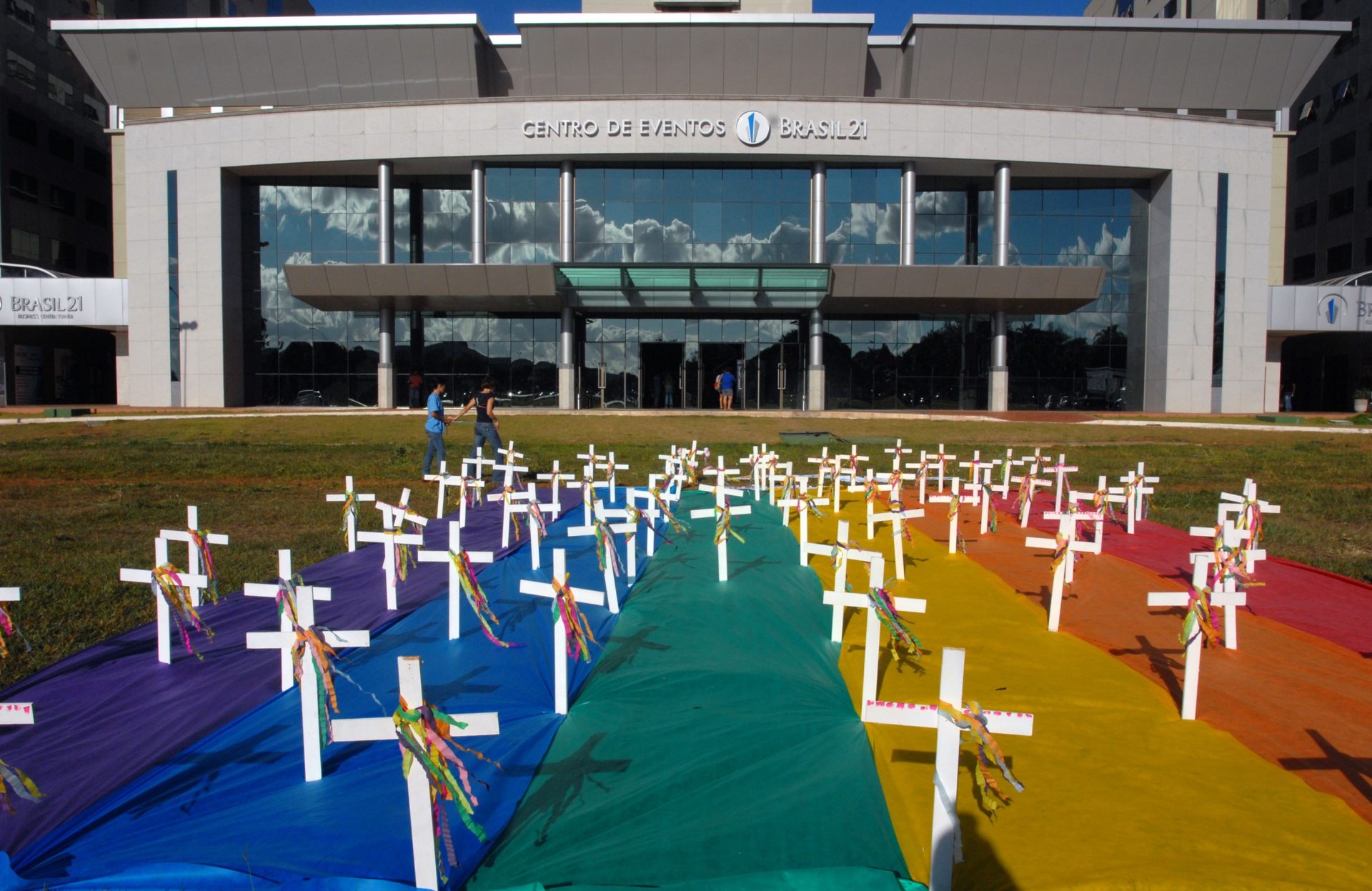
Brazil: Demonstration protesting homophobia (Photo: Elza Fiuza/ABr [CC BY 2.5])
Despite events related to LGBT occurring all over the world, conditions outside Europe and the U.S. are rarely reported.
LGBT reporting going forward
As we have seen, reporting on LGBT issues has generally been increasing, but its content is biased toward developed countries, especially Europe and the United States. As a result, the fact that countries in Asia, Africa, and Latin America also see various developments—both in advancing and in suppressing LGBT rights—remains little known. Precisely because understanding and interest in LGBT issues are growing, there is likely an emerging need to report on the global situation as a whole. When laws change in a major country like the United States, people change their Facebook status to rainbow colors. But the world is not only the United States. The media have a mission to convey the reality of the world. For readers to accurately grasp the current state of LGBT issues, the information provided needs to be balanced at a minimum. Nevertheless, the reality is that reporting on LGBT issues remains far from the balance that is needed.
※1 Lesbian: A woman who is romantically attracted to women.
Gay: A homosexual person, especially a man who is romantically attracted to men.
Bisexual: A person who has sexual desire for both the opposite sex and the same sex; a person attracted to both sexes.
Transgender: Among sexual minorities, a person whose gender identity does not align with their physical sex.
Intersex: A condition in which the external genitalia have an appearance opposite to the sex of the gonads, or in which an individual possesses both male and female gonads.
Queer: A collective term for sexual minorities, including homosexuals.
※2 Gender identity disorder: Despite having a clear biological sex, a persistent conviction of being a different gender psychologically, accompanied by attempts to adapt oneself physically and socially to that other gender. A medical term.
※3 In the Asahi Shimbun’s Kikuzō II database, full access to article content is available from 1984 onward. Analysis covers articles in which “LGBT,” “homosexuality,” or “gender identity disorder” are main themes。
Writer: Madoka Konishi
Graphics: Hinako Hosokawa




地域によって合法違法の差が歴然と現れていることが視覚的にとらえられて興味深かったです。波があるとはいえ、やはり報道量自体は上昇傾向にあるんですね。
@たまこさん
上昇傾向はいいことだとは思いますけど、どこまで続くのかがちょっと疑問です。
国際面のLGBT報道は結局、半分近くがアメリカ関連なので、アメリカで同性婚をめぐる議論が落ち着いたら、
「世界」のLGBT関連の報道の大部分が消えていくような気もします・・・
>世界はアメリカだけではないのだ
シンプルながら、いやシンプルだからこそ、心に響く言葉です。世界はアメリカだけではないことなんて誰でもわかっていますが、「海外」と言った時にアメリカやヨーロッパを思い浮かべてしまうのが、私を含め多くの日本人の現状だと思います。メディアと市民の両方が、こうした意識を改善していくためにできることをしていくべきですね。
LGBTといえばアメリカというようなイメージがあり、こんなにいろんな背景があることは知りませんでした。
非常に興味深い内容でした。
近年、日本国内ではSNSやドラマなどを通じてLGBTへの理解が高まっているように感じます。しかしながら理解が深まる国がある一方、法律により罰が与えられる国があること、そしてそれが広く知られていないことがLGBTの次の課題となっていると記事から分かりました。
南米ではLGBTのパレードがあって、先進的なイメージだったのに、差別が根強いというのは驚きでした。
大変興味深く拝読いたしました。
日本の国際報道においては同性愛をめぐる記事が多く、LGBT自体についての記事は少ないのかなと思いました。
もっと日本においても理解が深まることを祈ります。
同性愛者が死刑になる国があるなんて驚きました。
まだまだLGBTの方は、厳しい立場にあるんですね。
日本社会でも受け入れようとする意識が低い。。。
これらの性的少数者に対する嫌悪感は、今まで培われてきた価値観からくるものであると思うので、まずは性教育や報道など価値観に大きく影響を与えるものを、より多様性を取り入れたものへと変えていく必要があると思いました。
記事ありがとうございました。
個人的な感想ですが、人種差別に比べて、性差別の方が後天的なイメージがあります。日本には「性同一性障害」という言葉もあるように、その当事者たちがあたかも異質であるとみなすような風潮があるからかなと思いました。特に年代が上がるほどそのような傾向がある気がします。「病気」という説明の仕方をされたことがありますが、自分たちから切り離している気がして、無責任だなと思いました。