
About 1.4 billion people use it every day worldwide, and monthly active users number about 2.2 billion. With the global internet-using population estimated at around 4 billion, that means roughly one out of every two internet users worldwide opens a Facebook page at least once a month. As for time spent, on average people are said to use it for nearly an hour each day. In the online advertising market, together with Google it holds a 61% share, making the global online ad market an effective duopoly of Facebook and Google. In other words, more than half of the ads we see online are served by these companies. Moreover, despite being a free service, the CEO has climbed to become the world’s fifth-richest billionaire.
From all this, it is easy to see how deeply Facebook has infiltrated our everyday information-gathering environment and how great an influence it exerts when we obtain information online. Using the information we get in this way as a reference, we learn daily about society, politics, and world affairs, and cast our ballots for the representatives who best speak for our views. Here, we will explore the relationship between Facebook and democracy.
Facebook logo and mouse pointer (Photo: Simon/Pixabay)
Facebook’s News Feed
First, a brief explanation of Facebook. Founded in 2004 by Mark Zuckerberg and others, Facebook is a social networking service (SNS) whose defining feature is that real names are required in principle in order to reproduce real-world connections online. Compared with other SNS platforms such as Instagram, LINE, Snapchat, and WhatsApp, it is also distinctive in that it tends to be used as a source of news. According to a survey conducted in the United States, among those who said they sometimes gather news online, fully two-thirds—66%—said “Facebook is a source of news.” The first page that opens when you use Facebook is called the “News Feed.” The News Feed is akin to the “home page” of a general website. It is where you can browse various updates: posts by friends who have mutually approved each other on the site; updates from company pages that you or such friends have “Liked” (a function for indicating that you like, are interested in, or empathize with specific content); posts that have become popular among your acquaintances; posts by news organizations, companies, or governments that you follow or have shown interest in; and news articles, among others.
That said, Facebook does not simply list the posts of people and organizations you are connected with on your News Feed. In reality, by collecting and analyzing information—what terms you searched for, which posts you clicked, which photos you pressed the Like button on or commented on, who you are connected to, what your hobbies are, and so on—it intentionally “selects” posts and ads that each user is likely to find interesting and displays only a subset of them in the News Feed. The analysis is not limited to when you are logged in; even after you log out, the other websites you view are tracked by Facebook. This system is called the algorithm. Because users can find one interesting post after another, they may end up absorbed in Facebook for hours. To maximize ad revenue, what the company wants is for users to spend as much time on the site as possible.
![Facebook CEO Mark Zuckerberg speaking about data handling (Photo: Anthony Quintano/flickr [ CC BY 2.0])](http://globalnewsview.org/wp-content/uploads/2018/05/nv-g6-006b.jpg)
Facebook CEO Mark Zuckerberg speaking about data handling (Photo: Anthony Quintano/flickr [ CC BY 2.0])
Furthermore, Facebook sometimes edits the News Feed using its own algorithmic standards so that content deemed harmful to society is intentionally not displayed. However, there is often criticism of what gets targeted. For example, when a Norwegian author tried to feature the famous photo “The Terror of War,” which captured a girl fleeing napalm during the Vietnam War and won the Pulitzer Prize, Facebook classified it as child pornography and removed the article. In response, the major Norwegian newspaper Aftenposten protested. In the end, Facebook admitted fault.
There have also been cases of censorship influenced by governments. Shortly after Facebook agreed to partner with the Israeli government to counter online incitement, the accounts of Palestinian journalists were suspended. Although Facebook said it was a mistake, it complied with most of the more than 150 requests by the Israeli government to delete Facebook posts critical of the occupation of Palestine on the grounds that they could promote “terrorism.” Considering that 96% of Facebook users in Palestine use it as a means to obtain news, this fact is extremely significant.
There is also this case. In 2014, Facebook conducted a large-scale experiment to see how people’s reactions changed when their News Feeds displayed more positive or more negative topics. About 700,000 users became test subjects without any notification. The result showed that users who saw more positive topics tended to post more positive content themselves, while users who saw more negative topics tended to post slightly more negative content. Leaving aside questions about Facebook’s ethics, the experiment offers a glimpse of the unsettling power to influence people’s thinking and emotions, to a greater or lesser degree.
The Like icon (Photo: Pixabay)
Because it chooses what to “show” and what not to show in the News Feed, many have argued that Facebook in fact functions as a powerful “news organization.” Facebook, however, insists it is merely “a technology company that provides a platform where anyone can freely express opinions.”
Facebook and Democracy
Even under normal circumstances, the algorithm edits the information we receive. On top of that, Facebook sometimes unilaterally makes major shifts in posting priorities. For example, in January 2018 it announced a new company policy to “prioritize social connections.” Posts by family and friends would be shown preferentially in the News Feed, while posts by companies and news organizations would be deemphasized. The idea was to encourage active interactions among users rather than have them passively scroll. This policy shift has major implications at a time when many users rely on Facebook as a source of news.
Above all, it is worth noting that the area most affected is “democracy.” In democratic systems, information functions as the basis for judging social problems and their solutions, and public opinion is formed as part of that process. Much of that information is provided by the media. For citizens to make sound judgments about national policymaking, reliable sources of information are required.
And in reality, countries whose democracies are being affected by Facebook’s shifts have begun to appear. Consider Serbia. As indicated by its classification as a “flawed democracy” based on the Democracy Index, Serbia is one of the countries where democratization remains incomplete. One major obstacle to democratization is the system of media censorship in place. Information favorable to the government circulates widely, far from fair reporting. In such countries, to establish democracy, the presence of independent outlets—however small—that speak truth and expose wrongdoing is essential, such as KRIK (the Crime and Corruption Reporting Network). For small media organizations for whom public reporting is difficult, Facebook offers a means to reach many readers despite their size. KRIK depended heavily on Facebook, and for many people Facebook functioned as a valuable space to obtain information free from government interference. However, as a rehearsal for reducing posts by news organizations in the News Feed, Facebook secretly ran an experiment to “remove news articles from the News Feed,” and traffic plummeted as a result. Similar trends were seen in Guatemala, Slovakia, Serbia, Sri Lanka, Bolivia, and Cambodia. These fragile democracies were treated lightly in the name of improving service quality.
![Poster of Serbian Radical Party leader Vojislav Šešelj (Photo: Micki/Wikimedia Commons [ CC BY-SA 3.0 ])](http://globalnewsview.org/wp-content/uploads/2018/05/nv-g6-006d.jpg)
Poster of Serbian Radical Party leader Vojislav Šešelj (Photo: Micki/Wikimedia Commons [ CC BY-SA 3.0 ])
Even in major countries considered to have robust democracies, Facebook’s role has come under scrutiny—especially since the 2016 U.S. presidential election, which has drawn worldwide attention. First are cases involving fake news, meaning false information that mimics reporting. During elections, many examples occurred in which fake news about candidates spread via Facebook, which is said to have influenced the outcome of the U.S. presidential election. In addition, the British consulting firm Cambridge Analytica illegally obtained and analyzed the personal data of 50 million users leaked from Facebook, allegedly to influence voter behavior during the election. The “weapons” deployed against democracy through Facebook can take many forms.
Facebook’s attempts to evade regulation
Facebook’s influence shows no signs of stopping. In response to issues like those above, Europe has begun to act: the EU General Data Protection Regulation (GDPR) took effect in May 2018. GDPR is a framework aimed at protecting personal data, setting legal requirements for data transfer and processing. Just before the regulation’s enforcement, Facebook announced that of the 1.9 billion users outside North America whose data had been managed by its European headquarters in Ireland, it would move the data of 1.5 billion users outside Europe to its U.S. headquarters, where rules are looser in regulatory terms. Those 1.5 billion include people in Asia and Latin America, among others. This appears to be an attempt to flee the strict application of the rules out of fear. In other words, people will obtain information that is managed under looser regulatory conditions. That information, as one input among many, will shape people’s thinking and contribute to voting behavior. How much this will affect democracy remains unknown.
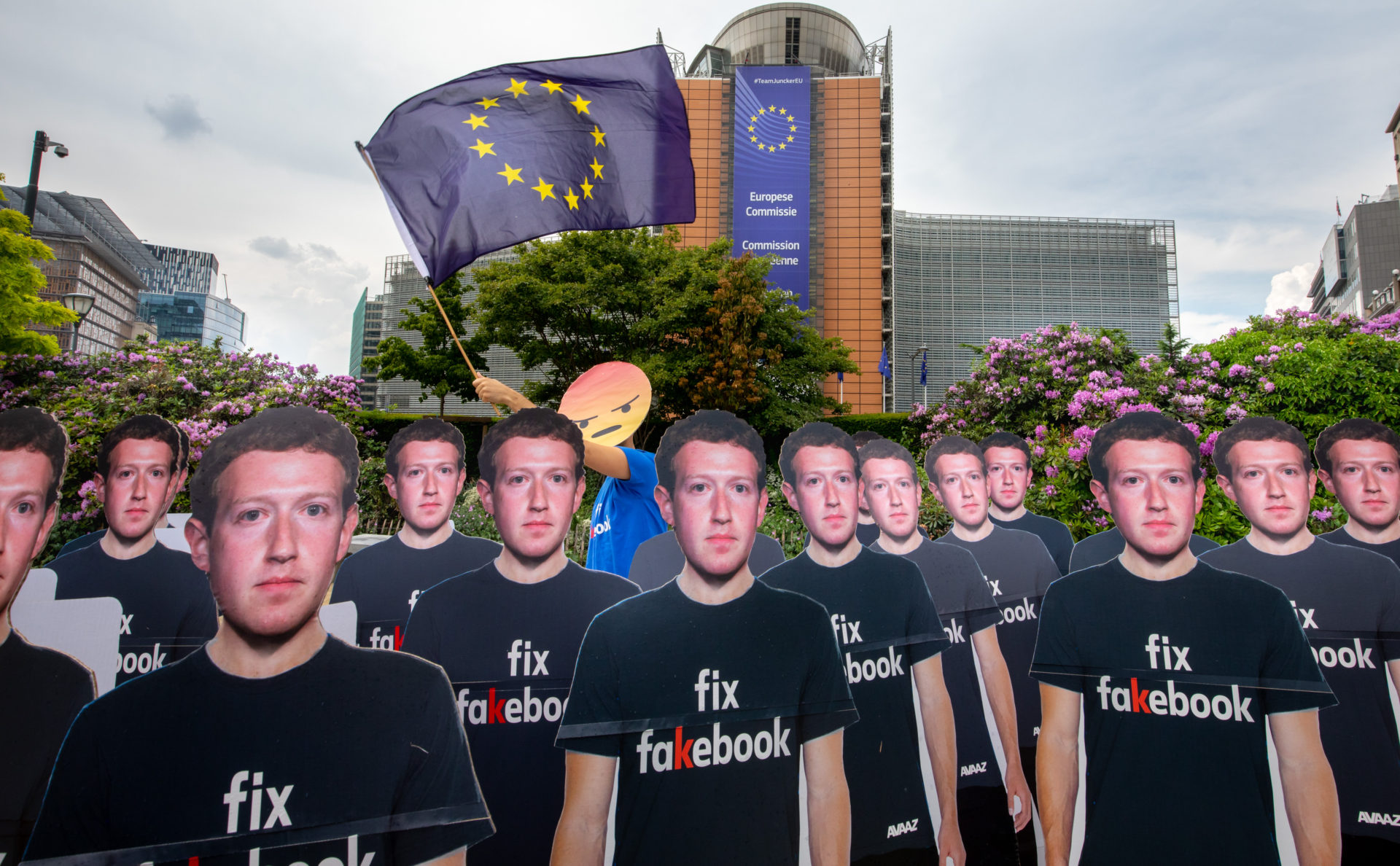
A protest against Facebook held in front of the European Commission headquarters building (Brussels) (Photo: Avaaz/flickr)
In response to criticism from many quarters, CEO Mark Zuckerberg testified before the U.S. Congress and the European Parliament. Although he apologized for the problems to date, he often sidestepped questions, making his concern about regulation clear.
We are entering an era in which an organization born under democratic systems can wield enormous influence over democratic politics in its own country, in other countries, and around the world. The role information plays in democracy is far greater than many imagine. Facebook now stands at a crossroads. We should keep a close eye on what happens next.
Writer: Yuka Ikeda








自分にとって都合のよい情報、あるいはfacebookに操作されている情報ばかりを鵜呑みにし、無意識にその世界の中だけで生きているという現実…
facebookの影響力の恐ろしさを知った
現代のネット社会で、個人情報を保護することなんて不可能なんじゃないかなって恐ろしくなりました。
また新しい展開が見られました。
https://www.theguardian.com/technology/2018/may/24/mark-zuckerberg-set-up-fraudulent-scheme-weaponise-data-facebook-court-case-alleges
このガーディアン紙の記事にあるように、やはり、フェイスブックはケンブリッジ・アナリティカの件以上に、
意図的に利用者とその友達の個人情報を利益のために大量に集め、売り出してきた疑いも出てますね・・・
情報を「武器化」したという言い方をしています。
やはり、フェイスブックのビジネスモデルそのものに悪質さを感じます。
厳しく規制をする必要がありますね・・・
ジャスミン革命などの近年の民主化革命に見られるように、SNSは民主主義にポジティブな作用をもたらすものとしてのイメージが強かったので、この記事を読んで新たな視座を得ることができました。勉強になりました。いつも読み応えのある記事をありがとうございます。
facebookの中での検索ならまだしも、ログアウト後も追跡するなんて…
“アルゴリズム” 怖すぎる…
知らないことがいっぱいありました!
ありがとうござます
多くのFacebookユーザーがこの現状を知らずに利用しているのだと考えると恐ろしいです。
このような切り口の記事を読んだのは初めてだったのですごくためになった。
Facebookが本当に”広告収入を最大限にするために、利用者ができるだけ長時間サイトを利用すること”を望んで様々な施策を打っているかは、この記事からだけでは判断できないが、いずれにせよFacebookが民主主義に大きな影響を与えているというのは明白なので、Facebookには社会にとっての報道について考えた上で良い選択をして欲しいと思った。