
Climate change threatens the survival of the Earth. Automobiles, which emit large amounts of greenhouse gases such as carbon dioxide, are considered one of the major causes of this phenomenon. Yet, because cars have become indispensable in modern society, we cannot simply stop using them. In response, hybrid vehicles that consume less fossil fuel and electric vehicles (EVs) that do not use gasoline have been developed as countermeasures. For example, it has been estimated that by 2030 there will be 118 million electric vehicles on the road worldwide, and in Europe some countries have even announced a ban on gasoline cars by 2040 (or 2050).
Compared with conventional vehicles powered by internal combustion engines, hybrids and electric vehicles may indeed emit fewer greenhouse gases while driving. But is it right to judge environmental friendliness based only on emissions during operation? In this article, we explore the environmental burden of electric vehicles.
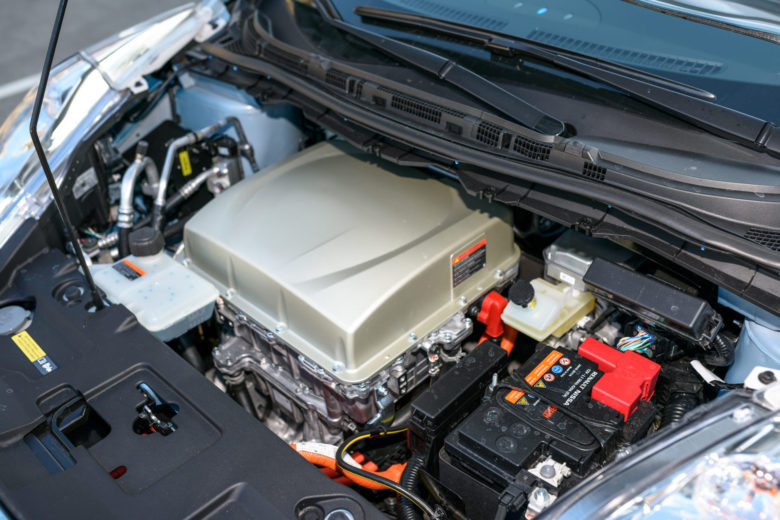
Electric vehicle motor (Photo: A. Aleksandravicius / Shutterstock.com)
Greenhouse gas emissions compared over the life cycle
The burden automobiles place on the environment is not limited to the time they are being driven. The extraction and smelting of mineral resources used in cars, the manufacturing of bodies and parts, assembly, maintenance, and the dismantling and recycling at end of life all require energy and emit greenhouse gases. In other words, we need to calculate emissions across the entire life cycle of a car.
An electric vehicle is largely made up of its battery, and large amounts of greenhouse gases are generated during the extraction and smelting of the raw materials needed to manufacture it. Depending on the model, the energy required to manufacture an electric vehicle and the greenhouse gases emitted in the process are said to be twice those of a conventional vehicle powered by an internal combustion engine. Moreover, because battery construction is complex, the dismantling and recycling processes at end of life currently impose a heavy burden on the environment.
In the manufacturing stage, electric vehicles emit more than vehicles with internal combustion engines and thus start from a deficit, but as they begin operating, that gradually reverses. Vehicles with internal combustion engines burn gasoline or diesel to run and therefore emit large amounts of greenhouse gases. In contrast, electric vehicles do not emit while running on a charged battery. That said, the “zero emissions (while driving)” often written on electric vehicles is highly misleading. Electricity must be generated for charging, and emissions vary greatly depending on the generation process. Electricity produced from renewable sources such as hydropower, wind, and solar keeps emissions low, but electricity generated by burning fossil fuels such as coal causes emissions to skyrocket. In short, even for electric vehicles, unless power generation itself is “clean,” emissions will be high. Furthermore, emissions also vary by the time of day you charge. For example, when charging at night, solar power cannot be used, making fossil fuels more likely, and naturally emissions increase.
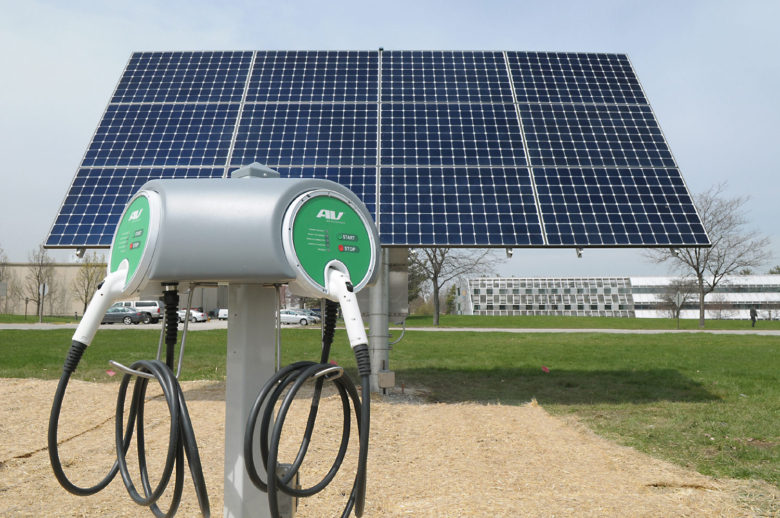
Solar-powered charging facility (Photo: Argonne National Laboratory [CC BY-NC-SA 2.0])
So, taking differences in power generation into account and viewing the issue from a vehicle life-cycle perspective, how do electric vehicles compare with internal combustion vehicles? According to a 2013 study, in countries such as India, Australia, and China where dependence on fossil fuels is high, the carbon dioxide emissions of electric vehicles are not much different from those of gasoline cars. Even in Europe, the United States, and Japan, where the energy mix is more diverse than in those countries, emissions are on par with those of hybrid vehicles that also use gasoline. A 2016 study focused on the United States likewise estimated emissions comparable to those of hybrids.
However, results vary depending on the assumptions. For example, the longer the distance driven before scrappage is set, the lower the emissions of electric vehicles become compared with internal combustion vehicles. In an EU study, when calculations assumed a lifetime mileage of 200,000 kilometers, it was shown that even in Poland, where the share of fossil fuels in power generation is high, electric vehicles emitted 25% less carbon dioxide than diesel cars. There is also research indicating that even in China, where coal’s share in power generation is overwhelmingly high, electric vehicles’ emissions are just barely lower than those of internal combustion vehicles.
In conclusion, for electric vehicles to serve as a real measure for reducing greenhouse gases, it seems crucial to greatly increase the use of renewable energy in power generation across society while making each electric vehicle last as long as possible.
Environmental destruction related to raw materials
However, the environmental burden of electric vehicles is not limited to greenhouse gas emissions. The extraction and smelting of mineral resources such as rare metals used for batteries involve contamination of soil, air, and water, as well as other forms of environmental destruction. Cobalt, nickel, lithium, and copper—needed for batteries and charging facilities—are of particular concern. The quantities required for electric vehicles are by no means small. Each vehicle requires 90 kilograms of copper (20 kilograms for vehicles powered by internal combustion engines) and about 8 kilograms of cobalt. Driven by anticipated demand from electric vehicle manufacturing, the market price of cobalt has tripled in two years.

A mine in the Democratic Republic of the Congo where cobalt and copper are extracted (Photo: Fairphone [CC BY-NC 2.0])
Mining and smelting of such mineral resources inevitably entail a certain degree of environmental destruction, but the extent varies greatly depending on the countries where they take place. For example, 54% of the world’s cobalt is mined in the Democratic Republic of the Congo (mainly from multiple mines in Katanga Province), and large quantities of copper are produced in the same region. Regulations to protect the environment in mining are almost nonexistent. Large-scale deforestation is carried out, and severe river and air pollution are frequently reported. Moreover, the same mines contain uranium, making radioactive contamination a concern. In areas around the mines and in Lubumbashi, the DRC’s second most populous city nearby, the numbers of respiratory diseases and birth defects have soared. The minerals themselves are traded extremely cheaply locally, and working conditions are terrible. Many miners work without protective gear such as masks, and child labor is also a major problem. With growing demand for electric vehicles, cobalt and copper mining is rapidly increasing, and the damage to the environment and people will continue to rise.
Nickel mining and smelting also cause large-scale environmental destruction. For example, in 2016 an accident at a mine in Norilsk, Russia, released large amounts of hazardous substances from a dam, turning a river deep red. And in the Philippines, the world’s largest producer of nickel, in 2017 the government ordered the closure of 16 mines that account for 50% of national production (10% of global supply), citing environmental destruction and impacts on local communities.
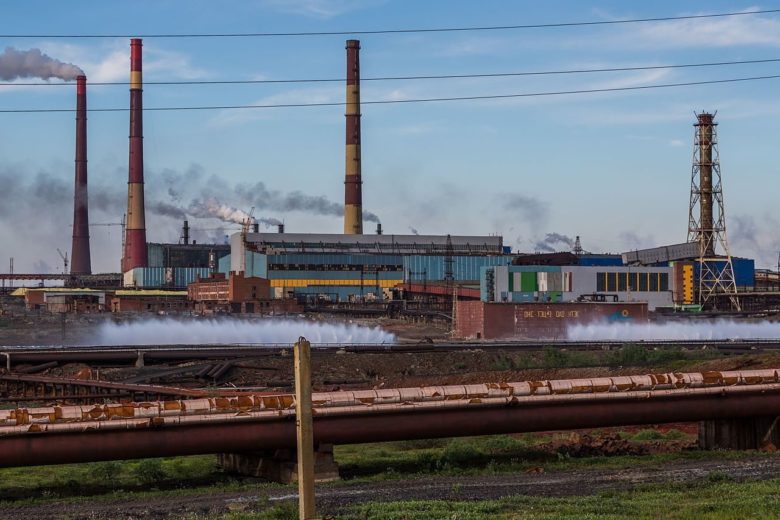
Nickel smelter in Norilsk, Russia (Photo: Ninara [CC BY 2.0])
Environmental destruction from the extraction and smelting of lithium—mined mainly in South America, including Chile, Argentina, and Bolivia—is said to be less than that of cobalt and nickel, but that does not mean there are no environmental issues. Smelting requires large amounts of water, and pollution can occur. It is also said to be prone to fires. As with other mineral resources, the greater the demand, the greater the burden on the environment and local residents becomes a concern.
Toward solutions
The development and spread of electric vehicles are indeed a major first step toward reducing greenhouse gases. However, if charging is done mostly with electricity generated from fossil fuels, the effect is not that significant. And even if electricity can be switched to renewables, the mineral resources such as rare metals used in batteries are not renewable. Reserves are limited, and the process of digging mineral resources out of the ground and turning them into parts of electric vehicles inflicts substantial damage on the environment and human societies.
So how should we proceed? One avenue for improvement is technology. Making the bodies and batteries of electric vehicles lighter will improve efficiency. To reduce the burden from mining and smelting mineral resources, we need advances in technologies that can efficiently extract and recycle the mineral resources contained in batteries. At present, however, the cost of recycling is high, and it is cheaper to dig up new resources. We need to develop the technology and bring those costs down. Moreover, batteries are not an issue unique to electric vehicles. Batteries used in electronic devices such as computers, smartphones, and cameras contain similar mineral resources, and recycling those resources is also urgent. Electric vehicle batteries can also be reused: even if they no longer have enough power to drive a car, they can be used in homes and elsewhere, as has been pointed out.

Wind power generation (Photo: HO JJ)
Nevertheless, technological progress in electric vehicles is only part of the solution, and we must think more comprehensively. To begin with, we likely need to reduce the use of cars themselves. And if we realistically proceed on the premise of continued car use, it is no exaggeration to say that the environmental benefits of electric vehicles depend on the energy mix of society and the world as a whole. Renewable energy brings its own issues, such as the need for mineral resources, but we must change the current energy mix as quickly as possible. We also need to investigate where and how mineral resources such as cobalt, nickel, and copper are mined and smelted and put effort into improving those practices. The environment and human lives are at stake.
Looking only at a quietly passing electric vehicle labeled “zero emissions (while driving)” right in front of you, it is understandable to get the wrong impression, but in reality the burden on the environment is still substantial. As the electric vehicle boom sweeps the globe, unless we face both the benefits and the costs at a global level, this reality will not change.
Writer: Virgil Hawkins




















質問をしてもよろしいでしょうか。
“ 電気自動車の大部分はバッテリーで構成されており、その製造にかかる原料の採掘や製錬などで大量の温室効果ガスが発生する。車種にもよるが、電気自動車の製造にかかるエネルギーとその過程で排出される温室効果ガスは、従来の内燃機関で動く自動車の倍に上るとされている。しかも、バッテリーの構成は複雑であるため、廃車時の解体やリサイクル作業での過程が、現時点で環境へ与える負担は大きい。”
この文章の、“倍に上る“という部分のエビデンスを教えていただけませんか?
ご質問ありがとうございます。
文中につけているリンクはこちら(https://www.weforum.org/agenda/2017/11/battery-batteries-electric-cars-carbon-sustainable-power-energy/)ですが、「倍」ともともと推定しているのはノルウェーの大学から発表された論文です。こちらです:https://onlinelibrary.wiley.com/doi/full/10.1111/j.1530-9290.2012.00532.x。
バッテリーのための鉱物資源の採掘やバッテリーの製造のプロセスに必要よエネルギーが大きく関与しているとのことです。
夜間の充電では発電量に占める水力や原子力(ベースロード電源)の割合が増えるので昼よりは環境負荷が小さいのではないでしょうか?
https://www.kepco.co.jp/sp/energy_supply/energy/nowenergy/future_energy.html