
Newspapers provide a wide range of information every day, from politics and the economy to topics related to daily life. It is, of course, the newspapers that decide what to report, and their choices of how and how much to report greatly influence what interests people; conversely, those decisions are affected by whether or not we, the readers, are interested. As the eyes of society shift day by day through the interplay of the two, to which fields and which regions is attention mainly directed? In international news, which accounts for only about 10% of total coverage in Japan, there is a clear line between topics that draw attention and those that do not.
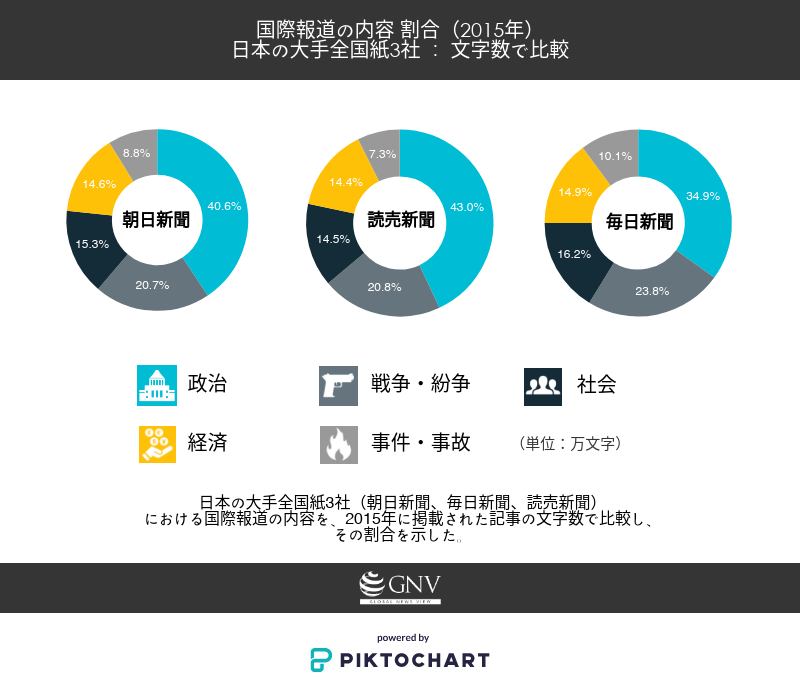
The figure above shows the breakdown by topic of all international news reported in 2015 by Asahi Shimbun, Yomiuri Shimbun, and Mainichi Shimbun. For all three, the topics are ordered by share as politics, war/conflict, economy, society, and incidents/accidents (Note 1). The specific numbers are strikingly similar, and can be taken as the priority order of international coverage offered by Japanese newspapers.
What happens to the volume of coverage by topic when viewed by region?
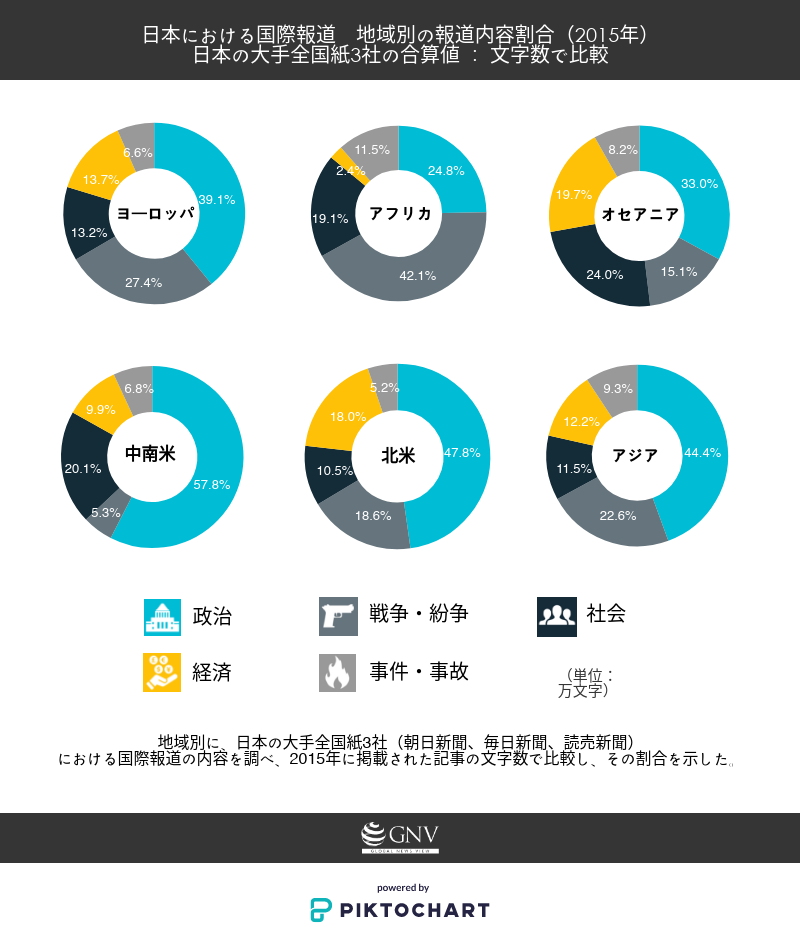
As the figure above (regional classifications by the United Nations Statistics Division) shows, in line with the overall distribution, most regions are covered primarily in terms of politics. Noteworthy, however, is the large regional variation in the share of conflict-related items. In particular, for Africa, conflict-related coverage is 42.1% while politics is 24.8%, a very distinctive pattern compared with the other five regions.
Here, let’s compare the global conflict situation in 2015 with the share of conflict reporting by region.

(Based on the criteria of the Conflict Barometer)
Conflicts are concentrated in Africa and the Middle East. In reporting on the Middle East (“Western Asia” in the UN Statistics Division’s regional classification), more than half of all items are conflict-related, while politics accounts for less than 30%. In regions facing acute conflict, it seems that conflict-related information is disseminated more than political or other topics.
However, compared with the actual situation, there is a region where the share of conflict stories is clearly high: Europe. Conflict coverage, which makes up about 30% for Europe as a whole, consists mostly of the two terrorist attacks that occurred in France and the conflict between Ukraine and Russia.
The high level of public attention to these two issues in Europe becomes even clearer when we look at the absolute volume of coverage.

Loading…
The sources of the conflict coverage that ranks second overall are Asia (including the Middle East) and Europe. By contrast, for Africa, which contains many conflict zones, the amount of information conveying its dire situation is minimal when we look at volume. The scale of a problem cannot be measured solely by the number of deaths, but the reality is that information on the 35,220 deaths from conflict in Africa in 2015 (combat-related deaths only) is overshadowed by information on the approximately 150 deaths from the terrorist attacks in France.
There are many inconsistencies in reporting on Africa. While there is little reporting relative to the number of conflicts, the large share taken by conflict reporting, coupled with a lack of information, creates a vague and negative impression among people. Even if conflicts are numerous, the fact that the countries shaded on the map amount to only about one-fifth of Africa suggests the existence of other information we should know about in other fields.
The broad picture for the topical focus of Japan’s international coverage is that, in terms of both total volume and in most regions, politics is at the center; only in regions with many conflicts does conflict reporting exceptionally exceed politics. Moreover, comparing the share and absolute volume of conflict reporting by region with the actual conflict situation clearly shows that, more than the number or scale of conflicts, the region in which they occur is a key factor in attracting public interest and attention.
Finally, I would like to question the reduction of political information in regions such as the Middle East and Africa, where conflicts are frequent. It is not easy to grasp the overall picture of armed conflicts, which have grown more complex in recent years. Still, to approach the issues with a broader perspective, we need sufficient information on political and social conditions and on the background knowledge that underpins those regions. The large gaps, within limited international coverage, between regions that are covered and those that are not—and between topics that are highlighted and those that are not depending on the region—will directly affect how people see the world.
Notes————-
Note 1: The five categories in the graphs encompass the following content.
See “GNV Data Analysis Method [PDF]”
Politics: politics
War/Conflict: war/conflict; military; terrorism; demonstrations/riots
Society: sports; science and technology; environment/pollution; education; arts/culture; society/lifestyle; health/medical care
Economy: economy
Incidents/Accidents: incidents/accidents; weather/disasters
Note 2: All shares in Figures 1, 2, and 3 are based on character counts.
Note 3: Japan’s major national dailies refers to the three papers Asahi Shimbun, Mainichi Shimbun, and Yomiuri Shimbun.
Writer: Miho Kono
Graphics: Yosuke Tomino



私はメディア分野を勉強している大学生です。
日本における国際報道の現状を知る上で、
大変参考にさせて頂きました。
今後も参考にさせて頂きたいと思います。