
In August 2023, a cargo ship named Pyxis Ocean set out on its first long-distance voyage from China to Brazil. This cargo ship incorporates wind power as part of its propulsion. It is equipped with two steel sails called WindWings, each 37.5 meters high, and by using the sails to generate wind power during the voyage, it is expected to reduce fuel used during the voyage by up to 30% compared with conventional operations. According to Cargill, which operates the ship, each WindWing can save 1.5 tons of fuel per day.
In fact, these WindWings are one of the decarbonization technology projects for shipping supported by the European Union (EU) initiative. In the shipping industry, decarbonization is being pursued not only by the EU but internationally as well. In July 2023, at the 80th session of the Marine Environment Protection Committee (MEPC80) held in the UK, the International Maritime Organization (IMO) adopted a strategy to achieve net-zero greenhouse gas emissions from ships around 2050.
This article looks at the current status of greenhouse gases emitted by shipping and how the industry is attempting to address them.
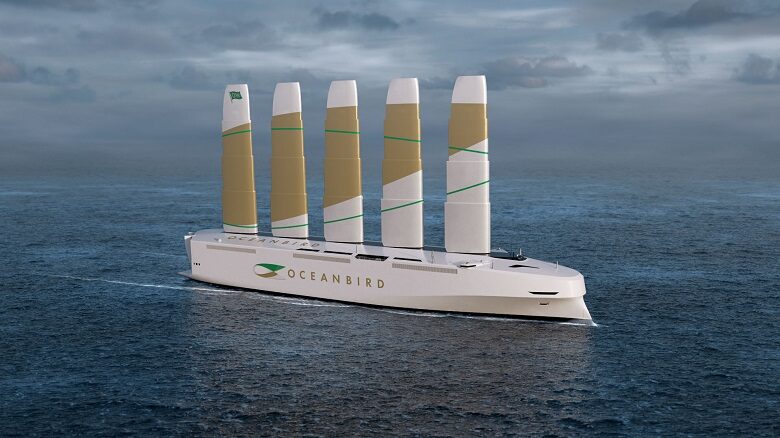
An image of a ship called Oceanbird equipped with wings, similar to Pyxis Ocean (Photo: Wallenius Marine / Wikimedia Commons [CC BY-SA 4.0])

目次
The current state of greenhouse gases emitted by shipping
Before examining the current state of greenhouse gases in shipping, let’s first outline what shipping is.
Shipping is the transport of goods and people by sea. It accounts for more than 80% of world trade and plays a major role in transporting raw materials, machinery parts, fuel, food, and more.
There are various types of ships used in shipping, such as cargo ships and passenger ships. Here, we primarily outline the types of cargo ships used in trade. Cargo ships are broadly classified according to the type of cargo carried. Common types include container ships that carry shipping containers, tankers that carry liquids such as oil, crude oil, and gasoline, bulk carriers that carry solid dry cargo such as iron ore, coal, and grain, and roll-on/roll-off (RORO ships) that transport vehicles loaded with cargo. For passengers, there are cruise ships mainly for leisure and ferries, which can also be used for transporting cargo and vehicles. These ships mainly use heavy fuel oil as their energy source, and as of 2022 almost all ships in international shipping run on fossil fuels.
According to the United Nations Conference on Trade and Development (UNCTAD), maritime trade fell sharply in 2020 year-on-year due to the pandemic but recovered in 2021. Global maritime trade in 2022 exceeded 12 billion tons. From 2023 onward, shipping is expected to grow by around 2% per year on average.
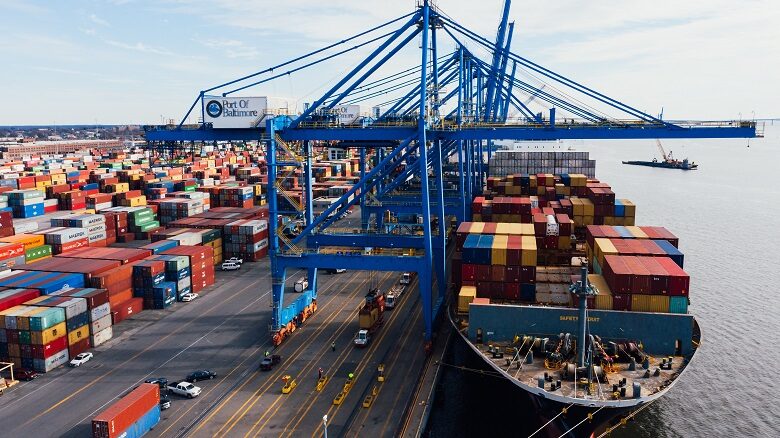
A port where a large number of containers are being unloaded (Photo: Kelly / pexels)
From here, we look at the status of carbon dioxide and greenhouse gases in shipping using data collected by international organizations. This time, we use data published by the IMO (※1), the International Energy Agency (IEA) (※2), and UNCTAD.
According to the IMO’s study in 2020, emissions of both greenhouse gases (※3) and carbon dioxide across shipping as a whole—including international shipping, domestic shipping, and fisheries—increased from 2012 to 2018. In 2018, carbon dioxide emissions from shipping exceeded 10 billion tons, and emissions including greenhouse gases other than carbon dioxide accounted for about 3% of humanity’s total greenhouse gas emissions.
Also, according to the IEA, while limited to international shipping data, we can see that carbon dioxide emissions have remained at similar levels since 2018. Although emissions temporarily fell in 2020 due to the impact of COVID-19, by 2022 they had already returned to the same level as 2018. A report that UNCTAD released in September 2023 on oceans also indicates that this trend has not changed and that carbon dioxide emissions remain at high levels.
There are multiple possible reasons for the increasing trend in greenhouse gas emissions from shipping. First, both world trade and shipping, which carries the vast majority of it, are on the rise, resulting in increased carbon dioxide emissions. Other factors include increased fuel use—and thus increased greenhouse gas emissions—due to various causes such as longer voyage distances, higher sailing speeds, and port congestion. The aging of ships is also cited as one factor; older ships generally have lower energy efficiency and tend to have higher emissions, it has been noted.
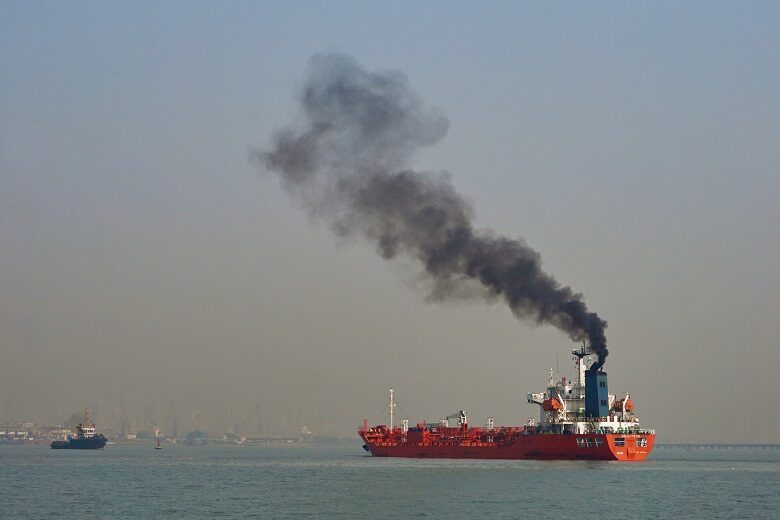
A ship emitting a large amount of exhaust gas (Photo: Cyprien Hauser / Flickr [CC CY-ND 2.0 DEED])
In fact, compared with other modes such as land transport, shipping has lower carbon dioxide emissions. Looking at the share of carbon dioxide emissions from the transport sector as of 2018, land transport (※4) and rail together account for about 75% of the total. Of the remaining 25%, air accounts for about 12% and shipping about 11%. Even so, carbon dioxide emissions from shipping account for roughly 3% of global anthropogenic emissions, almost equivalent to all the carbon dioxide emitted by Germany as a country.
In this context, the need to decarbonize shipping is being voiced ever more urgently.
The IMO’s overarching framework for decarbonization
From here, we follow the decarbonization pathway presented by the IMO, which sets global rules in the maritime field.
Before explaining specific measures, let’s touch on the MARPOL Convention (MARPOL), a treaty to prevent pollution from ships in general. There had previously been a treaty to prevent pollution of the sea by oil in 1954 (OILPOL Convention), but MARPOL was adopted in 1973 to more comprehensively prevent marine pollution by ships amid increased sea transport. A protocol was adopted in 1978 in response to a spate of tanker accidents before the 1973 convention could enter into force; that protocol absorbed the original convention and, through several amendments, remains in effect today. The convention has six annexes according to the source of pollution, and Annex VI, which entered into force in 2005, deals with air pollution. As of 2023, there are 161 parties to MARPOL and 105 parties to Annex VI, which is an optional protocol.
As mentioned at the outset, in July 2023 the IMO adopted a strategy to reduce greenhouse gas emissions from international shipping to net zero around 2050. Compared with the initial strategy the IMO released in 2018, which aimed for zero emissions early in the 21st century, this pushes decarbonization more forcefully. In line with the long-term goal of the Paris Agreement of 2015—to keep the global average temperature rise well below 2 degrees above pre-industrial levels and pursue efforts to limit it to 1.5 degrees—the shipping industry has set more ambitious reduction targets, it can be said.

The MEPC80 session where the IMO strategy was adopted (Photo: International Maritime Organization / Flickr [CC BY 2.0 DEED])
The IMO strategy of 2023 especially includes targets to reduce carbon intensity (※5). To achieve these goals, the IMO states that global promotion of technological innovation and alternative fuels is necessary, and it sets progressive targets including improving the energy efficiency of newly built ships, using fuels/technologies that do not emit carbon dioxide at the point of use, and benchmarks for greenhouse gas reductions. Specifically, by 2030, a 20–30% reduction in greenhouse gas emissions compared with 2008; by 2040, a 70–80% reduction compared with 2008, and so on.
In addition to the policies set this time, the IMO has proposed and implemented various measures in the past, grouped into short-, mid-, and long-term measures. Below, focusing on short-term efforts, we outline the initiatives the IMO has taken or plans to take.
Some of the short-term measures developed to meet the goals presented in the 2018 initial strategy started in January 2023. Aimed at lowering carbon intensity by reducing fuel consumption, they include introducing the EEXI regulation (※6) to regulate fuel efficiency of existing ships, the CII scheme (※7) to require ships to report and rate the carbon intensity of their fuel, and tighter requirements for the SEEMP (※8) to mandate efficient voyage planning. For newbuilds, there has already been the EEDI regulation (※9) in place since 2013. All these policies are incorporated into Annex VI of MARPOL and are legally binding.
However, some point out that the regulations implemented as short-term measures are insufficient to curb greenhouse gas emissions. For example, under current EEXI standards, the volume of carbon dioxide emitted by ships by 2030 would be reduced by only about 1% compared to a scenario without EEXI. It is also argued that the shift to newbuilds has been pushed by fuel prices and freight rates, and that the EEDI regulation has not led to the adoption of new technologies or improvements in ship efficiency. That said, the effectiveness of measures such as the EEXI regulation and the CII scheme is scheduled to be reviewed by 2026 at the latest at the latest.
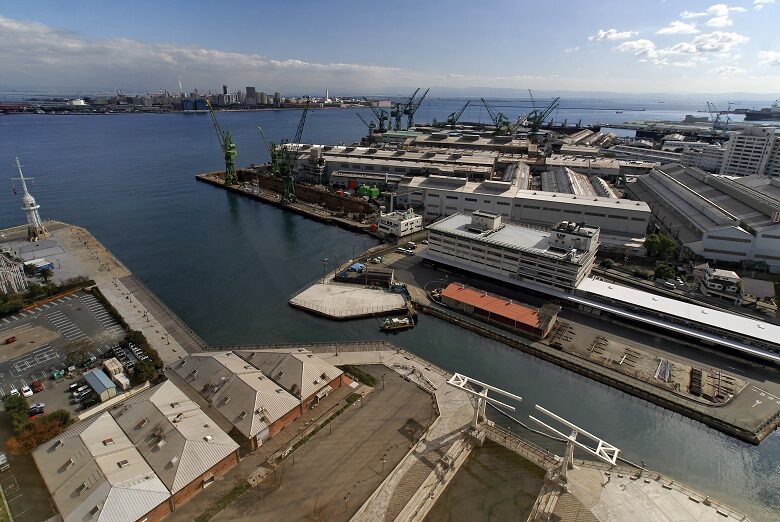
Kawasaki Heavy Industries’ shipyard in Kobe, Japan (Photo: 663highland / Wikimedia Commons [CC BY-SA 3.0])
We also briefly outline mid- and long-term policies, for which specific measures will be implemented going forward. As mid-term measures, the major items are: in the technical domain, establishing new standards to gradually reduce the greenhouse gas intensity of marine fuels; and in the economic domain, introducing a polluter-pays pricing mechanism for greenhouse gas emissions from shipping. For the long term, the fossil fuels currently used are to be replaced by new energy sources and technologies such as ammonia, biofuels, electricity, hydrogen, and wind power development. Details have yet to be set; the mid-term plan content is to be decided by 2025 and the outline of the long-term plan by 2028 according to schedule.
Technological initiatives
Now we discuss various technological initiatives underway to decarbonize the shipping industry. Some use existing technologies, while others require new technological development. We look at examples of each.
First, as an issue that can be addressed with current technology, consider port congestion. This occurs when cargo ships arrive beyond a port’s handling capacity. Because of port congestion, supply chains face delays and disruption, increased transport costs, and increased fuel use due to long waits at anchor, resulting in increased carbon dioxide emissions.
There are various causes of port congestion. They include increased trade driven by a rise in online orders and personal consumption during the pandemic that began in 2019 increase, basic infrastructure shortages at ports, labor shortages, and strikes, among other intertwined factors.
To solve these problems, proposals include further digitization to ensure smooth cargo handling and efficient port-call schedules for ships, and improving efficiency at ports in low-income countries, where ships tend to have longer port stays due to longer port transit times, infrastructure shortages, and low labor productivity.
In addition, slow steaming and route planning revisions can also reduce greenhouse gases. Considering that the faster a ship travels the more fuel it consumes, and the more fuel it consumes the more greenhouse gases it emits, it is clear that slow steaming can significantly curb emissions. For example, lowering a ship’s speed by 10% from conventional levels is estimated to reduce its carbon dioxide emissions by 27%.
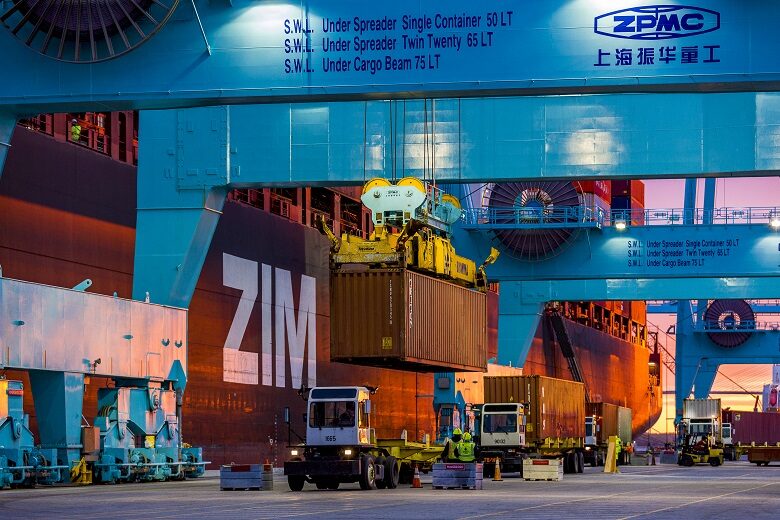
A ship and trucks transferring containers at a port (Photo: JAXPORT / Flickr [CC BY-NC 2.0 ])
Next, we focus on technological development toward decarbonization in the shipping industry.
As noted in the IMO strategy section, the development of renewable alternative fuels to replace fossil fuels is considered crucial. New fuels include synthetic fuels (e-fuel) such as green hydrogen (※10) and green ammonia (※11), methanol, and biofuels. Moves to use fuels with lower greenhouse gas emissions are gaining momentum in the shipping industry.
There are, however, several concerns. First, introducing such fuels is costly. Moreover, energy is needed to produce these low-carbon fuels, which can result in large amounts of fossil fuels being consumed. It would be counterproductive if a lot of energy were used in the process of producing energy meant to reduce carbon emissions. There is also the issue that personnel who can handle such alternative fuels and ports where they can be bunkered are lacking. Perhaps because of these obstacles, the IEA forecasts that by 2030, alternative fuels will account for only about 13% of energy consumption in international shipping.
Beyond fuels, ships capable of using these fuels—or combining them with existing propulsion—also need to be built. For existing ships that currently use fossil fuels, they cannot use alternative fuels as is, and need to be retrofitted at substantial cost.
As for newbuilds, ships designed to use various fuels are being developed around the world. For example, a Japanese shipbuilder developed a tour boat powered by hydrogen and biofuels that held its launching ceremony in September 2023. Using alternative fuels can reduce carbon dioxide emissions by 53–100% compared with conventional ships. However, considering that fossil fuels are needed in the production and transport of these fuels, overall carbon dioxide emissions will likely be higher than assumed. Regarding ammonia, although not yet in operation, in Greece an ammonia-ready vessel was already completed in 2022. However, many of these newbuilds—including the wind-powered ships mentioned at the beginning of this article—are still in the trial stage, and in any case they account for only a very small fraction of the world fleet.
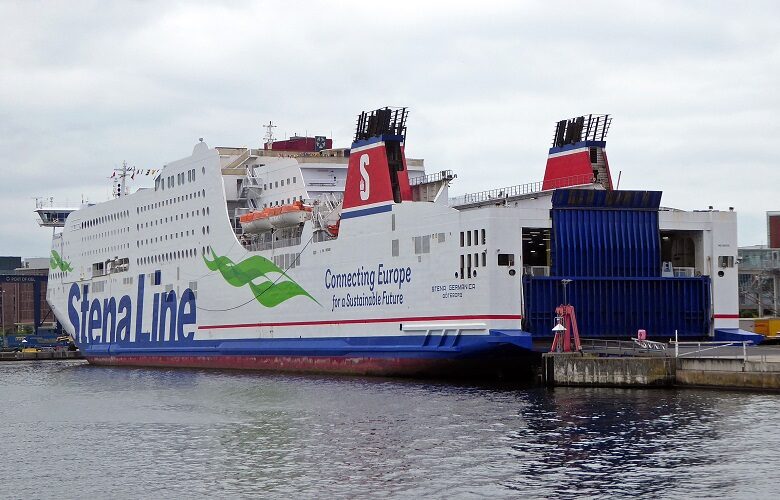
A ship called Stena Germanica that runs on methanol (Photo: Wolfgang Fricke / Wikimedia Commons [CC BY 3.0 DEED])
Another technology expected to be used in the shipping industry is on-board carbon dioxide capture. Carbon capture is a technology that separates carbon dioxide emitted from sources such as factories from the atmosphere, stores it underground, and utilizes it in other industries. It is already used at power plants and factories on land technology, and has the advantage that technologies used on land can be transferred to ships. For example, Dutch company JR Shipping plans to install carbon capture equipment on 10 ships by the end of 2023. The captured carbon dioxide will be temporarily stored in containers and later used in other industries such as agriculture.
Specific policies and laws
So what measures are being taken beyond the technological front? We look at what policies countries around the world are adopting for carbon dioxide and greenhouse gases from shipping.
The EU is taking strong decarbonization policies in this area. Since 2005, the EU has operated an emissions trading system (EUETS) (※12) within the bloc. Covered companies emit carbon dioxide within allocated caps and can trade allowances as needed. From 2024, this system will be gradually introduced in the shipping sector as well. Shipping companies must purchase allowances to cover 40% of their emissions in 2024, 70% in 2025, and all emissions from 2026 onward. The system covers not only ships sailing between ports within the EU, but also 50% of emissions from international voyages where either the origin or destination is within the EU. Emissions from cross-border voyages have often escaped regulation, but such ships can now be covered.
Furthermore, in July 2023 the EU adopted a new maritime regulation (FuelEU). FuelEU is part of the EU’s Fit for 55 policy package (※13) to promote decarbonization in Europe and aims to push decarbonization in the maritime sector. FuelEU aims to reduce the greenhouse gas intensity of fuels used by ships. To that end, it sets upper limits on the greenhouse gas intensity of fuels used by ships of 5,000 gross tons or more, excluding warships, and requires those ships to connect to onshore power while at berth.
Singapore, one of the centers of global trade, is also leading decarbonization in the global shipping industry. Singapore is particularly working to develop low-carbon hydrogen (hydrogen with low associated emissions in its production and use) as an alternative fuel in shipping, establish its supply chains, and support research. It is also promoting the electrification of vessels. By using batteries charged with renewable energy to power ships, carbon dioxide emissions are expected to be reduced. However, it has been pointed out that while electrification is possible for small vessels, batteries capable of powering large ships are technically difficult at present.
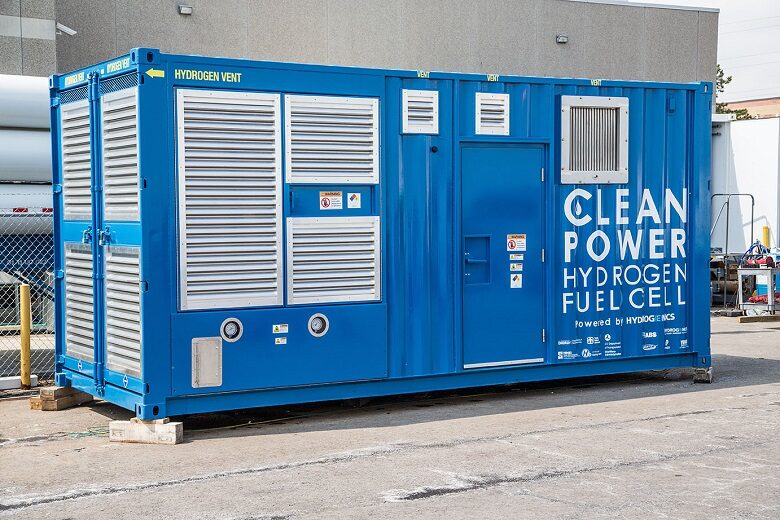
A hydrogen fuel cell development project for shipping at Honolulu Harbor (Photo: Sandia Labs / Flickr [CC BY-NC-ND 2.0 DEED])
As a multilateral effort, there is the policy of green shipping corridors. Green shipping corridors are routes between major ports where governments and industry collaborate to promote the operation of zero-emission ships that do not emit greenhouse gases during operation. The concept was highlighted at the 26th Conference of the Parties to the UN Framework Convention on Climate Change (COP26) in the UK in 2021 focus, and during that period the Clydebank Declaration (※14) to advance green shipping corridors was also announced. While some welcomed the declaration as an incentive to develop low-emission ships opinion, others criticized it for lacking specificity and being non-binding opinion.
As of July 2023, more than 20 corridors were under development, already exceeding the Clydebank Declaration’s goal of six corridors by 2025. For example, between the Ports of Los Angeles in the United States and Shanghai in China—one of the world’s busiest trade routes—an agreement was reached in 2022 to establish a trans-Pacific green shipping corridor agreement, and in September 2023 the parties announced an outline of the plan.
A difficult road ahead
In 2023, the IMO, which plays the leading role in global maritime rules, presented more ambitious decarbonization targets for the shipping industry. However, given the difficulties of technological innovation, high costs, and the fact that shipping is an industry that spans countries, the path to decarbonization is still only halfway.
The IMO strategy itself in 2023 has also faced criticism from multiple angles. For example, there is criticism that the current emissions reduction schedule will not achieve the goal of limiting temperature rise to below 1.5 degrees. Others criticized the omission of a carbon tax from the IMO strategy. Pressure to introduce a carbon levy on the shipping industry has been mounting since early 2023, and at the finance summit in Paris in June and at MEPC80 in July, Pacific island nations such as the Marshall Islands led calls for its introduction. However, there was strong opposition led by China, and the IMO strategy settled on the phrase “market-based or other economic elements,” without adopting a carbon tax itself.
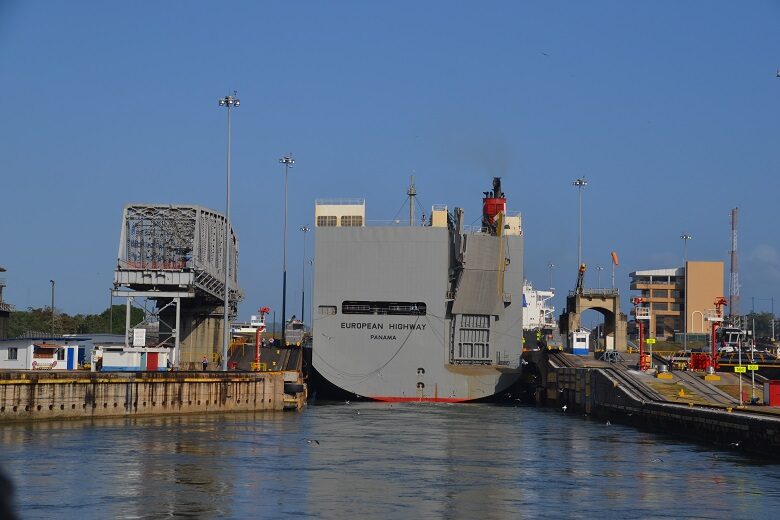
A ship transiting the Panama Canal (Photo: Malcolm K. / Flickr [CC BY-NC 2.0 DEED])
Meanwhile, environmental conditions continue to worsen. For example, at the Panama Canal, severe drought caused by extreme weather has reduced water levels, making it necessary to restrict transits until around 2024. As transits are restricted, ships’ waiting times have increased, which is estimated to be raising carbon dioxide emissions. It is ironic that the adverse effects of global warming are, in turn, leading to further greenhouse gas emissions.
The mid- and long-term policies under the IMO strategy will see their details decided over the next few years. We need to continue to watch whether effective policies for reducing greenhouse gas emissions are properly adopted.
※1 The IMO is one of the UN’s specialized agencies, established in 1959, that works to improve the safety of ships engaged in international trade and to prevent pollution from ships.
※2 The IEA is an independent body within the Organisation for Economic Co-operation and Development (OECD), established in 1974 after the first oil crisis, that provides energy statistics and policy analysis.
※3 In the IMO study, greenhouse gases include carbon dioxide, methane, and nitrous oxide.
※4 In the data used here, land transport refers to cars, motorcycles, buses, and taxis for passengers, and trucks for freight; it does not include rail transport.
※5 Carbon intensity is an indicator expressed as energy consumption per unit of activity, calculated by dividing “energy use” by “economic activity.” In the IMO strategy, it is used per unit of transport work.
※6 The Energy Efficiency Existing Ship Index (EEXI) sets benchmark values for the fuel efficiency of large existing ships engaged in international voyages of 400 gross tons (※15) or more and regulates them to meet those benchmarks. If a ship does not meet the benchmark, some improvement measures must be taken.
※7 The Carbon Intensity Indicator (CII scheme) is a system that requires certain types of ships of 5,000 gross tons or more to report their annual fuel-use performance to the competent authority, which then rates them.
※8 The Ship Energy Efficiency Management Plan (SEEMP), introduced in 2013, is a plan for efficient operation that ships of 400 gross tons or more are required to submit. It has been tightened in stages, including requiring data collection and reporting of fuel consumption for ships of 5,000 gross tons or more in 2019, and introducing the CII scheme in 2023.
※9 The Energy Efficiency Design Index (EEDI) sets benchmark values for the fuel efficiency of newbuilds and regulates them to meet those values.
※10 Green hydrogen is hydrogen produced by electrolysis of water using electricity from renewable energy. Because electricity from renewable sources is used in the production process, it can be generated without releasing carbon dioxide into the atmosphere. However, since electrolysis requires a large amount of energy, there is concern that relying entirely on renewable energy would be very costly.
※11 Green ammonia is ammonia synthesized from green hydrogen produced by the method above and nitrogen separated from air. Unlike conventional ammonia production using liquefied natural gas, it is characterized by not emitting carbon dioxide during production.
※12 The EUETS is a system that caps the total greenhouse gas emissions from certain companies in the covered region and lowers that cap each year to reduce emissions (cap). Companies must purchase allowances for the amount they need to emit (some industries receive free allocations), and companies exceeding their allowances must purchase additional allowances on the market from those with surpluses (trade). Revenue from the EUETS is used to fund the EU’s decarbonization. Participating in this system are the 27 EU member countries, plus Iceland, Liechtenstein, and Norway.
※13 Fit for 55 is the EU’s climate policy package under the European Climate Law to reduce greenhouse gas emissions by at least 55% from 1990 levels. It includes reform of the EUETS, adoption of FuelEU, and establishment of a Carbon Border Adjustment Mechanism (a system requiring declarations of emissions for certain products imported from outside the EU and the collection of charges according to those emissions).
※14 The Clydebank Declaration is joined by 24 countries: Ireland, the United States, the United Kingdom, Italy, Australia, the Netherlands, Canada, Costa Rica, Singapore, Sweden, Spain, Chile, Denmark, Germany, Japan, New Zealand, Norway, Palau, Fiji, Finland, France, Belgium, the Marshall Islands, and Morocco participation.
※15 Gross tonnage is a measure of a ship’s size, calculated by the method defined in the 1969 International Convention on Tonnage Measurement of Ships. It is obtained by multiplying the internal volume of the ship by a coefficient defined by the convention.
Writer: Ayane Ishida



















「2018年には、海運による二酸化炭素の排出量は100億トンを超えており」とありますが、正しくは10億トンではないでしょうか。