
“We are becoming very emotional because we are seeing Europeans with blue eyes and blond hair being killed every day.” This was a remark by Ukraine’s former deputy prosecutor general about the Russia–Ukraine war on a British BBC program in February 2022. The BBC presenter who interviewed the former deputy prosecutor general said in response, “I understand and respect that sentiment.” Also, in the same February 2022, a U.S. CBS News correspondent, speaking about the same Russia–Ukraine war, made the following comment: “This is not a place like Iraq or Afghanistan, where conflict has been going on for decades. This is a relatively civilized, relatively European city.”
The above are examples in Western media where the degree of attention and sympathy given to victims of armed conflict varies depending on appearance or region of origin. From the standpoint of news values, it is suggested that, unlike conflicts in Asia, Africa, or the Middle East, conflicts that occur in Europe are deemed more worthy of attention and sympathy.
In Japan as well, coverage of the Russia–Ukraine war has dominated the news. Even though, in the first half of 2022, deaths from the conflict in Myanmar exceeded those from the Russia–Ukraine war, in Japan’s major newspapers the amount of reporting on the latter was nearly 500 times that of the former. Moreover, there has been a great deal of empathetic humanitarian reporting not seen in coverage of conflicts in Asia, Africa, or the Middle East. In the Russia–Ukraine war, individual victims have been spotlighted, with their faces, names, and circumstances frequently featured in Japanese media. By contrast, the situations of other armed conflicts around the world and the personal suffering of their victims as human beings receive little media attention.
Given that multiple factors can cause differences in both the amount and the framing of coverage, how much weight is placed on the appearance or region of origin of conflict victims? In this article, we explore what lies behind the fact that some people are reported on and others are not.
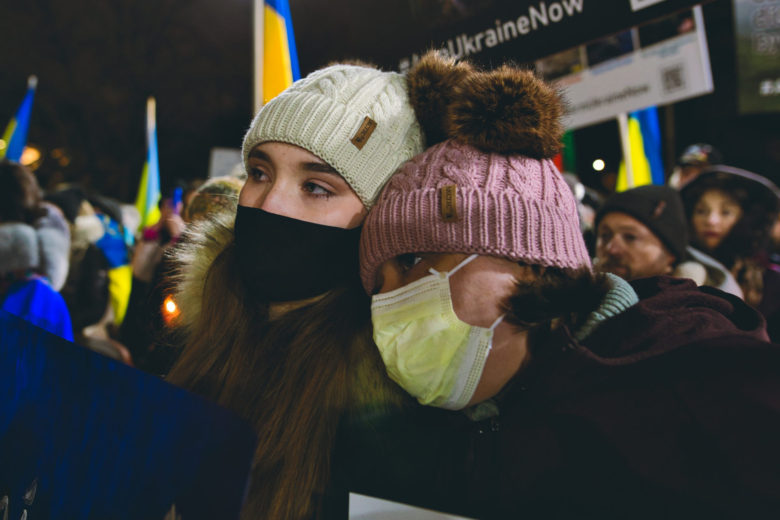
People in the United States reflecting on the Russia–Ukraine war (Photo: Alek S. / Flickr [CC BY-ND 2.0])
目次
Skewed international reporting
To date, GNV has investigated what lies behind the bias in Japan’s international reporting. First, it can be said that, in terms of volume, Japanese international news is heavily skewed toward the West and East Asia—a characteristic pattern. For example, when similar events or phenomena occur in Western and non-Western regions, the former tends to get attention even if the number of victims or people affected in the latter far exceeds the former.
Such tendencies can be seen in coverage of armed conflicts, terrorist attacks, refugees, and protests. Focusing on the volume of reporting on refugees, coverage is skewed toward Europe. For example, regarding refugees who emerged in 2015, there is a study by GNV. Of the world’s refugees in 2015, those originating in Europe accounted for 3.3% and, among host regions, Europe accounted for 11.7%. Despite the fact that Europe did not account for a large share of either refugee-producing or host countries, 50.1% of refugee-related coverage in Japan that year concerned Europe.
In addition, a similar pattern is seen with natural disasters. For instance, in East Africa, as of August 2022, as many as 20 million people were affected by food crises and other impacts due to lack of rainfall and insufficient humanitarian aid, resulting in the world’s largest drought disaster. Nevertheless, reporting on this severe drought was less than that on drought in Europe, and the drought in Europe—where food shortages were not occurring—received more coverage.
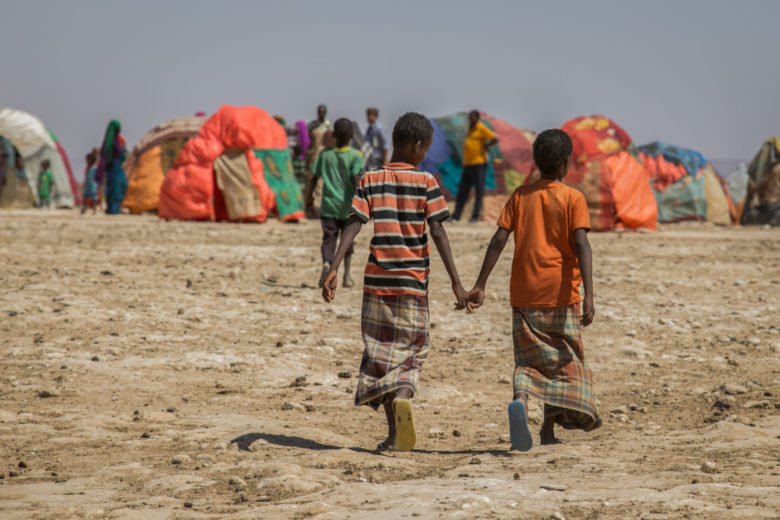
Children holding hands in a drought-affected area of Ethiopia (Photo: UNICEF Ethiopia / Flickr [CC BY-NC-ND 2.0])
Beyond these news items, there are other examples of coverage that prioritizes certain regions. For example, across several Latin American countries, major social movements and legal reforms toward legalizing abortion have occurred from 2019 through the present in 2023. Nevertheless, the legal change that took place in the United States in 2022 received overwhelmingly more coverage. Likewise, in reporting focusing on racism, many of the countries that appear are Western nations.
What lies behind the bias in international reporting
As reasons behind the emphasis on the West and East Asia, one might cite their relative proximity from a Japanese perspective and deep ties in areas such as trade and security. But does that explain it entirely? Although distance has been shown statistically to be related to volume of coverage, in terms of pure geography the West is not closer to Japan. Conversely, Southeast Asia is geographically close and deeply connected in trade and people-to-people exchange, yet it receives little coverage. The Middle East is also extremely important to Japan’s energy supply, yet coverage is scarce.
It might also be argued that the Russia–Ukraine war draws attention for reasons of national interest, as major powers are involved and links to nuclear weapons have been noted. However, it is hard to explain purely in terms of national interest why humanitarian reporting concentrates so heavily on Ukrainian victims of the Russia–Ukraine conflict. Whatever the people or region, if they are facing hardship, there should be room for empathy. Moreover, even in the past, conflicts have attracted great attention simply by occurring in Europe, despite not involving major powers or nuclear weapons. For example, in the 1990s the Bosnian War received far more attention in the Japanese media than larger-scale conflicts in Africa at the time. It seems a pattern has formed whereby conflicts in Europe are considered worthy of attention.
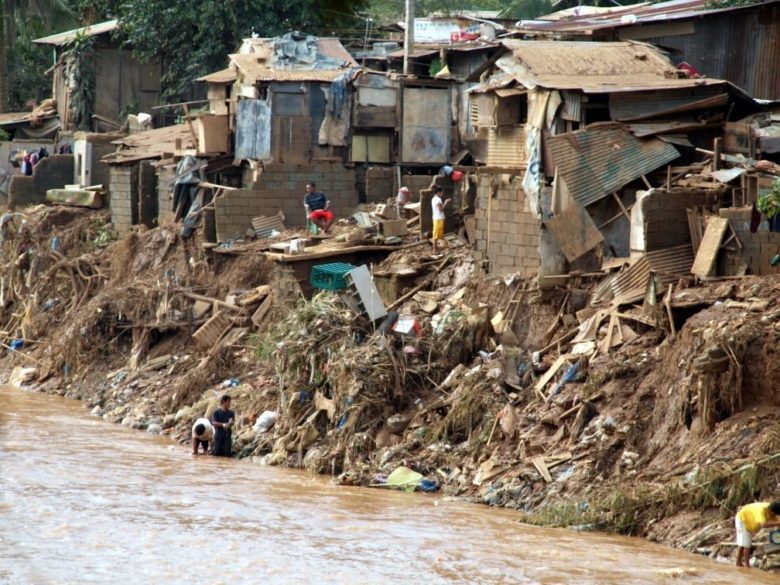
A low-income residential area in Manila, Philippines, during flooding (Photo: Jörg Dietze / Flickr [CC BY 2.0])
Statistical analysis also makes it clear that poverty has a major impact on the volume of coverage. In other words, the higher the poverty rate, the less reporting there is. This can, to some extent, explain the disparity in coverage between Western regions with low poverty rates and other regions with higher rates regarding the volume of reporting. But is lack of coverage solely due to poverty? As in the opening examples, external factors such as being “blue-eyed and blond” may also be one reason behind differences in coverage.
What do media professionals think?
Although, in international reporting, the amount of coverage varies greatly by region, it is hard to statistically identify with data how much, in the background of reporting, the appearance and region of origin of the people who become subjects influence those judgments. Therefore, we decided to ask working journalists about the imbalance in international news. We conducted individual interviews with 3 people at television stations (each belonging to a different broadcaster) and 1 person at a national newspaper. Here, without using names, we refer to them as Mr./Ms. A, Mr./Ms. B, Mr./Ms. C, and Mr./Ms. D. Below we summarize their views.
First, they all shared the view that the skew in the countries and regions taken up in international news arises because the number of overseas bureaus is limited, creating constraints on where they can report. When doing coverage of areas without a bureau, where they cannot obtain their own footage, in such cases they purchase video from Western media and others. As a result, the tendencies of Western outlets are they said inevitably reflected. Also, the space available to report on the world is small. Within this limited airtime and print space, when trying to address and explain new topics, it requires more time or pages than stories from countries that are regularly covered. Consequently, regions, countries, and issues already familiar to viewers and readers tend to be selected as news.
In addition, Mr./Ms. D says that the knowledge level of those who select content can also influence judgments of news value. Countries familiar to viewers and readers are also familiar to those producing the news. For that reason, there is a tendency for the regions covered to become fixed. Thus, they pointed out, a vicious cycle arises in which areas that have not previously been looked at as news subjects remain unreported.
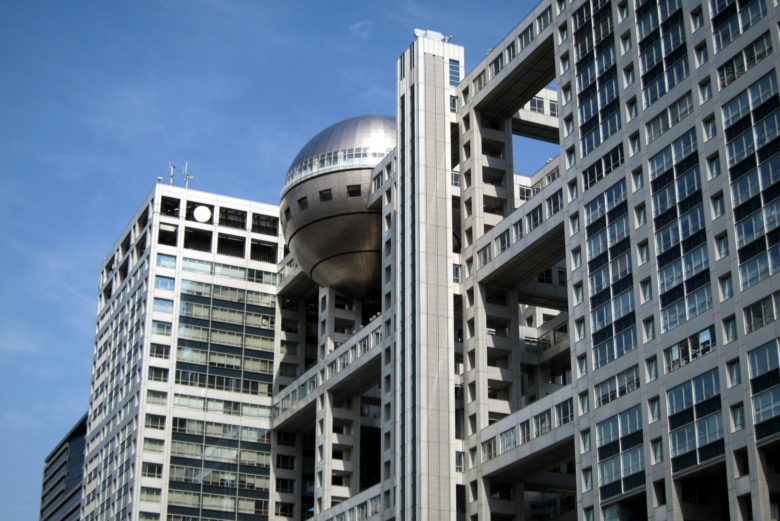
Overview of a TV station in Tokyo, Japan (Photo: Wally Gobetz / Flickr [CC BY-NC-ND 2.0])
In addition to familiarity with the subject, the ease of empathizing with the people covered is also said to be a key determinant of news value. It is thought to be easier to empathize with people who live in regions where the standard of living and lifestyle are close to Japan, and with events there. Because of this ease of empathy, events in countries similar to Japan in terms of living standards, etc., are more readily perceived as personal concerns and more likely to attract the attention of viewers and readers in Japanese society. This view is consistent with the statistical analysis above showing less reporting on high-poverty countries. Mr./Ms. C also noted that, especially in Japan, there has long been a tendency to admire London, Paris, and the United States, and that reporting on what happens in those places tends to be covered because it translates into ratings.
Mr./Ms. C added that Japan’s pride in being a G7 country fosters a sense of kinship with the West, and together with admiration, results in a lot of reporting about the West. This pride, they said, also has the effect of making people perceive themselves in affluent, high-income countries as above poorer countries and regions. As a result, they suggested, there is a tendency in coverage to neglect events in low-income countries, where empathy in Japan is less likely, based on a perceived hierarchy.
The story appeal and novelty of content also matter, and sudden conflicts or natural disasters are more likely to be selected as news—a common view of the journalists interviewed was. Mr./Ms. A said that editors are prone to misjudge conflicts or droughts in Africa as everyday, unremarkable occurrences, and therefore, even if they obtain such story tips from non-Japanese outlets, they are inclined to say in their decision that it should not be treated as international news. Stories involving major powers, or the confrontations of major powers—topics that seem momentous and are easy to cast as straightforward narratives—are actively covered.
Mr./Ms. D also pointed out that, as a social tendency in Japan, awareness of human rights is low. Additionally, Mr./Ms. C said that in the strongly self-centered climate in Japanese society, there is little interest in other countries as well. For these reasons, humanitarian reporting itself is limited in Japan. If humanitarian reporting on the Russia–Ukraine war seems exceptionally abundant, it seems to be merely a humanitarian focus attached to war-related coverage, and not because there is any special intent such as spurring humanitarian aid. Regarding coverage of the Russia–Ukraine war as well, they suggested that attention ultimately gravitates toward the moves of major powers that could affect Japan in an emergency. “I feel there is, in a sense, a merciless posture in Japan: enjoying it as a show, based purely on political interest“, Mr./Ms. C stated.

Reporter taking notes (Photo: President Of Ukraine / Flickr [CC0 1.0])
An admiration for “white people” in Japanese society?
So, does appearance affect Japan’s international reporting? In Japanese society there is said to be an admiration for so-called “white people” (※1), as pointed out in media opinion articles and the like. For example, in a news context, when foreign nationals appear as commentators on programs, it is often pointed out that they are usually “white” people from the West, rather than people from the Middle East or Africa who might be expected to speak on those issues reports. Similar tendencies are seen in media outside news programs as well.
Some of the journalists interviewed pointed out that factors such as appearance and region of origin can become criteria for judging news value. They said that, in Japanese society itself, there may be an aspiration toward so-called “white people,” and that this influences judgments. For example, Mr./Ms. B suggested that Japanese people tend to think of themselves as closer to “white people,” which may make it harder to empathize with those who are not. Mr./Ms. A also recounted a case in which the appearance of a Belarusian female athlete was the deciding factor in coverage. When the athlete’s criticism of her country’s authoritarian regime at the Tokyo Olympics caught a journalist’s eye, a certain producer argued internally for featuring her voice because they liked her “white”-looking appearance. At that time, Mr./Ms. A felt there are aspects in which coverage decisions are made based on lookism. They also pointed out that journalists sometimes cater to Japanese society’s tendency to prefer the appearance of “white” people,.
Do humanitarian sentiments vary by region?
Do people who consume media tend to react differently to two people facing similar problems when those people come from different regions? We therefore conducted an experimental survey by creating a fictional newspaper article and measuring humanitarian responses to it.
In the experiment, we used two groups of university students as respondent groups, and conducted a survey (※2) on whether a foreign man from a certain region should be granted refugee status. In one group (53 people), the man’s region of origin was described as Europe; in the other group (51 people), it was described as Africa. Aside from the man’s region of origin, the articles were identical. In broad terms, the article stated that the man was seeking refugee status from the Japanese government and that the government was considering the request. After reading the article, participants were asked to choose intuitively which of three options—admit him as a refugee in Japan, send him to a third country, or repatriate him to his home country—was most appropriate, selecting one of the 3 options.
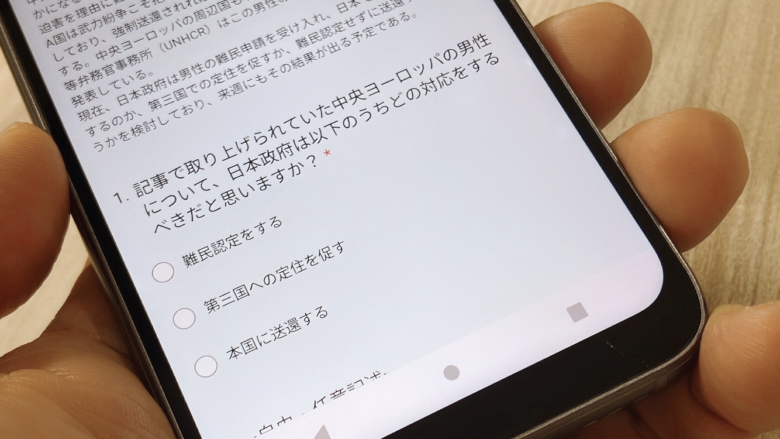
Person answering a questionnaire (Photographer: Rei Oishi)
Comparing the proportions of the survey responses, there were no differences between the two groups. In both, about 2 out of 3 respondents said refugee status should be granted, while about 1 out of 3 said he should be sent to a third country (※3). In this survey, the man’s region of origin did not appear to affect responses to the question of whether to grant refugee status.
We indicated that the article used in the experiment was fictional and, since the subjects were university students only and were a limited sample, this survey has limitations. As many television and news viewers are from the middle-aged and older demographics, results might have differed had we surveyed those age groups. However, at least in this survey on whether to grant “refugee status,” the university students studied did not show a tendency to judge based on region of origin.
Summary
Multiple factors create differences in the amount and framing of international coverage, and they intertwine in complex ways. This makes it hard to pinpoint whether people’s appearance or region of origin serves as a criterion for judgment for the level of attention and sympathy. For example, poverty rates are clearly one factor creating bias in coverage. At the same time, many high-income Western countries have populations composed largely of people considered “white.” In other words, for many people living in these regions, two elements—standard of living and appearance—overlap. Thus, we cannot rule out the possibility that appearance also plays a decisive role behind the coverage gap between high-income countries and other regions.
Furthermore, the concentration of coverage on certain regions can also be explained as something formed habitually over time. There is a tendency to keep focusing on the regions that have been highlighted up to now. Behind this are large disparities in the amount of information recorded in history and in education between the West and other regions. People unconsciously make distinctions based on images of regions and their inhabitants, and for countries and regions about which they lack background knowledge, both those who report and those who receive the news find them unfamiliar.
As a result, the regions that are covered become habitually fixed, creating a vicious cycle. Unless this is broken, Japan’s bias in international reporting will not be resolved. Whatever the reasons, there is no doubt that there are huge interregional disparities in the amount of international coverage. Is this really acceptable?
※1 The very term “race” is merely a concept created to forcibly and artificially classify things that cannot inherently be clearly categorized, to suit the needs of each society. There is no scientific basis for it. Accordingly, the expression “white people” is a generalized one, and no such classification exists biologically.
※2 The fictional articles and question used in this survey are as follows. The number of respondents to Article ① was 53. The number of respondents to Article ② was 51.
Article ① headline: Refugee status of man from country A in Central Europe: decision as early as next week
Body: A decision on the refugee application of a man from country A in Central Europe will soon be announced. This man from country A (29) came to Japan in 2019 and had sought refugee status on the grounds of persecution in his home country. While country A is not in an armed conflict, repression of minorities has accelerated in recent years, and experts point out that if he is forcibly returned, there is a risk of arrest or torture. Neighboring countries in Central Europe also view the current situation as problematic, and the Office of the United Nations High Commissioner for Refugees (UNHCR) has said that his situation merits refugee recognition. The Japanese government is currently considering whether to accept his refugee application and allow him to settle in Japan, encourage resettlement in a third country, or deny refugee status and return him, with a decision expected as early as next week.
Article ② headline: Refugee status of man from country A in East Africa: decision as early as next week
Body: A decision on the refugee application of a man from country A in East Africa will soon be announced. This man from country A (29) came to Japan in 2019 and had sought refugee status on the grounds of persecution in his home country. While country A is not in an armed conflict, repression of minorities has accelerated in recent years, and experts point out that if he is forcibly returned, there is a risk of arrest or torture. Neighboring countries in East Africa also view the current situation as problematic, and the Office of the United Nations High Commissioner for Refugees (UNHCR) has said that his situation merits refugee recognition. The Japanese government is currently considering whether to accept his refugee application and allow him to settle in Japan, encourage resettlement in a third country, or deny refugee status and return him, with a decision expected as early as next week.
Survey question: Regarding the man featured in the article, which of the following responses do you think the Japanese government should take?
Response options: (1) Grant refugee status (2) Encourage resettlement in a third country (3) Return him to his home country
※3 The breakdown of responses to Article ① was: (1) Grant refugee status, 36; (2) Encourage resettlement in a third country, 16; (3) Return him to his home country, 1. The breakdown for Article ② was: (1) Grant refugee status, 33; (2) Encourage resettlement in a third country, 16; (3) Return him to his home country, 2.
Writer: Rei Oishi



とても結果の気になるアンケートでした。
日本の平和ボケはよく言われますが、人権意識の低さの指摘にはハッとさせられました。
もちろん、発信元であるメディアの報道に偏りが生じることはよろしくありませんが、その改善は我々読み手のリテラシーや資質の向上あってのものなのではないのでしょうか。
そうでなければ、我々はメディアに舐められ切ったままだと思うので。
報道関係者へのインタビューにより報道現場でどのように偏りが生まれている背景を知ることができ、勉強になりました。
「青い目と金髪のヨーロッパ人が毎日殺されているのを見ているので、非常に感情的になる。」
BBCの中でこういった発信があったのはびっくりです。しかもBBCの人たち、あんまり差別的だって自覚してなさそう、、
>>日本社会自体において、いわゆる「白人」への憧れ意識が存し
これは間違っている、というよりも受取り手のよくある勘違いです。
日本の本質は、良い意味でも悪い意味でもエスノセントリズムです。
色白か美の基準であるというのは鎖国時代からあり、それに近い「モノ」に魅力があるというだけで、「白人と言う人種」自体は目に見えない形で見下されています。
「白人は軽薄でバカっぽい&頭がからっぽでルールが守れない」のイメージが脳裏にある日本人はわたしだけでない筈です。
黒人の場合は暴力的のイメージでしょうが・・・。