
The impacts of climate change on the planet—rising temperatures, extreme weather, sea level rise—are growing more severe year by year. In 2022, carbon dioxide emissions from the energy sector hit a record high, and there are concerns that 2023 could become the hottest year on record due to the acceleration of global warming to date. In addition, weather disasters like those occurring in Brazil, the Himalayas, and East Africa are expected to increase and worsen under the influence of climate change.
However, it is hard to say that the amount of reporting matches its severity. The effects of limited reporting on climate change go beyond failing to foster a sense of urgency among the public. Because media coverage does not scrutinize whether companies and governments are taking climate change seriously, it removes incentives for them to act. And while effective measures are not taken, the climate crisis accelerates.
Alarmed by the state of such coverage, multiple news organizations jointly launched in 2019 an international initiative called “Covering Climate Now” (Covering Climate Now). As of June 2023, more than 500 news outlets from around the world have joined, and GNV has participated as a partner organization since its inception.
From June 27 to July 1, 2023, Covering Climate Now held its sixth “Climate Week of Action” since its founding. During this “Climate Week of Action,” partner outlets in Covering Climate Now waive their copyrights and share stories among news organizations to concentrate and increase the volume of climate coverage. The theme this time is “Food and Water.” The campaign highlights how climate-related disasters, warming temperatures, and sea level rise affect global food systems, and conversely, how food production— which emits very large amounts of greenhouse gases— and consumption behaviors impact the environment.
GNV is also taking part in this Climate Week of Action, and this time we are translating and publishing articles from 2 partner outlets. The first, from the news site “Eos (American Geophysical Union & Eos Magazine),” is Meghie Rodrigues’s “Food Production Could Add 1°C of Global Warming by 2100.” This piece explains the characteristics of non-CO2 greenhouse gases and the impacts of food production on the planet. The second, from “Sentient Media (Sentient Media),” is Björn Ólafsson’s “Explainer: Why Is Beef Bad for the Planet?” This article explains the environmental harms that arise in the process of producing beef.
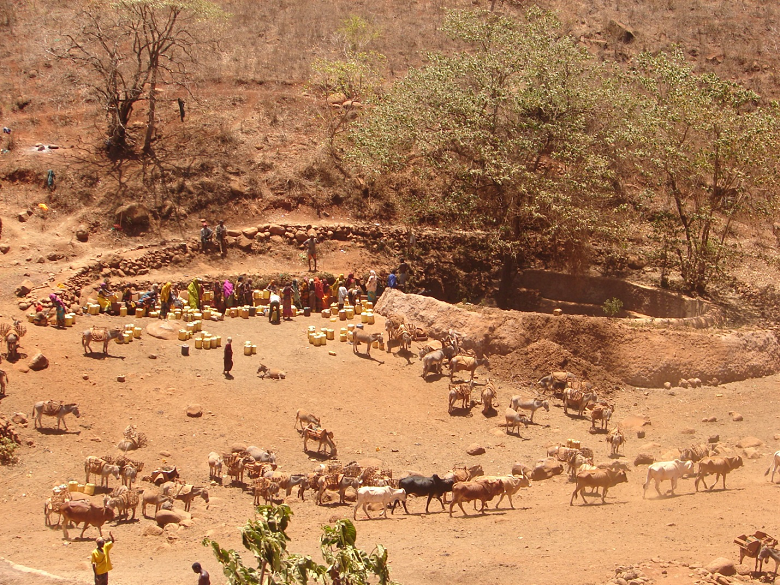
People in Marsabit County, Kenya drawing water from a well amid drought (Photo: ILRI / Flickr [CC BY-NC-ND 2.0])

目次
By 2100, food production could add a further 1°C of global warming
“Translated article from Eos (American Geophysical Union & Eos Magazine), English original, by Meghie Rodrigues (Note 1))”
A new study unpacks greenhouse gas emissions from agriculture and shows how the foods we eat are heating the planet.
Food production releases greenhouse gases into the atmosphere. According to the new research, the processes that bring food to our tables could cause the already-warming Earth to heat by another 1°C by the end of the 21st century. Combined with the 1.1°C of warming already observed since the Industrial Revolution, this could undermine efforts to limit warming to 1.5°C as set out in the Paris Agreement.
In the study published in Nature Climate Change, the foods we eat are tagged with greenhouse gas “price tags.” The analysis highlights the actions the global population should take to reduce emissions.
Beyond carbon, food is a burden too
Agriculture accounts for about 15% of the current global warming trend. For example, clearing new land, using synthetic fertilizers, on-farm energy use, and cattle belching all release greenhouse gases into the atmosphere. Agricultural production alone is responsible for nearly half of the world’s annual methane emissions, two-thirds of nitrous oxide, and 3% of carbon dioxide. These greenhouse gases differ in their heat-trapping ability and how long they remain in the atmosphere.
Methane, most of which is emitted during livestock and rice production, can trap more than 100 times as much heat as carbon dioxide. But whereas carbon dioxide can remain in the atmosphere for hundreds of years, methane persists for only about 10. Methane is a powerful but short-lived greenhouse gas. Nitrous oxide, emitted from synthetic fertilizers, is even more potent and longer-lasting than methane: it traps 250 times as much heat as carbon dioxide and remains in the atmosphere for about a century.
Although he did not participate in this new study, John Lynch, a biologist and climate scientist at the University of Oxford, notes that some studies report emissions in CO2-equivalents, a way to present gases’ effects more simply. According to Lynch, studies based on climate models should clarify the contributions of each greenhouse gas, but smaller-scale studies (for example, those that consider emissions from an agricultural system) tend to simplify data by using CO2-equivalent reporting.
Catherine Ivanovich, a climate scientist at Columbia University’s Lamont-Doherty Earth Observatory and the study’s lead author, says prior work on the climate impacts of food production measured pollutants only in CO2-equivalents, failing to account for changes in emissions and underestimating the gases’ true long-term impacts.
To account for these differences across food production, Ivanovich and colleagues separated emissions of each greenhouse gas from 94 food items using data from more than 100 studies. They then calculated annual emissions for each gas based on five different projections of population growth and food consumption across 171 countries. Finally, they applied those data to a simplified global climate model to predict how the five emissions scenarios would affect atmospheric temperature change.
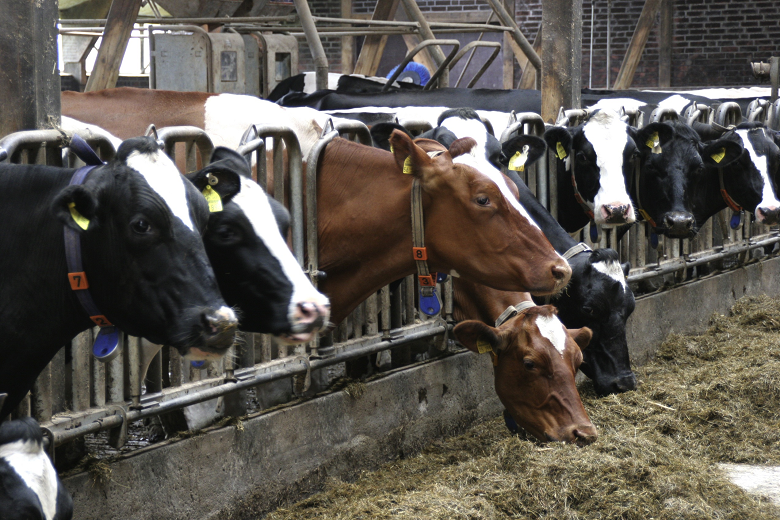
According to the analysis, if we maintain our current consumption patterns, today’s level of global warming is expected to increase by about 1°C. The foods contributing most to that rise are those that emit a lot of methane: red meat, dairy, and rice. Together, they account for 75% of the warming projected to be associated with food.
“I was surprised that the results align so well with previous research,” Ivanovich said. “Even with a new approach, we’re satisfied to see the findings match our existing understanding.”
The results are not without limitations. In the scenario that maintains current levels of food consumption, “we don’t account for how land use and climate change might affect future food production,” Ivanovich said. She added that whether certain crops can grow in specific places in the future will affect food production, but the study did not consider this.
Therefore, Ivanovich notes, the 1°C of warming attributed to food may be an overestimate. “On the other hand,” she added, “global demand for ruminants and animal-source foods more broadly is projected to increase dramatically over the next century, in which case our results could be an underestimate.”
Change is possible
“Typically, when reports or papers on the food system’s contribution to climate change come out, the various gases are reported in CO2-equivalent emissions,” Lynch said. But by clarifying the impact of each gas, as Ivanovich and colleagues did, scientists can better grasp the effects of shifts in diets and technologies such as changing cattle-rearing practices to reduce methane emissions, he noted.
The authors considered mitigation strategies such as reducing food waste at the retail level, improving production methods, and large-scale adoption of healthy diets, finding that combining these strategies could reduce the increase in warming by 55%. “To deliver meaningful change, these efforts need to move in concert,” Ivanovich said.
“Change is difficult, but possible—and it takes time,” said Ana Maria Loboguerrero (Note 2). “Policy is key to the transformation we need.”
Explainer: Why is beef bad for the planet?
“Translated article from Sentient Media (Sentient Media), English original, by Björn Ólafsson (Note 3))”
It’s no longer news that eating meat is bad for the planet. A steady stream of studies has confirmed how much pollution our food system generates. Emissions from meat and dairy account for about 14% of global greenhouse gas emissions.
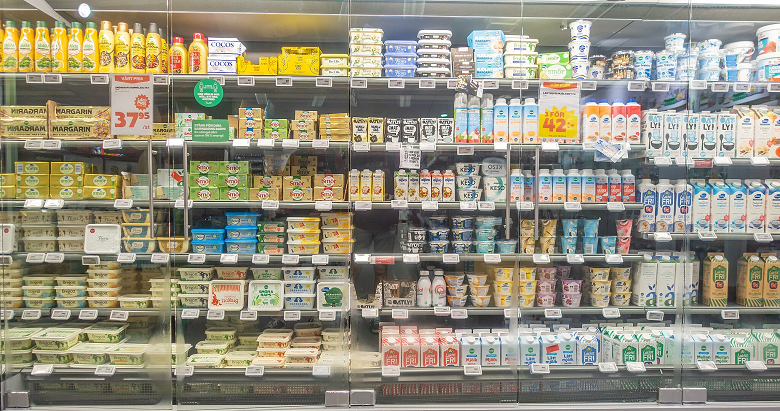
Dairy products crowd the shelves of a supermarket (Photo: Frankie Fouganthin / Wikimedia Commons [CC BY-SA 4.0])
What’s more, unless we tackle the amount of beef we consume, achieving the Paris Agreement goal of keeping warming below 1.5°C is impossible. It cannot be achieved.
Somehow, though, that message isn’t reaching consumers. A survey conducted by Purdue University researchers in January 2023 found that only 46% of respondents currently agree that eating less meat is good for the environment—“the lowest on record.” We clearly need a straightforward explanation of why beef is so bad for the environment. In the simplest terms, it comes down to two words: burps and land.
The biology of cattle
Cows belong to a category of animals called ruminants. The suborder includes goats, sheep, giraffes, deer, and buffalo. Ruminants eat grass, have hooves, and—crucially for climate emissions—have four stomachs to digest food.
This is where the magic happens. Grass enters the first stomach, called the rumen, where it ferments and begins to break down. After a while, the cow regurgitates some of the food (this regurgitated food is called cud) and chews it further to speed the breakdown of cells. The food then flows into the other three stomachs, where microbes digest it.
Thanks to this fermentation process, ruminants can eat all kinds of roughage that humans cannot (or at least wouldn’t want to) digest. That’s good news for cows, but it comes with a catch: the process produces methane, a harmful byproduct.
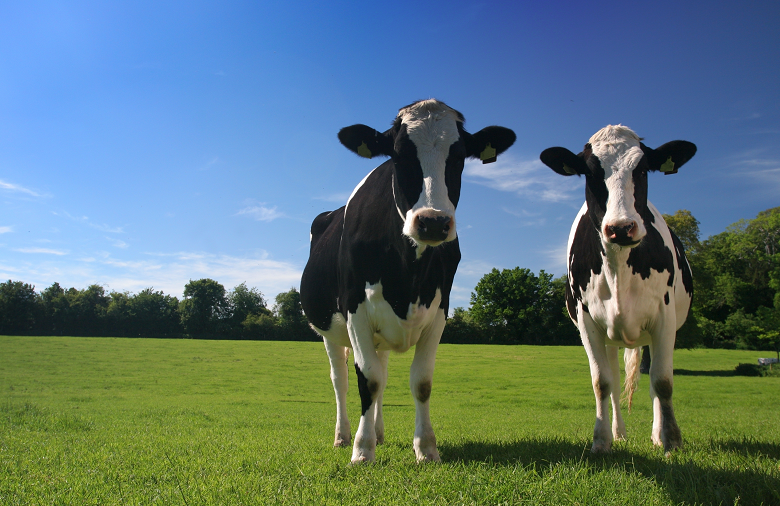
A cow, a type of ruminant (Photo: Ekta.Varia / pxhere [CC0 1.0])
Methane is a very potent greenhouse gas, causing 80 times as much warming as carbon dioxide over the first 20 years after it is released into the atmosphere. Although methane disperses and breaks down faster than carbon dioxide, it does more damage while it remains in the air.
Because of their unique biology, cows produce methane in large quantities. A single cow can emit up to 500 liters of methane per day. Today, the livestock sector raises about 1.5 billion cattle annually, making methane from cows a real climate problem. In fact, methane is the second most abundant greenhouse gas in the atmosphere. 40% of total methane comes from agriculture, and livestock production accounts for 32% of total methane.
Fortunately, methane has a property that creates a strong opportunity for climate action: compared to carbon dioxide, it persists in the atmosphere for a relatively short time. If we dramatically reduce methane emissions, we can see the benefits for emissions reductions quickly—and buy time to tackle areas where climate impacts are more entrenched.
Understanding land use
Before we get into how to reduce methane emissions, it’s important to understand another aspect of beef production that drives climate change: land use.
A full 77% of the world’s agricultural land is used for raising livestock. Analysis by Our World in Data shows that producing beef and lamb requires more land per gram of protein than any other protein.
The problem is that we behave as if farmland were limitless when it isn’t. As the world’s population grows, farmers are compelled to expand operations to produce more food. Between 2000 and 2019, global cropland expanded by 9%, according to Science. Expansion is happening most in tropical forests and grasslands—places where the climate costs of converting land are especially painful.
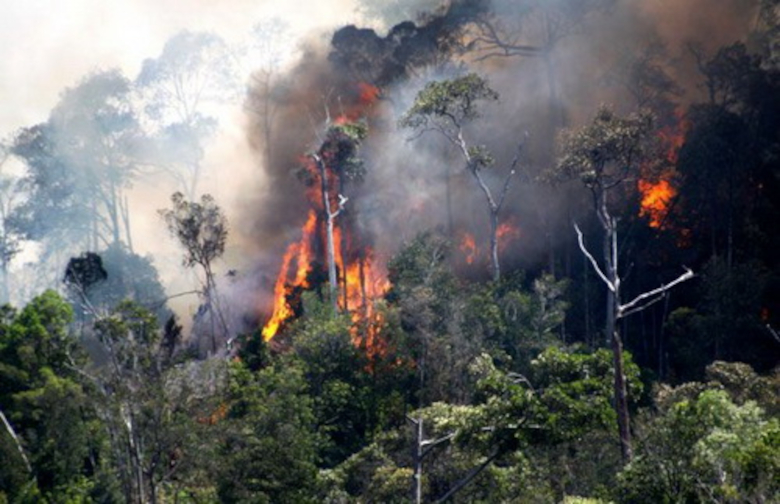
Here’s why. Forest regions like Brazil’s Chiquitano tropical forest and the Cerrado are vital carbon sinks that sequester and store carbon, keeping it out of the atmosphere. In other words, these forests are built into climate solutions and are often referred to as nature-based climate solutions.
When we clear such forests, we must account for emissions on two fronts. First, the carbon stored in the land is released. Second, every year thereafter there’s a loss because the cleared land no longer has the capacity to store carbon.
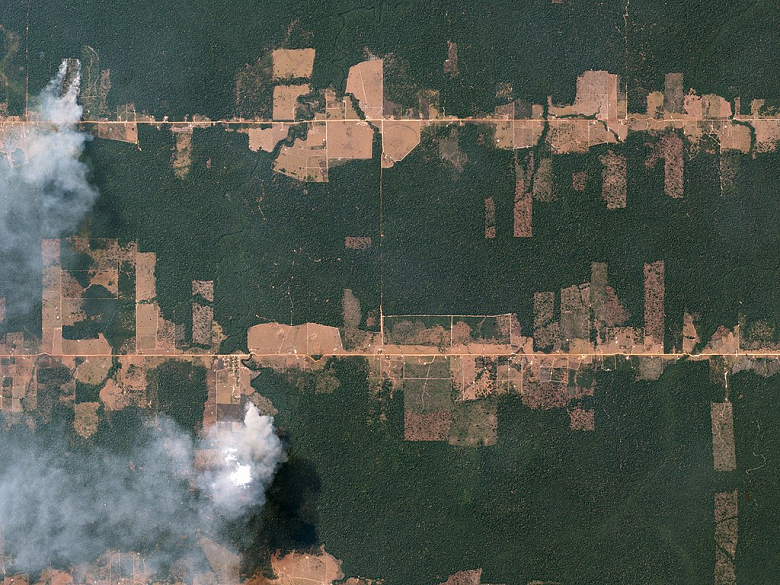
Deforestation underway in Rondônia, Brazil (Photo: Planet Labs, Inc. / Wikimedia Commons [CC BY-SA 4.0])
In the big picture, emissions keep rising, while lands turned into farms and pastures by deforestation can no longer be relied on to store carbon. This loss—what researchers call the carbon opportunity cost—further increases emissions associated with beef.
At the same time, the potential to reverse land loss is enormous. If the world shifted from animal-based agriculture to plant-based, we could free up more than 3 billion hectares of land. To put that in perspective, 1 billion hectares is roughly the size of Brazil—add Mexico, Canada, and the entire United States, and you get close to 3 billion hectares.
Because ecosystems and geology differ, not all of this land could be converted into plant-based agriculture suited for people—and that’s precisely the point. We would need only a fraction of it to grow food for humans. The rest could be returned to nature to store carbon and, needless to say, provide the habitats needed to maintain biodiversity. A 2022 study found that if wealthy countries switched from animal-based to plant-based agriculture, they could cut emissions by more than 60% and sequester about 100 million tons of carbon.
What you can do: shift to a plant-rich diet
Emissions aren’t the only consideration for climate impacts. Ranching increases the risk and likelihood of the next pandemic, antibiotics are overused (Note 4), 300 million cattle are killed globally each year, and workers bear physical and psychological trauma. And because of the inherent inefficiency of ranching, crises such as wars and pandemics make inflation and supply-chain breakdowns more likely.
These impacts are precisely why it’s so important for the public to better understand meat’s climate footprint. One of the most powerful climate actions is to reduce consumption of meat—especially red meat—and shift to a plant-rich diet.

Vegan food (Photo: Jabiz Raisdana / Flickr [CC BY-NC 2.0])
According to analysis by Project Drawdown, such dietary shifts combined with reducing food waste could cut global emissions by 12.4%.
Even better, you can amplify the power of personal choices by engaging in collective action. Consider supporting the Plant Based Treaty in your city, connecting with local advocacy groups, or engaging with livestock industry representatives.
Note 1: This article is a translation of “Food Production Could Add 1°C of Global Warming by 2100,” by Meghie Rodrigues of Eos (American Geophysical Union & Eos Magazine), a partner organization of Covering Climate Now (Covering Climate Now), in which GNV also participates as a partner organization. We would like to thank Eos and Ms. Rodrigues for providing the article.
Note 2: Ms. Loboguerrero is Global Policy Research Lead for the CGIAR (CGIAR) Research Program on Climate Change, Agriculture and Food Security.
Note 3: This article is a translation of “Explainer: Why Is Beef Bad for the Planet?,” by Björn Ólafsson of Sentient Media (Sentient Media), a partner organization of Covering Climate Now (Covering Climate Now), in which GNV also participates as a partner organization. We would like to thank Sentient Media and Mr. Ólafsson for providing the article.
Note 4: There is a problem of heavy use of antibiotics to improve livestock production efficiency. By eating foods produced in this way, people end up consuming large amounts of antibiotics.
Writers:
Meghie Rodrigues
Björn Ólafsson
Translation: Ayane Ishida

















興味深い記事でした。
牛がメタンを排出するのは生理的現象なので、牛の存在を批判しているようにも受け取られるリスクはありますが、
我々大衆に分かりやすいプロモーションをこうして掲げるのは、ひとつ進展かもしれないですね。
気候関係でよく言われるのはCO2ですが、食料生産も影響してるんですね
あと、アメリカの大規模企業農業の肉牛飼育はちょっと不衛生だと聞きます。
畜産の過程そのものがこれほど環境に作用しているのですね。生産の段階でこれだけ問題が起こっているのに、我々はそれと併せて食料の廃棄量も減らせていないので、なんだか問題が倍々になっているような気がしました。
牛の地球温暖化に対する影響や、牧場経営による様々な悪影響というものがいかに大きいのか理解することができました。実際このことはあまり周知されてはいないと感じます。多くの人が食糧生産の影響、プラントベース条約などの集団行動が行われていることなどについて知っていくことが重要だと思いました。