
As of May 2023, there are two countries with which China has not settled its land borders. One is India, and the other is Bhutan. In particular, Bhutan and China have both claimed sovereignty over the Doklam plateau area where the borders of the three countries meet. India supports Bhutan.
Regarding this region, on March 25, 2023, remarks made by Bhutan’s Prime Minister Lotay Tshering in an interview with the Belgian newspaper La Libre sparked controversy. He said that “India, China, and Bhutan have an equal say in the Doklam plateau dispute.”
At first glance, this might seem like a peaceful stance of resolving disputes through dialogue, so why has it become contentious? The complex relationships among China, India, and Bhutan are at play here. With those relationships in mind, let’s look at what is happening in Bhutan now.
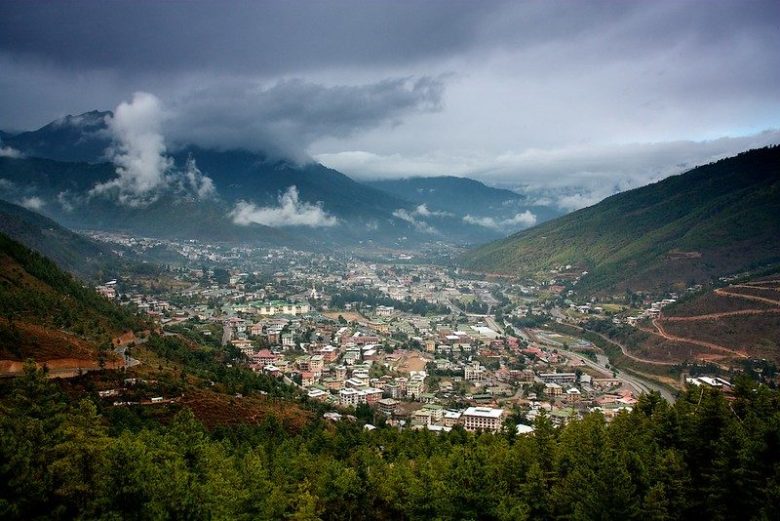
Thimphu, the capital of Bhutan (Birger Hoppe / Flickr [CC BY-NC-ND 2.0])
目次
Bhutan and its relations with neighbors
Bhutan is a country in the Himalayas with an area of about 38,000 square kilometers. Within its terrain of steep mountains and deep valleys, roughly 780,000 people are scattered across various regions. In terms of industry, agriculture is thriving, taking advantage of diverse climates created by the country’s large elevation differences across the land. At the same time, to earn foreign currency, Bhutan also focuses on exporting electricity generated by hydropower and on tourism. However, due to the constraints of its mountainous location and the small size of its domestic market, industries other than agriculture and the public sector are limited.
Politically, the Wangchuck dynasty, which took power in 1907, still exists, but the political system shifted to a two-party democracy in 2008. Bhutan is also known as a country that has officially adopted, in addition to the commonly used GDP indicator of material prosperity, the Gross National Happiness (GNH) (Note 1).
Turning to Bhutan’s neighborhood, India lies to the south and China to the north. The Bhutan–India relationship can be traced back to the era when Britain ruled India. In 1910, about three years after the Wangchuck dynasty took power, Bhutan was integrated into British India. Since then, Britain “guided” Bhutan’s foreign affairs and provided political protection against foreign invasions while granting Bhutan autonomy over internal affairs. After India gained independence from Britain, India and Bhutan concluded a Treaty of Friendship in 1949 (Note 2), under which India assumed control over Bhutan’s foreign relations. This treaty was revised in 2007, enabling Bhutan to act independently of India’s “advice” on diplomacy and granting it greater discretion. However, this applies only insofar as the Bhutanese government’s intentions are friendly toward India; in particular, with respect to territory, uses that would harm the other party’s security and interests are prohibited.
Bhutan and India are also deeply interconnected economically. The two countries have a free trade agreement under which each imposes no tariffs on the other’s trade. In 2020, Bhutan–India trade reached 1.2–1.3 billion U.S. dollars (Note 3), which meant India accounted for about 82% of Bhutan’s total trade. Electricity generated by Bhutan’s hydropower is an important export to India, making up about 15% of exports to India. Furthermore, the exchange rate of Bhutan’s currency, the ngultrum, is fixed at one-to-one with India’s rupee, underscoring the depth of the two economies’ ties.
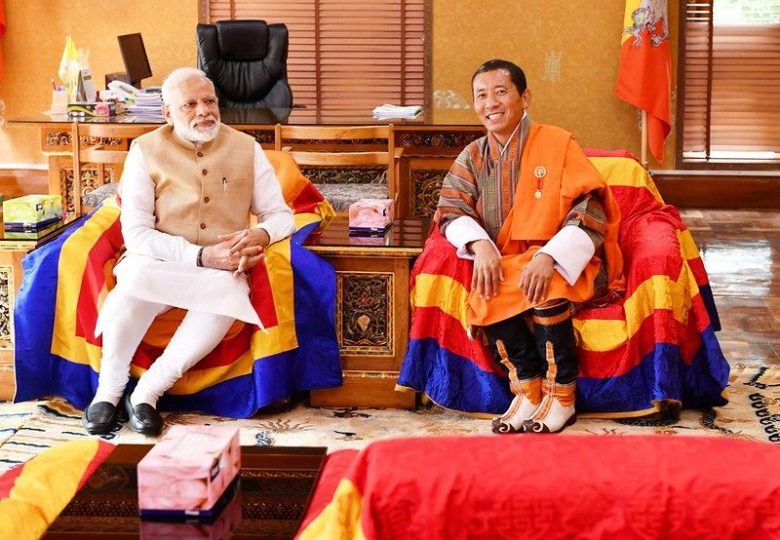
Indian Prime Minister Narendra Modi and Bhutanese Prime Minister Lotay Tshering (MEAphotogallery / Flickr [CC BY-NC-ND 2.0])
On the other hand, there are also concerns in Bhutan about economic dependence on India, trade deficits, and the construction of hydropower. According to such views, India seeks to exploit Bhutan’s markets and natural resources for its own interests. In particular, looking at hydropower, most construction costs are grants or loans from India, but by 2018 Bhutan had incurred about US$2.175 billion in hydropower-related debt on the loan portion. Such heavy dependence on India is thought to be one factor behind Bhutan’s search for relations with China to advance economic self-reliance.
Next, consider Bhutan’s relationship with China. Bhutan and China have no formal diplomatic relations. Reasons cited include not only the unsettled borders, as discussed below, but also pressure from India, which does not want Bhutan and China to draw closer, and concerns that formal diplomatic ties with China could invite interference in domestic affairs through economic power—these two views are often noted. Even so, there are de facto trade relations between Bhutan and China: in 2021, imports from China were about US$100 million and exports to China were about US$8,500. Notably, imports from China have surged in recent years, growing roughly 500-fold from about US$200,000 in 1995. Approximately 77% of imports are computer-related products.
There also remain unsettled border areas between the two countries. Bhutan claims four areas and China claims six. The main ones are the Doklam plateau in western Bhutan and the Jakarlung and Pasamlung valleys in the north. To resolve these issues, talks on border delimitation began in 1984. In 1996, China proposed recognizing the Jakarlung and Pasamlung valleys as Bhutanese territory in exchange for recognizing western Bhutan, including the Doklam plateau, as Chinese territory, but Bhutan did not accept the proposal.
India–China boundary demarcation meeting (MEAphotogallery / Flickr [CC BY-NC-ND 2.0])
Developments surrounding Bhutan
From here, let’s focus on the process of delimiting the Bhutan–China border. The Doklam plateau between Bhutan and China is actually also important for India because it is close to the Siliguri Corridor that connects most of India to its northeast. China’s territorial claims over the Doklam plateau have therefore long been a source of concern for India.
In June 2017, a major standoff occurred. Indian media reported that the Chinese military had built a road on the Doklam plateau, while Chinese media claimed that Indian troops had illegally entered Chinese territory; in any case, both Indian and Chinese forces deployed to the Doklam plateau. Although India does not itself claim this territory, it justified its intervention in the Bhutan–China dispute by citing the bilateral friendship treaty with Bhutan. In fact, the Indian military has bases in Bhutan and is responsible for training Bhutan’s armed forces. However, it has also been pointed out that the treaty itself does not mention defense. Moreover, Bhutan neither dispatched its own troops to join the Indian forces confronting China nor explicitly asked India for reinforcements, maintaining an ambiguous stance to avoid provoking either side.
At the time, about 300 soldiers from each side faced off on the ground; while no large-scale battle occurred, there were reports of pushing without the use of firearms. There were also reports that around 3,000 troops from each side were stationed in the surrounding areas. In August, the two sides agreed to withdraw their troops, but both subsequently moved to strengthen nearby bases. China also advanced infrastructure development in the region including the Doklam plateau. It has been argued that the objectives were to secure de facto access to the strategically important Doklam plateau and to create facts on the ground to bolster China’s claims. It has also been suggested that India did not react strongly because these activities took place away from Indian bases in Bhutan and, at the time, India did not want a confrontation with China (Note 4).
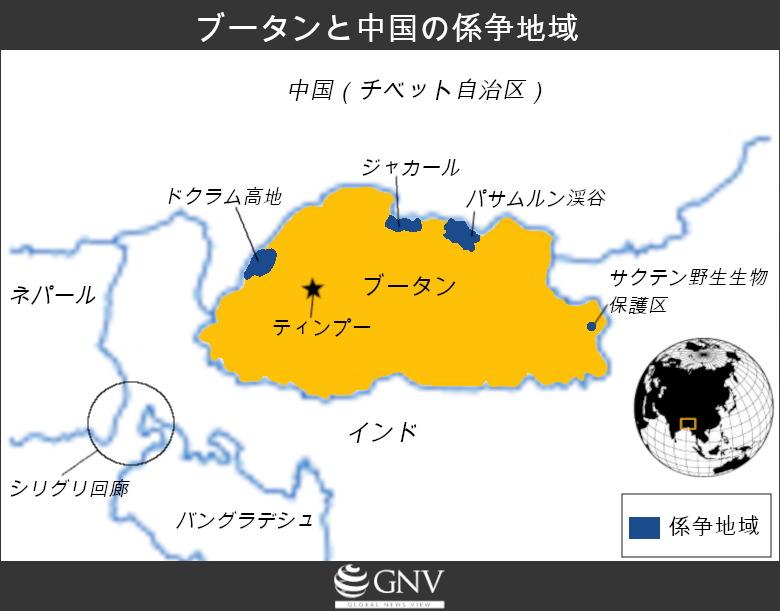
In 2020, China appeared to increase pressure. At the Global Environment Facility’s 58th Council, China claimed that the Sakteng Wildlife Sanctuary in eastern Bhutan—previously thought to be Bhutanese territory—was disputed between China and Bhutan. The sudden assertion has been interpreted as an attempt to pressure Bhutan and India. The same year, there were reports that China had begun building settlements about 30 kilometers from the Doklam plateau, which is disputed with Bhutan (Note 5). Meanwhile, a process toward negotiated settlement also advanced: in 2021, Bhutan and China signed a memorandum of understanding on a three-step roadmap. Although details were not reported, both sides signaled a desire to expedite negotiations.
On March 25, 2023, as noted at the outset, Prime Minister Tshering stated that Bhutan, India, and China have equal say in the Doklam plateau dispute. Some Indian media viewed this remark as tilting toward China. According to that view, whereas in 2019 Tshering argued that unilateral changes to the status quo at Doklam should be avoided, his 2023 remark suggested changing the status quo through negotiations and signaled an opening to hand Doklam to China. On this point, the prime minister insisted—at least in his public messaging—that there had been no policy change.
In the same interview, Tshering also denied reports that China was building villages inside Bhutanese territory. This too was portrayed by some as a pro-China statement. Bhutanese media argued that, at the time, Tshering had merely stated that there had been no Chinese incursions in areas already demarcated as Bhutanese territory, while acknowledging that some areas of the border remain unsettled. On April 3, 2023, Bhutan’s king visited India; Indian media reported this as an effort to allay India’s concerns arising from the prime minister’s comments and to strengthen Bhutan–India relations.
Thus, for decades Bhutan has faced instability over its disputed areas with China. India’s deep involvement with Bhutan is a major factor complicating the situation, and other factors cited include China’s steady non-military moves such as building roads and settlements (Note 6), China’s economic appeal to Bhutan, and the low level of international attention to the issue.
The India–China rift
Let’s broaden the view to reassess Bhutan’s situation through the lens of India–China relations. About 3,440 kilometers of the India–China boundary remain undemarcated. Historically, the issue dates back to when India was a British colony. At that time, Britain did not clearly demarcate borders with Russia or China. After India’s independence, both countries prioritized improving relations and shelved the border issue, missing opportunities for resolution. In 1950, China asserted sovereignty over Tibet and occupied the Tibetan city of Chamdo in October, bringing the shelved border issue to the forefront. This was seen as a threat to India’s security and deepened Sino-Indian tensions.
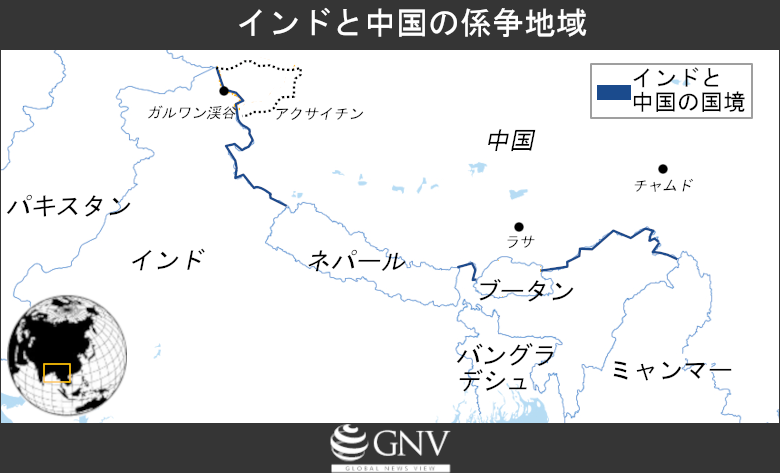
In 1959, a large-scale uprising erupted in Lhasa, Tibet’s capital. Thousands were killed (Note 7), and tens of thousands—including the Dalai Lama, leader of the influential Gelug (Yellow Hat) school of Tibetan Buddhism—fled. China objected to India’s acceptance of the Dalai Lama, and tensions rose between the two countries. In 1962, a major clash broke out in Aksai Chin, a disputed border area. The Indian army suffered a major defeat, and an estimated 7,000 were killed or captured on the Indian side. Aksai Chin is part of Kashmir, claimed by both India and Pakistan. China has supported Pakistan’s position while effectively controlling Aksai Chin, which India claims. In 1965, Tibet became an autonomous region of China. Clashes also occurred in 1967 and 1975.
In 2005, the two countries signed a protocol to build confidence, but in 2020 a deadly confrontation occurred in the Galwan Valley, a disputed area (Note 8). The clash did not involve firearms; instead, the sides fought with fists and clubs. Officially, 20 Indians and 4 Chinese were killed. In response, India tightened border management in the north. It has also been noted that the clash contributed to India strengthening ties with the United States, Japan, and Australia.
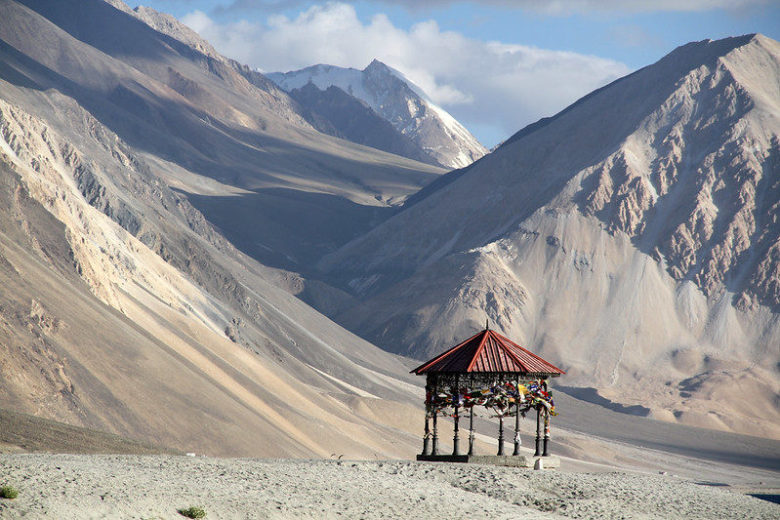
Such conflicts have affected the countries’ expanding economic ties. Specifically, following the 2020 clash, India banned dozens of Chinese smartphone apps and restricted investment from China by requiring Indian government approval (Note 9). Given that India is one of the world’s largest online service markets and some Chinese tech firms had made large investments in India, the app ban has been analyzed as a swift and powerful measure to pressure Chinese companies. There were also attempts in India to boycott Chinese products (Note 10).
Returning to Bhutan: geographically, it lies between India and China and borders China’s Tibet Autonomous Region. The disputed Doklam plateau overlooks India’s vital Siliguri Corridor. Given this geography, analyzing Bhutan’s border issues through a geopolitical lens—placing them within the India–China rivalry—can be illuminating.
Bhutan’s stance
Now, narrowing the focus to Bhutan itself, let’s briefly review its politics. Bhutan is a constitutional monarchy. Although the royal family holds significant influence, it has been assessed as being reluctant to interfere in policymaking. During the COVID-19 pandemic, the royal family earned public support through a series of responses, and it has been noted that neither the king nor politicians sought to entrench power by exploiting the crisis. The parliament is bicameral, with 72 seats in total: five are appointed by the king and the rest are elected (Note 11). The prime minister is appointed from the party that commands a majority in the lower house.
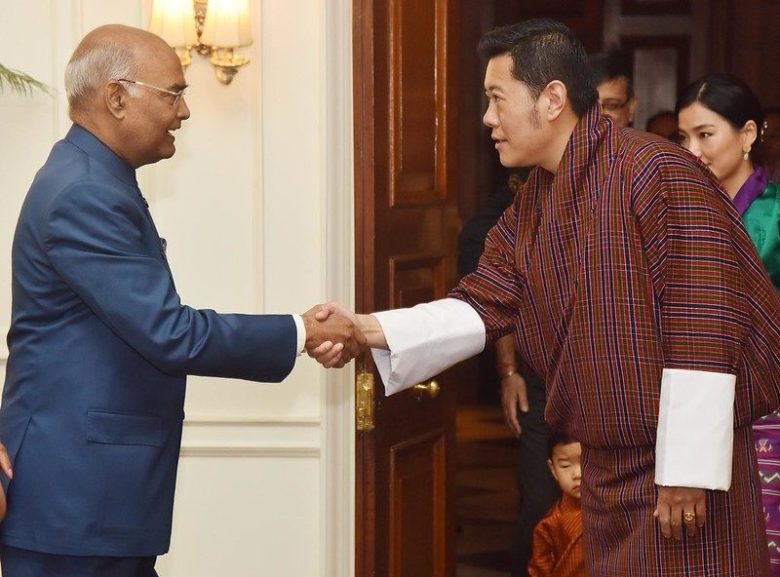
Bhutan’s Jigme Khesar Namgyel Wangchuck, the 5th King shaking hands with India’s Ram Nath Kovind President (MEAphotogallery / Flickr [CC BY-NC-ND 2.0])
While Bhutan is currently deeply engaged with India in many respects, there are concerns among Bhutanese—especially younger generations—about overdependence on India. Among those who hold such views, some argue that Bhutan should deepen relations with China to promote trade and investment. As for the Doklam plateau, in 2005 Bhutan considered a Chinese proposal to cede the western area including Doklam in exchange for recognizing disputed northern areas of Bhutan about 1.8 times larger as Bhutanese territory, but the government likely rejected it, prioritizing relations with India. Meanwhile, among people living near Bhutan’s northeastern border, there are opinions that Bhutan should accept the deal and demarcate the border quickly. The reason is that the area around the Doklam plateau, which is disputed between Bhutan and China, offers rich pastureland where both Bhutanese and Tibetan herders from China’s autonomous region conduct pastoralism. This is a serious issue for residents of northeastern Bhutan near Doklam and is a factor driving calls for border demarcation (Note 12).
One survey found that about 76% of Bhutan’s Twitter users and about 65% of its Facebook users question Bhutan’s excessive reliance on India when engaging in dialogue with China. In short, Bhutan’s deep ties with India are not unconditional; there are also views expressing concern about dependence on India and advocating closer engagement with China.
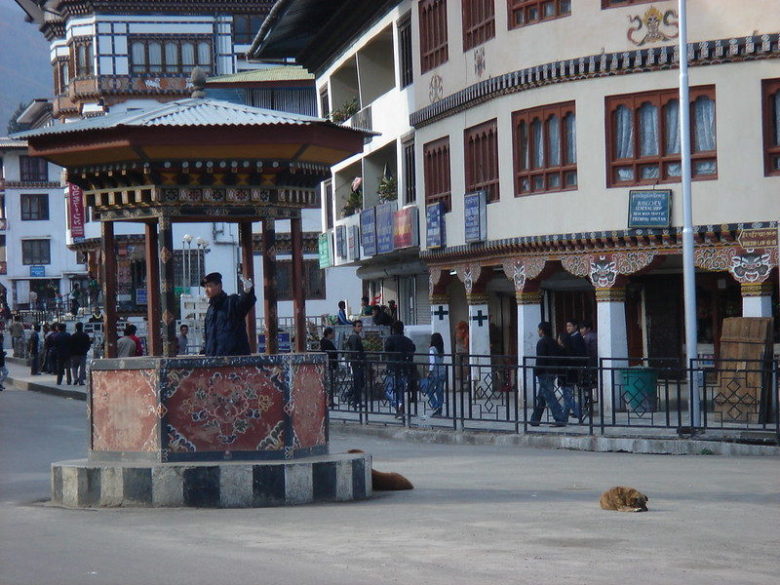
Downtown Thimphu, the capital of Bhutan (hewy / Flickr [CC BY-NC-ND 2.0])
There are cases where dependence on India has become a real issue. In 2012, at the UN Conference on Sustainable Development in Rio de Janeiro, Bhutan’s prime minister at the time announced after a summit with China that the two countries had decided to establish diplomatic relations. Following this announcement, India reduced subsidies for cooking oil and kerosene to Bhutan, a move some have described as sanctions in response to Bhutan’s outreach to China. The then-ruling party subsequently lost the next election. As of 2023, Bhutan and China still have not established diplomatic relations.
Next, consider the Bhutanese government’s diplomatic posture. There is a view that Bhutan is not merely being buffeted between India and China but is conducting its diplomacy with careful balance to avoid provoking either side in mind. For example, the government avoids commenting on Tibet and Taiwan, which are issues of concern for China. When Indian and Chinese troops faced off at Doklam, Bhutan issued only one statement calling for restoration of the status quo and did not lodge protests or criticism thereafter. In this way, when caught between great powers, Bhutan tends to rely on silence to maintain neutrality.
Bhutan shifted away from isolationism under King Jigme Dorji Wangchuck, who ascended the throne in 1952, and has since pursued diversification of diplomatic relations. His successor, King Jigme Singye Wangchuck, who ascended in 1972, continued this policy, expanding ties cautiously—prioritizing development assistance—so as not to be drawn into great-power rivalries.
Around 2009, Bhutan deviated from this cautious approach and rapidly expanded diplomatic ties. It also ran for a non-permanent seat on the UN Security Council, stepping up its diplomatic activity. Although it did not win a seat, Bhutan had ties with 28 countries by 2012 and 54 by 2020. At the same time, it still has no formal diplomatic relations with any of the five permanent members of the UN Security Council.
To smooth relations with India further, Bhutan has in recent years moved to strengthen ties not only with India’s central government but also with state and local governments in India. For example, in 2018 Bhutan opened a consulate in Assam in eastern India. Such moves are expected to facilitate relations along the Bhutan–India border and promote trade, investment, and tourism.
Outlook
As we have seen, Bhutan has not experienced direct violence over its border with China, but instability persists. Economically, it also faces challenges, including a severe trade deficit and excessive dependence on India. In this environment, Bhutan has so far maintained a neutral posture between India and China. In recent years, however, it appears more eager to improve relations with China.
Regarding the border issue with China, in March 2023 Tshering said the issue could be resolved after a few more rounds of talks only. Will the talks actually lead to a resolution, and how will India respond? Bhutan bears continued watching.
Note 1: Gross National Happiness (GNH) is an indicator of holistic and sustainable development based on the belief that humans seek happiness, balancing material and non-material values. Its four pillars are: promoting sustainable development; preserving and promoting cultural values; conserving the natural environment; and establishing good governance. Article 9 of Bhutan’s Constitution codifies a duty to strive to develop institutions and measures that enable the achievement of Gross National Happiness.
Note 2: It has been suggested that Bhutan’s decision to place its diplomacy under India’s “guidance” was influenced by the fact that the Chinese Communist Party took power in China in the same year (1949) the friendship treaty was concluded. The Communist Party’s rejection of monarchy ran counter to Bhutan’s monarchical system, and fearing a Chinese invasion, Bhutan sought to preserve its regime by maintaining relations with India. Note that the friendship treaty contains no mention of Bhutan’s defense.
Note 3: The figure of US$1.2–1.3 billion converts about 95 billion ngultrum, the 2020 value of Bhutan–India trade, at the prevailing exchange rate in 2020.
Note 4: It has been suggested that India sought to avoid confrontation to address its large trade deficit with China and that, rather than stoking confrontation, it believed it would gain domestic support by showing a willingness to deal with the United States and China through dialogue.
Note 5: It has also been argued that this construction may be part of a 2017 plan to build more than 600 villages in border areas of the Tibet Autonomous Region.
Note 6: China’s approach has been likened to a “salami-slicing” tactic, shaving off thin slices over time.
Note 7: The exact number of victims is unknown. China claimed several hundred, while the Dalai Lama estimated 80,000. Generally, the figure is believed to be in the several thousands.
Note 8: One backdrop to this conflict is the view that China was provoked when, in 2019, India divided the part of Kashmir it controls, stripped it of statehood, and downgraded it to a union territory administratively. As part of its Belt and Road Initiative, China has a plan linking China and Pakistan through Kashmir, and an increase in India’s influence in the region could threaten this plan.
Note 9: Technically, these restrictions applied to all of India’s neighboring countries. However, considering that 99% of the foreign direct investment India received over the past 20 years came from China, the restrictions have been analyzed as targeting Chinese investment.
Note 10: Despite these moves, overall trade with China has so far remained robust and, on the whole, has even increased.
Note 11: Bhutan’s parliament is designed for a two-party system. Elections are held in two stages: the top two parties in the first round advance to a second round in which seats are allocated according to vote share.
Note 12: There is a claim that herders’ incursions are pressure by China to gain advantage in negotiations with Bhutan. China, for its part, claims the area based on an 1890 treaty between China and Britain and cites documents indicating that, before the 1960s, Bhutanese herders had to pay taxes to China in order to conduct herding in the area—using these to argue the legitimacy of the herding.
Writer: Seita Morimoto
Graphics: Haruka Gonno
Yudai Sekiguchi







二つの大国に挟まれて、ブータンむっちゃかわいそうだな
自分のブータンの印象に反し、土地をめぐる衝突の存在や周囲の大国と上手く渡り歩く外交姿勢を知れて面白かった。
大国の影響のもとにある中で、上手く立ち回っているところから、かつての世界大戦のタイの外交を想起しました。
外交官ってスゴイ頭が切れますね。
大国の覇権争いに巻き込まれないよう、うまく中立を保っているのが、小国の生き残り方として上手だなと感じました。
今、外交広げていく政策をとっているようですが、今後はどうなっていくんでしょうか。
たしかにそう感じますね!でも、ブータンはブータンでバランスを取った外交を強かに行っています。小国なりの生き抜く知恵は興味深いですね!