
In November 2022, the 27th Conference of the Parties to the UN Framework Convention on Climate Change (COP27) was held in Sharm el-Sheikh, Egypt. During COP26, for example, a protest of around 100,000 people took place in Glasgow, Scotland, the host city, and protests demanding more proactive climate action from governments and industry are a fixture of COP. At the COP27 host site as well, protests of up to several hundred people were held, calling for compensation for climate change and for the release of British-Egyptian pro-democracy activist Alaa Abdel Fattah. He was arrested in 2019 on charges of “spreading false news,” was sentenced in 2021 to 5 years’ imprisonment, and as of 2022 remains incarcerated. However, these protests were small and took place within UN-managed grounds; protests outside were not permitted. This was because the Egyptian authorities had imposed strict repression on all protests in advance.
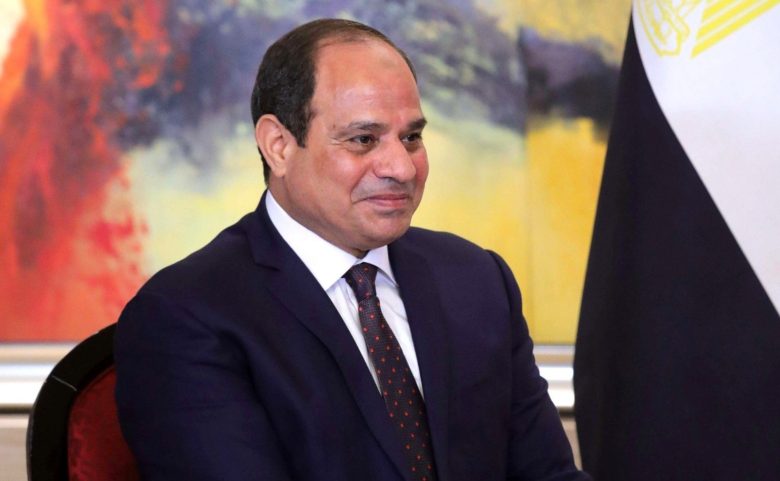
However, this is not limited to the period of COP27. In 2013, the then-government collapsed in a military coup, and since President Abdel Fattah el-Sisi took office thereafter, severe political repression has been repeated. Those regarded as threats to the government’s power base have been thoroughly suppressed, and as of 2019 it was estimated that around 65,000 political prisoners were being held in Egypt. This article examines the nature of Egypt’s power base and how it has been maintained to this day.
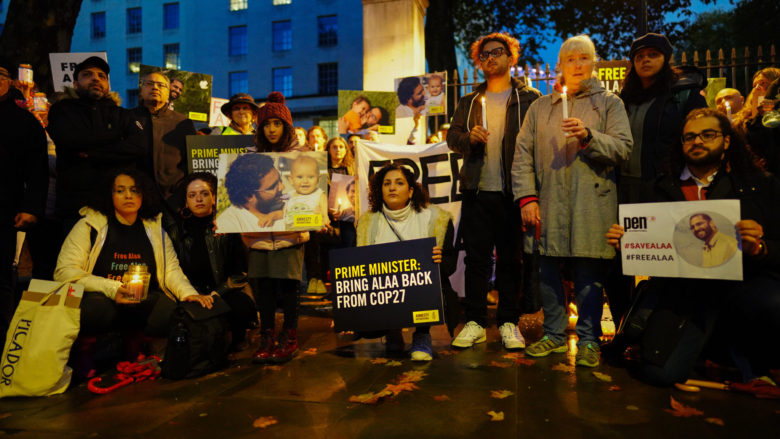
People in the UK calling for Alaa’s release to coincide with COP27 (Photo: Alisdare Hickson / Flickr [CC BY-SA 2.0])
目次
History of the Egyptian regime
How was the power base of the current Egyptian government formed? First, let’s briefly review the history of Egypt’s regime. The territory of present-day Egypt dates back about 5,000 years to the unified state of ancient Egypt, formed by the integration of the Upper and Lower Egyptian kingdoms. In 1517, it became part of the Ottoman Empire of Turkey, but the Ottoman Empire, which began to decline in the mid-16th century, limited itself to nominal rule. Egypt built the Suez Canal (Note 1) in 1859. Subsequently, in 1875, Britain purchased shares in the Suez Canal Company, gaining control over the canal, and British encroachment became conspicuous during this period. In 1882, British forces invaded, defeated the Egyptian army, and brought Egypt under control. With the outbreak of World War I in 1914, Egypt became a British protectorate, and the Ottoman Empire collapsed after its defeat in 1919. Egypt declared independence as a kingdom in 1922, became a republic in 1953, but British troops remained stationed in Egypt until 1956.
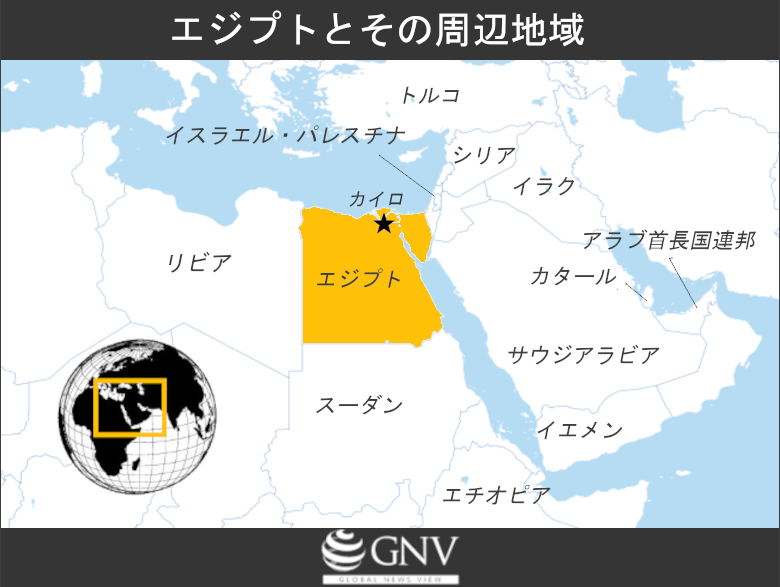
In 1956, when then-Egyptian President Gamal Abdel Nasser nationalized the Suez Canal, the Second Middle East War, also known as the Suez Crisis (Note 2), broke out between Egypt and Israel, the United Kingdom, and France. In 1967, the Six-Day War (Note 3) broke out with Israel. Afterward, Egypt fought Israel again in the 1973 Fourth Middle East War, but in 1979 it concluded the first peace treaty (Note 4) between Israel and an Arab country. Egypt’s shift to peace, having previously led the Arab countries in fighting Israel, drew the ire of other Arab states, and in 1981 President Anwar al-Sadat was assassinated.
After that, Hosni Mubarak, then vice president and former commander-in-chief of the air force, assumed the presidency in 1981. He declared a state of emergency and restricted freedom of political activity, expression, and assembly. He carried out repression against any forces deemed a threat of military dictatorship, and tens of thousands of people were detained in horrific conditions. Centered on the security agency, the State Security Investigations Service (SSIS), authorities engaged in systematic group torture and abuses such as arbitrary arrest and detention.
The Mubarak regime lasted 30 years, but public political and economic dissatisfaction with the long rule was growing. Inspired by the street protests in Tunisia urging the president’s resignation, known as the “Arab Spring,” anti-government demonstrations also broke out in Egypt in January 2011. It is said that at least 846 civilians were killed and more than 6,400 injured in these demonstrations. As a result of the protests, President Mubarak resigned in February 2011. Subsequently, in June 2012 Mohammed Morsi of the Muslim Brotherhood, who won the presidential election, became president. The Muslim Brotherhood is an Islamist organization established in the 1920s that combines religious and political activities with social welfare programs.
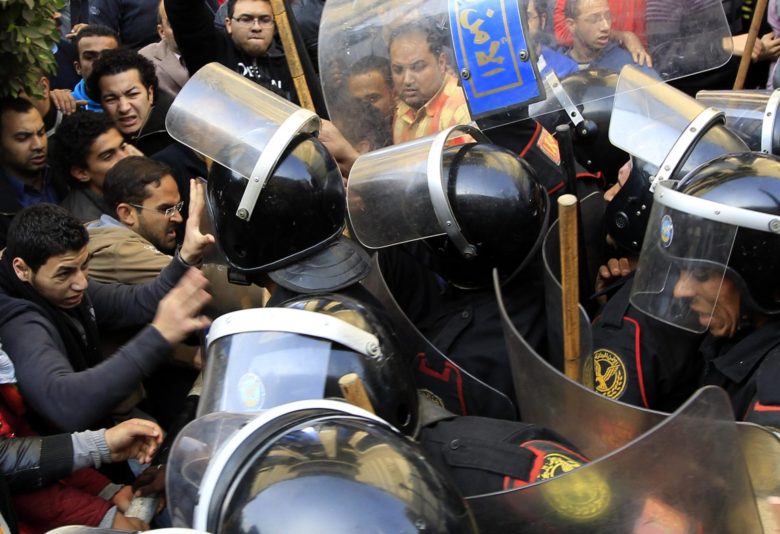
Protesters and police clash during the “Arab Spring” (Photo: oxfamnovib / Flickr [CC BY-ND 2.0])
However, nationwide backlash against the Morsi administration grew in response to economic hardship and the advance of Islam into politics. For the military, for whom the growing influence of Islam had become a threat, this backlash was an opportunity to return to power. In July 2013, the Egyptian military overthrew the Morsi administration in a coup and arrested Morsi. Although Adly Mansour assumed the presidency, real power lay with then Defense Minister Sisi, who directed the coup. The Muslim Brotherhood staged sit-ins in Cairo squares in protest against the coup, and together with its supporters, assembled peaceful protest camps of several thousand people. Aiming to dismantle the Muslim Brotherhood, the base of support for Morsi, the new regime carried out a massacre by security forces at the Brotherhood’s protest camps on August 14, 2013. While 817 deaths have been confirmed, it is estimated that more than 1,000 were actually killed.
In the May 2014 presidential election, perhaps due to the series of crackdowns on the Muslim Brotherhood directed by Sisi, many people, centered on the Brotherhood, boycotted the vote. By doubling the campaign spending limit from the previous presidential election, the overwhelmingly wealthy military elite gained the advantage, Sisi suppressed independent media, and secured privileged access to state media. Sisi won the presidential election with about 93% support. The election is suspected of intimidation, bribery, manipulation, and the arrest of major challengers. As of 2022, Sisi remains president.
Human rights and political repression
The previous section reviewed the process by which the power base was formed; next, we assess the repressive actions used to maintain it. Under Sisi today, human rights violations and political repression are rampant. Although harsh repression existed under Nasser, Sadat, and Mubarak, none matched the sustained brutality of today’s Sisi regime, it is said.
Regardless of occupation, gender, or age, those who oppose government actions or policies, point out corruption, or demand democratization have been targets of repression. In particular, the Muslim Brotherhood —which held power in the previous administration—has long (Note 5) been repressed. It is the largest Islamist organization in Egypt, where about 90% of the population is Muslim. Mobilizing grassroots support and advocating anti-monarchism, they are a threat to military rulers and thus targets of repression. After the fall of the Morsi administration, repression intensified, and in December 2014 the government designated it a terrorist organization. Many of the Brotherhood’s leaders and an estimated tens of thousands of supporters have been imprisoned or have fled into exile in countries such as Turkey and Qatar, which have supported the Muslim Brotherhood. Those arrested as political prisoners are not limited to the Muslim Brotherhood; in Egypt, political prisoners are estimated to be held in the tens of thousands.
Freedom of the press is also under threat; in the 2022 World Press Freedom Index, Egypt ranks 168th out of 180 countries. In 2021, there were 25 journalists imprisoned in Egypt, the third highest in the world after China and Myanmar. They were convicted on charges such as “social media misuse,” “spreading fake news,” and “terrorism,” or are detained in prison with investigations pending. About 600 websites, including media outlets and human rights groups, have also been blocked; for example, the websites of international human rights NGOs such as Human Rights Watch and the Egyptian Commission for Rights and Freedoms (ECRF), an Egyptian human rights group that is still active, cannot be accessed in Egypt.
Next is the suppression of freedom of association. In recent years in Egypt, human rights activists and civil society activists engaged in peaceful activities have been relentlessly prosecuted. The 2017 authoritarian law regulating NGOs was withdrawn, and in January 2021 new implementing regulations (Note 6) were issued, but restrictions on freedom of association became even stricter, and “political” activities were completely banned. According to remarks by human rights activist Hossam Bahgat in a panel discussion on climate justice and human rights at COP27, when activists visit a region, it is the local residents who are arrested rather than the activists themselves, making it difficult for activists to directly help regions facing environmental problems and for residents to seek help. Bahgat himself has been banned from traveling abroad since 2016, and his personal assets have been frozen. The Egyptian authorities have also arbitrarily added 408 people, including activists and opposition politicians, to a “terrorist list,” imposing bans on civic and political activities and five-year bans on foreign travel.
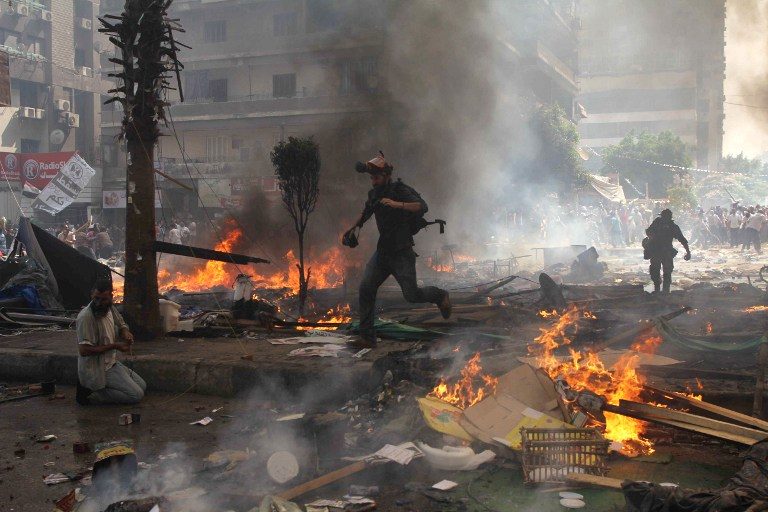
Muslim Brotherhood protest camps under repression (Photo: Diariocritico de Venezuela / Flickr [CC BY 2.0])
People suspected of wrongdoing are also arbitrarily detained even without a guilty verdict, and thousands are said to remain unjustly detained without legal basis or after severely unfair trials. Those targeted are not only people alleged to have engaged in political activity; LGBT (Note 7) people, women whose clothing was deemed problematic, and people who posted problematic statements on social media have also been arrested. In 2020 there were about 2,000 cases of enforced disappearance. Conditions in prisons and other detention facilities are also inhumane, with abuse and torture, denial of access to medical services, and restrictions or bans on family visits and communication.
Trials are also problematic. In 2021 alone, at least 356 people were sentenced to death in Egypt. Excluding China, North Korea, and Vietnam, where the realities of death sentences and executions are unknown, this was the highest number of death sentences in the world in 2021. The number of executions in 2021 was the world’s third highest, with at least 83 people executed. Mass trials in which hundreds are tried at once have also been held; in March 2014, 529 people were sentenced to death for the killing of one police officer, attempted murder of two police officers, and an attack on a police station.
The military’s vast influence over the economy
Behind President Sisi’s ability to maintain power lies not only repression but also the military’s control over much of the economy. More than 10 years have passed since the “Arab Spring,” but economic conditions have worsened. The inflation rate has continued to rise, reaching 16.2% in October 2022. The value of the Egyptian pound against the U.S. dollar has fallen, decreasing by about 36% in 2022. Tourism, which accounts for about 12% of domestic GDP, has been hit by world events; due to the impact of COVID-19, in 2021 it fell by about 70% compared with the previous year. It has also been affected by a decline in visitors due to the conflict between Russia and Ukraine, which previously accounted for about one-third of annual visitors. The country bears debt amounting to about 85% of the size of the economy. Looking at the proportion of people living below the ethical poverty line (Note 8) of US$7.4 per day, as of 2019 it was about 87%, and the vast majority of the population is living in severe poverty. One reason reforms to escape these crises are difficult is the expansion under the Sisi administration of the range and scale of the military’s involvement in the economy.
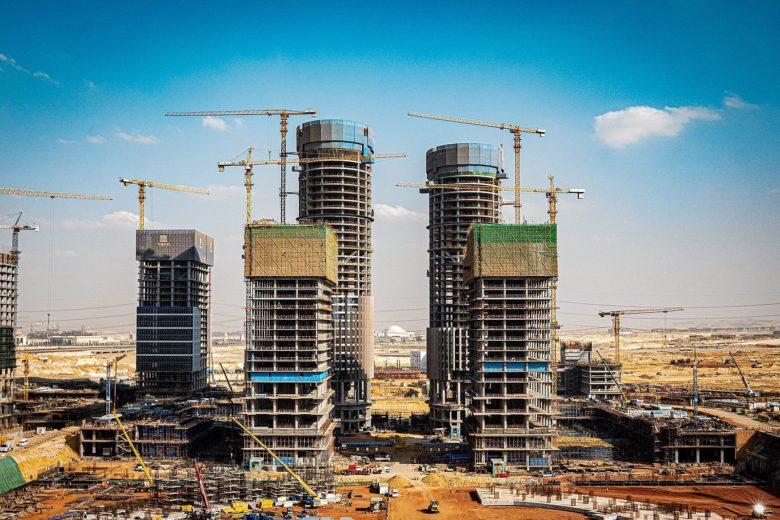
The new administrative capital whose construction is overseen by the armed forces (Photo: Ahmodye / Wikimedia Commons [CC BY 4.0])
Military figures influence the economy in various ways. The military engages in economic activity through institutions such as the Ministry of Military Production, multiple factories under its umbrella, and joint ventures with domestic and foreign companies. Thousands of retired officers are also assigned to government ministries, regulatory and operating economic authorities, local governments, and state-owned enterprises. The number of military-owned companies has increased about four times since the 1970s, reaching about 80 by 2022. They have expanded not only in the defense industry but also into various economic sectors, including the management of large-scale infrastructure projects, agriculture and industry, and healthcare.
The military’s political influence underpins its economic clout. Because senior officers are placed throughout state institutions, it is easier for them to win contracts than for private firms, and since military personnel are also assigned to the government’s main auditing bodies, unlike private companies the military’s economic activities can escape audit. The armed forces use conscripted labor, much of their economic activity is subsidized by taxpayers, and they can carry out projects at far lower prices than private companies. The expansion of the military’s influence over the economy is criticized for reducing investment in competing private firms. The decline in private-sector investment deprives the economy of its potential to contribute to growth, job creation, and human development. Youth unemployment remains high at about 24% as of 2021, and as of January 2022 young people under 24 account for about 54% of the population. With the population continuing to rise, job creation is one of the greatest challenges for Egypt’s economy.
Moreover, many of the large-scale infrastructure plans and public investments undertaken by the military do not prioritize benefits to the public. While the military’s economic policies have aspects that contribute to economic and social development, many are excessively large to flaunt military power and control, or are carried out in unproductive sectors and inefficient defense industries. Consequently, debt continues to swell, and in 2022 Egypt is expected to borrow US$73 billion and become the largest sovereign issuer in the emerging markets of the Middle East and North Africa. External debt has increased by about 300% since 2014, reaching US$137.9 billion in June 2021. These debts impose burdens on citizens through rising consumer prices and regressive tax policies.
Egypt’s foreign relations
Diplomacy is also an important tool for the current Egyptian government to maintain its power base.
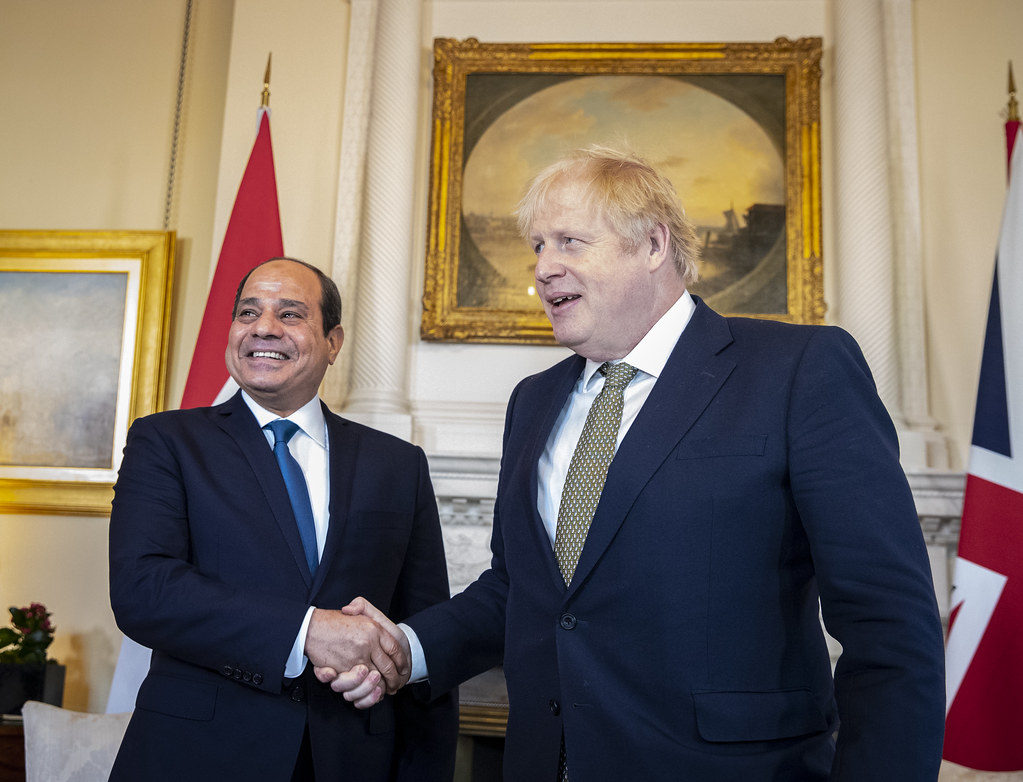
Former UK Prime Minister Boris Johnson and President Sisi shake hands (Photo: Number 10 / Flickr [CC BY-NC-ND 2.0])
Egypt does not have good relations with countries that support the Muslim Brotherhood, one of the greatest threats to the Egyptian government. One such country is Qatar. Qatar is considered to take a stance of supporting the Brotherhood. The state media outlet Al Jazeera, which wields great influence in the Middle East and North Africa, is regarded as a threat to the state; its website is blocked in Egypt, and in 2013 four Al Jazeera journalists were arrested in Egypt. In June 2017, Egypt announced a break in relations with Qatar, but ties were restored in 2021, and relations have continued to be rebuilt since. With Turkey, relations also deteriorated in 2013 when a military coup in Egypt ousted President Morsi, an ally of Turkish President Recep Tayyip Erdoğan. Political tensions continued for nine years thereafter, with Turkey’s support for the Muslim Brotherhood also a cause. However, in November 2022, Turkish Foreign Minister Mevlüt Çavuşoğlu stated the possibility of fully restoring diplomatic relations in the coming months and appointing ambassadors to posts that had been vacant for about nine years.
Regarding Libya (Note 9), since the turmoil following the collapse in 2011 of Muammar Gaddafi’s long dictatorship, Egypt has conducted airstrikes against the extremist group IS (Islamic State) and other extremist groups based in Iraq and Syria. For Egypt, instability in its western neighbor Libya and Turkey’s support for Libyan government forces are concerns, and in July 2020, Egypt’s parliament authorized military intervention in Libya. Egypt is also at odds with Ethiopia (Note 10) over the construction of a dam on the Nile.
Conversely, there are countries that, each for their own reasons, support the Egyptian government. Saudi Arabia and the United Arab Emirates (UAE) view the Muslim Brotherhood, like Egypt’s rulers, as a threat to monarchies and autocratic rule, and they backed the Egyptian military in the 2013 coup. They have taken the same stance toward Qatar as Egypt. The two countries have provided tens of billions of dollars in loans and investments to stabilize Egypt’s economy.
The United States has had decades of military and economic cooperation with Egypt, having provided more than US$50 billion in military aid and US$30 billion in economic aid since 1978, when the U.S. proposed the Egypt–Israel peace at Camp David. Military support to Egypt is considered part of a strategy to maintain continued access to energy resources in the Persian Gulf and to secure the Suez Canal—an important international oil route and route for U.S. warships—it is thought.
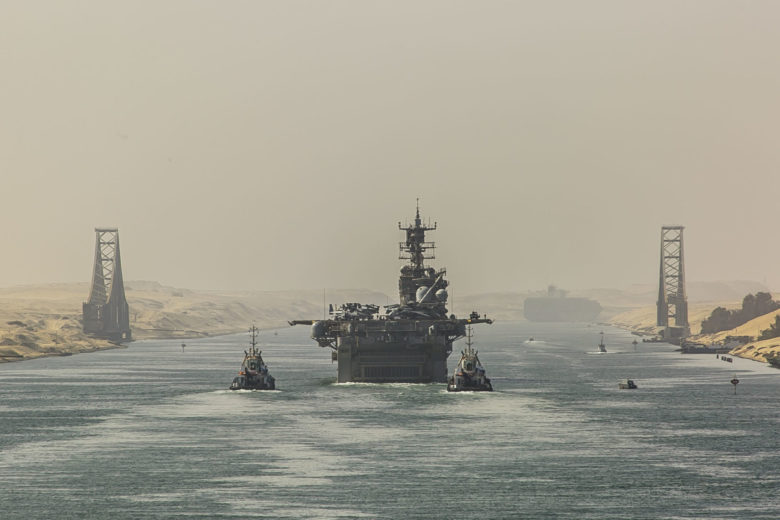
A U.S. warship transiting the Suez Canal (Photo: Official U.S. Navy Page / Flickr [CC BY 2.0])
Arms sales by European Union (EU) countries to Egypt have also risen sharply since the 2013 military coup; between 2013 and 2020, EU countries, including the United Kingdom, exported or licensed at least US$11 billion worth of arms to Egypt. Among them, France’s largest export destination for arms between 2012 and 2021 was Egypt, and in Germany, Egypt was the largest customer for armaments in 2021. In addition to direct investment from the EU, the European Bank for Reconstruction and Development (EBRD) has also provided support, and in 2018 Egypt became the EBRD’s largest investment destination. Egypt has major influence on migration and refugee flows across the Mediterranean and on the stability of the Middle East and North Africa, and maintains security cooperation with the EU. Alongside economic interests, as an important customer of the arms industry, Egypt has become a country with which EU states consider cooperation indispensable.
Criticism of human rights violations and a weakening presidency
While economic cooperation and military support are major pillars sustaining the current Egyptian regime’s hold on power, there has been a certain degree of criticism from abroad—centered on Western countries—of the Egyptian government’s repressive system. In March 2021, at the UN Human Rights Council, 32 countries, mainly from the United States and Europe, issued a joint statement calling for the lifting of restrictions on freedom of expression and assembly. In January of the same year, citing human rights issues, the United States announced it would withhold US$130 million in security assistance to Egypt.
However, as noted in the previous section, many countries depend on the Egyptian government’s cooperation to protect their own interests, and because support for the current regime continues, criticism often does not become full-fledged. As Western countries adopt a critical stance on human rights issues, Egypt has also deepened relations with China and Russia, which have similar strategies and do not seek improvements in human rights or military autocracy.
Recently, there are also views that President Sisi’s power is weakening. The presidency’s authority over the military and law enforcement appears to have diminished, and reforms by the president are being blocked. For a president whose position has weakened to improve Egypt’s deepening political and economic crises would inevitably collide with the military power base he has cultivated and will be extremely difficult. If international criticism or sanctions were to begin in earnest, would the crisis improve? The “Arab Spring” toppled the regime with dissatisfaction over corruption, repression, and unemployment as its driving force; similarly, public dissatisfaction with the current critical situation may boil over. To avoid further turmoil, urgent improvement of the crisis is awaited.
Note 1 Built in 1853 at the urging of French diplomat Ferdinand de Lesseps.
Note 2 As Egypt’s ties with Czechoslovakia and the Soviet Union deepened, the UK and France decided to cancel the loan they had promised for the Aswan High Dam, prompting Nasser to declare the nationalization of the Suez Canal. At the time of the Suez Crisis, the rights were held by the Suez Canal Company, and at the time the crisis broke out, the company’s interests were in the hands of the UK and France. Following the Israeli army’s invasion of Egypt amid deteriorating relations with Egypt, British and French forces that owned the Suez Canal Company also occupied the canal zone, but under pressure from the U.S. and the Soviet Union, Israel, the UK, and France withdrew.
Note 3 On June 5, 1967, as retaliation against attacks by the Palestine Liberation Organization on Israel since the Suez Crisis and against Egypt, which supported them, Israel launched a preemptive airstrike. In just six days, Israel captured the Sinai Peninsula, the Gaza Strip, the West Bank, Jerusalem’s Old City, and the Golan Heights, achieving a decisive victory. Egypt suffered more than 11,000 casualties in the conflict.
Note 4 After visiting Israel in 1977 and turning toward peace, in September 1978, with the mediation of U.S. President Jimmy Carter, the Camp David Accords were signed between Egypt and Israel, leading to the peace treaty the following year.
Note 5 In 1954, when a person believed to be a member of the Brotherhood attempted to assassinate Nasser, thousands of people suspected of belonging to the Brotherhood were imprisoned.
Note 6 Under the new law, all organizations—existing, newly established, and foreign—are prohibited from engaging in “civic activities” (defined as any non-profit activities aimed at the development of society) without prior registration and government permission. The registration procedures are unduly complex; organizations deemed illegal are subject to dissolution and asset freezes, and their staff risk government repression including indefinite arbitrary detention and criminal prosecution. Even registered organizations need prior approval for certain activities.
Note 7 LGBT is an acronym for lesbian, gay, bisexual, and transgender. It is used to express a person’s sexual orientation and gender identity. The expanded acronym LGBTQIA+—adding queer or questioning, intersex, and asexual, among others—is also used.
Note 8 GNV adopts the ethical poverty line (US$7.4 per day) instead of the World Bank’s extreme poverty line (US$1.9 per day). For details, see the GNV article “How should we read the state of global poverty?”.
Note 9 Since 2014, in Libya, fighters led by eastern commander Khalifa Haftar have been fighting government forces recognized by the international community. Egypt supports Haftar, while Turkey supports the Libyan government forces.
Note 10 In Ethiopia, conflict arose over the construction of a dam on the Ethiopian side of the Nile. There were concerns about the impact on the amount of water supplied to Egypt, reservoir levels, and hydroelectric generation. Since then, relations have been poor, with signs of Egyptian support for anti-government protests within Ethiopia and cyberattacks by the Egyptian government. In September 2022, Egypt called for a resumption of negotiations on the dam, and in November 2022, President Sisi asked the United States to act as a mediator in the talks.
Writer: Chika Kamikawa
Graphics: Takumi Kuriyama







弾圧対象となる人を、街頭調査に加え、SNSやマッチングアプリからもあぶり出していくと聞いたことがあり、恐ろしく監視の目が行き届いているなと感じたことがありました。この記事を読み、弾圧行為のひどさがより一層分かりました。
ピラミッドの印象しか無い国でしたが、6万人の罪のない政治犯がいたり何百人を一気に裁いたりと、想像もつかない弾圧が繰り広げられていることに衝撃を受けました。写真からも様々な背景が垣間見えました。
状況の凄惨さに驚きました。「アラブの春」前の状況を見ているように感じました。力での支配が続けば、国内での悪化は避けられないと思います。国外からの働きかけにも限界があると思うと、どのようにすれば問題が解決できるのか…と思います。