
In March 2022, just after taking office as president of Turkmenistan, Serdar Berdimuhamedow visited Russia in June of the same year, amid ongoing tensions over Ukraine following Russia’s invasion. The stated purpose was to confirm and strengthen bilateral relations. One of the things that ties Russia and Turkmenistan together is natural gas. Turkmenistan is a country richly endowed with natural resources and boasts some of the world’s largest natural gas reserves. For many years, it has engaged in international trade with countries such as Russia and China on the strength of its natural gas. Yet despite such abundant resources, roughly half the population is said to suffer from poverty. Many are forced into poor living conditions in spite of the country’s wealth of resources. Why does such a contradiction exist?
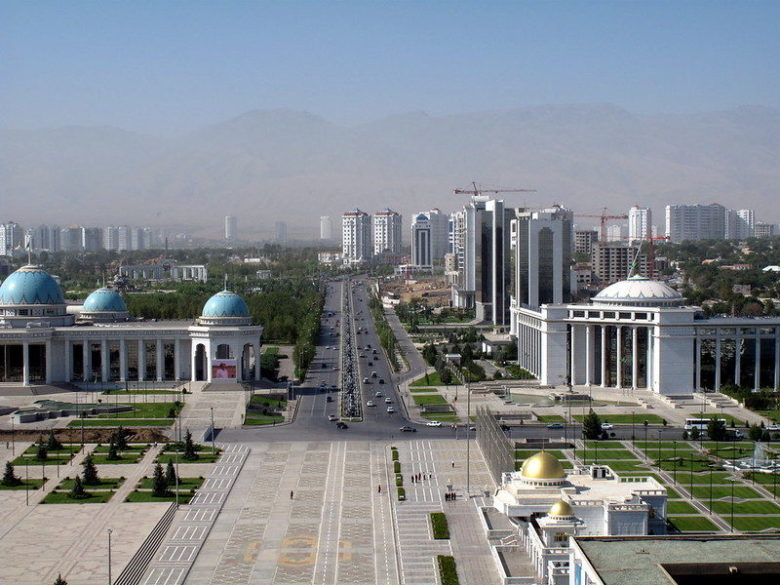
Scenes of the capital Ashgabat (Photo: Peretz Partensky / Flickr [CC BY-SA 2.0] )
目次
History and natural resources of Turkmenistan
Turkmenistan is located in the southwestern part of Central Asia and is the second largest country in the region after Kazakhstan. However, the Karakum Desert covers more than 80% of the land, and there are also many mountainous areas such as the Kopet Dag range. It is characteristic that the population is concentrated along the Caspian Sea on the western side of the country and near the border with Iran.
Turkmenistan was part of the Soviet Union from 1924 and became independent in October 1991. Since then, the country has remained under authoritarian rule. In the democracy rankings by the Economist Intelligence Unit, it placed 161st out of 167 countries (2021). Freedoms such as speech and the press are strictly curtailed, and in the annual press freedom index published by Reporters Without Borders, it ranked 177th out of 180 countries (2022). Restrictions on freedom of religion and association, torture and violence in police stations and prisons, human trafficking, and gender discrimination are among the many human rights violations cited.
Next, a brief introduction to politics after independence. Including the current president, Turkmenistan has had only three presidents. Saparmurat Niyazov, who served as the first president for about 15 years from independence in 1991, pursued a dictatorship based on extreme personality cult. He erected a huge golden statue of himself in the capital Ashgabat and implemented numerous bizarre policies, including naming cities, airports, and even the “months” and “days of the week” after his family.
At the end of 2006, Niyazov died suddenly while in office and the second administration under Gurbanguly Berdimuhamedow came to power, but Turkmenistan’s authoritarian system remained unchanged. Although he advocated a break with Niyazov, the personality cult continued, including the construction of his own golden statue. He also carried out self-serving constitutional revisions to allow himself to stay in office longer, extending the presidential term from five to seven years and abolishing limits on reelection and age. In March 2022, he handed the presidency to his son, Serdar Berdimuhamedow, an event widely discussed as a case of hereditary succession of power.
After taking office, current President Serdar Berdimuhamedow has shown enthusiasm for building external relations by visiting Russia and Saudi Arabia and signing cooperation documents with Iranian President Ebrahim Raisi, but it remains to be seen whether he will maintain authoritarian rule or move toward democratization.
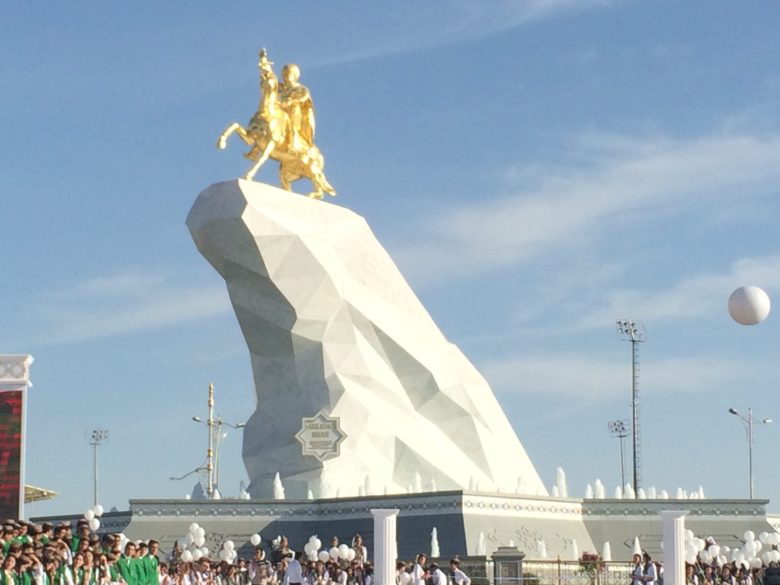
A huge golden statue of the second president, Gurbanguly Berdimuhamedow (Photo: Allan Mustard / Wikimedia Commons [CC0 1.0] )
At the same time, beyond being an authoritarian state, Turkmenistan has another major characteristic: it is rich in mineral resources such as oil and natural gas, sodium chloride, and sulfates. In particular, it has vast quantities of natural gas, with reserves estimated at about 19.5 trillion cubic meters, estimated to be the fourth largest in the world after Russia, Iran, and Qatar.
These natural resources form an important economic foundation supporting Turkmenistan. According to the International Trade Centre (ITC), revenues from natural gas and the like are estimated at about US$6.3 billion per year (2021), equivalent to about 35% of Turkmenistan’s GDP and about 80% of total fiscal revenue, it is said (※1). Around 10% of the world’s total natural gas supply comes from Turkmenistan. The largest current export destination is China, accounting for 78.8% of Turkmenistan’s total natural gas exports.
Thus, having abundant natural resources such as natural gas is Turkmenistan’s greatest strength. Yet despite possessing world-class natural gas reserves, many people in Turkmenistan suffer from poverty. According to the World Bank, the share of people living below the “ethical poverty line” (US$7.4 per day) (※2), indicating whether a minimum standard of living covering food, clothing, and shelter is ensured, is 47% of the population (※3).
In particular, since around 2017 the country has fallen into a severe food shortage, and prices at private grocery stores have ballooned to as much as six times pre-shortage levels. As a result, many poor people who cannot afford expensive food have no choice but to buy food at state-run grocery stores that sell at prices cheaper than the private sector thanks to government subsidies, forming long lines every morning for limited supplies. There are even brawls over the last piece of bread. In this way, half the population is being forced into a life of poverty.
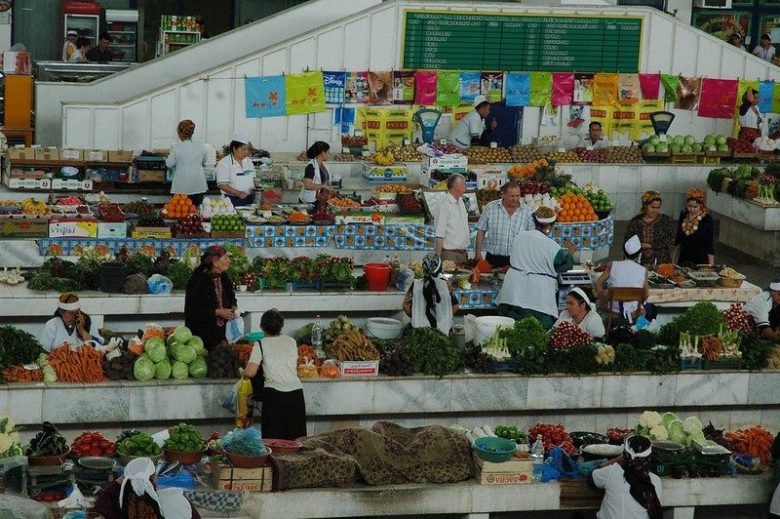
A bazaar in the capital Ashgabat (Photo: american_rugbier / Flickr [CC BY-SA 2.0] )
Opaque state management and pervasive corruption
As seen in the previous section, Turkmenistan has abundant natural gas and revenues from it. So why do so many Turkmen citizens suffer from poverty? One major reason is the opaque governance by a small elite within the country. Much of the revenue from natural gas and other resources flows to a small elite and is not returned to the people, a situation that has become normalized. Human rights groups such as Crude Accountability and other critics have even voiced suspicions that “up to around 80% of revenue from natural gas sales may be flowing to elite insiders, including the personal accounts of the Berdimuhamedow family,” raising questions. These funds reportedly serve as a financial source for the patronage network supporting the president, pay for projects that strengthen the personality cult, and are used to purchase real estate in Europe and the United States.
Revenue from natural gas that should be enriching the Turkmen economy is being used to line the pockets of the elite. This is one of the biggest obstacles to the country’s development. What is more surprising is that citizens know little about this state of affairs. In Turkmenistan, where freedom of speech and the press are not recognized, corruption such as the above can be easily concealed. According to a ranking prepared by the Natural Resource Governance Institute (NRGI), an NGO working to improve transparency in the oil and gas sector in various countries, Turkmenistan’s transparency in the sector scored 0 out of 100, ranking last out of 45 countries. In NRGI’s 2017 Resource Governance Index, which evaluates the quality of governance in the extractives sector across resource-producing countries worldwide, Turkmenistan scored 11 out of 100, placing 88th out of 89 countries. Notably, its score for “revenue management,” one of the evaluation items, was zero.
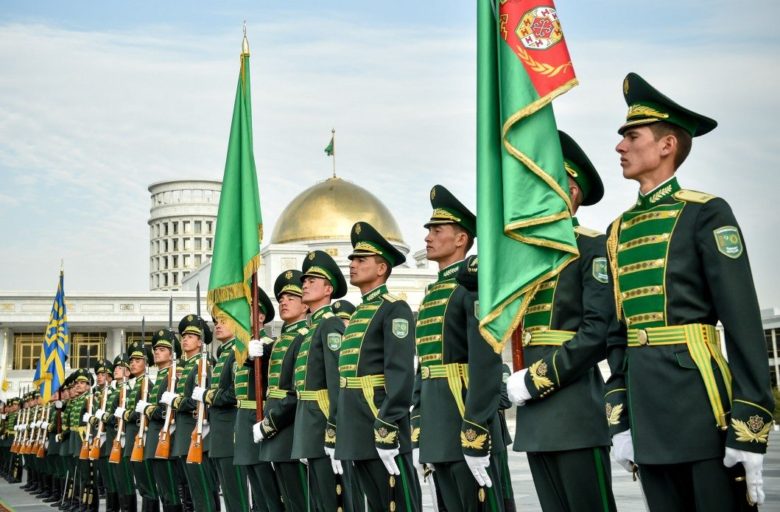
Infantry units clad in the national color, green (Photo: President of Ukraine / Wikimedia Commons [CC0 1.0] )
Turkmenistan’s opaque governance does not end there. In its official economic reports, the country puts annual GDP growth at over 6% (2018). This growth rate would rank 31st out of 189 countries, but in reality, the reliability of these reports is considered quite low. In fact, the World Bank, citing a “lack of reliable, high-quality data,” has refused to include fiscal data provided by the Turkmen government in its official publication, the Global Economic Prospects. There is even a view that real growth is below 1%. Beyond GDP, there are no reliable official announcements on details such as natural gas revenues or pricing, and the exact figures remain unknown.
Developing new export destinations and accumulated debt
Another major factor behind the failure of natural gas revenues to be returned to the people is the debt incurred in opening up new export destinations under former President Gurbanguly Berdimuhamedow, coupled with the collapse in natural gas prices.
The origin of the problem goes back to the Niyazov era, the first president. At that time, Turkmenistan’s main export destination for natural gas was not China, but Russia. However, in the latter years of the Niyazov administration, the Turkmen government grew increasingly dissatisfied as Russia frequently exerted pressure to restrain prices. Thus arose the need to open up new export destinations and to build pipelines to transport natural gas there.
Niyazov then set his sights on China. In April 2006, shortly before his death, he signed a contract with then-Chinese President Hu Jintao to lay the Central Asia–China pipeline and supply 30 billion cubic meters of natural gas annually for 30 years after opening. After Niyazov’s death, his successor Gurbanguly Berdimuhamedow focused on building friendly relations with China, and in December 2009 finally achieved the long-sought opening of the Central Asia–China pipeline. With natural gas demand in China expanding rapidly year by year, exports of natural gas to China increased steadily, and by the mid-2010s, China had become Turkmenistan’s largest buyer of gas.
At first glance this seems like a success, but things were not so simple. In exchange for finding a major trading partner in China, Turkmenistan incurred significant debt to China to finance pipeline construction. To make matters worse, from mid-2014 to around 2016 there was a historic collapse in natural gas and oil prices. Under this double blow of debt and price declines, Turkmenistan’s gas revenues fell significantly. In addition, because many companies in Turkmenistan’s natural gas sector are state-owned rather than private, and because of pervasive corruption, the country cannot attract investment and financing from international investors. For these reasons, Turkmenistan’s economic situation has not improved much, and gas revenues have barely increased.
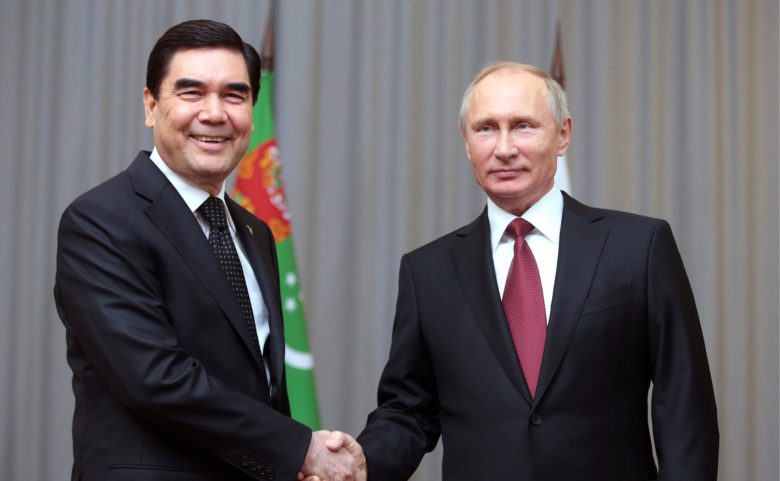
A 2017 meeting between the second president, Gurbanguly Berdimuhamedow (left), and Russia’s President Putin (right) (Photo: Пресс-служба Президента Российской Федерации / Wikimedia Commons [CC0 1.0])
As a result of these failures under the Berdimuhamedow administration, the burden shifted further onto the population, inflation spread, and the poverty rate rose even higher. During the Niyazov era, because Turkmenistan was rich in energy resources, gas, electricity, and water were free up to a certain amount of use, but that system was abolished in 2017. The failures of political leaders brought about even greater poverty among the people.
The TAPI project
Although the pipeline with China was completed in 2009, today Turkmenistan’s economy still relies heavily on Chinese gas demand, which at the same time indicates that it has not diversified its export destinations. It is clear that if demand in China falls, Turkmenistan would quickly lose a major source of revenue, yet it has not been able to find new markets. In fact, China was not the only candidate considered for opening up new export destinations during the Niyazov administration. Under pressure from Russia, diversifying and developing new export destinations was an urgent issue for the Turkmen government at the time.
This led to the launch of the TAPI (an acronym for Turkmenistan–Afghanistan–Pakistan–India) pipeline construction project. As the name suggests, it is a pipeline stretching 1,814 kilometers from Turkmenistan across borders to India, and if realized, it would be able to supply 3.3 billion cubic meters of gas annually. In fact, this project was under consideration as early as 1995, even before trade relations with China (※4). Financing from the Asian Development Bank (ADB) and the Islamic Development Bank was secured, and construction began in 2015; the project was making steady progress.
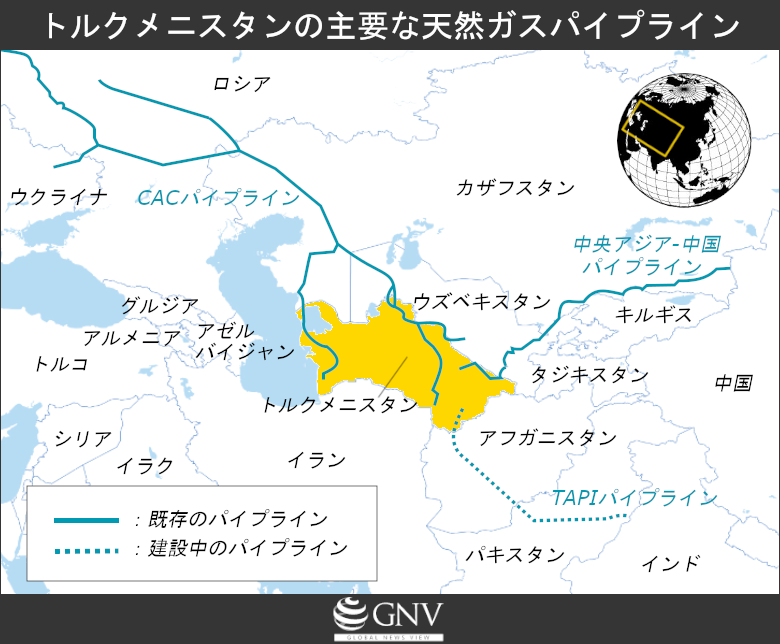
Based on data from the U.S. Energy Information Administration
However, the TAPI project is currently stalled. One reason is that Turkmenistan is facing difficulties in financing. The construction cost of about US$10 billion is to be allocated according to the equity shares of the pipeline construction consortium. Since Afghanistan, Pakistan, and India each hold 5% and the remaining 85% is held by Turkmenistan, Turkmenistan must shoulder the bulk of the construction costs. Of that 85%, it was decided that 34% would be covered by financial institutions such as the ADB and the Islamic Development Bank, but the remaining 51%, about US$5 billion, would be Turkmenistan’s responsibility.
Meanwhile, after the Taliban seized power in Afghanistan in August 2021, the ADB suspended all activities related to the TAPI project, and in March of the following year announced a statement that the project would not resume unless the Taliban government was recognized by the United Nations and the world’s major economic powers. With debts mounting and financing from international investors unavailable, the ADB’s postponement was announced—and financing has still not been secured to this day.
Furthermore, the situation in Afghanistan has affected construction itself. Construction in Afghanistan began in 2018, but due to the conflict between the Afghan government and the Taliban, it was soon halted. As of June 2022, work has not resumed.
As we have seen, Turkmenistan’s economy depends heavily on China, while also suffering from reduced revenues due to the debt incurred in building pipelines. Although it needs to diversify its export destinations to break its dependence on China and to increase export volumes and revenues, the TAPI pipeline—seen as a new opportunity—faces an uncertain future, and there are no signs of improvement.
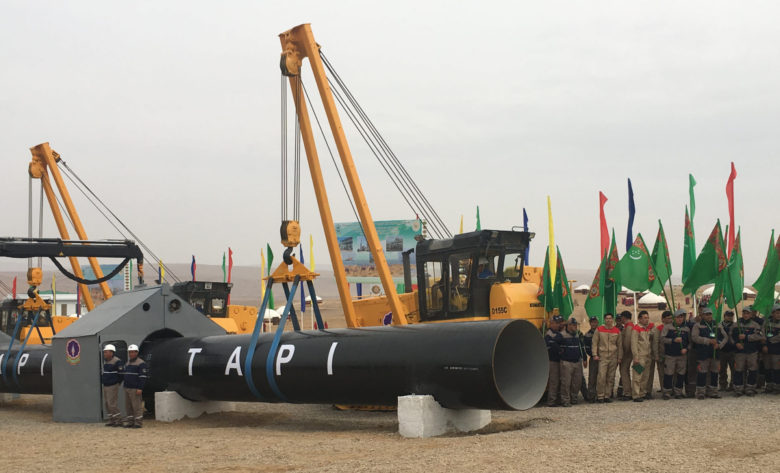
Ceremony celebrating the completion of TAPI pipeline construction work within Turkmenistan (Photo: Allan Mustard / Wikimedia Commons [CC0 1.0] )
The future of Turkmenistan
There has been some progress, however. Trade with Russia has resumed. As noted earlier, relations with Russia deteriorated over gas prices in the latter years of the Niyazov administration. As a result, Turkmenistan’s gas exports to Russia declined sharply from around 2010 and fell to zero in 2016. In May 2019, however, exports resumed. It is believed that Russia, which wants to resell gas purchased from Turkmenistan to European countries, and Turkmenistan, which wants to increase gas revenues, found their interests aligned.
It can be said that ties between Turkmenistan and Russia are currently strengthening. Amid the wave of sanctions imposed by Western countries in response to Russia’s invasion of Ukraine, President Serdar Berdimuhamedow visited Russia, and the two leaders signed a declaration to strengthen relations between Turkmenistan and Russia. Although details of the talks are unclear, it is reported that energy cooperation was a key topic.
In addition, in response to the situation in Ukraine, there is a new possibility of laying a new pipeline across the Caspian Sea from Turkmenistan to Europe without transiting Russia. In fact, consideration of this pipeline is not new; it has been discussed since the 1990s. However, opposition from Russia and Iran, which feared intensified competition in the gas market, and disputes over the ownership of the Caspian Sea among the five littoral states (Azerbaijan, Iran, Kazakhstan, Turkmenistan, and Russia) meant the idea was not pursued very actively. With the invasion of Ukraine, however, European countries that had depended on Russian oil and natural gas have begun to seek new suppliers, reigniting the debate. If realized, this could lead to the long-sought diversification of export destinations and an increase in export volumes.
Furthermore, there are signs that the TAPI project discussed in the previous section could also resume construction. Although funding issues remain unresolved, in January 2022 the Taliban, which seized power in Afghanistan in August 2021, announced that it would deploy about 30,000 troops from special units to ensure the safe implementation of the TAPI project. This could potentially accelerate the project’s progress.
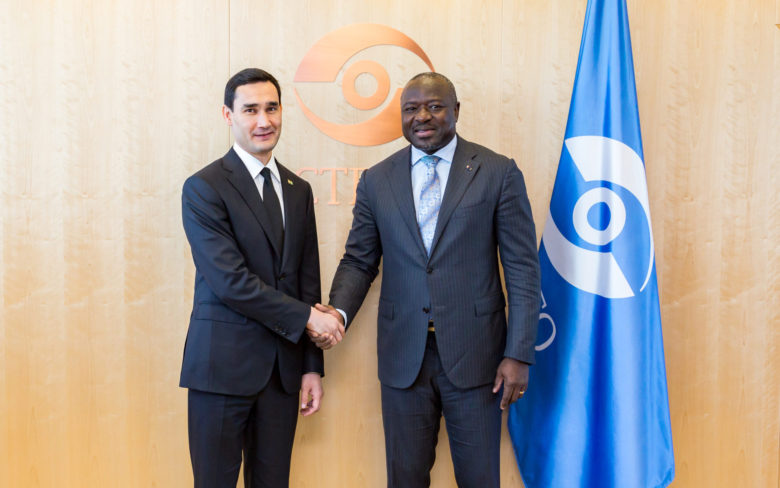
Current President Serdar Berdimuhamedow (then Deputy Foreign Minister) (left) and CTBTO Executive Secretary Lassina Zerbo (now retired) (right) (2018) (Photo: The Official CTBTO Photostream / Wikimedia Commons [CC0 1.0] )
However, simply diversifying export destinations and increasing export volumes will not lead to a fundamental solution. As we have seen, corruption is rampant in Turkmenistan and opaque governance continues. No matter how much export destinations are diversified and revenues increase, unless this system is reformed, there is little chance that the gains will be returned to the people.
Is there any prospect that this authoritarian system will improve? Unfortunately, the likelihood is seen as low. While some hope for reforms under President Serdar Berdimuhamedow, many take a cautious view. There are concerns that he will adopt policies similar to his father’s and continue governance based on a personality cult. Moreover, his father and predecessor, Gurbanguly Berdimuhamedow, serves as chairman of the upper house, raising concerns that he will continue to wield influence even after stepping down as president. If that happens, the likelihood that the same system will continue becomes even higher.
And Turkmenistan’s domestic problems are not limited to natural gas. As noted earlier, restrictions on freedoms beginning with speech, and human rights issues such as human trafficking and gender discrimination are also piling up—none of which are problems that can be solved overnight. Will the new president take measures to address these issues, or will opaque authoritarian rule continue? Will the day come when wealth is distributed equitably and the people of Turkmenistan can live prosperous lives? We sincerely hope for a society in which abundant resources bring about abundant lives as a matter of course.
※1 Since the Turkmen government does not officially publish national revenues and expenditures, the ITC figures are estimates.
※2 At GNV we use the ethical poverty line (US$7.4 per day), rather than the World Bank’s extreme poverty line (US$1.90 per day). For details, see GNV’s article “How should we interpret global poverty?”.
※3 Since the Turkmen government does not officially publish population figures, these are estimates. Although the population is estimated at 5 to 6 million, local media report that about 2 million people have left the country since 2008 and that the population is around 3.3 million, so the actual figure is unknown.
※4 However, when the project was first proposed, India was not a participant. India announced its participation in 2008.
Writer: Kyoka Maeda
Graphics: Mayuko Hanafusa



トルクメニスタンという国について今まで特に興味を持ったことがなかったが、独裁国家であることや天然ガスが豊富にあることなど、この記事は大変分かりやすく勉強になった。
しかし天然ガス収益が国民にほとんど還元されず、大統領個人の資金とされているなど、とてもひどい国だと思った。
それをトルクメニスタン国民自身が知らないというのが、本当にひどい。新しい大統領によってこの国が少しでもいい方に変わることを願っている。
日本にいては信じられないと思うような国が、今の時代になってもまだまだあるのだなという感想。
こういう記事を読むと、日本に生まれてつくづく良かったなと思う。せっかくの天然ガスに恵まれた国なのに、トルクメニスタン国民は不幸だ。
トルクメニスタンが、多くの国民が苦しい生活を強いられている独裁国家だと初めて知りました。
国民が正しい情報にアクセスし、富が然るべき比率で分配される日が来ることを願っています。
モノカルチャー経済の不安定さについては存じ上げていたが、輸出先にも多様性があるべきだという話は、考えてみれば当たり前であるが、盲点であった。天然資源を活かした繁栄をするにあたっては、独裁政権であることというよりも、その不透明性や、一部のエリートに富が集まる仕組み自体にボトルネックがありそうだと思われる。
今はロシア問題もあり、どこの国でもこの天然資源が不足していて、節電や節ガスが世界中で声高に叫ばれている。
トルクメニスタンにはその天然資源が豊かにあるというのに、ちっとも国民は幸せではないと言う…。
恵まれた国のはずなのに、恵まれていない。
資源があるのに貧困。
おかしな話だ。