
GNV has so far focused on reports by major newspapers to analyze international coverage, pointing out that the share of international news within overall coverage is low and that even within international news there is a bias in the countries and regions covered, as noted previously. But media is not limited to print. Television, which delivers news through video, is also one of the key media that brings information to us. This time, we analyzed international coverage in television news. Our subject is NHK’s news program “News Watch 9,” broadcast for one hour from 9 p.m. on weekdays. We analyzed the share of international coverage, the countries and regions featured, and the topics within the broadcasts in 2021 (※1). We would like to explore how NHK views the world.
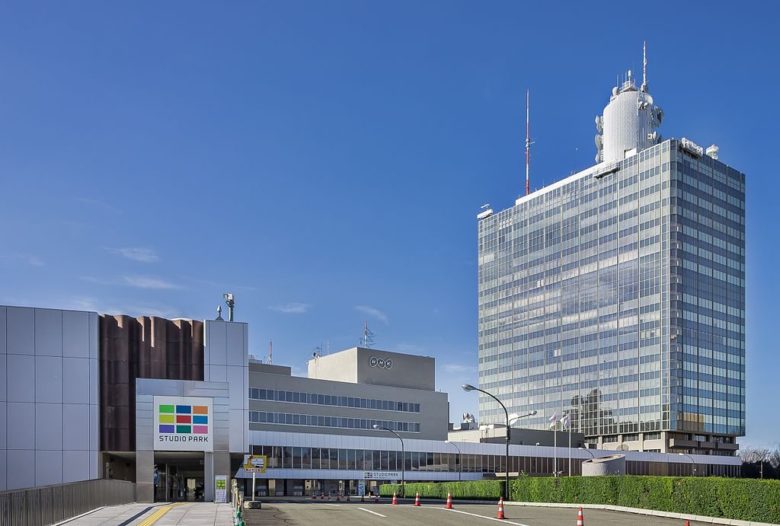
NHK Broadcasting Center (Photo: Kakidai / Wikimedia Commons [CC BY-SA 4.0])
目次
Share of international news
First, we look at the share of international news in overall news (※2). The survey found that international news accounted for 11.9% of the total. In a previous survey, the share of international news in the three major newspapers was around 10%, suggesting that the proportion devoted to international news by Japanese newspapers and NHK’s News Watch 9 is broadly similar.
On the other hand, there were differences in how it was featured. Newspapers have a dedicated international section, so a certain amount of space is allocated to international coverage every day. In the case of News Watch 9, however, the time devoted to international news varies by broadcast day. On some days about 20 minutes of the one-hour broadcast are devoted to international news, while on other days it is not covered at all. Sometimes it appears at the start of the program as the top news, while other times it is pushed to the latter half; there is no fixed slot within the program.
Next, we compare international news with sports news. The time allotted to sports news was about 18.8% of the total—about 1.5 times that of international news. The two also differed in how they were featured within the program. Sports news had a fixed slot of about 10 minutes toward the end of the program. When Japanese athletes performed well overseas, sports items were sometimes covered in the top news slot, but even then, the 10-minute sports slot remained. In this respect, the two were handled differently within the news.
International coverage by region
We now look at the regional breakdown of international coverage. As shown below, the shares of each region within total international coverage were: Asia 45.5%, North America 30.4%, Europe 14.3%, Africa 1.0%, Oceania 0.9%, and Latin America and the Caribbean 0.03%. Asia and North America were extremely large, and together they accounted for 80% of the whole. Overall, the trend is similar to newspaper coverage.
What stands out, however, is how little coverage Africa, Latin America and the Caribbean, and Oceania received. According to a previous survey of newspaper international coverage, Africa accounted for 3.4% of total coverage, Latin America and the Caribbean 2.1%, and Oceania 0.9%. Even these are quite small shares, but on television the disparity is even more pronounced. In particular, Latin America and the Caribbean were featured only once for about 30 seconds on Mexico during the entire year (※3), and there was not a single report on South America. As for Africa, only four countries were covered—Egypt, the Democratic Republic of the Congo, and Sudan twice each, and South Africa once—amounting to only about 18 minutes over the entire year.
There are three main reasons for this regional disparity in coverage. First, there is a limit to how much television can report at any one time. Compared to the volume of information a newspaper can include in a day’s print edition, the amount of information a TV news program can convey in one hour is far smaller. Because the information that can be conveyed is limited, selection becomes more pronounced, and regions that are not usually prioritized tend to be excluded. As a result of this selection, news from Asia and North America is reported disproportionately, and news from lower-income countries is less likely to be covered—a tendency that appears even more strongly than in newspaper coverage. Second is the nature of television as a visual medium. In print, newspapers can report global news without necessarily going on-site by citing wire services or other countries’ media. Television, by contrast, is a video-centric medium, so reliance on footage from other countries’ media is more limited than in print when covering world news. This makes reporting on distant regions even more difficult. Third is the uneven distribution of bureaus. NHK has bureaus in 31 cities worldwide, concentrated especially in Asia. In Africa, however, there are only two—Cairo, Egypt, and Johannesburg, South Africa—and in Latin America and the Caribbean only one, in São Paulo, Brazil. The small number of bureaus around lower-income countries likely reflects NHK’s low prioritization of those countries and regions. Newspapers also have few bureaus in Africa and Latin America and the Caribbean, but in television, the costs of moving equipment and crews are higher. Against this backdrop, regional disparities in TV coverage become even larger.
Coverage by country
While the regional breakdown yielded the results above, let’s look at the details. As shown below, the top 10 countries by share in international coverage were: the United States 28.2%, China 11.7%, Myanmar 7.5%, Afghanistan 6.0%, the United Kingdom 4.2%, North Korea 3.0%, South Korea 2.9%, Israel 2.6%, Russia 2.4%, and Germany 1.7%. Even if you add up all coverage of African and Latin American and Caribbean countries—both low overall—they would not make the top ten, indicating a large disparity in coverage. Compared with newspaper coverage, the tendency for the United States and China to dominate remained unchanged. The abundance of U.S. coverage was particularly striking: a single country, the United States, accounted for about 30% of the international coverage. In addition, Japan is counted as a related country in news about Japan-U.S. or Japan-China relations. Including this in the ranking, Japan accounted for 3.6% of the total, ranking just after the United Kingdom.
The heavy U.S. coverage likely stems, as with newspapers, from Japan’s strong political and economic ties with the United States and from the fact that the U.S. is the world’s leading military and economic power. Developments in the U.S. government and society greatly affect Japan, leading inevitably to more coverage. Specifically in 2021, Joe Biden took office as president on January 21, drawing attention to U.S. politics, which is also one reason.
Turning to Asian countries, China, South Korea, and North Korea were frequently featured, as in the newspapers. This likely reflects the fact that they are Japan’s neighbors with strong political, economic, and cultural ties. China was often covered in the context of its political confrontation with the United States, while North Korea tended to see spikes in coverage when it conducted missile tests.
Exceptions within Asia with unusually high coverage were Myanmar and Afghanistan. The large volume of coverage of these two countries was driven by major political upheavals in 2021. In Myanmar, a coup occurred in February 2021 and a military regime was established. In Afghanistan, U.S. forces withdrew in August 2021 and the Taliban returned to power, drawing worldwide attention. News Watch 9 aired daily footage of citizens’ protests against the regime, devoting substantial time. Meanwhile, coverage of Southeast Asia other than Myanmar was extremely limited, similar to newspapers. Although Southeast Asia is geographically close with strong economic ties to Japan, countries other than Myanmar accounted for only 1.7% of the total.
Other countries covered extensively included the United Kingdom, Israel, Russia, and Germany. The U.K. and Germany featured frequently in health-related news as their COVID-19 vaccination campaigns started early. Israel was also often featured for its early vaccination rollout, and additionally, the flare-up of conflict with Palestine from April to May 2021 drew attention, mirroring newspaper coverage. Russia was frequently covered in the context of political confrontation with the United States, and in December 2021, coverage increased after it conducted military exercises near the border with Ukraine.
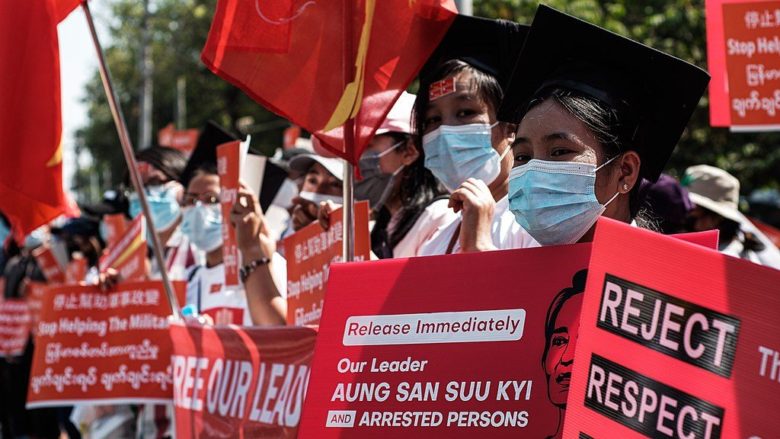
Scenes from protests in Myanmar in 2021 (Photo: MgHla (aka) Htin Linn Aye/ Wikimedia Commons [CC BY-SA 4.0])
News that was not covered
So far, we have looked at the countries and regions that News Watch 9 covered most. However, important events also occurred in countries that were not covered. GNV’s “Top 10 Underreported World News of 2021” highlighted ten major stories that Japanese newspapers covered little. Among those, the one News Watch 9 took up was the news about the widening global gap between rich and poor during the pandemic. It was reported once, in about an eight-minute segment, linking the widening economic disparity to the Sustainable Development Goals (SDGs). However, the other nine stories were not covered by News Watch 9. Below we look at three examples.
The first is that, for the first time ever, the World Health Organization (WHO) recommended a malaria vaccine. In health coverage, COVID-19 has been overwhelmingly prominent since 2020, but malaria has claimed many lives every year. The number of infections in 2019 alone reached 229 million, with 409,000 deaths annually, 67% of whom were children under five—an alarming disease. The vaccine had been in development for over 30 years and finally bore fruit in 2021. Yet this news was not mentioned at all on News Watch 9.
The second is the release of the Pandora Papers. The Pandora Papers exposed financial dealings making use of tax havens by political leaders and tycoons around the world, including 35 current or former heads of state. This revelation of tax avoidance—arguably fueling social inequality—shocked the world. But News Watch 9 did not cover it.
The last example is the legalization of abortion in some Latin American countries. In parts of Latin America, it had been a problem that abortion was not permitted even for women with unwanted pregnancies. From late 2020 through 2021, however, it was legalized in countries such as Argentina and Mexico. Despite the relevance of this news to improving women’s status and rights, News Watch 9 made no mention of it.
Thus, despite being globally significant stories, some were not covered by News Watch 9. Most of the stories cited here took place in lower-income countries. As noted earlier, Japanese media fundamentally focus on high-income countries such as the United States, China, and European nations, which GNV has previously pointed out. The same tendency appears in this analysis of News Watch 9.
International coverage by topic
Up to now we have focused on country and regional trends; here, we look at the shares of international coverage by topic within all news. As shown below, politics accounted for nearly half at 48.7%, followed by health/medical at 21.1%, society/life at 8.1%, military at 3.7%, economy at 3.6%, and environment/pollution at 3.3%.
The most common topic was politics, with content often related to security and associated talks and summits, especially in relation to neighboring countries and the United States. China was frequently covered due to its confrontational relationship with the U.S., while South Korea was largely featured in stories related to historical perceptions vis-à-vis Japan.
The next most common topic was health/medical, most of which concerned COVID-19. In particular, many items focused on vaccination status by country, spotlighting countries such as those in Europe, the United States, and Israel where vaccinations proceeded early. As for demonstrations/riots and war/conflict, most reports concerned Afghanistan and Myanmar, followed by coverage of Israel–Palestine. Regarding environment/pollution, there was some coverage before and after international summits such as the Conference of the Parties (COP) to the UN Framework Convention on Climate Change, but it was rarely covered in normal times.
The above summarizes our analysis of international coverage by topic on News Watch 9. A pronounced gap was evident between the volume of coverage in politics/health and other fields. As mentioned in the previous section, despite numerous developments in other areas—such as moves to legalize abortion in South America and the Pandora Papers—these were barely covered.
Conclusion
Through this analysis of News Watch 9, we examined NHK’s international coverage. For television as well, the share of international news relative to overall coverage shows a similar trend to newspapers, while the imbalance in countries/regions and topics featured is even more pronounced on TV.
Under such international coverage, how much can viewers truly grasp the state of the world?
※1 From January 4, 2021 to December 24, 2021. From July 23 to August 5, broadcasts were suspended due to Tokyo Olympic special programming, so NHK’s “News 7” broadcasts were analyzed instead.
※2 For GNV’s definition of international news, see “GNV Data Analysis Method.”
※3 GNV uses the United Nations Statistics Division (UNSD) classification, under which Mexico is treated as part of Central America.
Writer: Takumi Kuriyama
Graphics: Takumi Kuriyama








NHKの国際報道の傾向が新聞の報道の傾向と同じ部分も有れば、取り上げられる国・地域やトピックの偏りについてはより顕著に表れているという点がとても興味深かったです。またテレビ局が発信しているSNSはどのような傾向なのかについても気になりました。
日本の報道に偏りがあることは問題だが、では他の先進国では日本よりも偏りなく国際報道が出来ているのかが気になった。ここまでの偏りがあり、重大なニュースを取り上げないことは改善すべきだが、人間が報道を行っている以上、興味や関心、利益があるものに偏ることはある程度仕方のないことだと思うので、、、。
1年間のテレビ番組の特集がまとめられていて、大変勉強になりました。テレビは、他メディア媒体の引用もしづらく、映像主体だからこそ、支局数等の関係で国別・地域別の偏りも大きくなるのだと、実感しました。
限られた時間でなるべく生活に直結する情報を収集したいという視聴者のニーズに沿うために情報の偏重が生じてしまうことは、デイリーニュース番組の宿命のように思われます。ただ、他の番組、他の媒体で不足した情報の補完が行われているかは気になります。