
With globalization, businesses have become able to distribute work around the world. In other words, tasks that used to be completed in-house and within the country can now be carried out by selecting lower-cost, higher-capacity, and more efficient locations and talent from across the globe. One way to achieve this is “outsourcing.” Outsourcing is used for tangible operations such as in manufacturing, as well as intangible operations such as in services. The information technology (IT) industry is no exception; outsourcing of electronic product manufacturing and software programming has been increasing. While outsourcing offers many advantages for companies, it harbors various problems for those on the receiving end. In this article, we refer to intangible tasks in the IT industry as IT services and focus on the problems of outsourcing them.

Applications on a smartphone (Photo: HeikoAL / pixabay)
目次
Digitalization and outsourcing
Outsourcing can be broadly classified by where the work is delegated. Contracting within the same country as the company seeking to outsource is called onshoring; contracting to a neighboring country is called nearshoring; and contracting to a distant country is called offshoring. This article mainly deals with nearshoring and offshoring, where the destination crosses borders; below, we refer to both simply as “outsourcing.”
Outsourcing has been widely adopted across many industries, not limited to the IT sector, as a method to grow a business. For IT companies, a major purpose of outsourcing is to reduce costs, but for IT services there are also other reasons: entrusting work to people with more advanced skills, enabling in-house employees to focus on more core business operations, and improving efficiency by dividing up tasks.
The IT industry encompasses a variety of fields, including hardware, software, telecommunications, the internet, and information processing. Outsourcing occurs in all these fields, but delegating things like hardware product manufacturing involves the physical movement of goods. In other fields, outsourced work often consists of tasks such as data entry or programming that can be conducted over the internet without physical movement. As a result, the costs associated with outsourcing can be kept lower. Consequently, along with the global spread and use of the internet, demand for outsourcing related to IT services has been rising year by year. The IT outsourcing market expanded from USD 56 billion in 2009 to USD 137.2 billion in 2017, and expenditures on outsourcing are expected to increase by 5% annually from 2020 onward.
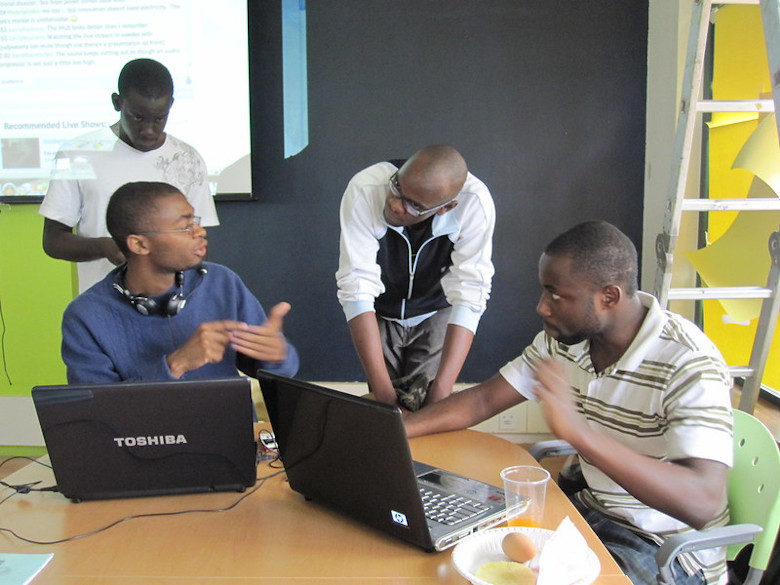
Scene from a hackathon held in Kenya (an event for intensive short-term software development) (Photo: Erik(HASH)Hersman / Flickr [CC BY 2.0])
Concrete examples of outsourced IT services include the development and updating of applications used on PCs and smartphones; application maintenance and support; database management; network operations and monitoring; and phone or online support for products or services sold.
So, from where to where is such work being outsourced? There are many companies that commission work, most of which are located in high-income countries; in particular, the United States, the United Kingdom, Spain, and Australia are among the countries with a large number of outsourcing companies globally.
On the receiving side, many individuals and companies in India and China—countries with large populations that have invested heavily in IT-related education—take on such work. In recent years, however, outsourcing to other countries has also increased. In Asia outside of India and China, the Philippines receives a lot of work due to lower wages, while in Eastern Europe, Ukraine, Hungary, and Poland are common destinations. Although wages in Eastern Europe are higher than in Asia, these countries are often chosen because they have a wealth of talent proficient in various programming languages. In South America, Brazil and Argentina are frequent destinations, and smaller time differences with the United States and Canada—where many client companies are located—are cited as reasons for selection.
Moreover, the reasons destinations are chosen are not just regional characteristics. In communication between the client and contractor, and between the client’s customers and the contractor, the use of a common language can be crucial. In countries where English is widely used—such as India, the Philippines, and South Africa—people tend to be proficient in English, lowering the language barrier for companies and customers in English-speaking countries. For other languages, Spain may find it easier to outsource to Latin American countries where Spanish is an official language, and for France, countries like Morocco and Tunisia with many French speakers may be easier to work with. While many of the countries mentioned so far are low-income, outsourcing to high-income countries also exists.
Next, let’s look at how outsourcing is carried out and the forms it takes. There are various forms of outsourcing. Broadly, they can be divided into cases where a worker contracts directly with a company as a sole proprietor, and cases where a company contracts with a contractor (vendor). There are multiple patterns within each: in the former, an intermediary may act between the worker and the company. For example, even when a direct contract is signed between a sole proprietor and a company, intermediaries may introduce work, or assignments may be made through online platforms. In the latter case, the contractor may distribute work to workers it employs, or there may be multi-tiered arrangements where the contractor further outsources to another contractor.

Programming code (Photo: Godfrey_atima / pixabay)
Outsourced tasks
What kinds of tasks are actually outsourced? Here we introduce four categories said to be particularly common. The first is call center operators. Call center operations can be divided into two patterns: responding to inbound calls from customers and making outbound calls to customers. The former corresponds to the “inquiry desk” when purchasing or using products and services, and in recent years support has expanded from phone to online channels. The latter involves sales or market research regarding products and services. Because these tasks can be done anywhere with a phone line or internet connection (VoIP), there is no need for the company to have an in-house department or to keep it domestic. As a result, they are outsourced to companies in countries where the customer’s language is spoken.
The second is programming work. Programming is a necessary skill across a wide range of fields—from developing and producing operating systems, games, and smartphone apps, to controlling factory machinery and conducting data analysis. A company outsourcing the work designs the end product and then commissions the necessary tasks either as a whole or by breaking them down into parts. Taking e-commerce application development as an example, based on the application design, the functions needed to build the app are divided into, for instance, order processing and inventory management, and programming for each function is outsourced accordingly. The number of professionals such as programmers and software developers engaged in such work exceeds 10 million across Asia, especially in India and China. Outside Asia, Eastern Europe has many such professionals, with an estimated 200,000 in Ukraine and about 300,000 in Poland.
The third is content moderation. Content moderation involves monitoring comments, photos, and videos posted on social media and removing inappropriate content; those who perform this work are called content moderators. “Inappropriate content” includes violations of national laws or platform rules, pornography, animal cruelty, violence, hate speech, and more. With the spread of devices like smartphones and PCs and the rise of social media, the volume of content has increased, and demand for moderation has grown. Although software and AI for moderation are being developed and deployed, it is not always possible to determine appropriateness clearly. Distinguishing between a nude photo and a work of art, or between hate speech and criticism of hate speech, can be difficult; cultural nuances can also lead to differing judgments of what is appropriate. Therefore, a large portion still relies on human judgment. Facebook alone employs 15,000 moderators, and the company has said it needs another 30,000.

Effects of AI training and operation verification (Photo: Ars Electronica / Flickr [CC BY-NC-ND 2.0])
The fourth example of work that is easily outsourced in IT is data entry for AI. AI has various capabilities, but for those capabilities to function properly it must be “trained.” Data entry corresponds to training for AI, and a huge volume of data is required for it to acquire skills. For example, to enable AI to recognize images of dogs, you must first train the program so it can reliably recognize dogs. To do this, you label images—such as various breeds, dogs from multiple angles, and images that look like they might include dogs—as “dog present” or “dog not present,” and feed that data into the AI. This enables the AI to recognize dogs as consistently as possible with minimal exceptions. There is data showing that even when such labeling is performed for 50 million photos, the number of objects an AI can accurately distinguish remains limited. Providing AI with functions such as object recognition and discrimination, or speech recognition and language understanding, requires an enormous volume of human-generated data and data-entry work. On Amazon Mechanical Turk, a platform offered by Amazon, there are about 500,000 contract workers, of whom 15,000–20,000 perform data entry each month.
Thus, the IT services that are outsourced range widely: from those requiring advanced skills such as programming, to those that can be done with a common language or short-term training, such as call center operations, content moderation, and data entry.
Problems with outsourcing
What problems arise when the kinds of tasks introduced above are outsourced overseas? The primary objective of outsourcing is arguably to secure low-wage labor and reduce costs. When cost reduction is the purpose, low wages and related issues can arise. There are two possible cases for low wages. The first is when the wage setting itself is insufficient for a decent life—i.e., the pay is inadequate for the workload or hours.
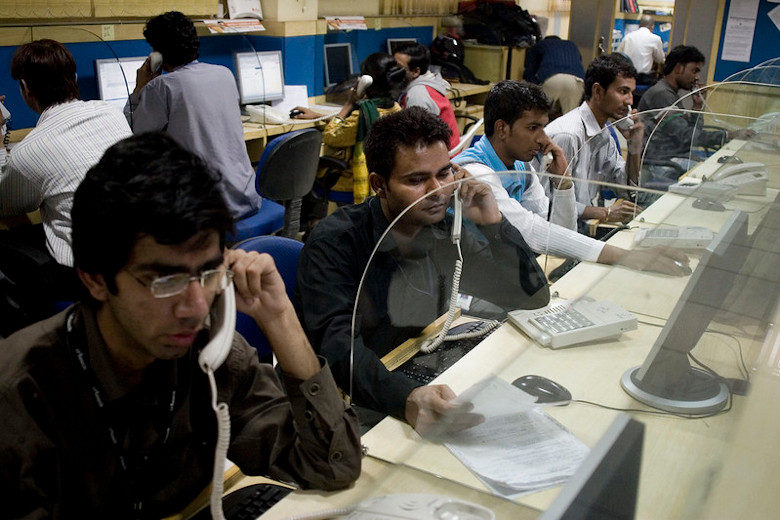
A call center for customer service in India (Photo: Marquet B.(ILO) / Flickr [CC BY-NC-ND 2.0])
Looking at real-world examples, operators at a call center in the Philippines to which the U.S. telecom company AT&T outsourced work are paid only USD 2 per hour. Among Amazon Mechanical Turk workers, some report earning USD 700 over two months working 4–5 hours a day, and only USD 25 for an 8-hour day. There is also a case in which Google underpaid thousands of temporary workers in dozens of countries in violation of the law.
The second issue is the wage gap between outsourced workers and employees working at the client company. Even when performing similar work with comparable skills and experience, there can be a large income disparity between the two. Comparing hourly rates for skilled engineers in software development requiring programming expertise, wages in the U.S. and Canada are around USD 60, whereas in Eastern Europe (Ukraine, Russia, Poland) they are around USD 20. Rates are even lower in some Asian and African countries: around USD 10 in India, the Philippines, and Vietnam, and below USD 10 in Egypt and Nigeria.
Such situations arise from an imbalance of power between companies and workers. Where job opportunities are limited, it becomes difficult for workers to speak out against low wages or poor working conditions, or to demand improvements on those grounds. As a result, many workers are compelled to continue providing IT services despite low pay or unfair treatment. These problems occur not only in the structure of outsourcing from high-income to low-income countries, but also in outsourcing of IT services from high-income to high-income countries. Moreover, it is currently difficult for workers in such situations to organize—e.g., to form labor unions—to demand better treatment, partly because many tasks do not require workers to gather in a single place, resulting in little interaction among workers.

Working on a computer (Photo: Jeremy SALMON / Flickr [CC BY-ND 2.0] )
Workers handling outsourced tasks abroad are not covered by the labor standards set by the client company or the systems and regulations of the client company’s country. As noted, even when they perform the same work as employees of the client company, there are differences in wages, among other things. In addition, two problems arise from the perspective of employment arrangements. The first concerns treatment: inadequate benefits such as paid leave; unrealistic quotas; extremely short deadlines; and insufficient consideration or compensation for mental and physical burdens. For example, content moderators face a high risk of psychological strain because they must view large volumes of “inappropriate” videos and images, yet most work environments lack daily time or volume limits for health, and provide no counseling or professional guidance. Continuing in such work can lead to psychological trauma such as post-traumatic stress disorder (PTSD), yet no measures are taken. In fact, in 2018 Facebook—which employs large numbers of content moderators—was sued for failing to take measures to prevent psychological stress and trauma among moderators or to provide compensation.
The second issue concerns job insecurity. Whether working as a sole proprietor or through a contractor or intermediary, if one relies heavily on outsourced assignments, contracts may be terminated or one may be dismissed when work is reduced or disappears. There is thus no guarantee of long-term employment, and even if one works for a long time, career advancement is rare because long-term contracts are not the default. Without career advancement, improvements in wages, workplace environments, and other working conditions cannot be expected. In practice, at call centers in South Africa, many young people remain stuck on low wages and face a constant risk of poverty.
Countermeasures to the problems
So far, we have touched on outsourcing in IT services and the issues it raises. As noted, with the spread of the internet, outsourcing is expected to continue increasing alongside the expansion of the IT market. Even for IT services alone, the global outsourcing market is projected to reach USD 937.6 billion by 2027.

Cables and ports for network connections (Photo: Public domain / Piqsels)
Such market expansion cannot be welcomed uncritically solely as industrial development. If measures are not taken to address current problems, it will likely mean the expansion of exploitation of many workers involved in the IT industry. To improve this situation, global-scale responses are needed. Below, we explore possible measures centered on four actors involved in outsourcing: companies, national governments, workers, and consumers.
First, companies—the primary actors engaging in outsourcing—could set fair compensation and conditions for workers at destination firms. However, if these companies set fairer compensation and conditions, their costs would increase, creating significant downsides for them. Given that their motivation for outsourcing is cost reduction, it is unlikely that companies will voluntarily tackle these problems.
Second, governments can take action. Governments can establish regulations and penalties for companies that outsource, set minimum wage guarantees to protect workers’ rights, and establish labor standards. Even if the work is not performed within their own country, governments can impose restrictions on companies headquartered in their jurisdiction. As noted, companies that outsource are concentrated in high-income countries such as the United States, the United Kingdom, Spain, and Australia. There is a view that if these countries alone were to establish systems regarding outsourcing, the situation would improve significantly. In destination countries as well, governments can develop labor-related systems to protect their workers. In fact, India planned to revise its laws in 2021 to protect workers who receive outsourced assignments from foreign companies, including clarifying labor and wage standards and expanding their scope.
Third is worker solidarity. While it may be difficult individually, collective action could lead to improvements. There is an example in which 10,000 content moderators joined together to sue a major corporation and secured promises to improve working conditions. In that case, Facebook’s content moderators united to sue the company over the lack of compensation for mental health issues; the company agreed to pay a settlement and to provide mental health care for moderators. This suggests that worker solidarity can lead to improvements in working conditions. In the Philippines, an online cooperative for freelancers—the Philippine Online Professional Service Cooperative (FOPSCo)—has been established, and there are efforts to empower workers to defend their own rights. There is also the Platform Cooperativism Consortium, an organization that promotes such activities online, and international expansion is expected.
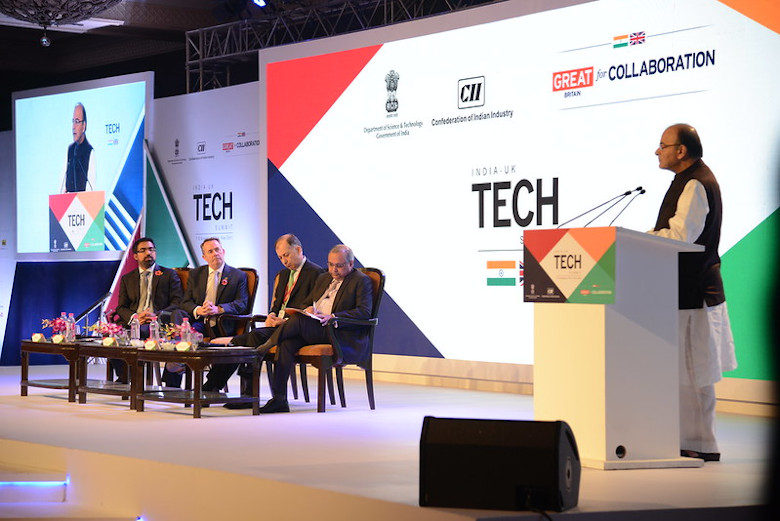
UK-India Technology Summit held in India (Photo: British High Commission, New Delhi / Flickr [CC BY-NC-ND 2.0])
Lastly, what can consumers—who benefit from the IT industry that exploits these workers—do? We should not forget that, after all the above processes involving countries, companies, and workers, it is consumers who use the finished products and services. Just as with the fair trade movement, consumers can consider whether a product was produced and manufactured through fair and just processes when making purchase decisions. For those that are not, consumers can express opposition—for example, by protesting to the companies that produce or manufacture them. The same appeals can be made to IT companies providing digital services.
IT services tend to be perceived as one with the hardware products—smartphones and PCs—that serve as their medium, and compared with these tangible devices at hand, consumers may feel less conscious that they are “using” them. As many are free to use, consumers tend to use them more passively. This can cause us to forget that many people are involved in the processes leading to completion and in ongoing management for use. Precisely for that reason, we must consciously pay attention and keep the spotlight on these issues.
Writer: Minami Ono



















私は日頃、ハード中心に学んでおり、自動車の東南アジア、メキシコでの生産など、ハード系の海外生産に注目しがちでした。この記事で、ソフト系における海外への業務委託の現状について知ることができました。業務を依頼する企業には、労働者の労働環境や福利厚生が適切であるかを、委託先についてもチェックしていく必要があると強く思います。一方で、委託先と依頼主の企業での同じ業務・技術に対する賃金格差は難しい問題だと感じました。途上国の低賃金という利点が無くなれば、委託される仕事自体が減少することになりかねず、現実的には、その国々・地域の賃金水準に応じて、労働・技術に見合った賃金とするしかないのかな、とも思いました。しかしながら、技術に対しては正当な対価が支払われる、評価される、そういった社会であって欲しいです。
ITがささやかれる時代になり、便利になっていく一方で、このような問題があることは知らなったので興味深かったです。日頃受けているサービスの裏側でも労働者にまつわる問題があるとおもうと身近に感じました。技術・スキルに対してきちんと評価してもらえる社会になればいいな、と思いました。
私はIT業界に全く詳しくなかったのですが、すごく読みやすい記事でした。知らない分野の中に深刻な問題があると知ることができました!
時代の変遷によって、産業もうつり変わっていくことは、頭の中で理解していたけれど、それに付随する問題まで目を向けたことはなかった。今はデジタルデバイスに関係しているサービスの問題があるが、ここでその問題を解決しても意味がなく、そのような問題が常に起きうるということを理解し、これから社会を生きていく必要があると思った。