
In May 2021, it became clear that about 1.14 million people in Madagascar were facing severe food shortages. The south of the country is experiencing the most severe drought in 40 years, and people are surviving by eating things like leaves and even soil. Why has Madagascar fallen into such an extreme food shortage? What does the reality look like? This article delves into the background of the food shortage, with attention to Madagascar’s history and poverty issues.
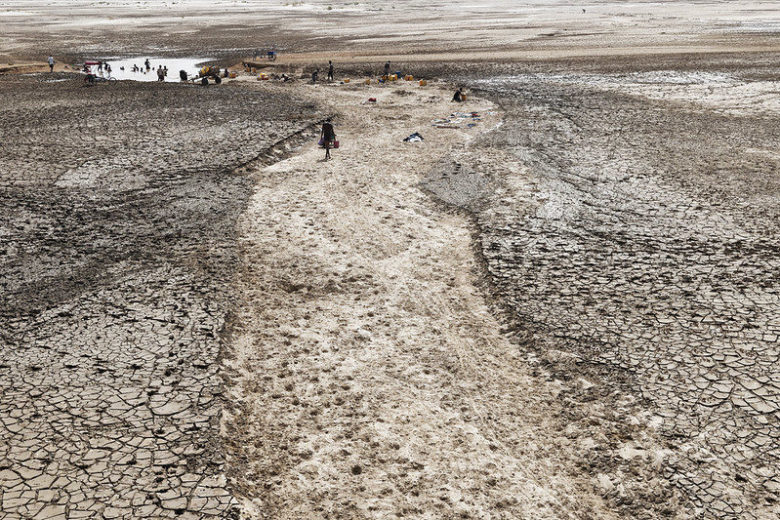
Dried-up river (Photo: International Labour Organization ILO / Flickr [CC BY-NC-ND 2.0])
目次
Overview and history of Madagascar
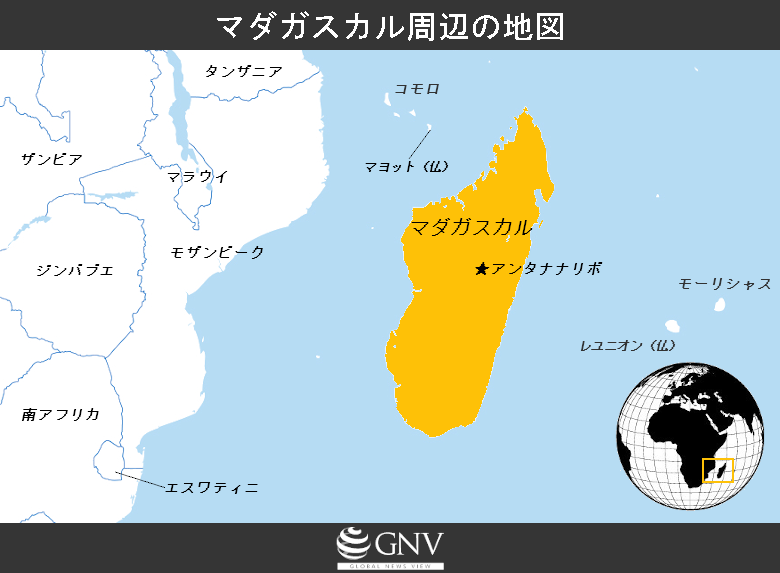
Madagascar is located in the southeastern part of the African continent, an island nation in the Indian Ocean and the world’s fourth largest. Its population is about 25 million, and its main industries are agriculture, tourism, textiles, and mining. From around the 15th century, the Merina kingdom expanded its control over the central highlands. But just before it could unify the entire island, France, which had been steadily increasing its influence in Madagascar, expanded its control further, and in 1896 the colonial era under France began. As noted below, vanilla, now a major export, was introduced by Europeans during the colonial period. After the Second World War, opposition to French rule grew and led to an independence movement. A 1947 uprising resulted in many deaths. In 1960, under its first president, Philibert Tsiranana, Madagascar finally achieved independence. However, even under Tsiranana, ties with France remained strong, drawing public dissatisfaction. With Tsiranana’s bid for a third term, large-scale riots broke out, and in 1972 a new government under Gabriel Ramanantsoa was established. Ramanantsoa severed the diplomatic relationship with France, a factor behind the unrest, and promoted ties with the Soviet Union. In 1975, Didier Ratsiraka became president and pushed socialist policies, such as promoting state-owned enterprises.
The economy did not improve; rather, it worsened, and Ratsiraka’s repressive politics stood out. As public opposition grew, Ratsiraka embarked on democratization reforms, including economic liberalization and constitutional revision, but he lost the 1992 election to Albert Zafy and the reforms were interrupted. Later Zafy’s corruption was exposed, and in 1997 Ratsiraka managed to return to the presidency. In 2001 a presidential election was held between Ratsiraka and Marc Ravalomanana, but a stalemate dragged on over the vote count. For about half a year it remained undecided who would assume the presidency, and there were moments of armed clashes during that period. Cyclones occurring at the same time also contributed to the economy’s decline. Ultimately, the High Constitutional Court recognized Ravalomanana’s victory. His administration sought to improve the economy by attracting foreign investment and contributed to halving the debt, but it did not lead to poverty alleviation.
In that context, although Ravalomanana was re-elected in 2006, he did not have universal support. Andry Rajoelina, then mayor of the capital Antananarivo, in particular was critical of the Ravalomanana administration, suspecting embezzlement of public funds and authoritarian politics. At the end of 2008, after Ravalomanana shut down a TV station run by Rajoelina, amid suspicions of corruption and the planned large-scale land sale to South Korea’s Daewoo conglomerate, a general strike took place and the opposition movement intensified. Some demonstrations turned violent, and the government at times suppressed them by force. In March 2009, after losing military support, a coup occurred and Ravalomanana went into exile in South Africa. A transitional government led by Rajoelina was formed, but its legitimacy was widely questioned, and instability persisted. In fact, Rajoelina did not meet the constitutional minimum candidacy age (40) at the time. Thus, the new constitution established in 2010 included lowering the candidacy age, changes favorable to Rajoelina. Elections based on the 2010 constitution were held in 2013; Rajoelina stepped down from the presidency once, but he won the 2019 election and serves as the current president.
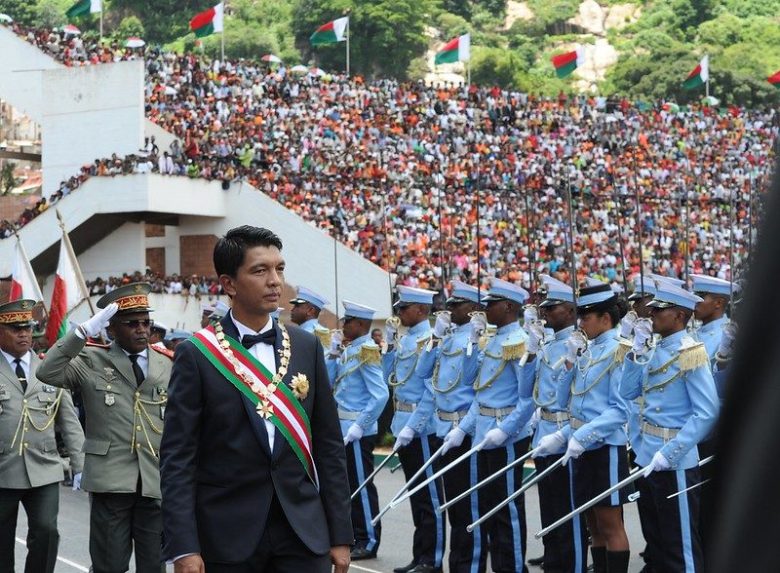
Current President Andry Rajoelina (Photo: GovernmentZA / Flickr [CC BY-ND 2.0])
As such, Madagascar has experienced several political crises and bears various challenges arising from political instability. The July 2021 revelation that an assassination of the president had been planned during the June Independence Day celebrations underscores this. In addition to political instability, domestic and international economic systems have historically had a major impact on Madagascar’s poverty. Today, the persistent poverty in Madagascar not only triggers a food crisis but also hinders its resolution. To understand the overall picture of the food shortage, we need to consider this fragile economic base as well. Below, we examine multiple perspectives.
Poverty among vanilla farmers
As noted above, agriculture is one of Madagascar’s main industries, and the agricultural sector accounts for 24% of GDP. Vanilla is a major source of income within the sector. However, many farmers who produce vanilla live in poverty. Below we explain why vanilla farmers suffer from poverty and the problems surrounding vanilla production.
Ninety-nine percent of the vanilla used worldwide is artificial, but in recent years the demand for natural ingredients has increased, affecting vanilla as well. Vanilla is the second most expensive spice in the world, and Madagascar accounts for 80% of the world’s natural vanilla exports. However, due to unfair trade, the proceeds are not properly reflected in farmers’ incomes. Vanilla farmers receive only 5% of the transaction price. This stems from the fact that intermediaries, trading houses, and companies that process raw materials into products have stronger bargaining power than farmers in the chain between shipment and the international market. As a result, the farmers’ share is small while other actors’ shares are large. Furthermore, vanilla cannot be harvested year-round; there is an off-season between production and harvest. Because incomes are low, farmers cannot cover living costs during the off-season and often borrow from middlemen using the next harvest as collateral. If they fail to meet the collateralized harvest volume or prices rise and repayment becomes impossible, they are forced into further borrowing and can fall into a debt trap. In fact, 75% of vanilla farmers live in extreme poverty on less than US$1.90 a day.
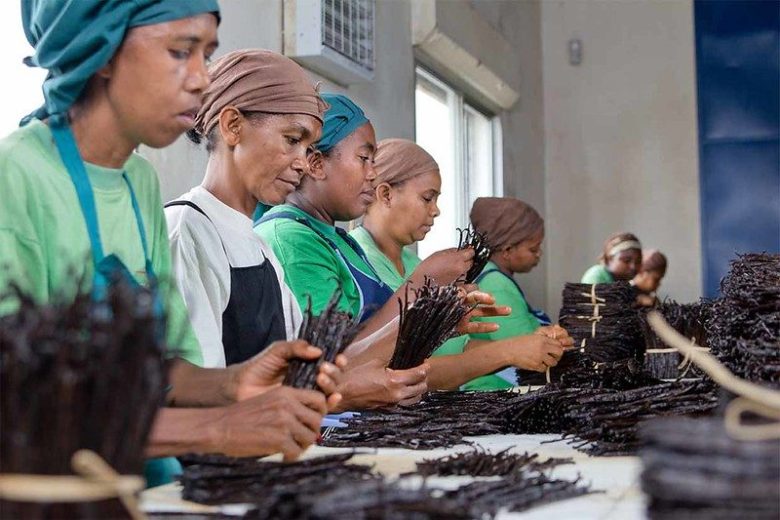
People engaged in vanilla production (Photo: The Barry Callebaut Group / Flickr [CC BY-NC 2.0])
Low incomes also lead to child labor. One-third of those engaged in vanilla production are children aged 12 to 17. Vanilla production involves many tasks, all done by hand, including pollination, and requires a lot of labor. As a result, producers are forced to rely on children, whose labor is cheaper. However, Madagascar has ratified the International Labor Organization (ILO) conventions on child labor and legally prohibits child labor. Because vanilla is expensive, theft also occurs. Beans are stolen from fields just before harvest, forcing farmers to stand guard all night. On the buyers’ side, companies cannot identify which vanilla is stolen, so stolen and legitimate beans are traded indiscriminately.
Problems in the mining sector
Unfair trade is not limited to vanilla; it is also a problem in mineral resources. Mining in Madagascar accounts for 4.4% of GDP, a quarter of total exports and one-fifth of the labor force. Minerals extracted in Madagascar include nickel, cobalt, gold, and gemstones. Among these, nickel and cobalt, as well as ilmenite, are mined by foreign companies. The large-scale nickel development project Ambatovy is funded by Japan’s Sumitomo Corporation and South Korea’s Korea Resources Corporation. Ilmenite is mined by QIT Madagascar Minerals, 80% owned by the UK-based multinational Rio Tinto.
A key issue with these development projects by foreign companies is the low royalties. Royalties refer to the percentage of profits from mining that companies granted the right to extract must pay to the government, which owns the resource. If royalties are high, profits from resource development can be used to invest in better welfare and education policies and infrastructure, enabling a more stable nation. But when royalties are set low, it becomes difficult for resource-rich countries and their people to benefit. In Madagascar, royalties on mineral resources are set at 2%, allowing mining companies to capture most of the profits with little reflected in the domestic economy. The Malagasy government has sought to raise royalties, but opposition from foreign companies has prevented this.
Meanwhile, gold and gemstones such as rubies and sapphires are mined via small-scale mining. Small-scale mining refers to extraction by hand by individuals rather than organized company operations using large machinery. The resources extracted by individuals are sold to intermediaries and trading houses. Small-scale mining is often conducted informally, with poor management of sites, volumes, working conditions, incomes, and export routes. As a result, it is not included in government revenues, and it is said that millions of US dollars flow out each year through illicit trade. This mining method has increased alongside political crises over the past 20 years, and some argue that political instability has made it impossible to manage labor conditions in mining. In addition, workers at small-scale sites lack knowledge of valuing mineral resources, so they sell at low prices and cannot significantly increase their income.
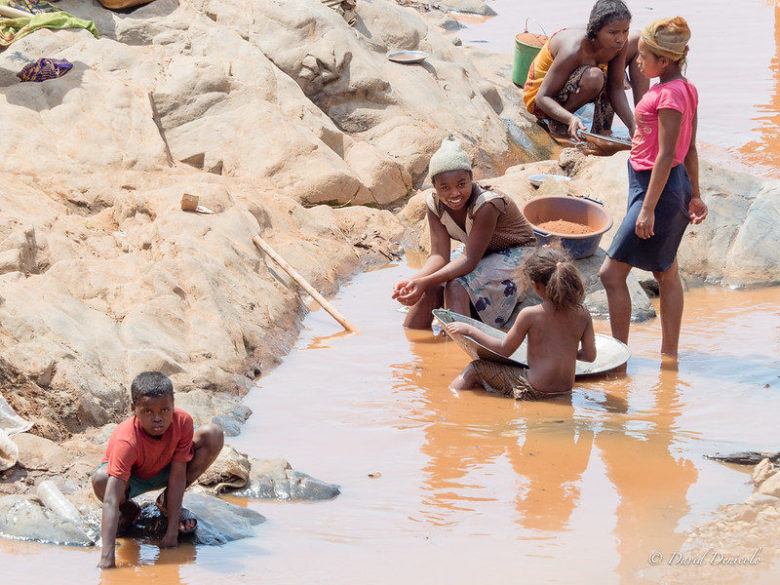
People mining gold (Photo: David Denicolò / Flickr [CC BY-NC-ND 2.0])
Environmental burdens from mining are also a concern. In particular, for nickel, the amount of usable nickel is very small relative to the amount of ore excavated, resulting in large volumes of waste. Like cobalt, nickel is used in batteries for electric vehicles, and demand is rising, but the production of supposedly “environmentally friendly” electric vehicles is paradoxically having a negative impact on the environment in Madagascar. Beyond environmental pollution from mining, deforestation is also a serious problem. Although some areas are designated as protected to conserve the environment, workers in small-scale mining suffer from poverty and have no other means of livelihood, so they sometimes continue mining by cutting down trees even in protected areas. Deforestation in Madagascar is occurring outside of mining as well. We look at this in more detail below.
The problem of deforestation
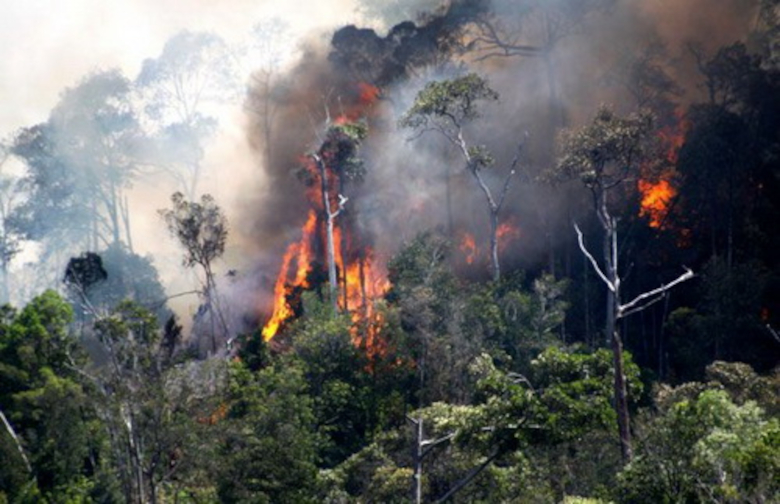
In Madagascar, deforestation is progressing so rapidly that 1 to 2% of the country’s forests disappear each year. As a result, only 10% of Madagascar’s original forests remain today. In addition to the impact of mining mentioned above, slash-and-burn agriculture is a major cause. In swidden agriculture, once the land is burned, time is needed to allow the soil to recover; however, in Madagascar, farmland is insufficient relative to population growth, and poverty limits the amount of land that each person owns, so fields are cultivated again without allowing sufficient fallow periods. This leads to land degradation. Furthermore, these fields are used not only for producing food for the farmers themselves but also for cash crops and grazing, generating profits for middlemen and foreign trading companies. Some middlemen are government officials, and there are claims that they fail to act because restricting deforestation would not serve their personal interests. In fact, deforestation was legally banned in 1987, but the law has been largely ineffective.
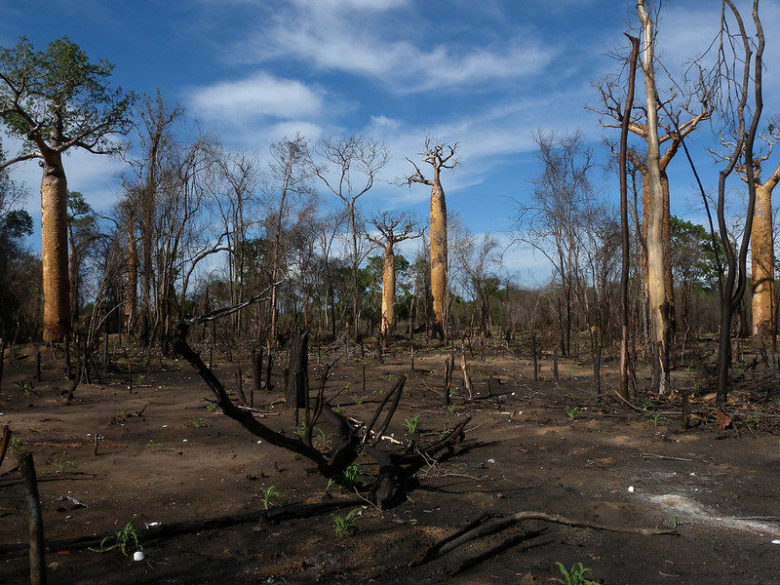
Forest where slash-and-burn was practiced (Photo: Frank Vassen / Flickr [CC BY 2.0])
Deforestation has also pushed many tree species to the brink of extinction. Madagascar was said to have 2,900 endemic tree species, but two-thirds are now threatened. In particular, rosewood and ebony—of which Madagascar accounts for one-third of global production—are valuable timbers, but illegal trade is rampant and their numbers have greatly declined. There is also the reality that people suffering from poverty are compelled to engage in illegal logging. Rosewood is exported mainly to China, but profits from the illegal trade in rosewood are sometimes laundered by traders as if they were legitimate profits from vanilla trading. Apart from illegal trade, the habitats of rosewood and ebony are also shrinking due to slash-and-burn practices. Beyond trees alone, Madagascar is a biodiversity-rich region with many endemic species, but their habitats are shrinking due to deforestation, undermining biodiversity. In such circumstances, since 2017 the United Nations and the Malagasy government have been cooperating on tree-planting projects to protect tree species on the verge of extinction.
Food shortages
We have described several challenges Madagascar faces; the food shortages mentioned at the outset are worsening due to a social context in which the above problems are intricately intertwined, combined with weather conditions. As noted, as of May 2021, about 1.14 million people faced food shortages, including 14,000 in particularly severe hunger. Hunger is concentrated in the south. The nutritional status of children under five has particularly worsened, and in the south the rate of acute malnutrition has reached 16.5%.
The south has experienced famine 16 times since 1896, eight of which have occurred in the past 40 years. Most people in this region make their living from agriculture, so when famine strikes, they not only lack food for themselves but also lose income. The 2021 harvest was projected to be 10–30% lower than last year and 50–70% below the five-year average.
Drought is cited as a cause of the shortage. The south is facing a severe drought; compared to those occurring in recent years, the 2020–2021 drought was particularly serious, with rainfall at half the usual level. The occurrence of drought is also linked to the deforestation described above; slash-and-burn agriculture worsens an already arid region.
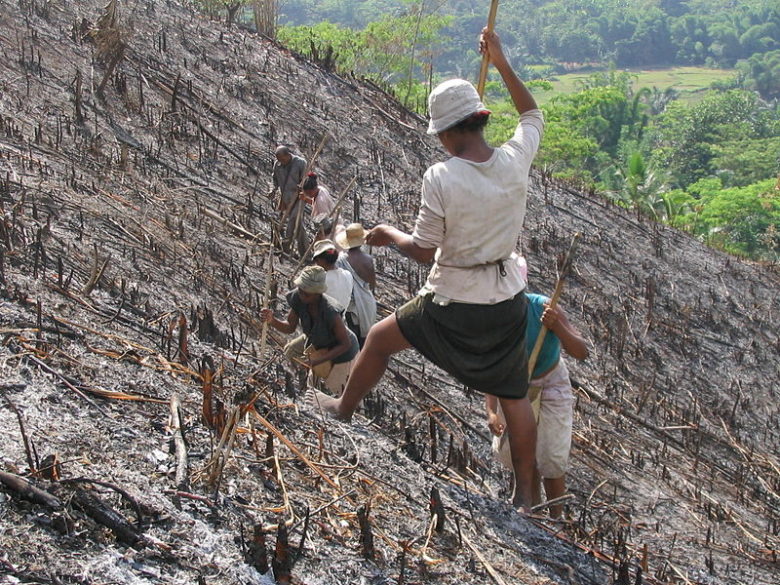
Rice cultivation by slash-and-burn agriculture (Photo: Paul Atkinson / Wikimedia Commons [CC BY-SA 3.0])
Moreover, climate change is said to be increasing the frequency of droughts themselves. Southern Madagascar used to be a biodiversity-rich land of lush vegetation, and farmers relied on rainfall for agriculture. However, with rainfall plummeting due to climate change, crop yields have fallen sharply. Drought-tolerant crops and irrigation facilities are needed, but in Madagascar, where poverty is widespread, it is difficult to realize these measures. Beyond drought, the region has also been hit by cyclones, sandstorms, and locust swarms, and these too are increasing in frequency due to climate change.
Food shortages are also driving up food prices. Rising prices are devastating for people in poverty outside the farming sector as well. While we focused above on the poverty of vanilla farmers, as of 2019, 75% of Madagascar’s population was forced to live on less than US$1.90 a day. In other words, even without drought, people were living in extreme poverty. In addition to prices, infrastructure is also an issue. For example, because roads are not well maintained, access to markets is limited, restricting the option of going to buy food. Furthermore, 85% of households have no access to electricity and therefore no means to store food safely.
What lies ahead for Madagascar?
From October 2021, the lean season—when food from the harvest runs out and food becomes scarce until the next harvest—was forecast to begin and be longer and harsher than usual, necessitating urgent measures. In response, the World Food Programme (WFP) is providing emergency food assistance and treatment for malnutrition among children under five, among other support. The Food and Agriculture Organization (FAO) has also been working since around 2019 with the Malagasy government and the German International Development Cooperation Agency to build resilience to climate change through forest conservation and improving farmers’ skills. The government itself states that it is working to improve disaster countermeasures for cyclones and floods and to enhance agricultural techniques.
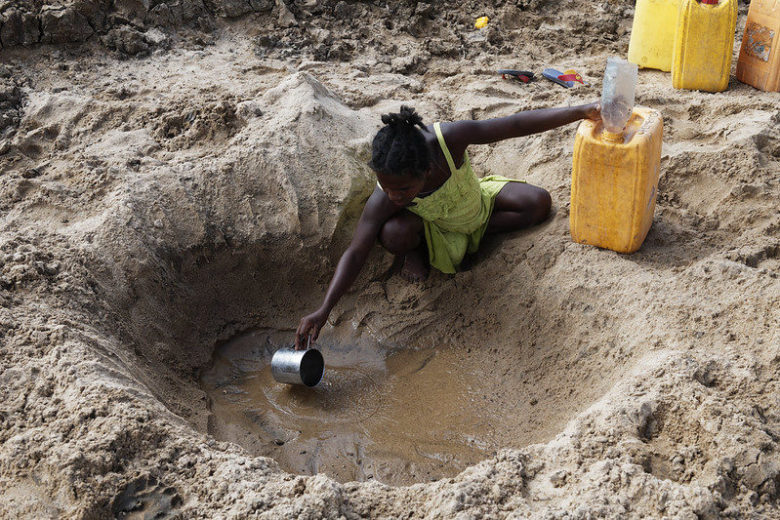
Child drawing water from a dried-up river (Photo: International Labour Organization ILO / Flickr [CC BY-NC-ND 2.0])
At the same time, even if these measures are taken and the current hunger is overcome, that will not be a fundamental solution. Going forward, Madagascar will need to build a robust economic base that can withstand crises such as drought. To that end, it will be necessary to address the chronic issues covered in this article: poverty arising from unfair trade in vanilla and mineral resources, deforestation in agriculture and mining, illegal trade in precious resources, and climate change. These challenges are by no means Madagascar’s responsibility alone; responsibility also lies with the companies and countries that benefit from unfair international trade systems and with the countries that have driven climate change. We hope that each will review its actions and that fundamental reforms will be realized.
Writer: Maika Kajigaya
Graphic: Minami Ono






政情不安、食糧不足、環境悪化、鉱業関連の悪循環、貧困問題が複合的に絡み合い負のスパイラルから中々抜け出せない状態にある事がよく分かり勉強になりました。
常に飢えに窮する国が同じ地球上にあること。フードロスの日本から見ると、とても心痛な思いです。
長期的な対策や支援を要するだけに、もっと多くの人にこれらの問題に目を向けてほしいと願います。これからも発信してください!
星の王子様で有名な木や珍しい動物など、生物があふれている印象があるマダガスカルで、生物多様性が脅かされ、森林伐採の問題が深刻化している現実に驚きました。