
“The festival of peace”—as the Olympics approach, we hear this phrase more and more. The Olympics are an international sports festival held every four years. It is a long-standing event where athletes representing their countries compete in various sports, vying in points and performance. The Fundamental Principles of the Olympic Charter define its purpose as “placing sport at the service of the harmonious development of humankind, with a view to promoting a peaceful society concerned with the preservation of human dignity.” However, the media in particular have come to emphasize only this peaceful aspect, and before long the Olympics came to be called a “festival of peace.” Is that really the case? Might there not be aspects that are not necessarily “peaceful”? And can we truly say the media reflect the Olympics’ true nature? Let’s explore that in this article.
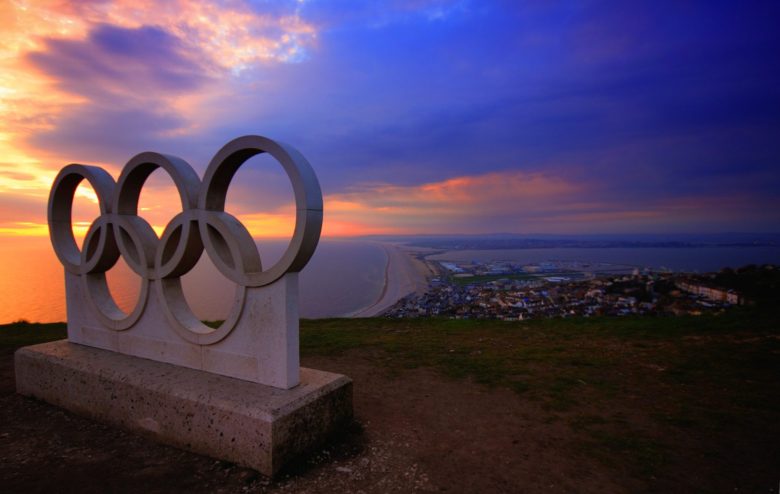
Monument of the Olympic rings (Photo: InspiredImages / pixabay)
目次
The history of the Olympics and peace
The origins of the Olympics date back about 2,800 years, to 776 BCE, when games were held in the Olympia region of ancient Greece. The ancient Olympics were a religious festival dedicated to Zeus, the father of the gods, and, as today, were held every four years.
Were the ancient Olympics considered a “festival of peace” as they are now? The answer depends on what “peace” means. What is peace in the first place? Beyond the mere “absence of violence,” it can also mean “a state that endures through cooperation and dialogue,” and there is a definition that regards peace as the coexistence of both (※1). During the ancient Olympics, an Olympic truce was instituted, and all surrounding conflicts were temporarily suspended. In that sense—the absence of violence—the games appear to have valued peace. However, many of the events were war-oriented, such as chariot racing, equestrian, and javelin—using vehicles, animals, and weapons actually used in war—as well as combat sports centered on boxing and wrestling. In fact, there are claims that the ancient Olympics were used as preparation for war. In light of these points, it can hardly be called peaceful.
The tradition of the ancient Olympics then continued for more than twelve centuries, developing through additions of events and expansions of eligibility. However, in 393 CE, when Roman Emperor Theodosius made Christianity the state religion and banned all “pagan” festivals, that history came to an end.
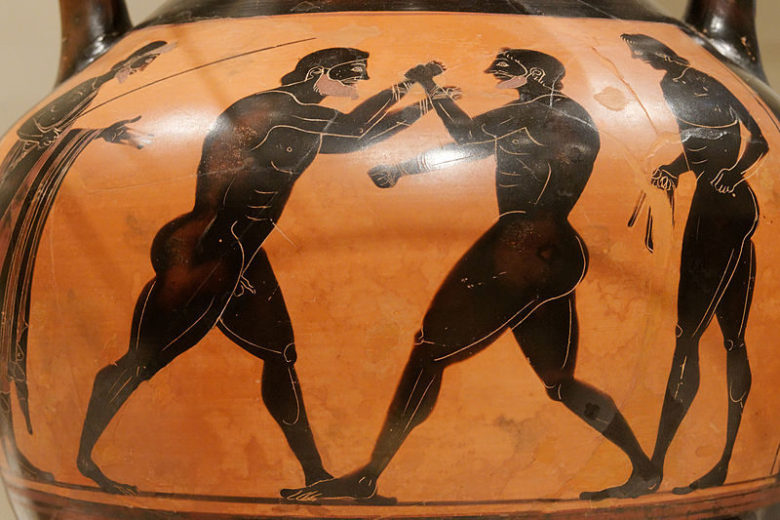
Artwork depicting combat sports at the ancient Olympics (Photo: Antimenes painter / Wikimedia Commons [CC BY-SA 3.0])
About 1,500 years later, the Olympics began their path to revival thanks to the efforts of Pierre de Coubertin, a French educator. Coubertin envisioned not merely a sports festival, but one that would contribute to the realization of peace through sport. As noted at the outset, this is also stated in the Olympic Charter. It can be said that this was the first time the Olympics were explicitly tied to peace—the beginning of the modern Olympics.
The Olympics’ non-peaceful origins and structure
Thus the modern Olympics were revived under the seemingly lofty ideal of “peace.” But let us ask again: Are the Olympics really a “festival of peace”?
First, consider the rationale for establishing the modern Olympics. As mentioned, Coubertin set world peace as the goal of the Olympics. Yet one cannot help but question his vision of “peace.” In fact, he was very much a white supremacist, leaving remarks such as, “Races are of differing value, and all other races should pledge allegiance to the white race, which possesses superior qualities.” At the same time, Coubertin called himself a “fanatical colonialist” and sought to expand France’s colonies under the slogan “Rebronzerla France!” (“Make France bronze again!”—a call to restore the glory of the colonial era). Furthermore, Coubertin was an ardent supporter of Germany’s Nazi Party and lavishly praised the 1936 Berlin Olympics as “a splendid Games brought about by Hitler’s enthusiasm and leadership.”
From the above, it is hard to deny that Coubertin’s vision of “peace” was heavily biased. Some have argued that behind his revival of the Olympics lay the aim of demonstrating white supremacy and strengthening European unity to expand empire. Thus the modern Olympics can be said to have been founded on a skewed ideology.
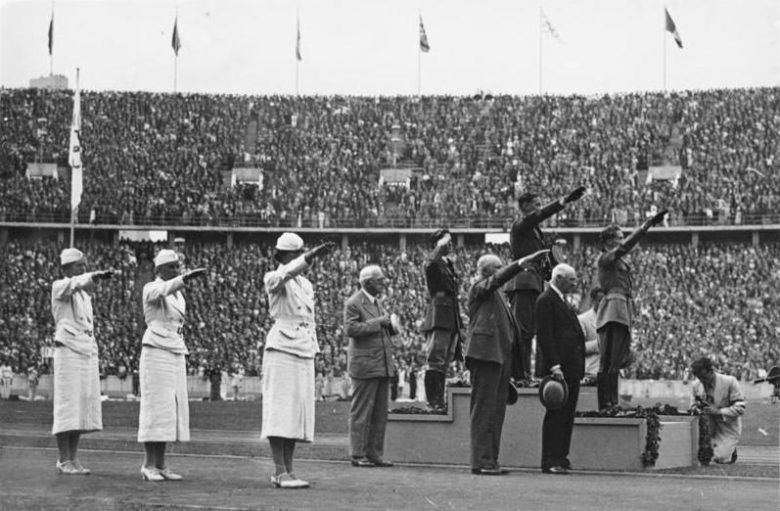
The 1936 Berlin Olympics. Nazi salutes during a medal ceremony. (Photo: Stempka / Wikimedia Commons [CC BY-SA 3.0])
In addition, we should note the non-peaceful origins of the Olympic flame (※2). Today, the torch relay is an indispensable event to build momentum for the Games. But it was not part of the modern Olympics from the start; it was introduced at the 1936 Berlin Games. Why? As today, there was a desire to hype the event—but there was another important purpose. The Nazi regime intended to use the torch relay as propaganda: to project Germany’s prestige to the world and attract Germans—especially youth—to the Nazi Party. In this connection, the U.S. broadcaster NBC, which held the rights to air the Tokyo Olympics scheduled for 2021 (as of May 20, 2021), ran an op-ed arguing that “traditions originating in Nazi propaganda, such as the torch relay, should be abolished,” drawing attention.
Next, look at the structure of the Games. By the nature of sport, the Olympics are an arena not of cooperation with others but of competition. Pitting athletes against one another, determining winners and losers, and ranking them may run counter to “peace,” which implies harmony and cooperation.
We also need to consider the events themselves. The modern Olympics, like the ancient ones, include events related to war. While chariot racing is gone, events using weapons—such as shooting, archery, and fencing—remain. Combat sports that involve attacking an opponent, such as wrestling, boxing, judo, karate, and taekwondo, also involve violence to some degree. This is not to deny their value as sports where technique is contested. However, there seems to be a striking contradiction in holding events that encompass violence and can be linked to war under a banner of “peace.”
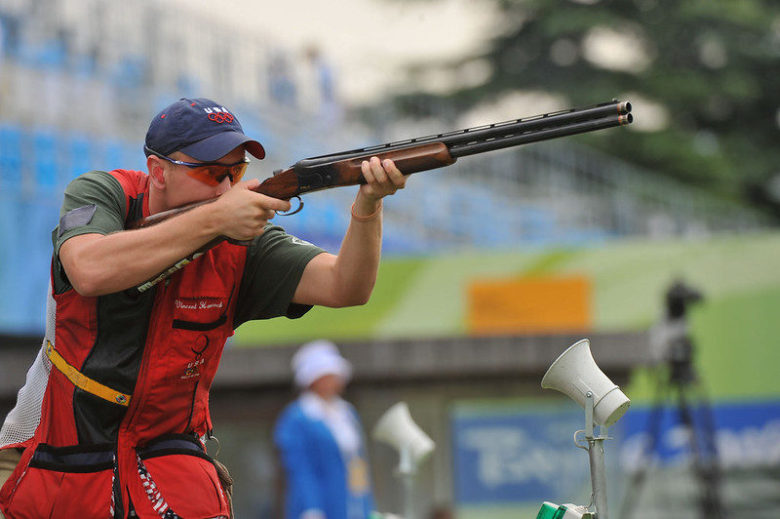
Shooting at the Olympics (Photo: The U.S. Army / Flickr [CC BY 2.0])
The Olympics as a driver of nationalism
The non-peaceful aspects of the Olympics are not limited to their origins and structure. There is also the very serious problem of fostering nationalism (※3). Except for the Refugee Olympic Team (※4) introduced in 2016, all athletes must participate not as individuals, but as representatives of a nation. Outcomes are contested by country, and medal counts are ranked by country. Spectators also view other countries as “rivals” or even “enemies” and cheer for athletes from their own country. Governments, media, and companies encourage rooting for their own nation. Some have argued that it looks as though nations are competing over moral virtue.
In this way, organizing teams by country and heightening athletes’ and spectators’ sense of belonging is a trait shared with war. Numerous studies show that international sports events tend to heighten a sense of national unity and hostility toward other countries. This is why the Olympics are mocked as “war minus the shooting.” At the same time, host nations use opening and closing ceremonies and medal ceremonies to showcase themselves and elevate national prestige—another element that fosters nationalism. Moreover, the dividing line between “us” and “others” is not limited to nationality; race and gender are, too. Historically, the Olympics have had many issues related to racism, and that continues to this day.
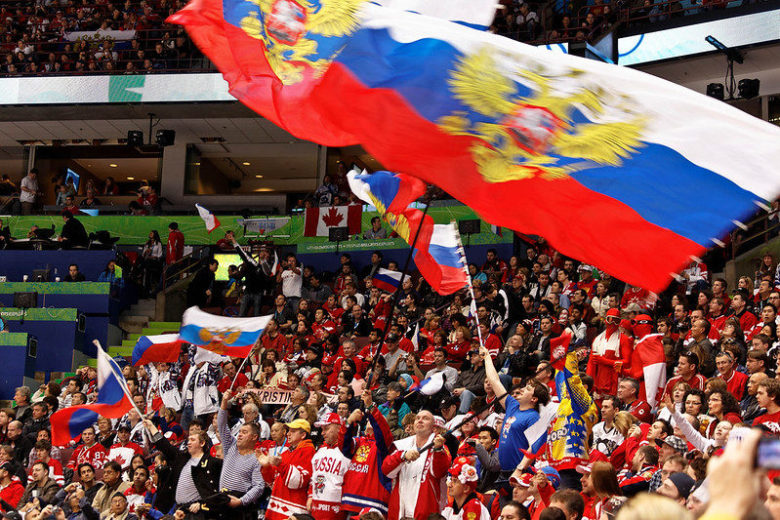
People waving national flags to cheer for their country (Photo: s.yume / Flickr [CC BY 2.0])
Fortunately, there has not yet been a case where nationalism fueled by the Olympics directly escalated into war. However, the possibility that it heightens interstate tensions cannot be denied. In fact, although not the Olympics, there are cases where rising nationalism around sporting events escalated into conflict or riots. In a 1969 FIFA World Cup qualifier between El Salvador and Honduras, the match became a trigger for a conflict dubbed the “Football War.” In a 2014 UEFA Euro qualifier, Serbia vs. Albania, spectators stormed the field and a riot ensnared players. There are many such cases where sports events became the spark for interstate strife, and it can be said that international sporting events carry the potential to trigger non-peaceful wars or incidents. The Olympics are, of course, included among them.
Conversely, preexisting conflicts and political confrontations have been brought into the Olympic Games. At the 1972 Munich Olympics, a Palestinian terrorist group broke into the athletes’ village and killed 11 Israeli athletes from a rival party in the conflict, resulting in a catastrophe. During the Cold War, at the 1980 Moscow Olympics, Western countries boycotted the Games in protest of the Soviet occupation of Afghanistan, and in 1984 at the Los Angeles Olympics, the Soviet Union and Eastern Bloc countries boycotted in return. The Olympics have been used in numerous such incidents.
As noted, in the ancient Olympics, at least during the Games, a truce was in effect and peace was guaranteed. In contrast, conflicts do not cease during the modern Olympics; moreover, the Games have even been canceled due to war five times. In light of these many examples, one cannot help but feel uneasy about calling the Olympics a “festival of peace.”
Of course, this does not mean the Olympics are entirely non-peaceful. At the 2018 PyeongChang Winter Olympics, South Korea and North Korea formed a joint team in women’s ice hockey and marched together at the opening ceremony—a move fresh in our memories. It is not an overstatement to say this was a step toward rapprochement triggered by the Olympics. However, since there was no further progress after the Games, it seems to have been short-lived. It is still insufficient to claim “peace.”
Some may argue that the very fact that athletes of diverse backgrounds gather to compete in the same sports is peaceful. If so, we need measures to prevent nationalism, such as forming joint teams across nationalities rather than competing by country. Abolishing flag-raising, national anthems, and country-by-country medal tables might also make it a bit more defensibly “peaceful.”
Olympic coverage that plays up “peace”
So far, we have examined the non-peaceful nature of the Olympics. Are these aspects reported by the Japanese media? For this article, we looked at pieces in the morning and evening editions of the Mainichi Shimbun from 2016 to 2020 that mentioned the relationship between “peace” and the “Olympics,” and examined their contents (※5). We found 156 such articles. Given the various non-peaceful aspects described above, you can see that this is not a small number. The graph below shows how the term “peace” was used in Olympic reporting and the proportion of each meaning (※6).
The most common category was articles treating “North Korean cooperation” as peaceful, accounting for 24.4% of the total. Specifically, pieces such as “We must make the PyeongChang Winter Olympics a turning point for improving inter-Korean relations and peace on the Korean Peninsula” (2018/1/11) (※7). All 38 articles pertained to the South-North joint team at the 2018 PyeongChang Olympics and were concentrated between 2016 and 2018.
The next most common was “world peace.” This may seem a vague category—and indeed it is. It encompasses uses where “peace” is employed as a nebulous concept rather than referring to a specific state or region. For example: “The International Olympic Committee (IOC) states in its charter and elsewhere that it promotes peace through sport, achieves gender equality, and considers the environment” (2019/12/31). In our count, this category accounted for 14.7% of the total, the second largest. However, while “North Korean cooperation,” the largest category, was concentrated in a specific period, articles in this category were scattered irrespective of time. This suggests that extending the period might make “world peace” the most common category.
Next, use of “peace” in the sense of “no war” accounted for 14.4%. This was often used to mean that the Olympics could be held because war had ended. In reality, wars and conflicts continue around the world today, but in many cases “the end of World War II = the end of war.”
The fourth most common was “no nuclear weapons,” at 8.0%. This wording was concentrated particularly around the Summer Games. One likely reason is that the anniversaries of the atomic bombings coincide with the Summer Olympics (in our period, the 2016 Rio de Janeiro Olympics and the Tokyo Olympics). Examples include “Use the Olympics, a festival of peace, to call for a ‘world without nuclear weapons’” (2020/1/7). There were also articles using “peace” to mean “no nuclear testing.”
Next came articles using “peace” to mean “no political interference,” and those referring to a state of “consideration for refugees,” each at 5.8%. Of the nine articles that fell under “consideration for refugees,” six were about the Refugee Olympic Team. This was followed by “no interstate confrontation,” at 5.1%.
Other uses included referring to a world without racism or sexism, without disasters such as earthquakes, without terrorism or incidents, and without doping. From 2019 to 2020 there were also uses to mean the subsiding of the novel coronavirus—equating “a world where COVID-19 has subsided” with “peace.” Furthermore, there were seven articles in which the word “peace” was used unrelated to context. For example: “Due to the spread of the novel coronavirus, the Tokyo Olympics, called a ‘festival of peace,’ were postponed” (2020/8/24)—pieces with no necessity to mention peace. And despite the non-peaceful origins of the flame, 14 articles referred to it as a “symbol of peace,” “flame of peace,” or “light of peace.”
As this shows, there were many instances where “peace” was used in ways that differ from its original meaning, or in very vague, non-specific ways such as “world peace.” It appears the image of “Olympics = peace” precedes and encourages the casual use of the word “peace.”
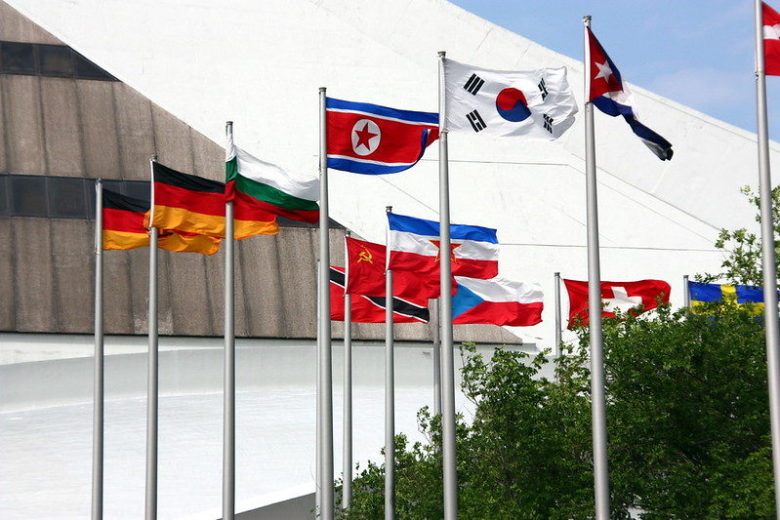
National flags lined up in front of the Olympic Stadium in Canada (Photo: Márcio Cabral de Moura / Flickr [CC BY-NC-ND 2.0])
Are the media reporting on the real Olympics?
Next, when the media link peace and the Olympics, how do they report it—what expressions do they use? Are there articles that question the emphasis on “peace,” or do they assert “Olympics = peace” without doubt? In this section, we classify and examine the expressions used in coverage.
First, not a single article in five years mentioned the non-peaceful aspects of the Olympics discussed in this piece. All articles affirmed the relationship between peace and the Olympics, but their expressions fell into three types (※8).
First is “assertion.” These are pieces that definitively state the peaceful nature of the Olympics, such as “The Olympics, a festival of peace” (2020/1/6) or “The purpose of the Olympics is to establish and maintain world peace” (2016/2/11). Next is “hearsay,” classifying pieces that use phrasing like “The Olympics, called a festival of peace” (2020/8/14). While not as forceful as “assertion,” one can still read the paper’s support for the Games’ peacefulness. The third type is “quotation/opinion,” reporting third-party statements regardless of the paper’s stance: remarks at press conferences or interviews, and opinions expressed in athlete-written columns, etc.
The most common was “assertion.” Of 156 articles, 86.5 used assertive expressions, accounting for 55% of the total. Next, 62.5 articles—40%—were “quotation/opinion.” Only seven articles, 5% of the total, fell under “hearsay.”
As this shows, the Mainichi Shimbun often reports that the Olympics are a festival of peace in assertive terms. This indicates the media harbor virtually no doubts about that peacefulness. The small number of neutral articles employing “hearsay” supports this trend. Why, then, was “quotation/opinion” the second largest? Although phrases like “festival of peace” or “symbol of peace” do not appear in the Olympic Charter, many people utter them. The media’s influence is no doubt in the background. People use expressions they have seen and heard in the media. Thus, the more the media write “assertive” pieces and spread the “common sense” that “Olympics = peace,” the more people will adopt and repeat it, increasing “quotation/opinion”—a likely correlation.
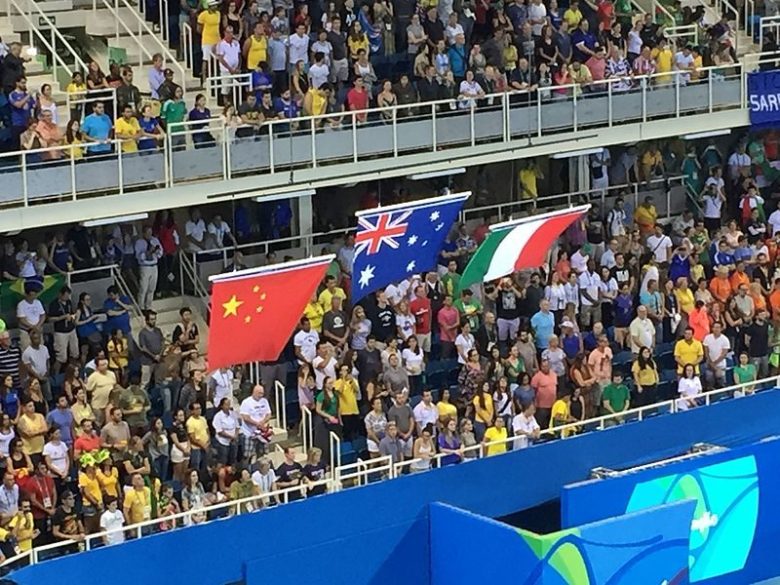
Raising of national flags (Photo: Sander van Ginkel / Wikimedia Commons [CC BY-SA 3.0])
The role the media should play in Olympic coverage
What is demanded of the media is neutral and objective reporting. Rather than emphasizing “Olympics = peace,” the media have a responsibility to view the Olympics from multiple perspectives and reflect their true nature.
However, two major barriers stand in the way. First, the media are heavily influenced by ethnocentrism. Whether or not to report accidents and incidents abroad is judged not by their severity or scale, but by whether our own nationals are involved. This tendency is particularly pronounced in sports reporting, which strongly focuses on, praises, and roots for domestic athletes. This style meets audience demand to know about their own country—but in meeting that demand, it creates further demand. Unless this dynamic changes, neutral and objective reporting is unlikely.
The second barrier is that the Olympics represent a major business opportunity for the media. Given the public’s high interest, the Olympics are a golden chance to increase viewership and readership, and demand for ad placements and commercials is extremely high. In other words, the Olympics are a prime revenue source for the media. As a result, many outlets are Olympic sponsors: Asahi Shimbun, Nihon Keizai Shimbun, Mainichi Shimbun, and Yomiuri Shimbun were “Official Partners” of the Tokyo 2020 Olympics, while Sankei Shimbun and Hokkaido Shimbun were “Official Supporters.” Needless to say, affiliated TV stations are under the same influence.
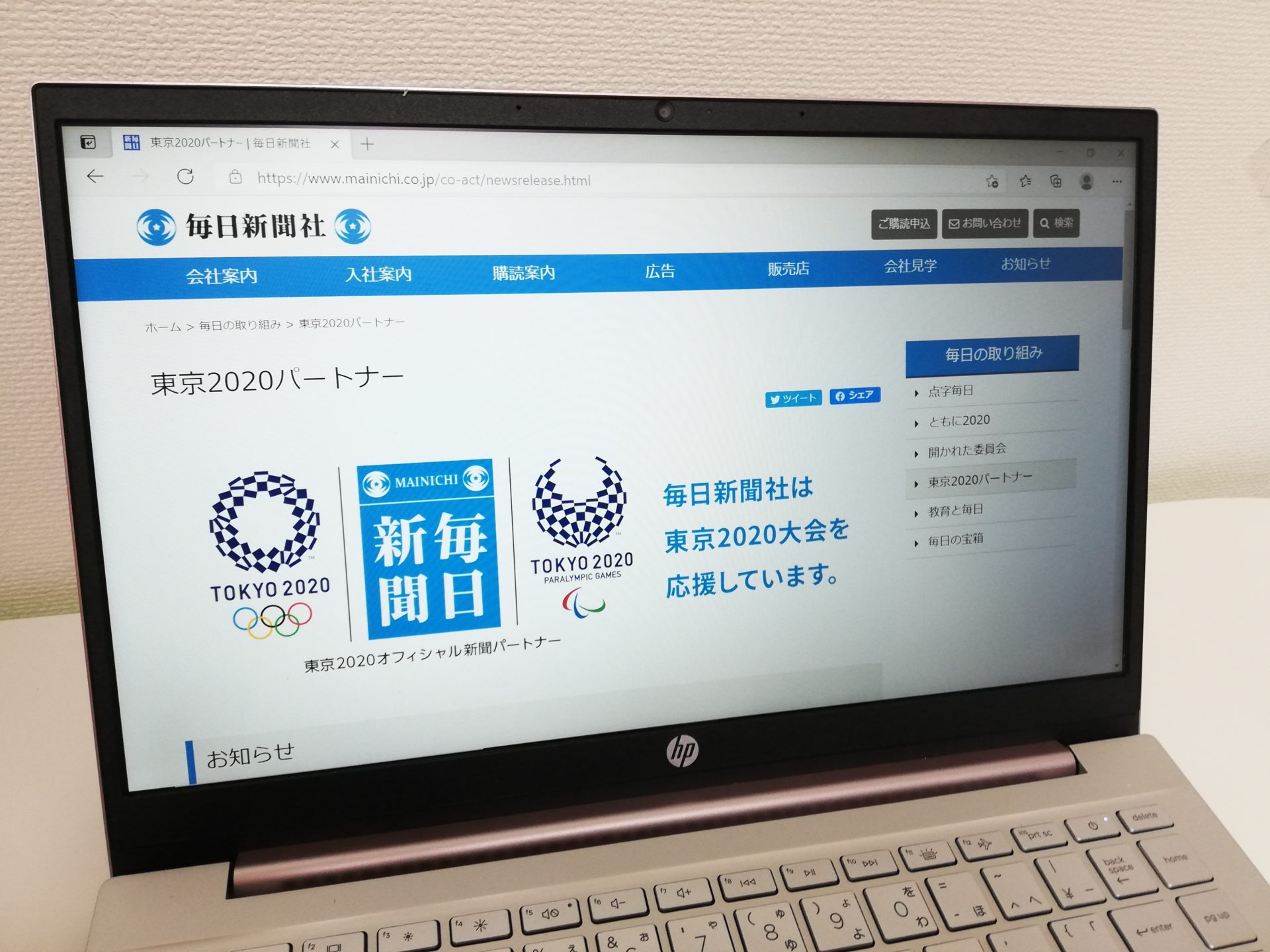
Mainichi Shimbun homepage (Photo: Kyoka Maeda)
For these reasons, the media do not write articles that objectively examine the Olympics or point out their non-peaceful aspects. Rather, they play the role of uncritically embracing and hyping them. No one points out the contradiction of news organizations—who should be neutral—serving as sponsors. We will not delve into whether media should be sponsors here, but it is easy to imagine that sponsorship inhibits neutral and objective reporting.
Reporting on the current state of the Olympics from multiple angles helps bring problems to light. At first glance, that may seem like spoiling the fun for those excited about the Games. But if we can identify future challenges, we may come to see what true peace is, what a peaceful world looks like. We intend to continue watching trends in Olympic coverage by the media.
※1 Peace scholar Johan Galtung argues that there are two types of peace. “Negative peace” is a state without any violence, while “positive peace” is the lasting continuation of a state with cooperation, equality, and dialogue. In this article, we define “peace” as the realization of both.
※2 In Japanese it is called “seika” (sacred flame), but in English and other languages it is called the Olympic Torch or Olympic Flame, without the connotation of “sacred.” (Torch: a handheld torch; Flame: flame.)
※3 Nationalism is an ideology that emphasizes promoting the unity, independence, and development of a nation or people, aiming to secure a distinctive superiority over other countries or communities. It is generally distinguished from patriotism, which means devoted love, support, and defense of one’s country. However, given the many similarities between the two, some argue that it is difficult to separate them.
※4 The Refugee Olympic Athletes (Refugee Olympic Team) are a mixed team of athletes from multiple regions who, as refugees, cannot compete for their home countries. The team was introduced at the 2016 Rio de Janeiro Olympics.
※5 We used the Mainichi Shimbun’s online database “Mainichi Shimbun Mai-Saku” to tally morning and evening editions published in Tokyo from January 1, 2016 to December 31, 2020. From articles whose headlines or texts contained the two keywords “Olympics” and “peace,” or “Gorin” (Olympics) and “peace,” we counted those whose full text was viewable and whose content was relevant to the peacefulness of the Olympics.
※6 To count each article equally, when two meanings of “peace” appeared in one article, we counted each as 0.5 of an article. For example, if an article used “peace” in the sense of both “North Korean cooperation” and “no war,” we counted “North Korean cooperation” as 0.5 and “no war” as 0.5. In this tally, no article contained more than two meanings of “peace.”
※7 The articles cited in this piece are as follows (in order of citation, all Mainichi Shimbun):
2018/1/11 (Tokyo morning edition) “President Moon of South Korea: ‘Comfort women agreement unacceptable’; framework unchanged”
2019/12/31 (Tokyo morning edition) “Q&A: Why SDGs at the Olympics? Promote the Games with sustainable development — Answer by Kazuhiro Tahara”
2016/8/6 (Tokyo morning edition) “Features: Today’s Star: Winds from Hiroshima — Third-generation A-bomb survivor sprinting for sub-10 seconds — Athletics: Ryota Yamagata (24)”
2020/8/24 (Tokyo morning edition) “Challenge the News Test: Level 2 this time — Although an Olympic Games had once been set to be held, which Games were not held due to the impact of war?”
2016/8/12 (Tokyo morning edition) “AMIGO: Festival of Diversity: Rio Olympics — Shooting — Georgia — Nino Salukvadze (47), Tsotne Machavariani (18)”
2020/2/15 (Tokyo morning edition) “Boxing: Women’s boxing — Fighting spirit in both research and competition — Kito aiming for the Olympics”
2020/8/14 (Tokyo morning edition) “Q&A: Why is the dove a symbol of peace? An anecdote from ‘Noah’s Ark’; Picasso helped cement it — Answer by Go Kumagai”
※8 As with the tally of “peace” meanings, when two expression types were used in a single article, we counted each as 0.5 of an article. In this tally, no article contained all three expression types.
Writer: Kyoka Maeda
Graphics: Kyoka Maeda



オリンピックに対して比較的ポジティブなイメージを持っていましたが、この記事でオリンピックの起源について知り、仕組みについて改めて考えたことで、そのイメージが変わりました。自分がいかに受動的に情報を得ていたのかに気付かされました。
オリンピックの成り立ちをこの記事で初めて知りました。全世界の様々な種目のトップアスリートが競い合い、讃えあう今のオリンピックを否定はしませんが、メディアや政府から見え隠れするナショナリズム的な要素には違和感を覚えます。
とても興味深く読んだ。近年は特にオリンピックが金儲け化しているところは納得だ。メディアの力とは、また意味とは、とても考えさせられる内容だった。オリンピックがまるでお祭りの如く各国で盛り上がるのは一見楽しくいいことのように思うが、例にもあったように戦争にも発展しかねない現実を知ると恐ろしくもある。積み上げた歴史を変えるのは簡単ではないだろうが、もしも国民の認識を変えることでオリンピックが良いように変化していくことができたなら素晴らしいと思う。そのためにもメディアの力は欠かせないと感じた。
古代オリンピックと現代オリンピックの違い、復活した経緯、またオリンピックが平和の象徴だとしたのはメディアの力が大きいなど、初めて知る話ばかりでした。オリンピックのことだけでなく(例えば今ならコロナ報道など)、人はいかにメディアに踊らされているか、身につまされる思いです。とても面白い記事でした。
確かにオリンピックを非平和的に報じているものを見たことがないし、私たちはメディアにオリンピックは平和的なものだと植え付けられているのかと驚きました。とても興味深い記事でした。
一般的には、言及しにくいはずのオリンピックの矛盾について詳細に分析されていて、最近開催国になったこともあり、正の側面しかみていないことに気付かされました。また、もともとのオリンピックの形から大きく変化はしているものの、現在も根本にあるのは競争、闘争というのには間違いはないのではないかと思いました。
逆に、オリンピックが「平和の祭典」と言える理由や、平和に寄与した例を知りたくなりました。
この記事を読んで、オリンピック=平和とするのには確かに違和感を覚えました。改めてメディアが真実を報じないことの罪深さみたいなものを感じましたし、メディアの本来の在り方を今一度考えるべきだと思いました。
オリンピックの起源は世界史の教科書によく載っていると思いますが、復活のきっかけは初めて知りました。そして、その復活によってオリンピックの意味合いが変わったことがとても印象的でした。オリンピックの開催期間中や開催地決定までの期間は、オリンピックに関する報道が増えると思うので、そういったオリンピックが注目されている時期に、オリンピックの歴史などこの記事に書かれているようなことも併せて報道してほしいと思いました。
記事中であったナショナルチームのように、国や人種に関係なく楽しめるような大会になるよう、スポーツが手段として活用されるようになればいいのかなと思います。
凄く分かりやすくて読みやすい記事でした。いろんな例が詳細に書かれており、今まで見えていなかったオリンピックの側面が垣間見れて面白かったです。いろんな感動を生むオリンピックだけど、一歩間違えれば戦いを生んでしまう危険性をはらんでいるのですね。
これからオリンピックを見る目が少し変わりそうです。
大手メディアが無批判に「平和の祭典」を増幅しているのはそうだと思う。
ただ記事中に「平和の祭典である」ことの検証が無いのは片手落ち。
深淵を覗く時、深淵もまた。
ご指摘ありがとうございます。確かに、本記事ではオリンピックの平和的側面については触れていません。
ただGNVでは「報道されない世界」に関する情報・解説を提供しています。日本では報道されていない、もしくは報道量が極めて少ない出来事、現象を中心に情報を発信しています。「オリンピックが平和の祭典である」ということは、記事中にもある通り多くの報道がされているため、本記事では深くは触れていません。既にある報道と見比べていただき、オリンピックの良い面、悪い面を少しでも知っていただけましたら幸いです。お読みいただきありがとうございました。
とても興味深い記事だと思いました。自分がいかにメディアが演出する「オリンピック」という言葉が生み出すイメージをそのままに受け取り、その批判的側面を見ていないかを痛感しました。「平和」という言葉だけが先走りして、実際の問題については目が行っていないどころか、オリンピック自体がナショナリズムを引き起こしている側面もあり、だからこそ今オリンピックのあり方自体を問い直さなければならないと感じました。ありがとうございます。
nnal4y