
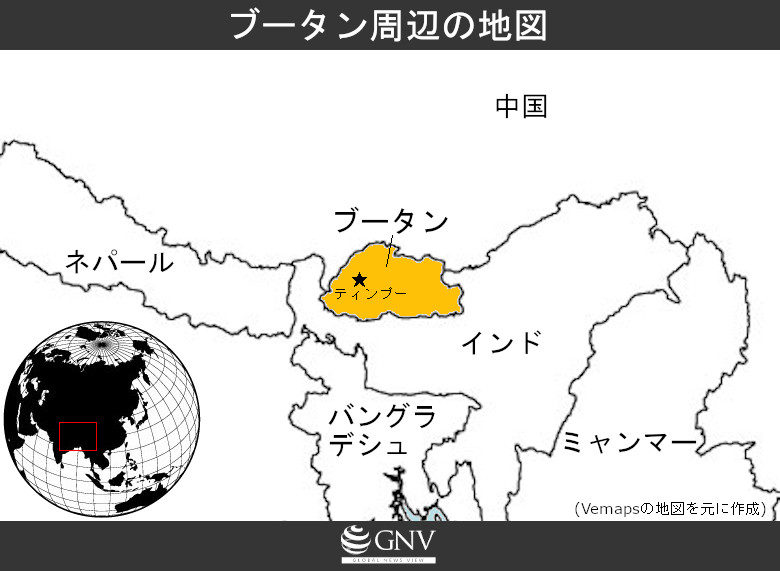
Known as the “Land of Happiness” and the “last Shangri-La,” Bhutan was the first country in the world to adopt Gross National Happiness (Gross National Happiness:GNH) as a benchmark for national development, steadfastly pursuing a unique path that emphasizes environmental protection alongside industrialization and economic growth. As a policy response to climate change, its achievements are reflected in the numbers. Bhutan is one of only two carbon-neutral countries in the world (※1), and in 2018 it absorbed roughly three times as much carbon dioxide as it emitted domestically.
With urgent action needed—for example, it has been pointed out that to keep the rise in global average temperature within 1.5℃, greenhouse gas emissions must fall by 7.6% every year through 2030—Bhutan’s policies that have achieved carbon neutrality merit attention. However, Bhutan’s environmental policies are not going smoothly across the board. This article explains Bhutan’s environmental policies and the challenges they face.
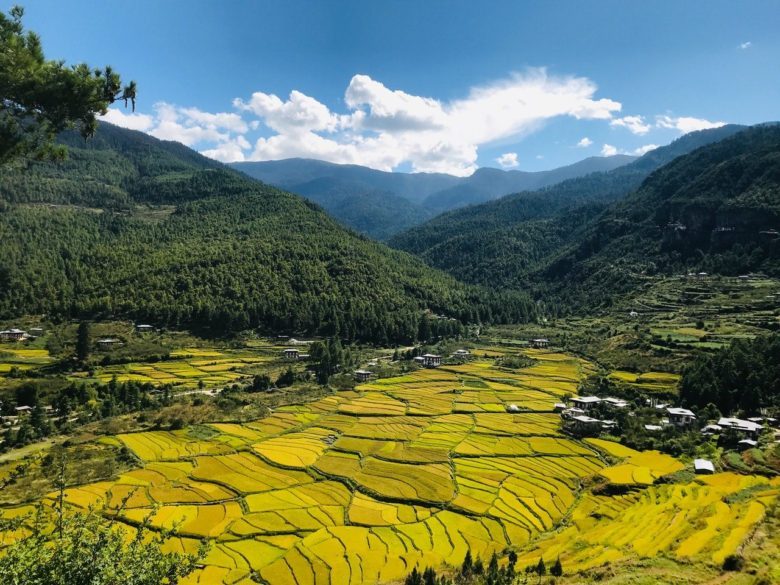
Terraced rice fields spreading across a valley (Photo: Ram Iyengar / Pexels)
目次
Background to Bhutan’s unique policies
First, why does Bhutan pursue environmental protection policies that stand out globally? One reason lies in the concept of Gross National Happiness that underpins Bhutan’s policy-making. Gross National Happiness is a national philosophy that places importance on the balance between material prosperity and spiritual and cultural well-being. It rests on four pillars (※2): ① Good Governance ② Sustainable and Equitable Socio-Economic Development ③ Preservation & Promotion of Culture ④ Environmental Conservation. A well-known theory holds that the concept was coined on the spur of the moment by the then king during an interview abroad in 1979 as something more important than Gross Domestic Product (GDP), but its origins are the subject of various interpretations. In fact, 1996 was the first time GNH was referenced in a government publication, and it has also been suggested that from around 2000 it was vigorously introduced to strengthen social cohesion. In Bhutan’s constitution enacted in 2008, the obligation to put in place systems to secure GNH was codified, and it has functioned as a guiding principle of state governance to this day.
Moreover, the fact that Bhutan is a Buddhist state (※3) also reinforces the emphasis on environmental protection. In Buddhism, humans and the environment are always one; the environment is part of the spiritual world that requires protection, and respect for the environment and living beings is indispensable for national development. These Buddhist values are reflected in GNH. It can be said that Bhutanese people’s Buddhist-based view of the natural environment has led to many environmental protection initiatives.
Furthermore, Bhutan’s strong sense of urgency regarding climate change—due to its high vulnerability—also helps make it a leader in environmental protection. In addition to its mountainous geography, Bhutan’s largely agrarian way of life is easily constrained by natural conditions, and it has borne the brunt of climate change impacts such as poor harvests, flash floods and flooding caused by melting glaciers, ecosystem collapse, and damage to hydropower. Because temperatures tend to rise more in mountainous regions due to climate change, there are also concerns about higher incidence of malaria and dengue fever, among other issues—meaning the effects of climate change pose many obstacles to life in Bhutan.
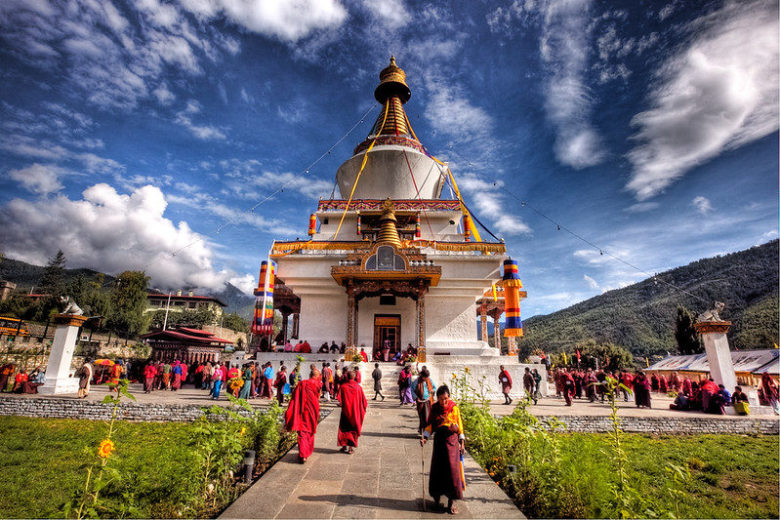
A stupa in the capital, Thimphu (Photo: Gelay Jamtsho/Flickr [CC BY-NC-SA 2.0])
Bhutan’s environmental policies
To protect its natural environment while advancing development in a sustainable way, Bhutan has introduced a range of policies. A major reason it can absorb far more carbon dioxide than it emits is that forests cover over 70% of the country. Blessed with natural environments and a large population-to-forest area ratio, it has been able to achieve carbon neutrality. According to one projection, Bhutan’s domestic emissions could nearly double by 2040, but if the current level of forest cover can be maintained, carbon neutrality can be sustained. It is thought that Bhutan’s steep mountain slopes made it difficult to build forest roads—hindering forest development—and that the lack of industrialization kept domestic demand for timber low, which in turn helped preserve vast forests.
However, Bhutan’s ability to maintain extensive forest cover is not merely a matter of lacking the capacity or will to develop. Bhutan is the only country in the world that protects forests in its constitution, mandating that more than 60% of its land remain under forest cover. Currently, the Ministry of Agriculture and Forests’ Department of Forests and Park Services is in charge of forest protection administration, and the government manages forests comprehensively—from establishing and monitoring protected areas to afforestation, cleanups, and resource management such as logging. The constitution contains an entire article on environmental protection, and it states, among other things, that contributing to the protection of the natural environment and the conservation of biodiversity is a fundamental duty of every citizen—showing a commitment to environmental protection. Based on this constitution, Bhutan has introduced policies such as banning plastic bags, prohibiting the export of timber, converting to organic agriculture, taxing tourists around USD 200 per person per day for environmental protection, and aiming for zero waste by 2030.
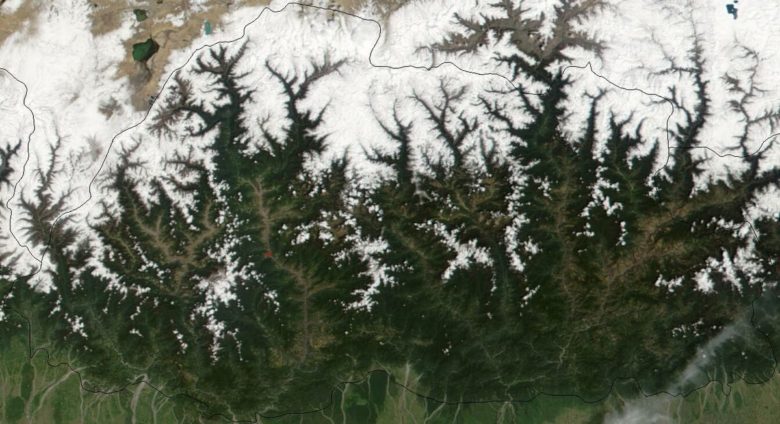
Satellite image of Bhutan (Photo: Jacques Descloitres, MODIS Land Rapid Response Team, NASA/GSFC/Wikimedia Commons [public domain])
Bhutan is also proactive in energy policies that curb greenhouse gas emissions. To realize a sustainable society, the development and promotion of renewable energy have progressed. Hydropower holds the largest share in Bhutan, and looking across the year, generation from hydropower far exceeds domestic demand. Other renewables such as solar and wind are still at an early stage, but they are prioritized to diversify energy sources and cope with rising demand. For example, solar power has helped achieve sustainable electricity access by providing solar home systems (※4) to rural areas without transmission infrastructure. In recent years, rapid electrification has spurred a shift in energy consumption from firewood and briquettes to electricity, and by 2019 electricity accounted for about one-third of energy demand—most of it covered by hydropower. Bhutan’s policy is to continue promoting hydropower and other renewables going forward.
Challenge 1: Economic dependence on India
While Bhutan’s policies to protect the natural environment and pursue sustainable development may appear unprecedented and innovative, as noted at the outset, they face many problems.
One issue is an economic structure dependent on neighboring India through hydropower. Trade with India accounts for 80–90% of Bhutan’s international trade, and the economy is supported by exporting hydropower-generated electricity to India. In 2018, 13% of Bhutan’s GDP and 23% of total government revenue came from hydropower income. If all currently planned hydropower projects are completed smoothly, revenues from hydropower are projected to account for more than half of GDP.
Although the relationship—where Bhutan can generate excess electricity beyond domestic demand at peak times and India suffers energy shortages—appears fair and complementary, that is not necessarily the case. Most of the dozen-plus hydropower projects in Bhutan since 1974 have been funded by Indian grants and loans, but for the loan portion, as of 2018 Bhutan carried about USD 2.175 billion in hydropower-related debt, and the amount is increasing. In recent years, India has shown a tendency to shift from grant aid to commercial lending.
In 2009, India provided new loans for 10 hydropower projects. However, with hydropower itself in a critical situation and maintenance costs rising (see next paragraph), and long-term profitability uncertain, there are several concerns: that profits generated by these projects will ultimately go to debt repayment and not benefit the domestic economy; that the use of Indian workers and construction by Indian companies will limit domestic job creation; and that delays in completing some projects will upend plans by preventing anticipated revenues from being realized.
Although Bhutan’s annual generation can adequately cover domestic demand, generation is concentrated in the summer when river flows are high. In winter, when flows are lower and generation drops, domestic power cannot meet demand, and expensive electricity must be imported from India. Moreover, Bhutan currently relies on India for the import of almost all consumer and capital goods, including petroleum, and this trade imbalance with India cannot be dismissed as a factor stagnating Bhutan’s economy.
Challenge 2: Climate change and the sustainability of hydropower
Hydropower itself stands at a crossroads. One reason is climate change. Because most of Bhutan’s hydropower is run-of-river—using river flows without damming them—generation is highly sensitive to water volume. However, in Bhutan, glaciers upstream are melting due to climate change, and in the future the melting portions may disappear, reducing water volume. In fact, Bhutan has lost more than 20% of its glaciers over the 30 years since 1980, and in the coming decades river flows could decline significantly, with a possibility that hydropower facilities will no longer be able to operate.
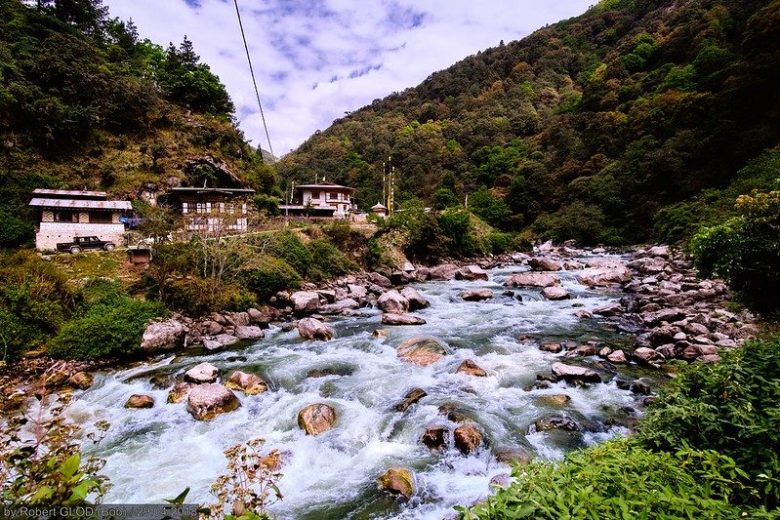
The Mangde Chhu, a tributary of Bhutan’s largest river (Photo: Robert GLOD/Flickr [CC BY-NC-ND 2.0])
Floods caused by glacial melt and extreme weather also carry large amounts of debris and sediment that damage hydropower facilities. Stopping a single turbine at peak can mean a loss of 1 day of USD 83,000, and the need for frequent repairs is a heavy economic burden.
There is also the problem that hydropower facilities themselves damage the natural environment. The dams currently being planned adopt a storage type rather than the run-of-river method mentioned above; while storage can secure water volume year-round and increase generation, it requires large reservoirs. Concerns include depriving rare species of their habitats and clogging waterways by dumping large amounts of silt into rivers, making it impossible to secure domestic water supplies in some areas. In addition, because dams for hydropower are sited upstream, sediment that would have flowed downstream accumulates upstream, with potential for lowering riverbeds downstream, accelerating coastal erosion, and causing nutrient shortages that affect downstream ecosystems.
Challenge 3: Rising energy consumption with modernization
Energy consumption presents challenges as well. With a history of long isolation—Bhutan only allowed the internet and television in 1999—the country has raised its standard of living rapidly in recent years. The electricity access rate rose from 61% in 2006 to 100% in 2016. As a result, domestic power consumption has increased and electricity demand is rising.
In recent years, energy consumption has surged especially in the industrial and transport sectors, and a car boom has led to an increase in car purchases. Consequently, imports of fossil fuels—mainly from India—have become a major economic burden and are increasing carbon dioxide emissions. The Bhutanese government has launched a project to promote electric vehicles, but EVs are not necessarily always better for the environment, and the country continues to struggle to balance the natural environment, the economy, and aspirations for a modern society.
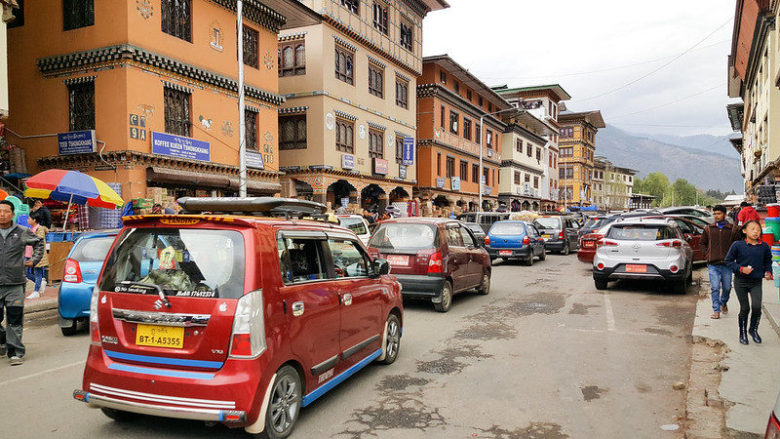
A road in the capital, Thimphu (Photo: taver/Flickr [CC BY-NC-ND 2.0])
Conclusion
As we have seen, while Bhutan proclaims carbon neutrality and has introduced groundbreaking policies, it faces many challenges. Notably, Bhutan’s challenges are not confined to what can be solved domestically. In effect, the country that absorbs the most carbon dioxide and is energetically engaged in environmental protection is, ironically, also strongly affected by climate change. One could see here the structure of “climate apartheid.” Bhutan has declared that it will keep its carbon dioxide emissions below its absorption into the future, and while shouldering the financial burden of implementing these environmental policies, it is seeking understanding and “support” from wealthy countries that have consumed vast resources and emitted large quantities of greenhouse gases—causing climate change—in part to compensate for economic losses incurred.
The balance between development and environmental protection is now an issue for every country. Climate change knows no borders, and the efforts of a single country cannot stop global warming. Will Bhutan serve as a model in confronting climate change and will the world move in step on climate action? Or will Bhutan’s efforts be drowned out by other countries and the planet warm even faster? We should keep a close eye on Bhutan’s future—it is not someone else’s problem.
※1: Carbon neutrality (Carbon Neutral) refers to a state in which the amount of carbon dioxide emitted by a given production or activity (for a country, all national activities) equals the amount absorbed. Currently, only two countries—Bhutan and the Republic of Suriname—have achieved carbon neutrality.
※2: The four pillars of Gross National Happiness are written in English as ①Good Governance ②Sustainable and Equitable Socio-Economic Development ③Preservation & Promotion Of Culture ④Environmental Conservation on the website. (Numbers added by the author)
※3 : Bhutan recognizes Buddhism as the nation’s “spiritual heritage” and as a special religion, and about 75% of the population is Buddhist. At the same time, freedom of religion is recognized, and there are people who practice other religions such as Hinduism and Christianity in the country.
※4: A solar home system is a small, household solar power generation system used in rural areas without electricity supply. While it cannot produce large amounts of electricity, it can power household appliances such as lights, mobile phones, and TV.
Writer: Yumi Ariyoshi
Graphics: Yumi Ariyoshi










ブータンが「幸せな国」というイメージは以前からありましたが、その国民幸福度を測る基準の中に持続可能かつ公平な社会経済開発が含まれていることは知りませんでした。環境保護に力を入れている国が気候変動の影響を大きく受けているという皮肉な状況が改善されていくように、世界全体で協力していかなければならないなと改めて思いました。
ブータンの環境保護はこれほど進展してきたのが知らなかったです。ほかの国もぜひ習ってほしいです。
テレビが導入されたことで、消費が今後促されるのか、そうならないように国営放送で一本化されているのかが気になりました。