
In Southeast Asian countries, the number of internet users increased by 100 million over the four years from 2015 to 2019, reaching 360 million. This does not only mean a surge in people who can obtain information and interact online with family, friends, and colleagues. There has also been a rapid increase in people purchasing a wide range of goods and services via the internet—buying products, watching movies, booking hotels, and hailing taxis. Southeast Asia’s digital economy has continued to grow at a remarkable pace and is greatly supporting economic development. This article looks at the state of the digital economy in Southeast Asia.
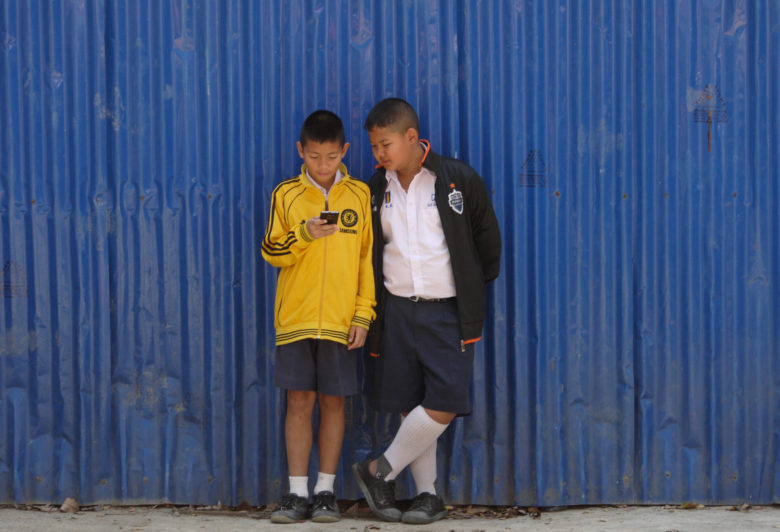
Students using smartphones. As of 2013, Thailand had about 90 million mobile phone subscribers, equivalent to 136% of the population. (Photo: Asian Development Bank / Flickr [CC BY-NC-ND 2.0])
目次
The internet environment in Southeast Asia
First, let’s look at the current state of the internet environment, which is indispensable for the digital economy. To begin with, how widespread has internet use become in Southeast Asia in recent years? Let’s look at each country’s internet penetration rate.
In Brunei, Singapore, Thailand, and Malaysia, internet penetration already exceeds 80%. Compared with these countries, Vietnam, the Philippines, and Indonesia have lower rates, but they are still above 60%. Meanwhile, Laos, Myanmar, and Timor-Leste lag behind on this point, at around 40%. However, as infrastructure such as 4G networks (※1) continues to be developed, countries that currently have few internet users are expected to see large increases.

Loading…
The size of the digital economy in Southeast Asia
Now, we would like to introduce the current state of the digital economy created by the spread of the internet. The size of the digital economy in Southeast Asia was expected to exceed US$100 billion in 2019 (※2). And it is projected to reach US$300 billion by 2025.
There are various views on how to define the digital economy, but the United Nations Conference on Trade and Development (UNCTAD) defines it as “an economy that uses information and communications technology (ICT) in the production and distribution of goods and services.” Southeast Asia’s digital economy can be divided mainly into four sectors: e-commerce (EC sites for buying and selling goods), online travel (hotel and air ticket bookings), digital media (games, video, music, etc.), and ride-hailing. In addition, virtual currencies (※3) such as Bitcoin are a byproduct of economic digitalization, linking these transactions.
Loading…
Among these, in the past few years e-commerce has become embedded in the daily lives of tens of millions in Southeast Asia and has become indispensable. Almost all everyday shopping has become even easier thanks to the internet. For example, by consulting reviews, you can quickly decide which product to choose, and improvements in logistics networks have made same-day delivery possible, enabling the purchase of daily necessities and fresh food.
Similarly, like e-commerce, the use of ride-hailing has permeated people’s daily lives. Before ride-hailing apps appeared, the choices were limited to lining up at a taxi stand or flagging one down on the street. Thanks to smartphone-based ride-hailing apps, however, it became easy to summon a taxi anytime, anywhere, and they quickly became popular. The main players in ride-hailing are Grab (founded in Singapore) and Gojek (founded in Indonesia). Since their founding, these apps have become “super apps,” expanding into platforms that bundle multiple services that support consumers’ lives—not only ride-hailing but also food delivery, parcel delivery, and finance. By 2025, the size of food delivery is expected to equal that of ride-hailing. Grab, in particular, has expanded across borders into Singapore, Cambodia, Indonesia, Malaysia, Myanmar, the Philippines, Thailand, and Vietnam—that is, 8 of the 11 countries in Southeast Asia.

A Gojek ride-hailing driver on the road in Jakarta, the capital of Indonesia (Photo: Andika Wardana/Pexels [CC 0])
Let’s look at conditions within each country. Indonesia, where the pace of expansion of the digital economy is the most striking, has drawn global attention. With the world’s fourth-largest population, it is said to have the greatest market potential. Indonesia has produced many prominent startups, including Gojek in ride-hailing, Tokopedia in e-commerce, and Traveloka in travel bookings. The Indonesian government has set a goal of becoming a digital-economy leader and has introduced policies such as the “Indonesia’s E-Commerce Road Map.” Under this policy, by providing funding to e-commerce ventures, the government aims to create 1,000 technology startups by 2020. With the government driving digitalization, more giant tech companies are expected to emerge in the future—so-called “unicorns,” unlisted companies valued at over US$1 billion.
Within the region, the only country whose growth rate rivals Indonesia’s is Vietnam. Boosted by e-commerce, since 2015 Vietnam’s digital economy has grown at an annual rate of 38%. By contrast, Singapore, Malaysia, the Philippines, and Thailand are more digitally advanced than Indonesia and Vietnam, so their future growth rates are expected to be relatively lower.
The “digital divide”
However, access to the internet is essential to participate in these economic activities. In other words, those who cannot use ICT such as the internet due to shortcomings in communications infrastructure, etc., risk being excluded from digital economic activity. The gap created between those who can use ICT and those who cannot is called the digital divide.
Such a digital divide can be seen among Southeast Asian countries. As noted above, there is a 64% gap between Brunei, with the highest internet penetration (95.3%), and Timor-Leste, with the lowest (31.3%). Similar to Timor-Leste, the three countries of Laos, Myanmar, and Cambodia—with low internet penetration—cannot catch up with others in the region’s digital economy largely because they are lagging in economic development and have deficiencies in basic communications infrastructure.
Myanmar has other circumstances as well. After a long history under a military regime, access to the internet was strictly restricted, and possession of mobile phones was not permitted until 2011. Affected by this political system, infrastructure development has been delayed. Because of such digital divides, the stages of digital economic development differ greatly by country. This is expected to widen disparities between nations and make them more severe. A phone shop in Nyaung Shwe, Myanmar, selling low-priced smartphones from China (Photo: Asian Development Bank/Flickr [CC BY-NC-ND 2.0])[/caption]
Similarly, a digital divide exists within countries. In some countries, while digital services have spread rapidly, infrastructure has not been fully extended, and the poor, who cannot afford data charges, have limited access to the internet. In particular, the digital divide between rich and poor and between urban and rural areas is pronounced in countries where the digital economy is advanced.
In six countries—Singapore, Malaysia, Indonesia, Vietnam, the Philippines, and Thailand—although the populations living in the largest cities with the highest internet penetration make up only 15% of the six countries’ combined population, they account for 52% of the digital economy’s gross merchandise value (GMV) (※4).
Challenges facing the digital economy
Widening disparities are not the only challenge the digital economy faces. In recent years, along with the spread of the internet, illegal economic activities conducted online have increased substantially. One example is fraud perpetrated over the internet. One method of internet fraud is fake e-commerce sites. Imitating online shopping, fake e-commerce sites often steal consumers’ personal information and money. In addition, various criminal organizations use the internet to commit illegal economic activities such as child pornography, human trafficking, and drug sales. There are also frequent cyberattacks using malicious software (malware) to steal important information, including confidential data and trade secrets, or to extort money. In Southeast Asia, where cybersecurity measures are still underdeveloped, unless cybercrime is properly policed, the internet—which ought to enhance convenience in daily life—will continue to be a hotbed of crime.
In step with global trends, major confrontations between high-tech companies and governments are not uncommon in Southeast Asia. In recent years, Google, the giant search engine company, has been criticized in several countries, including Indonesia, on suspicion of tax evasion or avoidance. Such high-tech firms base themselves in low-tax countries like Singapore or in tax havens and keep much of their profits there, failing to bear sufficient tax burdens in the countries where they actually conduct economic activity.

A Grab ride-hailing taxi in Chiang Mai, Thailand (Photo: Jon Russell/Flickr [CC BY 2.0])
In addition, monopolization by high-tech companies is also viewed as a problem. Price increases caused by monopolies are disadvantageous to consumers. For example, in 2018 Uber Technologies, a major U.S. ride-hailing company, sold its Southeast Asian business to Grab and the two integrated their operations. In Singapore, that integration was deemed a violation of antitrust law, and a fine of US$9.5 million was imposed. Similarly, Malaysia’s competition commission found that Grab had violated competition law and imposed a fine of about US$20 million. In Thailand, too, in order to promote competition by domestic companies, the government plans to include e-commerce operators as taxable entities. Such strengthened regulation of high-tech companies is being seen across Southeast Asia.
Future prospects
How is Southeast Asia’s digital economy likely to evolve from here? First, growth of the digital economy is expected to spread into financial fields such as investment, insurance, and lending. The total value of payments for using these services is expected to exceed US$1 trillion by 2025, making up about half of all transaction value in Southeast Asia.
Efforts are also being devoted to regional economic integration within the digital economy. At the 2019 Association of Southeast Asian Nations (ASEAN) summit, national leaders announced a “roadmap for human capital development and innovation” aimed at creating common rules in the digital economy field. Spurred by the rapid growth of the digital economy, ASEAN—which has long sought to realize an economic community—may be able to take a step closer to achieving that goal.
The global outbreak of the novel coronavirus (COVID-19) has dealt a major blow to the world economy. However, with social distancing now required, demand for the digital economy is rising even further. As a result, the digital economy is growing more rapidly than the economy as a whole.
Looking ahead, expectations are mounting for how advances in the digital economy will unfold in Southeast Asia. While the development of the digital economy enriches society, in practical terms there is a “digital divide” in which whether one has access to the internet can widen income disparities. In addition, various challenges remain, including illegal economic activities carried out over the internet, tax evasion and avoidance by high-tech companies, and monopolies by such firms. Against a backdrop of improved internet environments and the spread of inexpensive smartphones, as the digital economy progresses, it is hoped that development will proceed in a way that leaves no one behind and returns benefits to society as a whole.
※1 4G is an abbreviation for 4th Generation and refers to fourth-generation wireless communication systems.
※2 The report “e-Conomy SEA 2019” covers six countries: Singapore, Malaysia, Indonesia, Vietnam, the Philippines, and Thailand.
※3 Virtual currency is a currency that can be exchanged over the internet. It exists only as “digital data” and is not issued by any particular country.
※4 Gross merchandise value refers to the total sales value of goods and services purchased by consumers in a market. GMV stands for gross merchandise value.
Writer: Yow Shuning
Graphics: Yow Shuning

















グラブみたいなサービスがあまり普及してない日本では、そういうサービスが日常にある感じがあんまり理解できてないんで、そういう生活を体験してみたいです!
ただ、インターネットありきの生活が進めば進むほど、デジタルディバイドによる生活の不都合が進みそうなのが怖いなと思いました…
これほどまでにデジタル経済が東南アジアで発展しているとは知りませんでした。デジタルディバイドなどの課題も含めて今後の展開に注目したいと思いました。
日本でもやはり情報格差は広がっていると思う。世代間でも、スマホやパソコンに慣れている若者と、デバイスに対して苦手意識の強い老人との間に格差があるし、同じ世代でも、富裕層と貧困層では、電子機器の普及率や、電子機器に関する・電子機器を利用した知識の格差が多い。この格差を埋めるのはかなり難しいと思います。東南アジアでも、経済格差がそのままデジタルデバイドに繋がっていて、後進国が追いつくのは不可能に近いんじゃないかなと思いました。既に進んでいる国は更に進んでいくから…
デジタル格差は東南アジアだけでなく特に経済力に乏しい地域を中心に世界全体で起きている問題なのではないかと感じている。都市と農村の格差も激しいと思われるが完全な整備は採算もとれないというジレンマもあるんだろうなあ。
国家間でインターネットの普及率がかなり違ってくることに驚きました。インターネットが普及し便利な面もある一方でデジタルディバイドなどの問題は考えていかないといけないと思いました。