
Climate change threatens people’s lives. Its threat grows by the day, and climate change is now even referred to as a “climate crisis.” We must address this global issue that will continue for decades to come. So, in the face of such a problem, what role should the media play?
In recent years, as a better way of reporting, “solutions journalism (Solutions Journalism)” has been proposed—coverage that focuses not only on the social problem itself but also takes a forward-looking approach to the remedies, solutions, and responses to the problem, evaluating and scrutinizing them. Media outlets around the world are increasingly incorporating this approach into their reporting on various social issues, but are Japanese media managing to report with a focus on responses to social problems? In particular, what kind of reporting is being done on climate change, a global issue? This article explains and analyzes, from a solutions journalism perspective, the importance of the media reporting on solutions to social problems and the coverage of climate change issues in Japan.
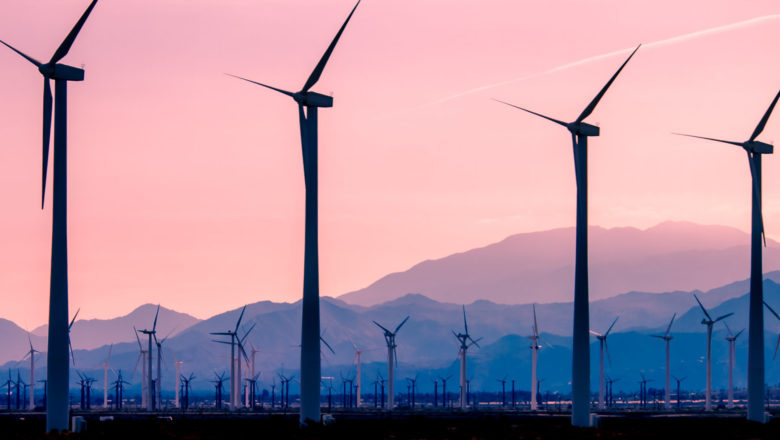
San Gorgonio Pass Wind Farm in California, USA (Photo: Ian D. Keating / Flickr [CC BY 2.0])

目次
What is solutions journalism?
The media is expected to play many roles, such as conveying events in society and monitoring those in power. However, whether it is simply reporting events dispassionately or exposing wrongdoing and corruption by those in power, such coverage alone does not necessarily lead to substantive solutions. Governments, businesses, and civil society consider and introduce various responses to the problems facing society and the world—but are these responses appropriate? Sufficient? Effective? Do they have side effects? In recent years, it has been proposed that questioning and evaluating responses to social problems is also an important role for the media. In other words, the role increasingly required of the media is to evaluate the solutions currently being considered for social problems and to present them to society—this is “solutions journalism.”
The nonprofit organization (NPO) advocating solutions journalism, the Solutions Journalism Network (The Solutions Journalism Network), defines it as “rigorous and compelling reporting about responses to social problems,” encouraging media outlets to critically and accurately investigate, analyze, and explain the actions people are taking toward solutions. To that end, the same NPO presents the four principles of desirable solutions journalism: ① “Report deeply on the response to a problem and include meaningful information about how that response works,” ② “Focus on evidence of effectiveness rather than claims about intentions or good will,” ③ “Discuss the limitations of the approach,” and ④ “Offer useful insights.” These are based on the idea that reporting from a perspective that views problems and solutions as a whole is important.
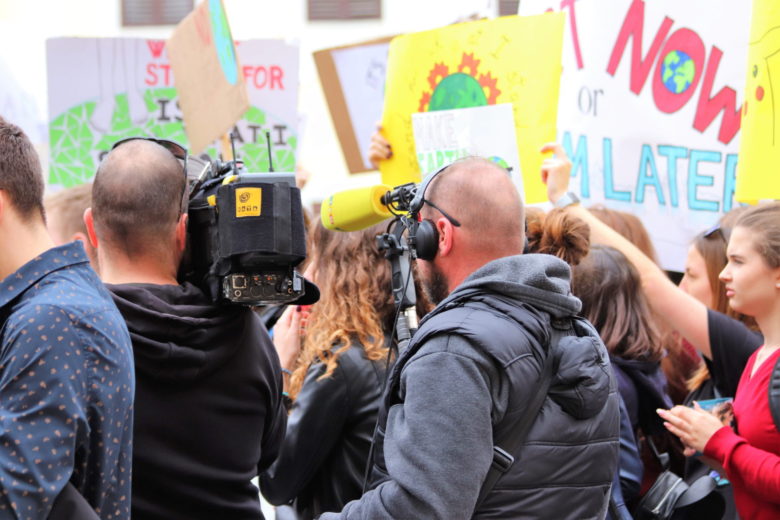
Journalists covering a “Fridays For Future” school strike demonstration attended by young people (Photo: pxfuel [CC0 1.0])
Why, then, is solutions journalism needed? The same NPO summarizes the necessity of solutions journalism in 10 reasons (※1). A common element among these is the purpose of enabling citizens to understand society holistically and, through that, achieving positive social change. Reporting aligned with this purpose not only scrutinizes and holds to account those who propose and implement responses but also leads to action by those who receive information from the media. Even if citizens are told only about the current problems, they may not know what actions to take. If the media can present solutions while showing data, recipients can express support for those solutions and move to act themselves. In this way, as a society, we can develop effective solutions to the problems we face.
From this perspective, solutions journalism is a highly effective means for solving climate change. Focusing on “how critical” the climate crisis is remains extremely important, and acting as a watchdog over governments and corporations that continue harmful behavior or refuse to introduce solutions is also an essential role of the media. However, for recipients of information, being told about a crisis does not easily translate into action. Moreover, if the media continues for years to report only that it is a “crisis,” readers’ and viewers’ interest will wane. Terms such as “renewable energy” and “recycling” are sometimes mentioned, but without sufficient information, it is very difficult for information recipients to evaluate how effective these responses actually are.

An electric vehicle presented at the European Parliament’s Science and Technology Options Assessment (STOA) in 2010 (Photo: European Parliament/Flickr [CC BY-NC-ND 2.0])
Fortunately, many policies and inventions that contribute to improvements are being announced based on investigation and research, so media should be able to evaluate solutions and improvements in a method grounded in quantitative evidence and provide them to audiences. If the media can report with an awareness of solutions journalism, as mentioned above, it could help reform the actions of citizens, companies, and governments to move society in a better direction. Therefore, solutions journalism can be said to be an important perspective in the role of the media.
Analysis of the volume of reporting on climate change
So far, we have discussed the meaning and necessity of solutions journalism. To what extent, then, is a solutions-journalism approach being adopted in Japanese media coverage of climate change? This time, we tallied how many climate change–related articles appeared in the morning and evening editions of the Mainichi Shimbun over the one-year period from April 2019 to March 2020, and analyzed their content from the perspective of solutions journalism.
Before delving into the content, we analyzed how climate-change reporting was carried out over this one year. As a result, there were 346 articles that included the keyword “climate change” in the headline or body; of these, 153 articles focused primarily on the issue of climate change (※1). On average, that amounts to about 13 articles per month. Comparing the number of articles by month, the most was in December 2019 with 41 articles—more than twice the amount in the second-highest month. Conversely, the fewest was July 2019 with only 1 article, followed by April 2019 (2 articles) and March 2020 (3 articles). These results show that the volume of reporting on climate change fluctuates greatly, and in months with little coverage, it was almost not reported at all for a whole month. Given the overall volume of reporting and the reality that the threat of climate change is steadily increasing, this seems insufficient.

Loading…
Why did this happen? Looking at December 2019, which had an exceptionally high number of reports compared with other months, the 25th Conference of the Parties to the UN Framework Convention on Climate Change (COP25) (December 2019) was held, and many articles reported on the main points of the meeting and the matters discussed. Similarly, coverage increased in September 2019 when the UN Climate Action Summit was held. Conversely, in the other months without notable events such as international conferences, the volume of reporting decreased; after the spike during COP25, climate-related reporting virtually disappeared, perhaps also because coverage of the novel coronavirus increased.
In GNV’s past coverage analyses, it has also been shown that the volume of reporting on climate change increases during and around international conferences on the topic. Indeed, as seen in GNV’s previous interview with an Asahi Shimbun reporter, because climate change is a long-term phenomenon, it does not easily become “news,” whereas political developments such as climate-related summits and COP25 are easier to focus on and cover. Given the current situation in which the climate crisis is looming, if the media were to report not only during summits and conferences but throughout the year on the state of climate change and coverage that leads to solutions, it would increase opportunities for readers and viewers to become aware of the problem.

Journalists gathered at COP25 held in Madrid, Spain, in December 2019 (Photo: Connect4Climate/Flickr [CC BY-NC-SA 2.0])
Is solutions journalism being practiced?
The analysis of the volume of climate-change reporting suggests that the amount of coverage feels insufficient relative to the scale of the problem, but what angles did the individual articles take? As noted earlier, factual reporting to convey the current state of the climate crisis and watchdog reporting that monitors those in power are necessary. However, to actually move toward solutions, reporting that focuses on concrete responses and takes a deeper approach is useful.
Accordingly, we classified the 153 articles mentioned earlier by the perspective they placed at the core of their coverage of climate change. From those closest to solutions journalism to those farthest: ① articles that describe responses in detail and mention their effectiveness and challenges; ② articles that explain the content of responses with some specificity; ③ articles that do not focus on the responses themselves but center on people’s statements or events related to responses; and ④ articles that cover climate-change–related events or the current state of climate change unrelated to responses. We then tallied the results.
Loading…
As a result, 4 articles (2.6%) fell into category ①; 44 articles (28.8%) into ② “articles that explain the content of responses with some specificity”; 64 articles (41.8%) into “articles that do not focus on the content of responses themselves but center on movements or events around responses”; and 41 articles (26.8%) into category ④, other climate-change–related items unrelated to responses. Because there was a large amount of coverage of events aimed at climate action, such as the Climate Action Summit and COP25, articles focusing on responses accounted for a large share at 73.2%. However, of those, only 4 articles over the entire year conducted evaluations based on data from a solutions-journalism perspective. Most of the reporting that focused on responses was limited to the content of discussions at international conferences or statements by politicians about considering or implementing responses, and only a very few evaluated or scrutinized each response in depth.
Looking at specific articles that fell into category ①, we saw pieces that, as responses to climate change, addressed lifestyles such as food and transportation, and touched on greenhouse-gas reduction targets and rethinking coal-fired power, quantitatively summarizing the effects that could be achieved based on scientific data—demonstrating consideration from a solutions-journalism perspective. Even so, none of the articles were detailed enough to be called sufficient overall, and they did not discuss the feasibility of the responses or potential side effects upon introduction; in these respects they fell short of ideal solutions journalism.
Meanwhile, special series such as “Fighting Climate Change: Climate Politics,” which ran six times during the analysis period, and “Kurashi Navi: Environment,” showed a conscious commitment to deepening readers’ awareness of climate change and environmental issues that are otherwise underreported. Within such initiatives, we hope to see more in-depth coverage of solutions to climate change from a solutions-journalism perspective—reporting that is more detailed in substance and that scrutinizes effectiveness and challenges.
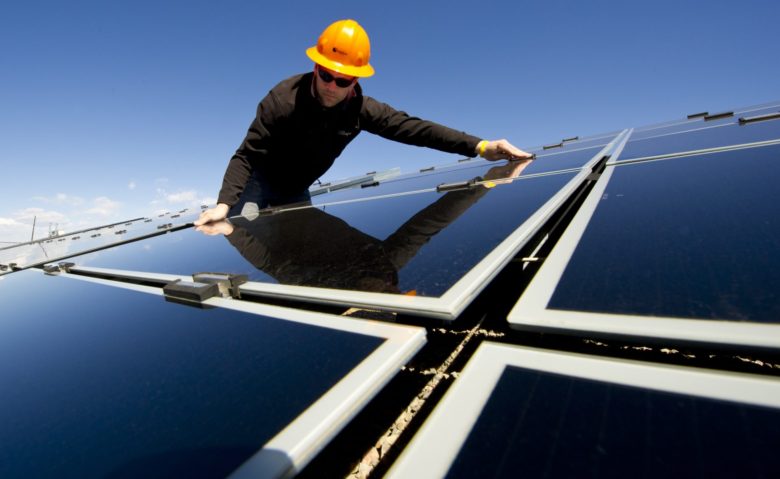
A test conducted in the United States to improve the energy efficiency of solar panels (Photo: United States Department of Energy/Wikimedia Commons [Public Domain])
The climate crisis grows more serious by the day, and stronger action is increasingly required. Governments, businesses, NPOs, and individuals—each member of society—must confront this shared, major problem. With time limited in the face of the looming threat, action from all social actors is needed. The media can help spur that action. If the media can present responses in detail and evaluate them based on evidence, it could lead to concrete behavioral change among members of society. Reporting with an awareness of solutions journalism—the role of presenting specific responses and their effects, along with the evidence—will be increasingly demanded of the media.
《GNV, participating as a partner organization in “Cover Climate Now” (Covering Climate Now), has designated the week of 4/19–4/26 as a week of coverage and is calling on participating news organizations to report under the theme “Climate Solutions.” This article was written in support of that week of coverage.》
※1 The 10 reasons are explained as follows: ① enables a more comprehensive understanding of society; ② provides feedback mechanisms to society and improves individuals’ problem-solving abilities; ③ provides information indispensable for solving problems; ④ enhances citizenship; ⑤ creates opportunities to shine a spotlight not only on harm but also on benefit; ⑥ reveals hidden opportunities for social change; ⑦ deepens journalists’ understanding of society; ⑧ sharpens traditional journalism; ⑨ also sharpens investigative reporting; ⑩ attracts new audiences.
※2 Tallies were made using “Mainichi Shimbun Maisaku,” the Mainichi Shimbun’s online database, for the morning and evening editions published in Tokyo from April 2019 to March 2020. Among articles that included the keyword “climate change” in the headline or body, items that could not display the text of the article, those that from the headline were deemed unrelated to climate change, and those unrelated to climate-change responses that mentioned only domestic circumstances were excluded from the tally.
Writer: Taku Okada
Graphics: Taku Okada
















気候変動に関する報道量ばかりに危機感を抱いていましたが、具体的な解決策を示しながら報道する必要性に気づくことができました。
良く考えてみると当たり前で、多くの人々が気候変動に気づいてはいても、具体的な解決策を理解している人は少ないと思います。人々のアクションを起こすきっかけとなるソリューション・ジャーナリズムはとても大切だと感じました。
また、企業や権力者の行動を監視し、そういった方に向けてもソリューションを示していって欲しいと思います。
事実を伝えるという役目もそうですが、社会問題は発信する側の視点がかなり影響を及ぼすと思うので、客観的に発信するということが課題になると思います。ソリューションジャーナリズム自体は重要な観念だと思うし、メディアが目指すべき姿だと思います。
気候変動という長期に渡った問題だからこそ、ソリューション・ジャーナリズムが大事になってくるということに共感しました。メディアの役割を改めて考える機会になりました。
記事を客観的に分析するのが難しそうだなと感じました。
気候変動の対策について述べている記事の少なさに驚きました。
効果や妥当性を問うのは専門的な知識が必要そうだなと感じました。専門家の間でも見解が割れていたりする場合、どれがより正確な指摘かどうかを報道する側が判断するのが難しそうな気もします。気候変動に関する研究がもっと報道されていくといいなと思いました。