
In September 2019, protests broke out in front of the National Assembly in Quito, the capital of Ecuador, after a bill to ease abortion restrictions for victims of rape and incest was voted down. There were also violent clashes, with police using pepper spray to disperse demonstrators. Why has abortion become such a major issue? This article examines the abortion issue in Ecuador from historical, political, and social perspectives.
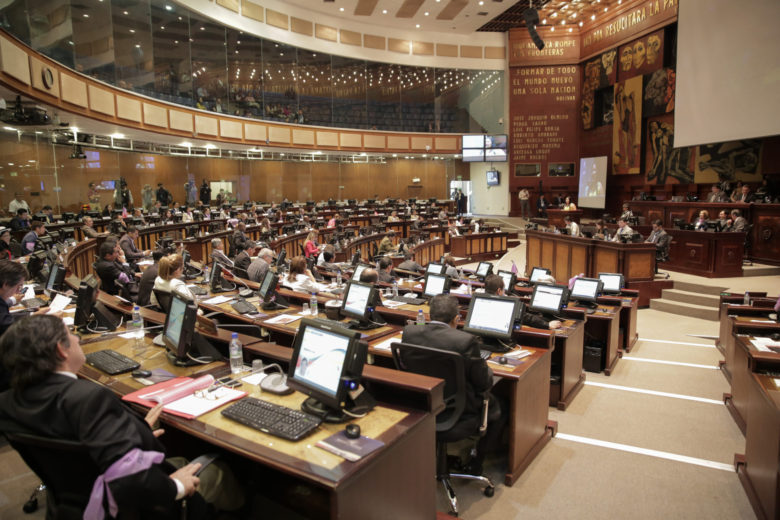
Debate in the National Assembly on violence against women (Photo: Asamblea Nacional del Ecuador/Flickr [CC BY-SA 2.0])
目次
Background
Abortion is the termination of a pregnancy by removing the fetus from the uterus at an early stage. Specific methods include surgical procedures such as suction and curettage, and non-surgical methods using medication. The reasons for having an abortion can broadly be divided into three. First, health problems affecting the mother or fetus. Second, the individual or her family does not want the pregnancy. This includes rape, economic reasons, age, interference with education or work, and unplanned pregnancy. Third are social reasons, meaning cases where the pregnancy is socially undesirable. In regions where extramarital pregnancies are religiously or culturally taboo, women may have no choice but to choose abortion.
Although there are various reasons to choose abortion, whether it is actually permitted varies greatly by country. The figure below color-codes countries according to the strictness of abortion laws. Regulations are divided into five categories by the Center for Reproductive Rights. From least to most restrictive, they are: “allowed on request,” “permitted for social and economic reasons,” “permitted for health and therapeutic reasons,” “permitted when the mother’s life is at risk,” and “completely prohibited.” Ecuador falls under “permitted for health and therapeutic reasons.” Given that more than half of the world’s women live in countries where abortion is permitted at least for social and economic reasons, Ecuador’s laws are strict by global standards.
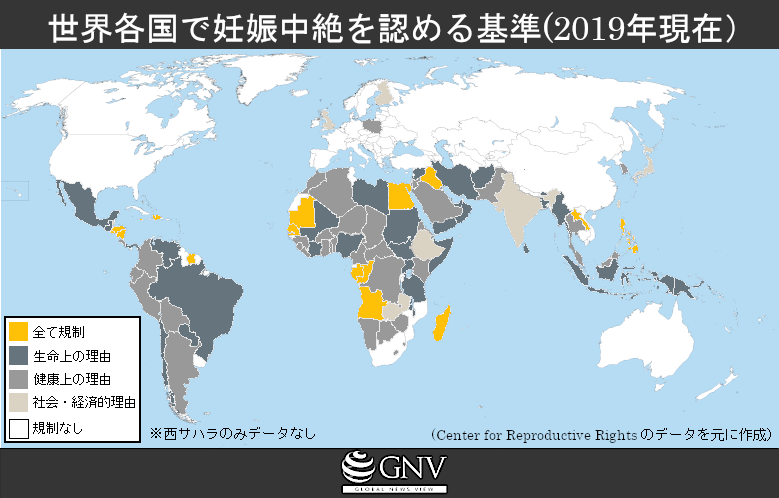
Let us look specifically at Ecuador’s current abortion law. At present, abortion is permitted only when there is a serious risk to the mother’s life, or in cases of pregnancy resulting from rape of a woman with a mental disability. This law has been in place since 1938, and violators are subject to up to two years’ imprisonment. In other words, if a person who is not mentally disabled becomes pregnant as a result of rape and has an abortion despite having no health problems, it is a crime and she can be imprisoned. Why does Ecuador have such strict regulations on abortion? From a historical perspective: Ecuador was colonized in 1534 and came under Spanish rule. During that time, the Catholic Church, Spain’s religion, strengthened its ties with the upper classes, permeated society, and grew in power. Today, 94% of Ecuador’s population is Catholic, and its teachings prohibit acts that take away life given by God. Abortion is considered one such act, and the archbishop of Quito has said, “God is the God of life, not the god of death,” opposing the relaxation of abortion restrictions. In short, strong opposition to abortion in Ecuador can be attributed to the deeply rooted influence of Catholicism.
![(Photo: grebmot / pixabay [pixabay license] https://pixabay.com/service/license/)](http://globalnewsview.org/wp-content/uploads/2019/10/gv-g6-012-2-e1572487374537.jpg)
Basilica Church in Quito, the capital (Photo: grebmot/pixabay [pixabay license])
So what are the laws in other Latin American countries, where even today Christians—particularly Catholics—are numerous and the church wields significant influence? Many Latin American countries allow abortion in cases of pregnancy resulting from rape—such as Argentina, Bolivia, Brazil, Chile, Colombia, Mexico, and Panama. On the other hand, Honduras, Nicaragua, and El Salvador completely ban abortion. Thus, responses to abortion vary even within the region.
Current state of abortion
We noted that abortion is heavily restricted in Ecuador, but how many abortions actually take place? According to a study, 431,614 abortions were reported between 2004 and 2014. On average, that’s 115 per 1,000 live births. In this study, “abortion” includes both spontaneous miscarriages and induced abortions, and distinguishing between the two is difficult. Given that abortion rates in countries with similar socioeconomic levels are 34–45 per 1,000, Ecuador’s numbers are high by comparison. Looking at regional data, the number of abortions tends to rise with population size, but the incidence relative to population is not necessarily higher in more populous areas. The figure below shows the number of abortions per 1,000 live births by region. Rates vary by region, but it is suggested that the proportion of abortions increases where education and health systems are underdeveloped.
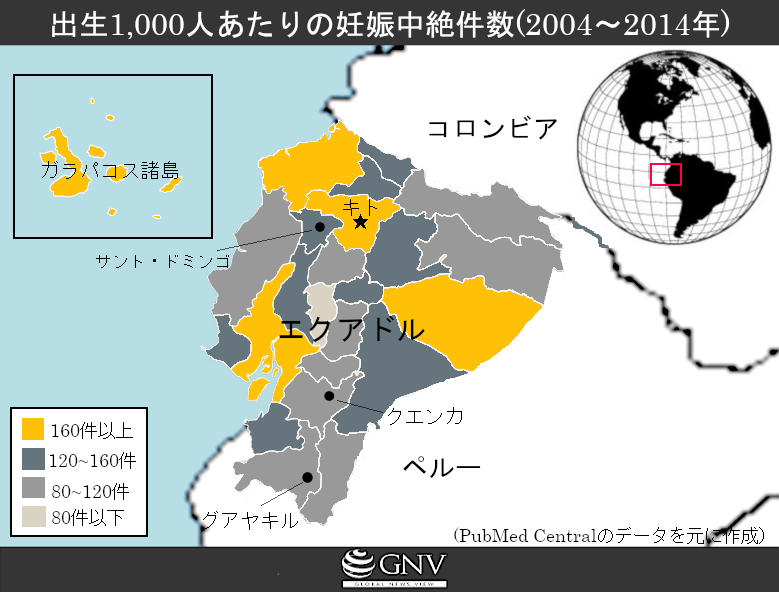
The bill rejected in 2019 would also have allowed abortion in cases of pregnancy resulting from rape. Today, pregnancies resulting from rape are a serious concern in Ecuador. Between 2015 and 2018, 14,000 rapes were reported, 718 of which involved girls under the age of 10. Moreover, from 2008 to 2018, more than 20,000 girls under 14 gave birth. Fourteen is the age at which one can marry without parental consent in Ecuador. According to a 2012 survey, one in four women experiences sexual violence during her lifetime, indicating that many women in Ecuador are victimized. Perpetrators are not only strangers; abuse also occurs at the hands of friends, family members, and coworkers, with cases involving them. Rape by relatives also gives rise to the problem of incest.
Although abortion in cases of pregnancy from rape is illegal unless the woman has a mental disability, wealthy women can afford safe conditions, or to travel to other countries for the procedure. However, poor women cannot, and are often forced to choose particularly unsafe options, leading to maternal deaths. Specific causes of death include severe hemorrhage during the procedure, infection, and poisoning from drugs used for abortion. Between 2004 and 2014, there were 189 reported maternal deaths related to abortion in Ecuador. In 2014, abortion-related deaths accounted for 15.6% of maternal mortality.
This points not only to the abortion issue itself, but also to problems in Ecuador’s health-care environment. In addition, when a pregnant woman goes to a public hospital after an abortion to treat complications, there is a risk of being reported to the police by hospital doctors.
Political struggles and the abortion issue
This was not the first time, as with the recent protests, that activists pushed for looser abortion restrictions; a similar movement occurred in 2013. However, then-President Rafael Correa stated that “the constitution guarantees the protection of life from the moment of conception,” and strongly opposed decriminalization of abortion. He said he would resign if the legislature decided to legalize abortion.
![Former President Rafael Correa visiting a clinic (Photo: Agencia de Noticias ANDES / Wikimedia [CC BY-SA 2.0])](http://globalnewsview.org/wp-content/uploads/2019/10/gv-g6-012-3-e1572489183557.jpg)
Former President Rafael Correa visiting a clinic (Photo: Agencia de Noticias ANDES/Wikimedia [CC BY-SA 2.0])
Despite the existence of laws regulating abortion, why has the movement to legalize abortion gained strength in Ecuador? Today, 57 of the 137 members of the National Assembly—41.6%—are women, reflecting increasing female representation in politics. Until recently, abortion was considered a private matter; although laws existed, arrests were rare. Around 2010, however, government enforcement tightened, and investigations and prosecutions related to abortion surged. Between 2009 and 2014, 40 women were prosecuted for abortion, and since 2015 at least 378 prosecutions have been reported. This trend has fueled calls for legal reform. For example, at the September protests, not only female politicians but also hundreds of women activists rallied under the symbol of green scarves. One activist group, Las Comadres, marched under the slogan “Girls are not mothers,” advocating that abortion should be allowed when a child becomes pregnant. The group’s name encompasses meanings such as friends, midwives, and godmothers. Since 2015 they have pursued the short-term goal of promoting safe, medication-based abortion and the long-term goal of legalization. In the recent National Assembly session, the bill fell five votes short of the 70 needed to pass and was rejected. However, as women activists continue to petition President Lenín Moreno for legal change, it is clear that their movement is growing in prominence.
![Women activists hold a press conference on the 2019 reform bill (Photo: Asamblea Nacional del Ecua / Flickr [CC BY-SA 2.0])](http://globalnewsview.org/wp-content/uploads/2019/10/gv-g6-012-4-e1572490632377.jpg)
Women activists hold a press conference on the 2019 reform bill (Photo: Asamblea Nacional del Ecua/Flickr [CC BY-SA 2.0])
As such, efforts around the abortion issue are growing in scale. However, even after the abortion reform bill was voted down, new large-scale protests over economic issues erupted in Ecuador, pushing abortion lower on the national agenda. Still, Jaime Nebot, a politician seen as a strong presidential contender, has declared that abortion restrictions should be eased. The abortion issue will not be resolved overnight, but one hopes that the voices of the people will reach the legislature and that women will gain better options.
Writer: Moe Minamoto
Graphics: Saki Takeuchi









エクアドルの中絶問題がここまで深刻であるとは知りませんでした。また、カトリックが中絶に対して否定的であるというのは聞いたことがありましたが、国によって様々なんですね。
中絶する権利は女性にあるに決まっていますが、国は介入してはいけません
「犯罪、倫理的タブーを通して宿った命」についても、母体をしのいで優先すべき命があるという考え方には問題があるとは思うのですが、どう正当化(説明)すればいいのでしょうか。難しい問題だと思います。
エクアドルで中絶が規制されていることにも驚いた上に、性暴力を受けている女性があまりにも多いことに衝撃を受けた。中絶を合法化する法案が否決されたのは、宗教的な理由のほかに何かあるのか気になった。