
In goods, money, people, culture, and every other field, we are now squarely in the midst of accelerating globalization: the world is becoming more interconnected, and events around the globe feel closer to home. Yet, amid this, journalism seems to be moving counter to the global current. Events around the world have a major impact on Japan’s public sphere and daily life, and likewise events in Japan affect the world; however, the news media, whose duty is to “to fulfill their public and cultural mission” and “to provide information useful to social life and strive to enrich the lives of the people,” has reduced international coverage over the past 30 years. Why has international reporting declined? What problems in Japanese journalism lie behind this decrease? This article explores these questions.

(Photo: Max Pixel [CC 0])
目次
International reporting is declining
Before considering why international reporting has decreased, let’s first look at when and how it has declined. We will use the Asahi Shimbun as an example.
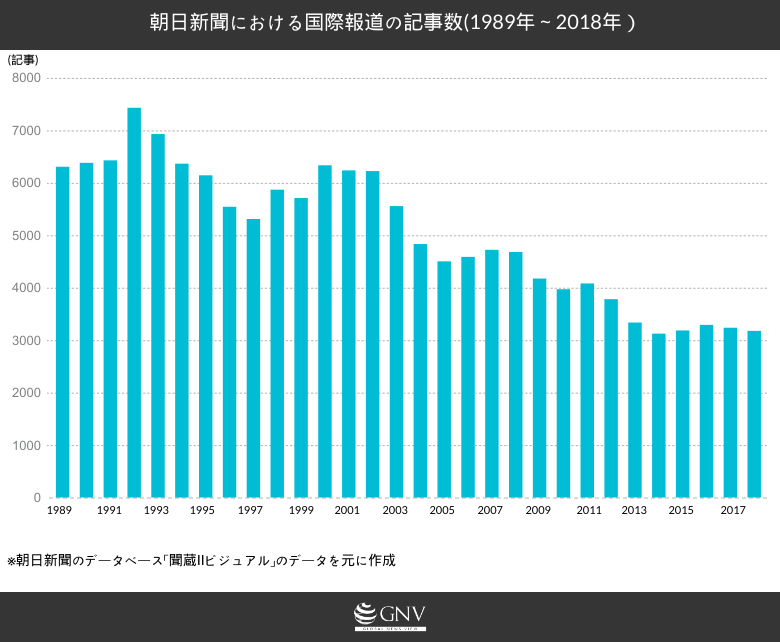
This graph shows the number of international news articles in the Asahi Shimbun from 1989 to 2018 (※1). Although there are some fluctuations, the overall trend is clearly downward. The number of international news articles is undeniably decreasing.
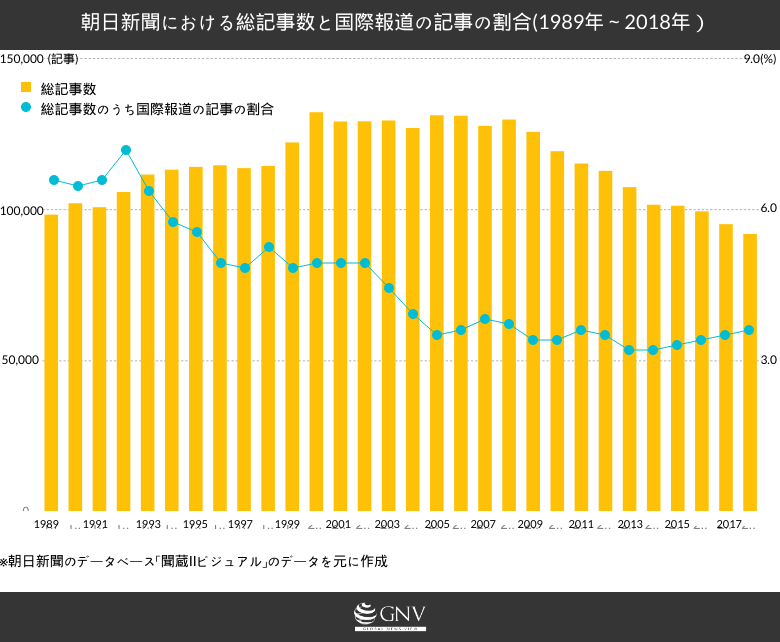
How does this compare with the total number of articles? We can confirm that the total number of articles has also hit a 30-year low. It is conceivable that the overall decline in newspaper output and the reduction in the number of pages (※2) have contributed to the decrease in international coverage. However, even within that overall decline, international reporting has fallen at an even faster pace. The share of international news articles as a proportion of all articles has dropped significantly compared with 20 and 30 years ago. Similarly, in the Yomiuri Shimbun, international reporting accounted for 22% of the total in 1998, but fell to 13% in 2018, a 9-point decline (※3).
That said, the data above are comparisons of article counts, and former Asahi Shimbun reporter Makoto Kusakawa, who was interviewed by the author, argues that fewer articles do not necessarily mean less international reporting; rather, it is possible that individual articles—such as reportage (on-the-ground reporting) and analysis—have become longer. He points out that as the internet has spread and sources have multiplied, readers have come to expect value-added articles rather than simple summaries of incidents, and that easier information gathering has allowed more details to be included even in the first reports. Still, these factors alone seem insufficient to explain the current extent of the decline in international reporting, and this situation warrants further examination.
Many news organizations maintain overseas bureaus and dispatch correspondents for original reporting, but some have been shrinking these networks. At Yomiuri Shimbun, the number of overseas bureaus (including general bureaus) decreased from 34 in 2008 to 27 as of July 2019, a reduction of 7 bureaus in about 10 years. This could be seen as a weakening appetite to gather information and provide international news. Shrinking overseas networks not only reduce the volume of international reporting, but also lead to regional bias and diminished quality.
The collapse of news organizations’ revenue models
So why has international reporting ended up in this state? One cause is closely tied to the financial health of news organizations. Economic downturns and the spread of the internet have made it difficult to maintain the traditional revenue model, which has affected international coverage. Let’s look more closely at changes in the financial situation of news organizations.

Newspapers in Japan (Photo: fas/Pixabay)
One major blow to news organizations was the broad economic downturn that began with the bursting of the bubble in the early 1990s. As the economy worsened, corporate performance declined and ad placements fell. In 1991, newspaper ad revenue declined for the first time in 26 years, and in 1992, for the first time since World War II, TV ad revenue fell below the previous year’s level. The economy then seemed to recover around 2000, and as corporate performance improved, advertising activities picked up, appearing to halt the decline in TV and newspaper ad revenue. But from the 2000s, a second wave—the spread of the internet—arrived to erode ad income.
In today’s so-called internet society, fewer people encounter news via traditional media like newspapers and TV, and more obtain information online. According to a survey by Japan’s Ministry of Internal Affairs and Communications, in terms of usage rates, the internet surpassed newspapers in 2012 and is spreading among people at a pace that could overtake television. Changes in the ad industry began in the early 2000s, when the internet started to become the primary information source. Newspaper and TV ads declined while online advertising soared. This trend dealt a major blow to commercial broadcasters that relied on print ads and TV commercials, and especially to newspapers. News organizations suffered a double hit, making it difficult to rely on their traditional revenue structures.
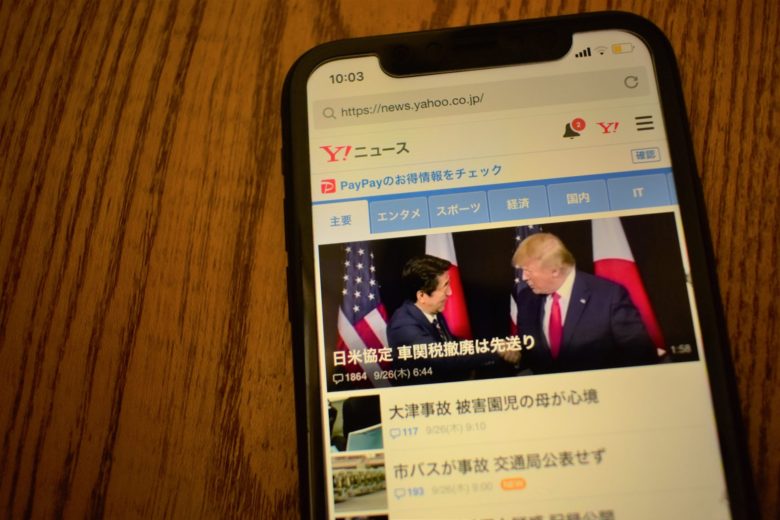
Yahoo! News top page (Photo: Yumi Ariyoshi)
Many news organizations responded to the internet age by publishing articles online, only to encounter a major obstacle: even if they provide news online, advertising revenue is siphoned off by companies that provide news distribution services, such as Google and Yahoo. How do we typically access news online? According to a survey by the Ministry of Internal Affairs and Communications, in Japan in fiscal 2018 only 2.2% of respondents said they primarily used newspaper companies’ news sites, whereas 59.9% said they used portal sites (such as Google News or Yahoo! News), social media (such as LINE NEWS)(※4), or curation services (such as SmartNews or Gunosy). In other words, even when people read a newspaper company’s article, most do so not directly on the newspaper’s site but via companies that aggregate and distribute news from multiple outlets. And ads on these news services (excluding newspaper-owned sites) typically pay fees to the service provider rather than to the individual news content providers. While a portion of that ad revenue is paid out by the service provider to the content providers (news organizations), the terms favor the service providers and do not constitute a sustainable business model for news outlets.
As a result, even if news organizations report online, the structure makes it hard for them to earn revenue. According to the News Media Alliance, Google is estimated to have generated about 4.7 billion dollars in 2018 from news organizations’ content. That figure is comparable to the 5.1 billion dollars the entire U.S. news industry earned from digital advertising that year. Yet Google’s search engine holds a 75% share in Japan and 92.3% worldwide (both as of August 2019), and these news services often serve as the front page guiding readers to news organizations’ sites, making it difficult for news outlets to take countermeasures against these companies. In this way, the financial condition of news organizations has deteriorated, leading to a decline in overall coverage, including international reporting.
International reporting as the casualty of shrinking pages
Faced with the financial pressures described above, news organizations have been forced to cut costs across the board in order to survive. As a global trend, international reporting has been particularly hard hit because it is considered costly and of relatively low audience interest. Providing international news requires obtaining information from geographically distant locations. In addition to delivering accurate, timely news, outlets also pursue distinctiveness from competitors, which often necessitates on-the-ground reporting. Whether reporting from an overseas bureau or traveling from Japan, field reporting incurs travel, lodging, and safety costs. To boost speed, transmission methods are also essential, often requiring specialized equipment. In the case of U.S. newspapers, it is said that the annual cost of maintaining an overseas bureau—on average about 200,000–300,000 dollars—has never been fully covered by revenue from international reporting. Compared with domestic reporting, the costs are high, and in reality international coverage is subsidized by other revenue. According to Ken Ando, an Asahi Shimbun reporter with correspondent experience who was interviewed by the author, the funds available to overseas correspondents have decreased over the past 30 years. Technological advances have reduced necessary expenses to some extent, but overall budgets, including correspondent compensation, appear to be on a downward trend.
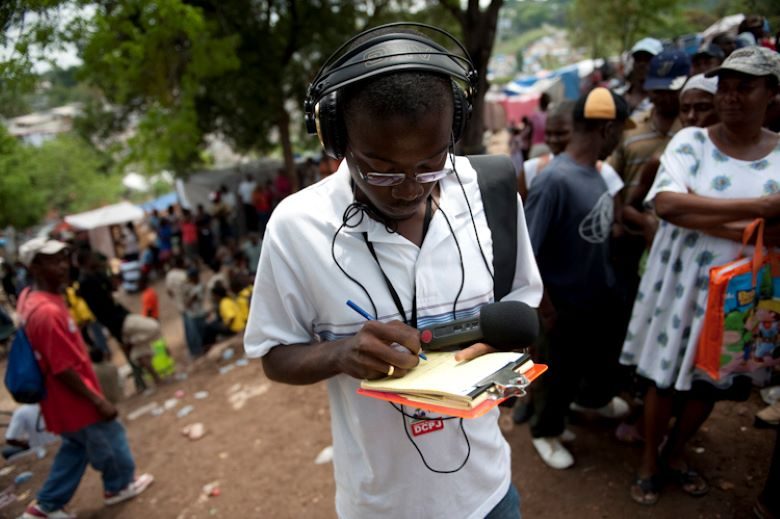
A journalist taking notes (Photo: Internews Europe/Flickr [CC BY-NC-ND 2.0] )
As noted earlier, newspapers have reduced their page counts, but according to Mr. Kusakawa, what gets cut in response to page reductions are not the regular domestic or international pages but the “feature pages,” where international reporting would often appear; thus international stories may have been the ones trimmed. Moreover, shrinking page counts due to falling revenue have led to the regional skew in coverage that GNV has long flagged as a problem. Fewer pages inevitably mean fewer reported stories. Those that get cut tend to be from regions deemed to have low reader interest. Decisions about what to cover are based on various factors, with particular emphasis on reader interest. In fact, there is a trend in which countries with larger trade volumes with Japan receive more coverage in Japan—likely because economic ties are stronger and interest is higher.
If so, despite technical advances and lower information-gathering costs, the persistent bias in the countries and regions covered may stem from judgments that viewers and readers have little appetite for such international news. Both Mr. Kusakawa and Mr. Ando acknowledge the possibility that coverage centers on countries considered closely connected to Japan, such as the United States and China, with other regions getting short shrift. Since the bubble burst and resources have tightened, opportunities to think about geographically and psychologically distant regions have diminished in Japan. While both see this as lamentable, they also say it is difficult to increase coverage of regions that consistently draw little interest from Japanese readers. However, when certain international coverage is reduced, readers and viewers lose opportunities to develop new interests, which further depresses interest. Journalism makes choices about what to convey, and the content of reporting can stimulate new interests among audiences. To break the vicious cycle of low interest and reduced coverage, we need to reexamine the role of journalism and pursue reporting that focuses not only on existing interests but also on the interests that coverage can create.
International conditions and international reporting
To consider the decline in international reporting, we must also touch on the relationship with international circumstances. Along with changes in the global situation, the demand for information about the world—that is, the need for international reporting—appears to have declined. Please look again at the graph of Asahi Shimbun article counts at the beginning. The steepest drop is from 1993 to 1997, the period after the end of the Cold War and the collapse of the Soviet Union. As noted, falling revenue may be one factor, but during this period international news volume also decreased in the United States, United Kingdom, and Germany. It is thought that the perceived importance of world events changed with the end of the Cold War. While Mr. Kusakawa and Mr. Ando dispute this, the significant role of the United States in Japanese media has already been noted, so it may be applicable to Japan as well. International coverage held in the 4% range for some time thereafter, but declined again after 2003, and has hovered around 3.5% since 2005. This decrease overlaps with the period when the aftermath of the 9/11 attacks and the Iraq War began to subside and interest in Japan briefly ebbed, so there may be some connection, though this has not been verified.

People walking past the fallen Berlin Wall (Photo: Raphaël Thiémard/Wikimedia [CC BY-SA 2.0] )
International reporting on television
So far we have mainly examined newspaper data, but what trends are seen on television, which has more users than newspapers? At one Tokyo key station—although this is a partial survey—in terms of the number of scripts, the share of international news has not changed dramatically over the past 15 years, accounting for 15–20% of all scripts (※5). The only dip over those 15 years was in 2011, when it fell to about 10% due to extensive coverage of the Great East Japan Earthquake in March 2011. We could not look back 30 years, but as the data indicate, on television the proportion of international news is not necessarily declining.
However, regarding the regions covered, television appears to show trends similar to newspapers. Shinya Mitsui, a cameraman in the News Department at Yomiuri Telecasting Corporation who has experience working in the Paris bureau and who was interviewed for this article, suggests that advances in live and transmission technologies, along with increased inbound tourism and business globalization, have heightened demand for information on countries closely connected to Japan, such as the United States and China. As globalization progresses, demand may be rising for information from regions with strong ties, while other regions are deemed to have low demand and receive insufficient coverage—this is the current state of TV. According to Mr. Mitsui, unlike newspapers, which have fixed pages such as the international page, TV does not have a set allocation for international news, making this tendency stronger than in newspapers. The main criteria for deciding what to cover on TV are whether it significantly affects Japan and whether it has impact. News from regions with weak ties and that feel distant are not reported, and even if an event seems likely to affect Japan, it is less likely to be covered if it lacks impact. Based on his experience in Paris, Mr. Mitsui feels that coverage of Europe is insufficient. If even Europe—with its strong economic ties—is undercovered, it is hard to imagine adequate reporting from regions such as Africa, where ties are relatively weak, there are no correspondents, and delivering fresh news is difficult. While viewers may currently want news with strong relevance and proximity, the problem of the aforementioned vicious cycle of low interest and reduced coverage can also be pointed out for television.

A TV news crew (Photo: Max Pixel [CC 0])
The future of international reporting
As we have seen, international reporting has tended to decline at newspapers due to multiple factors—economic downturns, reduced revenue from the rise of the internet, waning interest, and shifts in international affairs—and across news organizations overall there is a clear possibility that coverage of regions that are typically underreported will continue to decrease. We need to reconsider this situation. The world is connected; whether an event occurs domestically or in a distant country, it affects us—or we affect it—to some degree. Can we look away from that? News organizations help shape public opinion through what they choose to report. We must not discard the perspective that reporting can create new demand, rather than merely responding to existing demand. Precisely because we live in a so-called global society, we need to reconsider the importance of international reporting.
※1 Aggregated from the Asahi Shimbun article database “KikuzoⅡ Visual.” Using the total number of articles in the main paper only (excluding regional editions) and the number of articles the database classified as international reporting (in Detailed Search, selecting “International” under the “Page name” option, which includes international stories not only on the international page but also on page 1, page 2, etc.), we calculated the share of international articles out of all articles. Note that over the 30 years the database’s coverage range has changed.
※2 Comparing April 2018 with April 1998 (about 20 years earlier), the number of pages per day decreased by 7.2 pages in the Asahi Shimbun. Over the same period, the Yomiuri Shimbun decreased by 7.2 pages and the Mainichi Shimbun by 1.8 pages. Calculations are based on the total number of pages in morning and evening editions issued by the Tokyo headquarters of each company, as listed in the Japan Newspaper Publishers & Editors Association’s Nihon Shinbun Nenkan ’98 ’99 and Nihon Shinbun Nenkan 2019.
※3 Aggregated from the Yomiuri Shimbun article database “Yomidas Rekishikan.” Using the total number of articles in the national edition only (excluding regional editions) and the number of articles the database classified as international reporting (select “International” in the main category and all in the detailed categories), we calculated the share of international articles out of all articles.
※4 In the ministry’s survey, only LINE NEWS was given as an example, but Facebook and Twitter also distribute news provided by media organizations.
※5 We were granted special access to the information system of a Tokyo key station. All scripts that had aired (terrestrial, BS, and CS) or been posted online were divided into all scripts and foreign-news scripts; we counted the number of scripts from April 1 to 30 for each year from 2005 to 2019 (a span of 15 years) and calculated the share of international reporting. Note that the count is by number of scripts and does not consider length.
Writer: Yumi Ariyoshi
Graphics: Saki Takeuchi
We’re also on social media!
Follow us here ↓

















報道機関の都合で国際報道が減少していくのは悲しい。利益などに関係なく、問題意識を持って国際報道できる機関が増えて欲しい。
国際的な関心が高まっていそうなのに、報道が減少しているというのは少し不思議でしたが、要因は様々にあるのですね。
私企業としての報道機関が国際報道を増やすためにはどうすれば良いのでしょうか。
報道機関の使命感を信頼するしかないのでしょうか。
行政が規制をするわけにもいかないと思います。
やはり、国際報道が必要だと考える読者、視聴者側が声をあげなければならないのでしょうか。
皆間違っている。国際報道の割合は15年前から減っていない事が記事中からも分かるのだから、これを維持したまま全体の数を増やせば良い。ここでの本質は国際報道に対する無関心さではなくニュース自体に対する無関心だ。新聞の購読者数の急落を見ればこれは明らかだろう。国際報道の捉え方の問題でなく日本人の知性の無さの問題だ。
新聞の購読数=ニュースを見ている人の数、ではないと思います。
テレビのニュース枠も以前より増えているように思いますし…
新聞の購読者はネットニュースに流れたのではないでしょうか?
また、この記事を読んだところ、国際報道の割合は20.30年前に比べて減っていること、割合が近年安定しているといっても低いままで増えてはいないこと(グローバル社会なのに…)、報道されない地域がさらに報道されなくなることが問題ではないかと感じました。
国際報道は、報道がされないと私たちのが関心をもつ機会もなかなか得られないので、関心を新たに持てるような報道に期待したいです。
>> 新聞の購読数=ニュースを見ている人の数、ではないと思います。
新聞以外の全うなニュースを得る手段を教えてください(あらかじめ申し上げると、スポーツ、芸能等の割合の高いテレビ、ヤフーニュースやラインニュースは却下)。もちろんあるにはあるのでしょうが、数少ないのではないでしょうか。新聞紙の購読者数の減少がそのまま新聞社の有料電子版に移っているのであればいいのですが、そうではないでしょう。私はネットニュースやワイドショー番組等の質の低い報道(?)を見てニュースを知った気になる者が増えているのではないか、ニュースというものに対して受動的になっているのではないかという懸念を覚えます。
返信ありがとうございます。
たしかに、ネットニュースのトップページやワイドショーは質の低い報道が展開されているのかもしれません。芸能人の不倫問題に文量を割くより、環境問題や難民問題や報じるべき問題は多くあると私も思います。でもそれは新聞も同じだと思います。話題性の高いトピックに流れて質の高い報道とは程遠いものもあるでしょう。どのメディアも一長一短であり、新聞だけが正義だとは思いません。ネットニュースを活用して海外も含めた様々な報道機関のニュースを閲覧するほうが質の高い情報を得られることだってあると思います。
だからこそ、新聞社も、テレビ局も、それらのコンテンツを受けるネットニュースも、今一度視聴者のあらたな関心を生むような質の高い報道を提供する必要があるのではないでしょうか?そしてその質の高い報道のためには、国際報道の意義を見直す必要があると思います。この記事と貴方のコメントを踏まえるなら、アメリカや中国のニュースを見て世界を知った気になっている人に、まだ知らない世界を伝える必要があるということです。
テレビのニュース枠は増え、ネットニュースのサービスが拡大している今、ニュースに対し受動的になっているのかは疑問ですが、質の低い報道で知った気になっている人に質の高い報道を提供すべきだという点では同じ意見だと感じました。
各メディアの報道内容に関して大問題と小問題を比べて「どのメディアも一長一短」「新聞だけが正義だとは思いません」とするのはフェアではないと思います。
ネットニュースも米中以外の国際報道も重要であるし、あるべきだと考えています。ただし何が一番大切なのかという事です。私の言い方が悪かったのかもしれませんが、ネットニュースを見る事を否定はしていません。私が言いたいのはネットニュースもいいのですが、大前提として新聞(一般紙)を読みなさいという事です。金が無いなら図書館で読むのもいい。紙がいやなら新聞社(or通信社NHK)のホームページでもいい。「ネットニュースを活用して様々な報道機関のニュースを閲覧」するまえにまず一般紙をできれば複数紙読みなさい。日経だけ読んで一般紙を読まないのがダメなように、新聞だけが正義でないとかへ理屈を言ってネットニュースに駆け込む前にまずするべき事があるでしょうと。枝葉を付ける前に根幹を付けなさい、これが私の主張です。国際報道で言えば現時点での日本では米中が根幹でしょうね。他国の報道も必要ですが根幹が大前提です。紙面スペース、資源リソースに限りがある以上はメリハリがあるのは仕方がないし必要ということです。そして木の形がそれぞれ違うように、人によっては他に必要な情報もあるでしょうから、そこではじめて一般紙以外が生きるということですね。
受動的云々に関してですが、新聞購読者が減ってネットニュースが拡大すると何故受動的でないと言えるのでしょう。第二次安倍政権発足ごろからでしょうか、ヨーロッパのニュースが減っていますね。経験から断言できるのは基本的に国際報道は視聴率ががくっと下がります。国際報道に対する視聴者の関心の無さも新聞購読者の減少も受動的、内向きになっている証左でしょう。もちろん国際報道はもっと増えてもいいですが読む人間が減ってますからね。むしろそんな中で15年前の水準を維持する朝日は称賛されてもいいのかもしれません。「質の低い報道で知った気になっている人に質の高い報道を提供」しても意味は薄く、受け手側を能動的にさせる事が重要。で、最初の主張に繋がるわけですが、国際報道増やせ云々言う前に報道に対して能動的になる人を増やすべき。そして更に言えば能動的な人は皆新聞を読む。
長くてすみません。
グローバル化進んでいる中で、国際報道数は減少するのおかしい。。。
日本は、日本語だけを話し日本のことだけしか知らなくても生きていけると考えている人が多いと思います。国際報道を知る必要があると考えている人が少ないのが一つの原因なのでは、と感じました。
国際報道に限らずですが、「知らない事」を知らない自分でいる事が怖いです。
何か良い方法ないでしょうか。(ここのサイトを見始めた一つの理由でもありますが)