
In the morning, a newspaper placed on the dining table alongside breakfast. People skimming the news while folding their papers on crowded commuter trains. As scenes like these become less common, the medium for reading news has shifted from newspapers to smartphones. According to a survey by the Newspaper Communication Research Organization, in 2018 the percentage of people who read news on smartphones reached 71.4%, surpassing newspapers at 68.5%. The fact that newspaper companies are beginning to roll out digital editions—Asahi Shimbun touts a print-and-digital “hybrid media”—also shows that smartphones are rising as a medium for obtaining information. Companies that deliver information via smartphones act as news aggregators, collecting data from various news organizations and distributing it to the public. Thanks to the convenience of viewing content from multiple outlets on a smartphone, the smartphone has developed as a medium for delivering information.
Amid this shift, the app expanding its presence both domestically and internationally is SmartNews. Although launched in 2012, according to a 2018 survey it ranked third among the most-used portal-type news apps (※1) and first in satisfaction with mobile news. But how has the information obtained through such news apps increased compared with traditional media? For example, with globalization advancing and reporting becoming digital, information about the world should be easier to access via smartphones than before—but how has international reporting changed? SmartNews upholds the mission to “deliver high-quality information from around the world to the people who need it”, and the app promises you can “check the world’s news in one minute each morning”, emphasizing the global scope. In reality, what kind of international coverage does it provide? This article looks at SmartNews and its international reporting.
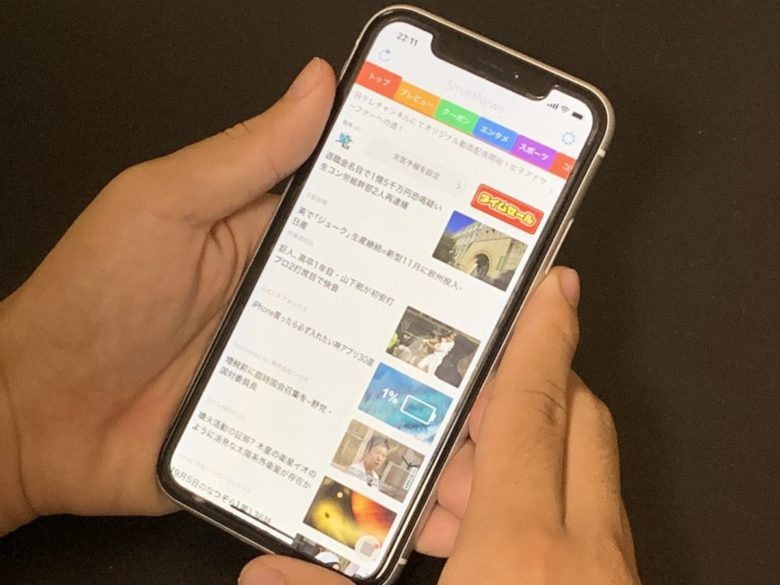
Smartphone app SmartNews (Photo: Yoshinao Araki)
目次
Basic information about SmartNews
The company behind SmartNews, SmartNews, Inc., was founded in June 2012 as Gocro Inc. and became SmartNews, Inc. in October 2013. It began with a service called Crowsnest that specialized in crawling Twitter, gathering content, and personalizing trending information. Pivoting toward the general public in December 2012 led to the creation of SmartNews. SmartNews is a smartphone app that partners with five national dailies (Asahi Shimbun, Mainichi Shimbun, Yomiuri Shimbun, Nihon Keizai Shimbun, Sankei Shimbun) and 13 regional newspapers, delivering trending news on the internet and making it readable within the app. It expanded to the United States in October 2014 and surpassed 40 million downloads in Japan and the U.S. combined in 2019.
SmartNews follows the following procedure to select which articles to offer. First, it collects information about user actions—such as clicking on unique URLs or bookmarking them—across the internet. Next, it identifies the language the content is written in and the topic category. It then removes similar items to prevent duplication and enhance diversity, keeping only distinct information. Finally, it assesses attention levels based on user reactions when delivered via SmartNews. These reactions include whether users merely tapped the item or read it thoroughly, among other behaviors. Following this automated process (algorithm), news items are selected for display. About eight are shown as top news; items are also chosen by category—such as International, Entertainment, and Sports—and grouped into tab-like sections called “tabs.” In addition, “Recommended for you” picks are surfaced based on each user’s browsing history.
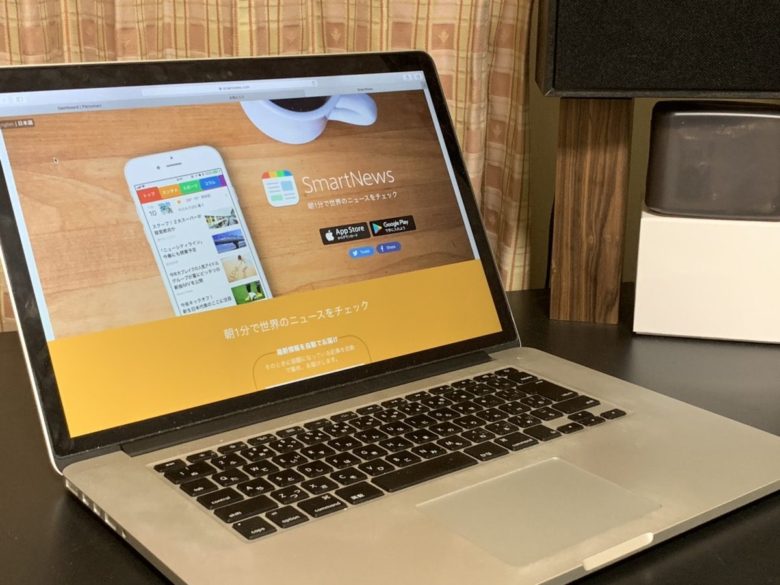
SmartNews homepage (Photo: Yoshinao Araki)
SmartNews is praised first and foremost for its “speed” and “convenience.” The quick transition to the next page when you tap the screen and the ability to read even where there is no signal are rated as very convenient. The channel feature is another hallmark: by adding preferred topics and outlets, you can narrow down and view only news in those channels. Lastly, a key factor behind its rapid rise in popularity in the U.S. is its response to the “filter bubble.” The filter bubble refers to a phenomenon on the internet where only information a user finds agreeable is selectively presented, leading to ideological isolation from society; it became a major issue in the 2016 U.S. presidential election. To address this, SmartNews adopted a political balancing algorithm. This algorithm enables users to view political news from diverse viewpoints rather than pre-filtering articles to align with users’ characteristics or beliefs.
SmartNews and international reporting
So how much emphasis does SmartNews, whose mission is to deliver information about the world, place on international reporting? We collected articles from SmartNews focusing on international coverage from January to June 2019 (※2).

Loading…
The share of international pieces among the roughly eight top news items selected each day was 11.2%, which can hardly be called high even with a generous reading. Compared with the 2017 average of 11.6% for the big three newspapers (Asahi, Mainichi, Yomiuri), it remains on par with newspapers. Furthermore, grouping the top-news international articles by the region of the country covered shows Asia at 41.5%, North America at 28.6%, and Europe at 20.0%—meaning heavy coverage of regions that include countries we often see in newspapers and on TV, such as China, the Korean Peninsula, the U.S., and Western Europe. By contrast, South America is 3.8%, Oceania 3.0%, and Africa 1.5%, indicating extremely little coverage of regions less visible in newspapers and on TV. We can say the biases seen in international reporting in newspapers and on TV are also present in SmartNews.
What if we limit the scope to the International tab, which lists only news in the international category?
Loading…
Even within the International tab, where people interested in global news gather, the regional distribution is heavily skewed: the combined total for Africa, Latin America, and Oceania is just 8.5%, reflecting a bias as stark as that seen in SmartNews’s top news or in the international pages of newspapers. Moreover, the top five countries by volume of coverage— the United States, China, the United Kingdom, Russia, and France—account for 46.9% of all reporting, demonstrating an extreme imbalance. Among those interested in the international category, there are surely some who want news from countries other outlets do not cover, but articles focusing on such nations are few. In this way, one can learn only fragments of a portion of the world and cannot gain a comprehensive view of the whole. Despite proclaiming a mission to convey the “world,” why has it ended up in this situation?
Causes of bias in international reporting and possibilities for solutions
While SmartNews’s mission is to “continue delivering high-quality information from around the world to the people who need it,” the absolute amount of international reporting is small, and within that limited volume there are major regional imbalances. It is hard to say it delivers news from around the world to people. One reason is that SmartNews lacks its own reporting capability. As an aggregator, it simply collects existing information, and thus reflects the biases of existing media as they are.
Another major cause likely lies in the article-collection algorithm. As noted earlier, attention scoring is part of the collection process. This mechanism selects information based on what people want and what they read intently, but if attention is the criterion, items that seem “interesting” and somewhat sensational tend to be prioritized, making it difficult to provide evenly distributed coverage of the world. In addition, international reporting from regions not previously covered by traditional media is judged to have low public interest and therefore, in terms of attention, many regions within international news are not selected. Language detection is another factor that can generate regional bias in international reporting. Language detection identifies the language an article is written in, but as long as the current Japanese edition of SmartNews carries Japanese-language articles, it is likely assuming that the articles needed in Japan are written in Japanese—in other words, non-Japanese articles are filtered out. This leads to selecting articles from a pool where international coverage is already limited and biased by region.
Can this situation be improved? It may indeed be difficult to eliminate the scarcity and imbalance of international reporting so long as the underlying news sources and algorithms remain the same. Even so, SmartNews holds potential to enrich its international coverage. This article introduces two possibilities.
The first is to refine the algorithm. We mentioned SmartNews’s political balancing algorithm as a feature. If an algorithm can be used to remove ideological bias, it should also be possible to introduce one that reduces bias in international coverage. If the aim is to “broadcast the world,” it is important not to rely solely on attention as a criterion, but to report in a balanced way that helps people learn more about the world.
The second is SmartNews’s expansion capacity. SmartNews currently provides services in 150 countries, meaning it aggregates news distributed in each country. If even a portion of the news published outside Japan were made readable in Japanese, readers would gain access to stories from a wide range of countries. That said, this would require translating various languages into Japanese, which would be costly in the current setup. However, if introduced gradually, a smartphone app could cover a scope of information far beyond that of newspapers. We look forward to the day when SmartNews delivers news from all around the world.
※1 1st place: “Yahoo! Japan/Yahoo! News”; 2nd place: “Gunosy.”
※2 Aggregated once per day. Collected news up to the top news section. For the International tab, collected the top five items. Recorded whether items were international news and which country/region they covered. For stories involving two countries (e.g., U.S.–China relations), each was recorded as 0.5.
Writer: Yoshinao Araki
Graphics: Yoshinao Araki
We also post on social media!
Follow us here ↓



















国際報道の少なさに驚きました。インターネットにしか出来ない工夫を期待したいですね。
どこでもいつでも見れるスマホでの国際ニュースの割合が、新聞より少ない事に驚きました。報道が、より身近に簡単に見られる方法が進んでいる現代ほど、グローバルな世界に自分がいる事を実感できたらと思います。GNVのような質の高いニュースを望みます。
Seksuele inhoud is breed beschikbaar op speciale platforms voor volwassenen. Kies voor betrouwbare adult hubs voor veiligheid.
My page: BUY VIAGRA
Adult video’s kijken op veilige en betrouwbare platforms.
Vind betrouwbare sites voor een premium ervaring.
Here is my web-site; BUY VIAGRA